After Claude Fable/Mythos 5 Was Blocked, GLM-5.2 Suddenly Arrived: The Availability Risk of Closed Models Is Becoming Harder to Ignore
Anthropic's Claude Fable 5 and Mythos 5 were urgently taken offline after a U.S. government export-control order. At nearly the same time, Z.ai announced GLM-5.2 first on its official X account. This overlap is sharpening developer concerns about the availability of closed models, policy dependency, and sudden access bans, while making the question of whether open models are safer far more practical.
The most important AI story over the past two days is not a single model launch. It is the structural signal that appears when two separate developments are viewed together.
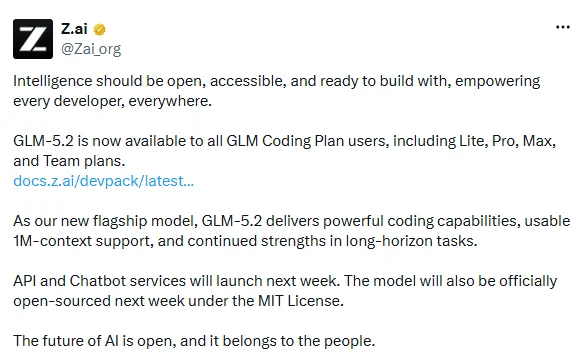
The first is that Anthropic officially confirmed that Claude Fable 5 and Claude Mythos 5 were suspended after a U.S. government order tied to national-security export controls. The second is that Z.ai announced GLM-5.2 first through its official X account and made it available to all GLM Coding Plan users before its website blog had even caught up.
If you look at these two events separately, the first looks like a regulatory incident and the second looks like a product release. But when they happen in the same time window, the more important question is no longer which company has the stronger model. The real question is this: as frontier models are increasingly treated as national-security assets, how stable is the availability of closed models in practice? And under those conditions, could open models actually offer a stronger sense of operational safety?
1. First, get the timeline straight
At this point, the rough timeline around the Claude Fable 5 / Mythos 5 suspension is becoming fairly clear.
On 2026-02-24, Anthropic published Responsible Scaling Policy v3. In that policy document, Anthropic reiterated a long-standing position: company self-governance alone is not enough, and high-risk frontier AI requires more effective government involvement.
On 2026-06-02, Trump signed a new executive order on AI review. Public reporting has broadly interpreted it as the start of a more systematic national-security review framework for frontier models in the United States.
On 2026-06-10, Anthropic CEO Dario Amodei again argued for stronger constraints on frontier AI in the policy essay Policy on the AI Exponential, including mandatory testing, independent evaluation, and government authority to block or discourage deployment in high-risk cases. Strictly speaking, this was not a slogan calling to "pause AI." But it did represent a very clear policy direction: using institutional brakes to slow the unconstrained advance of high-risk frontier models.
On 2026-06-12, Anthropic said it received a government order at 5:21pm ET. The order required Anthropic to suspend access to Fable 5 and Mythos 5 for any foreign national, including foreign nationals inside the United States and even foreign employees within Anthropic itself. To ensure compliance, Anthropic temporarily shut both models off for all customers.
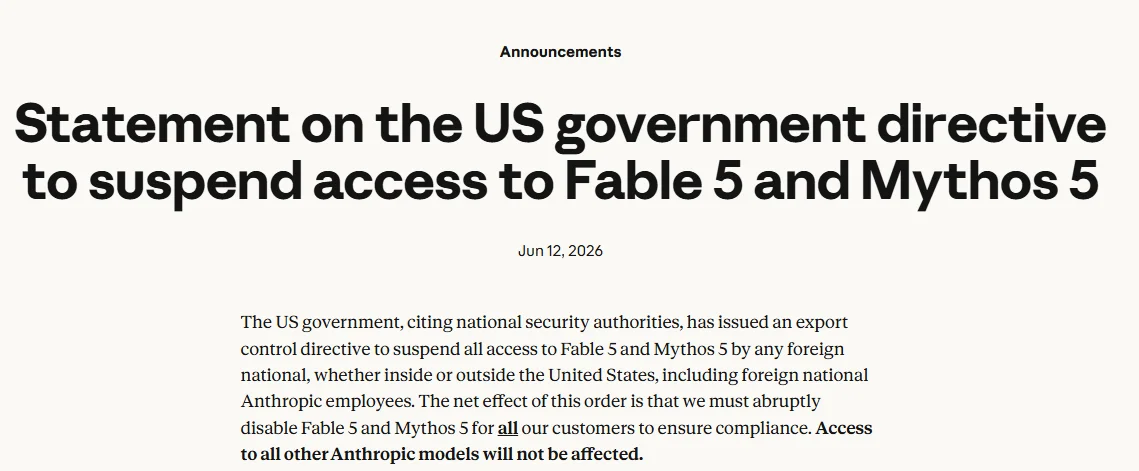
After that, Financial Times, Axios, and AP added more context. The move was widely framed through the lens of export controls and national security, and outside observers generally traced it to intervention led by the U.S. commerce apparatus. Anthropic's official statement did not explicitly name the Department of Commerce, but the core fact itself is no longer really in dispute: access to the models was interrupted because of a U.S. government order.
Then the second piece of news arrived. On 2026-06-13, Z.ai announced on its official X account @Zai_org that GLM-5.2 had been rolled out to all GLM Coding Plan users across the Lite, Pro, Max, and Team tiers.
The post also included several key details. GLM-5.2 was positioned as the new flagship model. It emphasized coding capability, available 1M context support, and continued strength on long-horizon tasks. API access and Chatbot services were scheduled for next week. The model was also scheduled to be officially open-sourced next week under the MIT License.
That means GLM-5.2 really has been released. The only unusual part is that its first public rollout happened through official social media and product availability, rather than through the company's website blog.
2. What Anthropic ran into was not just a simple takedown
If this is understood only as "a model got banned," its importance is easy to underestimate.
What really matters is the way Claude Fable 5 / Mythos 5 was handled. This no longer looks much like traditional internet content moderation, or even an ordinary commercial restriction. It looks more like the national-security logic used for advanced chips, sensitive equipment, or critical infrastructure is now being extended to model access itself.
At least three things follow from that.
First, frontier closed models are being pulled much more explicitly into geopolitics and export-control systems. A model is no longer just an API service, and no longer just a SaaS subscription product. At certain moments, governments may treat it as a strategic resource whose circulation, contact surface, and capability boundaries need to be restricted.
Second, what developers buy is not really an asset in the full sense. It is a conditional access license. That license can be interrupted by price changes, by platform strategy shifts, or by policy events that cut it off instantly. For anyone building a business on top of a closed model, this means the biggest risk may not be model quality. It may be whether the model can still be called at all.
Third, even a company like Anthropic, which has long argued for stronger AI governance and for giving governments authority to stop dangerous model deployments, cannot guarantee that it will never be the party forced to comply with a specific enforcement action. Anthropic's position this time is subtle. It does not deny that governments should have intervention authority, but it clearly objects to what it sees as a lack of transparency, insufficient evidence, and unclear technical grounding in this case.
In other words, Anthropic supports strong regulation with procedural constraints. What reality may produce instead is a temporary administrative move that effectively says "block first, explain later." For users, that difference is not small.
3. Why this intensifies concern about closed models
In the past, when people discussed the risks of closed models, they usually meant high prices, rate limits, context limits, vendor lock-in, or the possibility that a model might suddenly feel less capable. The Fable / Mythos 5 incident pushes the conversation one level further: the problem may not be a worse experience, but the loss of the entire capability layer.
That is especially sensitive for developers and companies because the value of a closed model often increases precisely after it has been deeply integrated into production workflows.
Once your workflows, code-generation pipelines, internal tools, customer-support systems, analytics dashboards, and automated agents are all tightly bound to one closed model provider, "ban risk" is no longer an abstract public-policy topic. It becomes a business continuity problem. You thought you were renting a powerful model. Eventually, you discover that what you really rented was a capability channel that can be cut off at any time by policy, legal review, or company strategy.
From that perspective, the weakest point of a closed model is not its capability but its dependency structure. The stronger the model, the deeper the dependency. The deeper the dependency, the higher the cost when the connection is severed.
4. Why GLM-5.2 looks especially important at this moment
If GLM-5.2 were just a routine update, it would not automatically carry this much symbolic weight. But it appeared at a highly sensitive moment.
On one side, the U.S. government is using national-security and export-control logic to intervene in access to frontier closed models. On the other side, a Chinese vendor is using official social media to push out a new flagship model and explicitly promising that API, Chatbot, and MIT License open-source availability will follow shortly.
That juxtaposition naturally creates a powerful psychological contrast.
The closed-model camp offers the strongest, most integrated, and often the most expensive capabilities, but you must accept that the platform control is not really yours. The open-model camp may not lead on every metric, but it can offer something else that is increasingly critical: reproducibility, portability, and the certainty that in an extreme case your capabilities cannot be cut off by a single point of control.
For developers, that certainty is not abstract. It maps to a few very concrete questions:
Can you deploy the model yourself.
Can you continue using the same model if a vendor changes its policy.
Can you preserve your workflow after overseas services go offline, regional restrictions appear, your account gets flagged, prices jump, or legal rules change.
Can you turn the model from a black-box capability rented from the cloud into software infrastructure you can actually control.
If the answer points toward the latter, then the significance of open models is not simply that they are cheaper. It is that they are structurally better suited to serve as a long-term, controllable technical foundation.
5. If open models are "safer," what kind of safety is that
It is important to be precise here. Saying open models are safer does not mean they are safer in every sense.
If the discussion is about social governance, misuse risk, proliferation risk, or content safety, open models are not inherently safer. In many cases, they may even increase diffusion and governance costs. That is one reason why frontier open-source AI remains globally controversial.
But if the question is, "As a user, am I likely to suddenly lose access?" then open models often are safer.
That safety mainly comes from four layers.
First is availability security. Once you control the model weights, inference stack, and deployment path yourself, a unilateral vendor takedown does not make the capability disappear immediately.
Second is policy-isolation security. If one platform is ordered to stop serving users, that does not automatically reduce the entire ecosystem's capability to zero. As long as the weights, implementation, and community pathways still exist, users retain room to migrate.
Third is bargaining security. You do not hand every critical dependency to a single API provider. Even if you continue using cloud services, open models can serve as a substitute anchor and reduce total passivity.
Fourth is time security. The lifecycle of a closed service is determined by the company. The lifecycle of an open model depends much more on the community, deployers, and actual demand. The former can break suddenly. The latter usually decays more slowly and more predictably.
So the more accurate claim is not that "open models are always more advanced, stronger, or better." It is that "under policy environments with high uncertainty, open models behave more like capability assets you can host, while closed models behave more like capability subscriptions that may come with additional conditions at any time."
6. What this may really change is not model rankings, but procurement logic
Over the past year, many teams chose models mainly by leaderboard position, coding scores, price, and context length. Those metrics will still matter. But they may no longer be enough.
The Claude Fable / Mythos 5 incident is a reminder that in the future, companies integrating models into their stack need to ask at least three more questions.
First, how resilient is supply continuity? Is there a risk of sudden interruption caused by policy, geography, compliance, or vendor strategy?
Second, how replaceable is the model? Is the workflow bound to a single provider? Is there an open-source fallback? How expensive is migration?
Third, what does the power structure look like? Are you holding the model capability itself, or only an entry point that someone else is temporarily allowing you to use?
This will likely push more companies toward a more practical architecture choice: keep closed models for high-value, high-performance primary tasks, while using open models as the fallback, replacement, self-hosted, and controllable base layer. It is not a question of either-or. It is a question of replacing "best performance" with "best combined performance and continuity."
7. Conclusion
The blocking of Claude Fable 5 / Mythos 5 and the sudden appearance of GLM-5.2 look like two unrelated headlines on the surface. In reality, they answered the same question on the same day.
That question is this: when model capability itself is increasingly shaped by national security, export controls, and platform control, what do developers actually need most?
The answer may not be merely "a stronger model." It may be "model capability that does not suddenly disappear at the critical moment."
In that sense, open source may not win every benchmark, but it is becoming more valuable on one of today's scarcest metrics: durable availability. Closed models will continue to lead many frontier experiences, but every sudden access ban reminds more people of the same thing: what is truly safe is not only the most capable model, but the model you can still use reliably when you need it.
References
- Anthropic official statement
- Anthropic policy page: Policy on the AI Exponential
- Anthropic Responsible Scaling Policy v3
- AP report
- Financial Times report
- Axios report
- Z.ai official X post
- Z.ai GLM-5 repository
Related Reading
Source Notice
This article is published by merchmindai.net. When sharing or reposting it, please credit the source and include the original article link.
Original article:https://merchmindai.net/blog/en/post/claude-fable-mythos-5-ban-and-glm-5-2-open-source