EU Withdrawal Button Rule 2026: What Shopify Stores Need to Fix Before 19 June
A practical guide to Directive (EU) 2023/2673, the new online withdrawal function, and what stores selling to EU consumers should do before 19 June 2026.
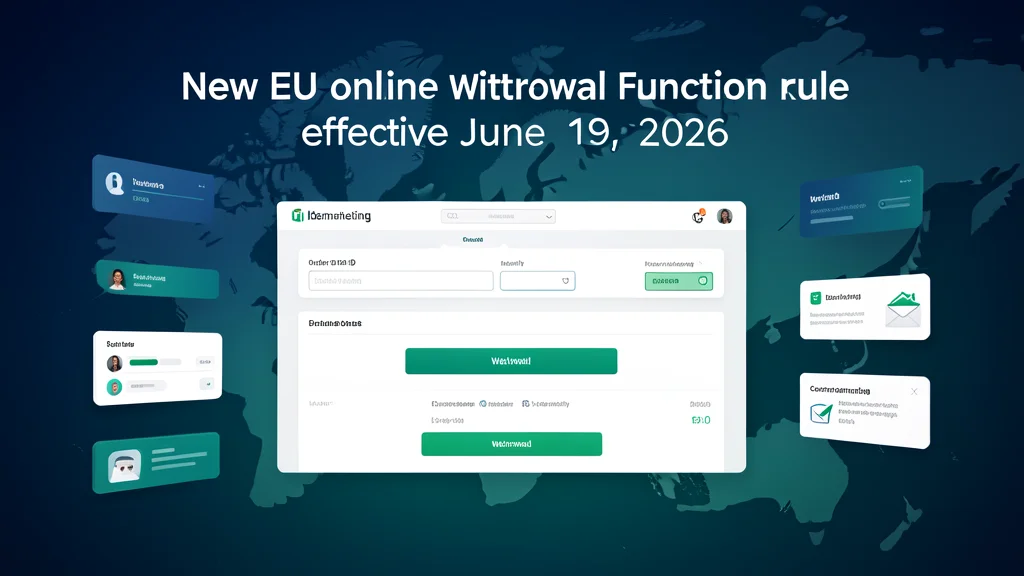
EU Withdrawal Button Rule 2026: What Shopify Stores Need to Fix Before 19 June
If your store sells to consumers in the European Union, 19 June 2026 is a date worth taking seriously.
Directive (EU) 2023/2673 adds a new online withdrawal function to EU consumer law. In practical terms, that means merchants using an online interface for distance contracts must make it possible for eligible consumers to withdraw from a contract online through a clearly presented flow. The rule is part of a broader update to the Consumer Rights framework, and the relevant national measures apply from 19 June 2026.
The short version is this: if EU consumers can place an order on your site, and the contract falls within the scope of the EU right of withdrawal, cancelling during the withdrawal period needs to be straightforward online. The legal direction is clear: withdrawal should be as easy to exercise as purchase.
This article explains what changes, what does not change, which merchants should pay attention, and what a compliant implementation should look like for Shopify stores and other ecommerce sites.
What the law actually says
The most important addition is Article 11a in the amended Consumer Rights framework.
The official EUR-Lex text says that for distance contracts concluded by means of an online interface, the trader must ensure that the consumer can also withdraw by using a withdrawal function. It further requires that:
- the function be labelled with the words "withdraw from contract here" or another unambiguous equivalent;
- the function remain continuously available throughout the withdrawal period;
- the function be prominently displayed and easily accessible;
- the consumer be able to submit an online withdrawal statement;
- the flow let the consumer provide or confirm key details such as name, contract identification, and where confirmation should be sent;
- the trader provide a confirmation step;
- the trader send an acknowledgement of receipt on a durable medium without undue delay, including the content plus the date and time of submission.
That is the core legal structure. So the popular summary of "the EU now requires a withdrawal button" is directionally right, but the real requirement is more specific than a single button in isolation. It is a complete withdrawal function with visibility, accessibility, confirmation, and acknowledgement requirements.
What is not changing
The new rule does not create a brand-new cancellation right from scratch.
The familiar 14-day withdrawal period remains the basic starting point for many consumer distance contracts covered by EU law. What changes is the expectation around how consumers can exercise that right online when the purchase itself was made through an online interface.
So this is not a story about a longer standard cooling-off period. It is a story about a stricter online execution standard.
Why this matters to Shopify stores
Many merchants still handle withdrawal and cancellation in ways that were common a few years ago:
- telling the customer to email support;
- burying instructions inside a returns policy;
- requiring a manual support interaction before a withdrawal request is accepted;
- making the customer search for the right form or contact route.
That is exactly the kind of friction this rule is trying to reduce.
For Shopify merchants, the operational risk is obvious. If you target or accept orders from consumers in Ireland, Germany, France, the Netherlands, Spain, Italy, or any other EU member state, you cannot treat this as an abstract Brussels issue. It is a checkout and post-purchase flow issue.
The merchant does not need to be established in the EU for this to matter. If you sell cross-border to EU consumers, EU consumer protection rules can still affect that transaction. For UK brands in particular, this is the reason the rule is commercially relevant even after Brexit.
Scope: not every order, not every product, not every situation
This is where merchants need precision.
It is too broad to say that every Shopify store selling into Europe will need the exact same implementation for every single order. The safer reading is:
- the rule concerns distance contracts concluded through an online interface;
- it matters where the consumer has a right of withdrawal under EU law;
- some categories and scenarios can still fall outside that right, depending on the product or service and the applicable legal exception.
In other words, merchants should not assume universal coverage across every SKU or business model. But they also should not use edge cases as an excuse to ignore the requirement. For a standard ecommerce store selling ordinary consumer goods to EU buyers, this rule is highly relevant.
What a compliant flow should look like
At a practical level, merchants should think in terms of a two-step withdrawal flow rather than a decorative button.
1. A clearly visible entry point
The withdrawal function needs to be easy to find, prominently displayed, and available throughout the withdrawal period.
That means:
- no hiding it several clicks deep inside legal text;
- no forcing the buyer to contact support first;
- no design that makes the action technically available but realistically hard to discover.
The law uses the phrase "withdraw from contract here" or an unambiguous equivalent. Localized wording is possible, but the meaning needs to be clear.
2. A simple information capture step
The consumer should be able to provide or confirm:
- their name;
- details identifying the contract or order;
- the electronic contact details needed for confirmation.
In practice, an order reference plus customer identity will usually be the minimum useful implementation.
3. A deliberate confirmation step
The flow should not trigger a withdrawal by accident. The directive explicitly contemplates a confirmation function labelled "confirm withdrawal" or an unambiguous equivalent.
This matters because merchants need a defensible process, and consumers need clarity that the request was actually submitted.
4. An automatic acknowledgement on a durable medium
Once submitted, the merchant must send a receipt of the withdrawal without undue delay on a durable medium, such as email.
That acknowledgement should include:
- the fact that the request was received;
- the content of the submission;
- the date and time it was submitted.
This is not just a nice-to-have workflow email. It is part of the legal architecture of the process.
What non-compliance can look like
Enforcement mechanics can vary by member state because directives are implemented through national law. But the business risks are real.
Potential consequences can include:
- consumer authority scrutiny or legal warnings;
- fines or other penalties under national enforcement regimes;
- disputes over whether the withdrawal process was properly made available;
- extended withdrawal exposure where information duties were not properly met.
One point merchants should take seriously is the longer-tail returns risk. Under EU consumer law, failures around withdrawal information can create a much longer period in which the consumer may still exercise withdrawal rights. That is where a seemingly small UX omission can turn into an inventory and margin problem.
This is why the issue is not just compliance theatre. A missing or badly implemented withdrawal function can become an operational liability.
Why the timing matters now
The applicable date is 19 June 2026. That is close enough that merchants should already be testing solutions, especially if they sell at volume into the EU.
Leaving this until the final week is risky for a few reasons:
- theme or app changes may need QA across desktop and mobile;
- order lookup and customer identity logic may need support from other systems;
- confirmation emails need localization and auditability;
- legal, CX, and engineering teams may each assume another team owns the project.
Compliance failures often happen not because the rule was unclear, but because implementation ownership was unclear.
What Shopify merchants should do this week
A practical response plan looks like this:
1. Map your EU exposure
Check which EU countries you currently ship to, how much revenue comes from EU consumers, and whether your existing cancellation or return flow is manual, semi-manual, or self-serve.
2. Review the current withdrawal journey
Try completing the process as a customer would.
Ask:
- Can the customer find the withdrawal option quickly?
- Can they submit the request online without contacting support?
- Is there a confirmation step?
- Is an email acknowledgement automatically sent?
- Is the flow still workable on mobile?
3. Separate withdrawal from general support contact
An inbox address inside a policy page is not the same thing as a compliant online withdrawal function. If your current process depends on support manually triaging emails, you likely have work to do.
4. Confirm coverage and exceptions with counsel
The directive creates a clear implementation direction, but merchants still need legal review for how it applies to their catalog, services, subscriptions, digital products, and localized terms.
5. Test and log everything
You need proof that the flow works:
- the button or link is visible;
- the request reaches the merchant;
- the acknowledgement email is sent;
- timestamps are stored;
- the process can be reproduced.
If a regulator or customer dispute appears later, a clean audit trail matters.
Compliance is only the floor
Merchants should not confuse legal compliance with good commercial design.
A well-designed withdrawal flow can still protect the customer relationship. For example, after a valid withdrawal request is initiated, the merchant can structure downstream steps to:
- explain what happens next;
- clarify refund timing;
- present return instructions clearly;
- capture the reason for withdrawal for internal analysis;
- reduce avoidable support tickets.
What merchants should not do is build friction disguised as retention. If the flow feels like a trap, it defeats the purpose of the rule and increases legal risk.
Final take
The headline is simple: from 19 June 2026, merchants selling covered distance contracts to EU consumers through an online interface need to be ready for the new online withdrawal function required by Directive (EU) 2023/2673.
For Shopify stores, the question is no longer whether the issue is real. The question is whether the current post-purchase experience is legally and operationally ready.
If your present setup still depends on "email us to cancel" or a buried policy-page workflow, that is the gap to close now.
The stores that handle this well will not just reduce compliance risk. They will also remove a point of post-purchase friction that consumers increasingly expect to be self-serve, immediate, and documented.
Source Notice
This article is published by merchmindai.net. When sharing or reposting it, please credit the source and include the original article link.
Original article:https://merchmindai.net/blog/en/post/eu-withdrawal-button-rule-shopify-stores-june-2026