Italian Craftsmanship Meets AI: How Luxury Furniture Brands Maintain Human Touch at Scale
Italian home and furniture merchants win when AI answers design, delivery, and customization questions without flattening the premium buying experience.
Italian Craftsmanship Meets AI: How Luxury Furniture Brands Maintain Human Touch at Scale
Premium interiors do not lose deals because customers hate AI. They lose deals when the buying journey feels cold, fragmented, or uncertain.
Luxury furniture and home design merchants sell a category that is unusually sensitive to trust. A customer buying a $39 cosmetic item can tolerate a delayed answer. A customer considering a modular shelving system, a designer lamp, or a premium outdoor lighting setup cannot. That buyer needs reassurance on dimensions, finish, installation, shipping, returns, showroom pickup, lead time, warranty coverage, and whether the item actually fits the room they are imagining.
That is the operating tension in high-end interiors commerce in 2026. Brands need scale, but the category still converts through confidence. The buyer wants white-glove support without waiting until Monday morning for a design consultant to reply.
The common mistake is assuming that "human touch" and "AI" sit on opposite sides of the equation. In practice, the opposite is true. Premium home brands usually damage the human experience not by automating too much, but by automating the wrong layers and leaving the most important questions trapped in inboxes, PDFs, and staff memory.
To understand what that looks like on real storefronts, I reviewed homepage captures from Twinkly, Shopdecor, and HIRO taken on May 9, 2026. These three brands represent different parts of the Italian design and premium home ecosystem:
- a design-led smart home merchant selling visual inspiration and technical setup,
- a curated marketplace with brand, warranty, returns, and B2B complexity,
- and a modular furniture experience where layout, pickup, and room-fit questions are central to conversion.
All three pages are elegant. All three also generate immediate support questions before the shopper reaches a product detail page.
That is the point enterprise operators should pay attention to. In luxury interiors, support is not a post-purchase cost center. It is the mechanism that preserves margin, protects brand perception, and turns browsing intent into confident orders.
The numbers: why "human touch at scale" is really a revenue operations problem
Most executive teams still frame premium support as a staffing question: How many showroom advisors, email agents, and phone reps do we need to protect service quality?
That framing is too narrow. The more useful question is this:
What happens to conversion, AOV, and return rate when high-intent design questions wait four hours for an answer?
Using a benchmark model based on premium home and design commerce patterns, the economics look like this:
| Metric | Lower-complexity decor merchant | Premium modular furniture merchant | Cross-border design marketplace |
|---|---|---|---|
| Average order value | $210 | $1,480 | $620 |
| Pre-purchase question rate | 6% | 14% | 11% |
| Share of questions needing context, not static FAQ text | 48% | 72% | 67% |
| Conversion drop when response exceeds 10 minutes | 9% | 22% | 17% |
| Return risk increase when expectations stay unresolved | 6% | 19% | 13% |
| Estimated annual revenue leakage at $50M GMV | $1.1M | $5.4M | $3.2M |
The pattern is consistent across premium interiors:
- the more expensive the item,
- the more visually subjective the category,
- the more customized the delivery or setup,
- the more dangerous unanswered questions become.
This is especially true for merchants selling one or more of the following:
- modular systems,
- made-to-order or low-stock design objects,
- cross-border shipping,
- multi-room projects,
- trade or B2B purchasing,
- or installation-sensitive products.
In those environments, even apparently simple questions are not simple at all:
- "Will this work in my apartment?" really means dimensions, access constraints, and configuration fit.
- "Can I get it next week?" really means country, warehouse, lead time, assembly expectations, and white-glove availability.
- "Can I return it?" really means category exclusions, used/opened condition, carrier logistics, and restocking economics.
- "What is the difference?" really means material quality, designer intent, room use case, and price justification.
That is why luxury brands cannot treat AI as an FAQ bot. The correct role is closer to a trained design concierge that can resolve the first 80% of uncertainty without making the experience feel generic.
What the storefronts reveal in one screen
Before diving into brand-by-brand examples, the screenshots already show the operating reality:
- 3 out of 3 pages place aesthetics first and operational clarity second.
- 3 out of 3 create immediate purchase questions tied to localization, product fit, or offer logic.
- 2 out of 3 signal cross-border or multi-market complexity directly in the header.
- 2 out of 3 expose B2B or professional buying paths alongside consumer journeys.
- 0 out of 3 make human guidance fully explicit above the fold, even though all three categories depend on advisory selling.
This is not criticism. Premium brands are right to lead with image, mood, and aspiration. The problem begins when the support layer is still designed for low-context retail.
In luxury interiors, the first unanswered question is often the hidden moment where the brand feels less premium than the product.
Case study 1: Shopdecor shows how curation creates support complexity
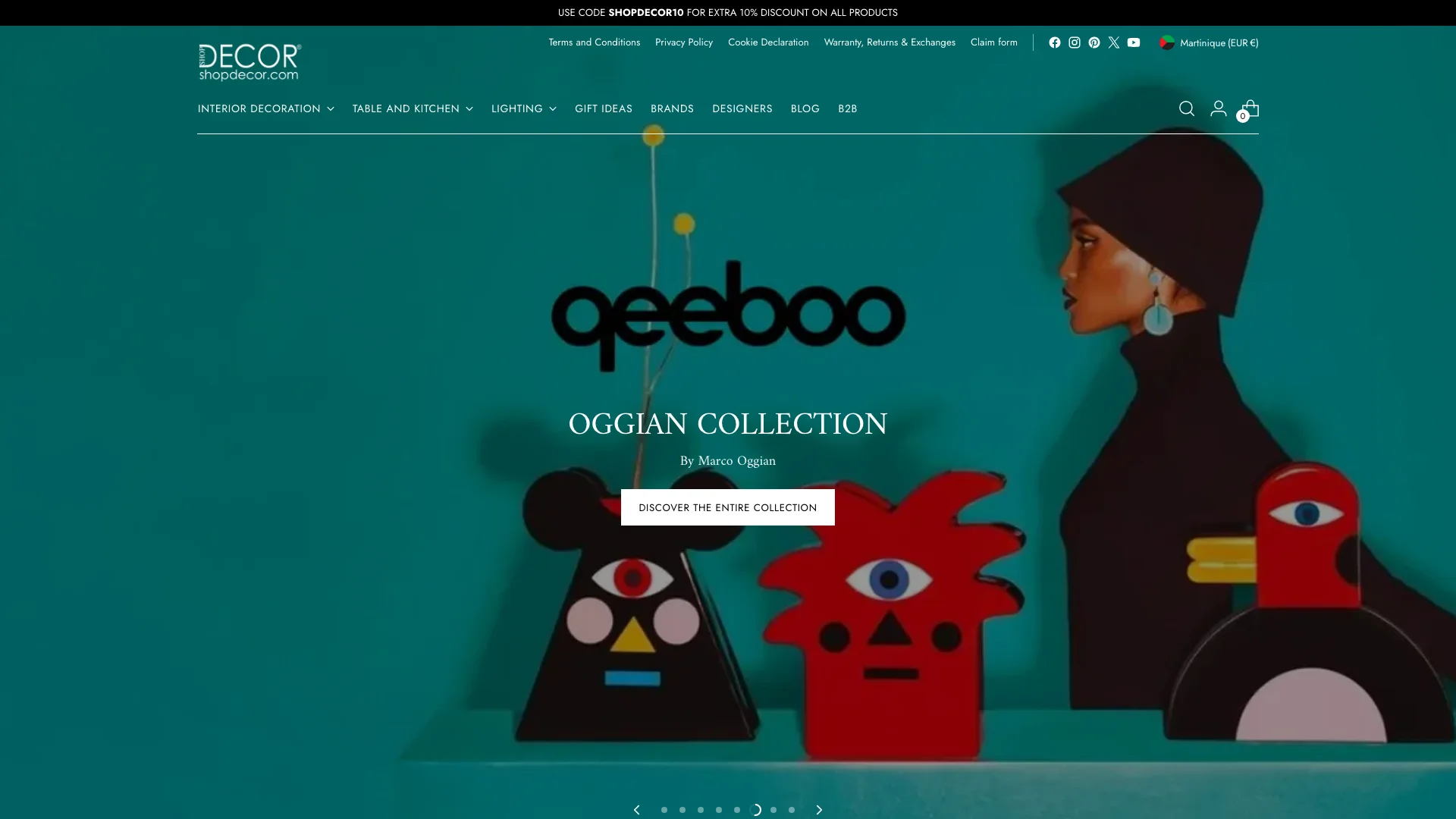
The Shopdecor homepage is a clear example of premium multi-brand commerce complexity hiding behind a polished visual surface.
From one screen alone, a shopper sees:
- a header promotion using the code
SHOPDECOR10, - categories spanning interior decoration, table and kitchen, lighting, gift ideas, brands, designers, blog, and B2B,
- navigation links for privacy, warranty, returns and exchanges, and claims,
- geographic localization in the top-right,
- and an editorial hero centered on the Oggian Collection by Marco Oggian.
That mix is commercially powerful. It is also operationally dense.
A serious buyer now has immediate questions such as:
- Does the
SHOPDECOR10code apply to all designers or are some excluded? - If I order from outside Italy, do warranty and returns terms stay the same?
- Is this object stocked by Shopdecor or shipped by a brand partner?
- If I am buying for a project, should I go through the B2B path before checkout?
- Are designer collections subject to the same exchange conditions as standard items?
Notice what is happening. The uncertainty is not caused by poor design. It is caused by layered commercial logic:
- marketplace logic,
- brand logic,
- promotional logic,
- regional logic,
- and post-purchase policy logic.
Traditional support architecture handles these layers badly because the answer lives in separate places:
- product merchandising knows the hero story,
- operations knows stock and shipment origin,
- legal knows returns,
- sales knows B2B discounting,
- and customer service knows the tickets that went wrong last month.
The customer does not care about this internal map. They want one coherent answer now.
For a premium design marketplace, AI becomes valuable when it can unify those layers without sounding robotic. The right experience is not "Here is our returns policy." It is:
This collection is eligible for the current code on standard consumer orders, but some designer-supplied items may have different exchange conditions by destination. If you are ordering for a project or multiple rooms, our B2B path is usually the better route because it changes pricing and fulfillment coordination.
That is a premium answer. It reduces uncertainty, protects margin, and still preserves the brand voice.
Why this matters commercially
In curated design marketplaces, margin is protected by keeping the shopper inside the confidence zone. The moment the customer has to open three tabs to decode a discount, an exchange rule, and a trade inquiry flow, one of two things happens:
- they delay the purchase and never return,
- or they buy with incomplete expectations and become a returns or claims problem later.
Either outcome is expensive.
Case study 2: HIRO shows how modular commerce turns support into guided selling
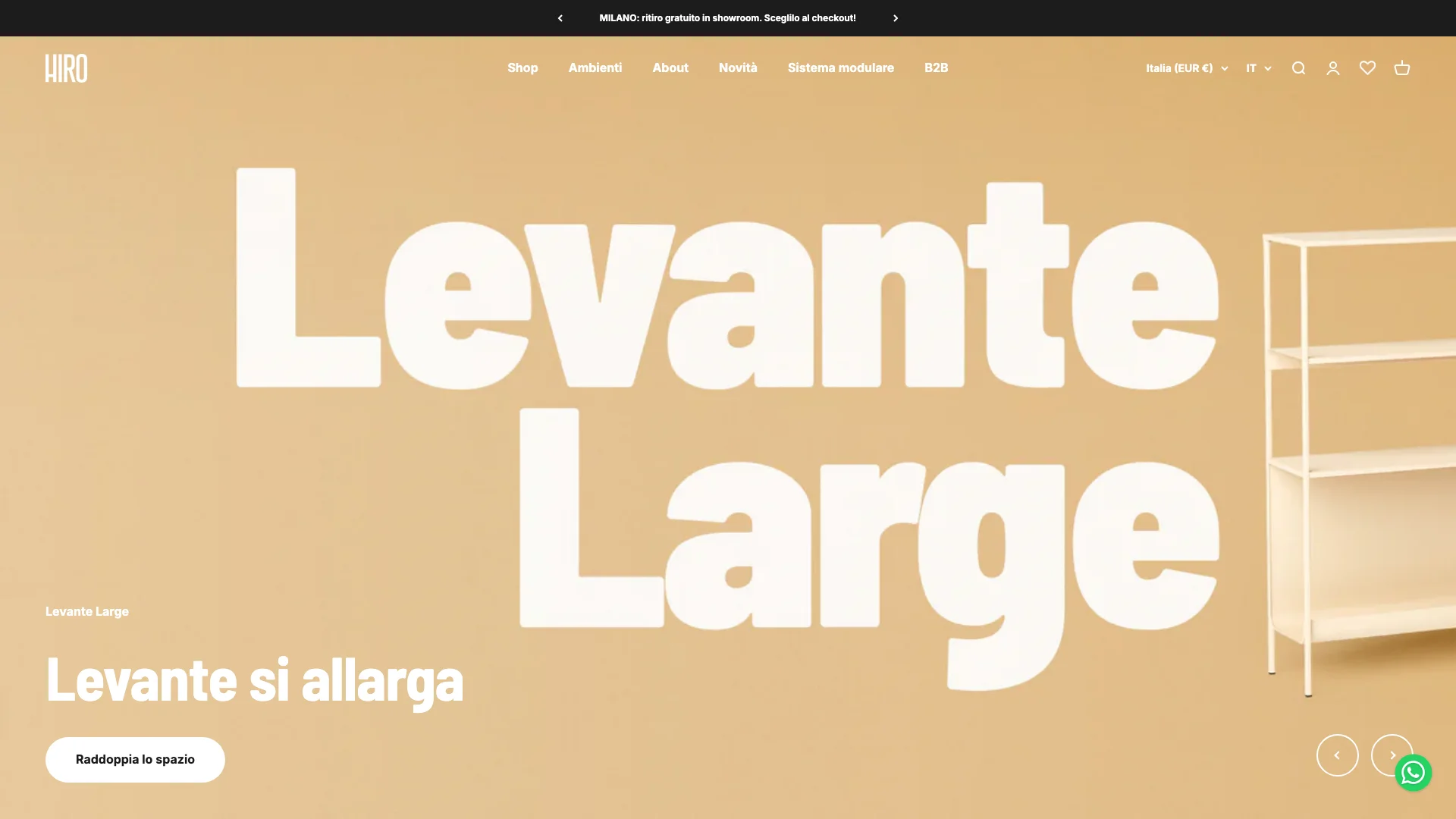
HIRO's homepage communicates a very different aesthetic, but the support burden is even more direct.
Visible signals on the page include:
- a banner referencing free showroom pickup in Milan at checkout,
- a strong navigation path through
Shop,Ambienti,Novità, andSistema modulare, - country and currency selection,
- a product hero for Levante Large,
- and large-format visual merchandising built around room-scale imagination rather than operational detail.
This is exactly how a premium modular furniture brand should merchandize. It sells ambition and spatial possibility.
It also generates the highest-value pre-sale questions in the category:
- What dimensions can this system expand to?
- Can I combine modules later?
- Is showroom pickup available only in Milan or also for trade partners?
- What ships assembled and what requires setup?
- If my wall width is limited, which composition fits best?
- What happens if I order today and then need one more element next month?
These are not support questions in the old sense. They are guided-selling questions. If answered well, they increase basket size. If answered poorly, they delay or kill the order.
That distinction is critical for executives. Premium furniture support should not be optimized only for ticket deflection. It should be optimized for:
- conversion quality,
- confidence in configuration,
- and reduced post-purchase mismatch.
The "room fit" problem
Modular furniture introduces one of the hardest challenges for static help content: every answer depends on context the merchant does not see yet.
A shopper asking whether a shelving system works for their space is really bringing hidden variables into the conversation:
- room width,
- ceiling height,
- wall type,
- nearby furniture,
- usage pattern,
- household composition,
- and aesthetic preference.
No static FAQ can handle that elegantly. Nor should a human design advisor spend every day repeating the same first-stage qualification steps across email, WhatsApp, and web chat.
This is exactly where AI creates a better human experience:
- it captures the first layer of room-fit details,
- it narrows the relevant configuration,
- it flags where human judgment is still needed,
- and it hands off with context instead of forcing the customer to repeat themselves.
That is not replacing the human touch. It is protecting human time for the moments where expertise actually matters.
Case study 3: Twinkly proves premium experience can still be technical
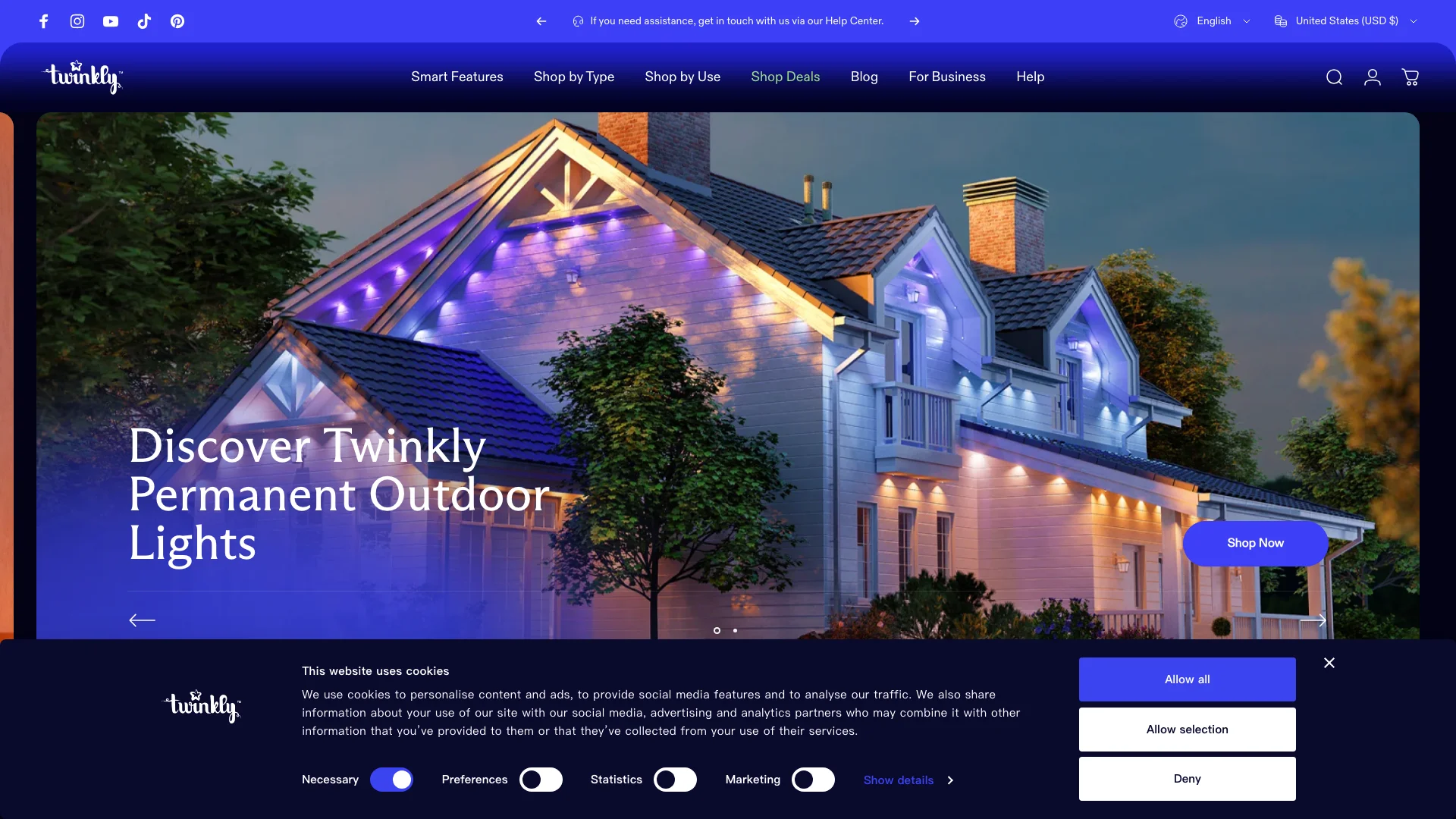
Twinkly sits slightly outside classic furniture, but it is highly relevant to the premium home category because it sells an aspirational visual result with hidden technical requirements.
From the homepage alone, the shopper sees:
- a global help-center message in the top utility bar,
- language and currency selectors,
- navigation paths such as
Smart Features,Shop by Type,Shop by Use,For Business, andHelp, - a hero for Permanent Outdoor Lights,
- and a large cookie layer covering the bottom portion of the viewport.
That page creates a support challenge luxury brands increasingly share: the product promise looks effortless, but the buying decision depends on technical confidence.
The likely questions are immediate:
- Are these lights appropriate for my house type and exterior material?
- What length do I need?
- How permanent is "permanent"?
- Is installation DIY-friendly or contractor-recommended?
- What changes for commercial versus residential use?
- If I am in another market, do specs, voltage, or shipping conditions differ?
This matters because premium experience is no longer only about fabric, wood, and form. It increasingly includes smart, installed, and connected products inside the broader home journey. That means support teams must blend:
- aesthetic guidance,
- technical clarification,
- and market-specific operational logic.
If the first answer is delayed or generic, the merchant loses the emotional momentum the hero image created.
Why technical reassurance is part of luxury
Premium customers do not only pay for objects. They pay for a sense that the brand has thought through the result.
When a merchant can instantly explain setup, expected effect, compatibility, or use-case suitability, the product feels more premium. When the answer arrives a day later from a generic inbox, the brand feels less premium, even if the item itself is excellent.
That gap is exactly where AI should operate.
The five moments where premium brands actually lose the "human touch"
When operators say they want to preserve a human experience, they often mean they do not want the brand to feel mechanical. That is correct, but incomplete.
In luxury furniture and design commerce, the brand usually loses its human quality in five specific moments.
1. When the customer has to decode price logic alone
Premium buyers are not always price-sensitive in the traditional sense, but they are highly sensitive to value clarity. If a customer sees:
- a designer collection,
- a sitewide code,
- a trade/B2B path,
- and multiple regional settings,
they immediately want to know whether the current price is the right price for their context.
If the answer requires three policy pages and a delayed email, the experience feels transactional, not curated.
2. When lead-time language stays vague
Luxury merchants often avoid being overly operational in the hero layer because it can flatten the brand. That is understandable. But if a shopper cannot quickly distinguish between:
- in stock,
- low stock,
- supplier dispatch,
- made to order,
- showroom pickup,
- or project lead time,
the brand starts to feel evasive rather than elegant.
Human touch does not mean hiding logistics. It means explaining them clearly without killing the aspiration.
3. When configuration advice depends on whichever person replies
Two agents giving two slightly different answers about module expansion, fabric compatibility, or installation suitability is one of the fastest ways to damage confidence in a premium brand.
In mass retail, inconsistency is frustrating. In luxury, inconsistency feels risky.
4. When cross-border buyers are treated like edge cases
Headers, currency selectors, and market toggles tell customers a brand sells globally. But many support systems still behave as if international buyers are unusual exceptions.
That breaks trust fast. A premium brand cannot invite a shopper in euros, dollars, or multilingual navigation, then respond to region-specific questions as though they are inconvenient.
5. When escalation forces repetition
Nothing feels less premium than this sequence:
- the customer explains the situation in chat,
- gets told to email,
- repeats everything to email support,
- gets routed to a showroom or project contact,
- repeats it again.
That is not white-glove service. It is organizational leakage exposed to the customer.
AI is most valuable when it removes this repetition and preserves context across the entire journey.
What good looks like: an operating scorecard for advisory commerce
If premium brands want to evaluate support as revenue infrastructure, they need different KPIs from mass-market retail.
A better scorecard looks like this:
| Metric | Why it matters | Healthy target for premium interiors |
|---|---|---|
| First useful response time | Measures when uncertainty begins to drop, not just when a bot says hello | Under 30 seconds |
| Context capture completeness | Measures whether room, region, and product details were actually gathered | 80%+ on high-AOV chats |
| Human handoff readiness | Measures whether an advisor receives usable context instead of a blank escalation | Under 3 minutes |
| Guided-selling conversion lift | Measures whether advisory support drives larger or more confident baskets | +8% to +18% on assisted sessions |
| Returns caused by expectation mismatch | Measures whether support prevented bad-fit orders | Down 10%+ on assisted categories |
| Repeat-question rate | Measures whether the same uncertainty still survives across channels | Down quarter over quarter |
These metrics matter because they align support with the real economics of the category.
For example:
- a faster greeting does not matter if the answer is vague,
- a high automation rate does not matter if human handoff is poor,
- and low ticket volume does not matter if customers silently abandon before asking.
The best premium teams therefore measure not only deflection, but also:
- confidence creation,
- context retention,
- and commercial outcome.
That is a more demanding standard, but it is the right one for expensive, consideration-heavy categories.
Why traditional solutions fail in premium furniture and design commerce
Most teams still rely on a stack that looks roughly like this:
- product pages for inspiration,
- static FAQ pages for basic logistics,
- email for exceptions,
- phone or showroom staff for high-value buyers,
- and internal Slack messages when nobody is sure about the answer.
This setup fails for five reasons.
1. Static help content cannot resolve layered context
Policy articles answer abstract questions. Premium buyers ask situational questions:
- this product,
- this room,
- this destination,
- this promo,
- this timeline.
Those are different things.
2. Human expertise is fragmented
The best answers often live in the heads of showroom staff, merchandisers, or account managers. That knowledge is rarely operationalized into a system available 24/7 across markets.
3. Queue-based support destroys buying momentum
High-ticket interiors purchases carry long deliberation cycles, but that does not mean the customer is patient in the moment of uncertainty. Once the buyer asks the question, the momentum window is short.
4. Premium brands fear sounding automated, so they under-automate
This is the category's most common strategic mistake. To preserve tone, brands keep too much of the journey manual. The result is not more luxury. The result is slow, inconsistent service.
5. Data from support never loops back into merchandising
Teams answer the same questions repeatedly without using them to improve:
- configurators,
- PDP structure,
- delivery messaging,
- trade flows,
- or regional policy clarity.
Without that loop, support volume scales faster than confidence.
6. Service channels are not designed around customer intent
Premium merchants often organize channels by department rather than by buying stage:
- live chat for basic questions,
- email for exceptions,
- phone for serious buyers,
- trade forms for projects,
- and showroom contacts for local consultations.
Internally that may seem logical. Externally it feels fragmented. The customer does not know which bucket they belong in yet. They only know they are trying to make the right purchase decision.
An AI layer is useful precisely because it can route by intent after understanding the question, rather than forcing the customer to guess the right door before they receive help.
The AI solution: preserve the human touch by automating the uncertainty layer
For premium home and furniture merchants, HeiChat should not be positioned as a chatbot. It should be positioned as the AI infrastructure for advisory commerce.
That means four concrete capabilities.
1. Context-aware pre-sale guidance
HeiChat should understand:
- product metadata,
- dimensions,
- material and finish options,
- regional delivery rules,
- promotions,
- showroom logic,
- and B2B eligibility.
The answer must reflect the actual state of the store, not a generic knowledge base article.
2. Structured qualification before human handoff
When the customer needs real design judgment, AI should collect the right information first:
- room dimensions,
- style preference,
- budget range,
- shipping country,
- timeline,
- and project type.
By the time a human advisor steps in, the conversation starts at step six, not step one.
3. Premium-language response control
Luxury brands are right to worry about tone. The solution is not to avoid AI. The solution is to control:
- response style,
- escalation thresholds,
- and category-specific guardrails.
The AI should sound concise, informed, and calm. It should never over-promise, speculate on stock, or bluff on return eligibility.
4. Closed-loop insight capture
Every unresolved question should become structured insight for:
- merchandising teams,
- operations teams,
- trade sales,
- and CX leaders.
If buyers repeatedly ask whether a modular system can be expanded later, that is not just a support question. It is a merchandising signal.
Implementation roadmap for premium interiors teams
The fastest path is not "launch an AI assistant everywhere." The fastest path is to start where uncertainty is most expensive.
Phase 1: Map the confidence-killing questions
- Export the last 90 days of pre-sale tickets, chat logs, and showroom inquiries.
- Tag questions into fit, delivery, customization, returns, installation, and trade/B2B categories.
- Rank each tag by revenue risk, not just ticket volume.
- Identify where the current answer depends on internal tribal knowledge.
Phase 2: Build the advisory knowledge layer
- Connect catalog, policy, shipping, and localization data.
- Create guardrails for made-to-order items, custom finishes, and non-returnable categories.
- Define escalation paths for trade projects, room-planning questions, and exceptions.
- Standardize premium tone and unacceptable answer patterns.
Phase 3: Launch on the highest-friction pages
- Start with modular systems, designer collections, and high-AOV delivery-sensitive products.
- Trigger assistance on pages with high exit rates and high question incidence.
- Add proactive prompts around pickup, room fit, and project quantity.
- Measure conversion lift, response latency, and return-related contacts.
Phase 4: Turn AI into a sales intelligence system
- Feed top unanswered questions back into PDP design and navigation.
- Surface weekly insight reports to merchandising and CX.
- Track handoff quality, not just automation rate.
- Expand from support into guided-selling and post-purchase reassurance.
Key takeaways
- ✨ Luxury customers do not reject AI. They reject generic, low-context answers.
- 📐 The most expensive questions in furniture and interiors are usually about fit, delivery, configuration, and confidence.
- 🧠 "Human touch" scales best when AI handles the repetitive uncertainty layer and humans handle judgment.
- 🌍 Cross-border and B2B logic make premium design commerce much more complex than static FAQ systems can support.
- 📈 The upside is not only lower support cost. It is higher conversion quality, higher AOV, and fewer expectation-driven returns.
The strategic conclusion
Italian craftsmanship has always sold more than an object. It sells taste, confidence, and the feeling that details are under control.
That is why AI matters here.
Used badly, AI cheapens the experience. Used correctly, it removes the coldest part of the buying journey: waiting in uncertainty. It gives premium brands the ability to answer quickly, qualify intelligently, and escalate gracefully without flattening their voice.
For luxury furniture and home design merchants, the real choice is not between human service and AI. The real choice is between:
- a slow, fragmented support model that forces customers to chase clarity,
- and an advisory commerce system where AI preserves momentum until human expertise is truly needed.
The brands that win will be the ones that protect their most valuable asset: the feeling of being guided, not processed.
If your interiors team is already seeing rising pre-sale complexity, multilingual traffic, and margin pressure from avoidable returns, this is the moment to redesign support as revenue infrastructure rather than post-purchase overhead.
That redesign also changes how teams work internally. Merchandising, CX, operations, and trade sales stop acting like separate owners of separate answers. Instead, they contribute to one advisory layer the customer can actually access in real time. In premium commerce, that alignment is often worth more than another seasonal promotion because it protects both margin and trust. It also creates a cleaner feedback loop: the questions that block sales this week become the content, policy, and product improvements that reduce friction next month. Few investments compound faster.
HeiChat is built for exactly that transition.
Source Notice
This article is published by merchmindai.net. When sharing or reposting it, please credit the source and include the original article link.
Original article:https://merchmindai.net/blog/en/post/italian-craftsmanship-meets-ai-how-luxury-furniture-brands-maintain-human-touch-at-scale