OpenAI Reopens Pro $200 at 10x — and Adds a $500, 25x Tier
OpenAI reopened its $200 ChatGPT Pro plan at 10x usage and added a $500, 25x tier. Here's what Tibo announced, the math behind it, and what it costs you.

On September 10, 2026, OpenAI stopped taking new sign-ups and upgrades for the $200 ChatGPT Pro plan — the tier it calls Pro 20X. Twenty days later, on September 30, the plan came back. It is not the same plan.
Thibault "Tibo" Sottiaux, who leads product for Codex and ChatGPT Work, broke the news himself in two posts on September 29. The first led with the uncomfortable part: measured against API list prices, the new Pro $200 is worth half the dollars of the old one. The second added the ladder — Plus = 1X, Pro $100 = 5X, Pro $200 = 10X — and a transition deal for people already paying.
That same day, at DevDay, OpenAI put a $500 tier on sale: Pro 500, at 25x Plus, selling speed rather than capacity.
Below: what's actually confirmed, what the numbers mean, and whether any of it should change what you pay.
First: what changed and what didn't
| Before the pause (pre-Sept 10) | After reopening (from Sept 30) | |
|---|---|---|
| Monthly price | $200 | $200 (unchanged) |
| Multiple vs Plus | 20x | 10x |
| API-equivalent allowance | baseline | roughly halved |
| 5-hour rolling window | disabled | disabled (OpenAI says it stays off) |
| New sign-ups and upgrades | closed | open |
| Existing $200 subscribers | keep 20x | keep 20x "for a bit", plus extra credits |
| Paid instant resets ($80) | available on some accounts | paused, no return date |
| Higher tier | none | Pro 500 — $500, 25x, Ultrafast |
One widely repeated claim needs correcting: this was never a permanent ban on buying Pro 20x. OpenAI's help center used the words temporarily pausing, and even at the freeze's tightest point there was a narrow way back in. Anyone who held Pro $200 on September 10, or whose access ended in the 30 days before that date, could return once, within 30 days of losing access.
Timeline
- September 3, 2026 — GPT-6 Astra starts rolling out in stages, priced at $10 per million input tokens and $50 per million output.
- September 10 — OpenAI pauses new sign-ups and upgrades to Pro $200, including upgrades from Free, Go, Plus and Pro $100. Tibo's explanation: Astra demand was "unprecedented," and the $200 tier strained the system hardest, so pausing it was "the smallest step." Pro $100, Business, Enterprise and the API were unaffected.
- Mid-September — OpenAI updates its help center with a one-time return path for lapsed Pro $200 subscribers.
- September 22–23 — GPT-6 Sol and GPT-6 Luna ship at half the price of their predecessors. Per OfficeChai, Sol goes from $4/$20 to $2/$10 per million input/output tokens.
- September 25–28 — Codex has a short outage; Tibo resets usage limits for all paid users several times.
- September 29, 06:41 UTC — Tibo pre-announces the reopening and the recalculation.
- September 29, 15:10 UTC — Tibo posts the multiplier table.
- September 29 — DevDay. OpenAI's own recap lists more than 20 announcements, including the new Pro 500 tier (25x) and Astra Ultrafast across ChatGPT, Codex and the API.
- September 30 — Pro $200 reopens to new subscribers.
What Tibo's two posts actually said
The first, on the reopening and the cut:
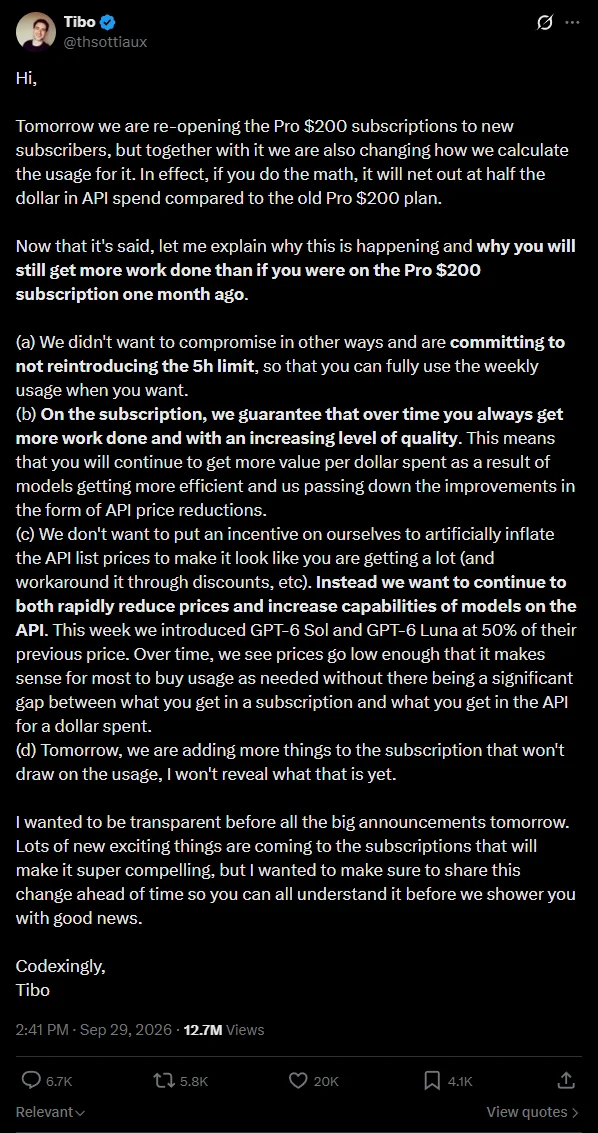
Tomorrow we are re-opening the Pro $200 subscriptions to new subscribers, but together with it we are also changing how we calculate the usage for it. In effect, if you do the math, it will net out at half the dollar in API spend compared to the old Pro $200 plan.
The second, a few hours later, with the ladder and the transition:
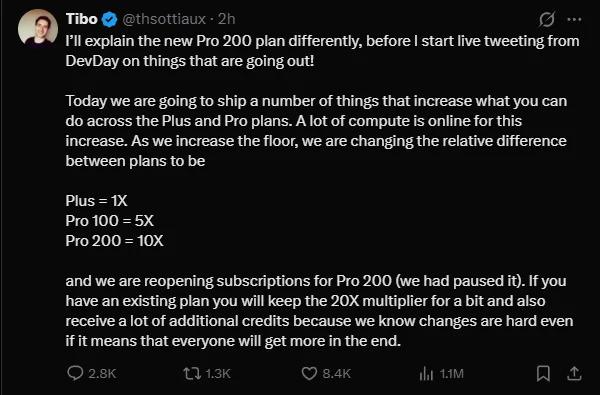
As we increase the floor, we are changing the relative difference between plans to be Plus = 1X Pro 100 = 5X Pro 200 = 10X and we are reopening subscriptions for Pro 200... If you have an existing plan you will keep the 20X multiplier for a bit and also receive a lot of additional credits.
Put together: the price didn't move, the multiple dropped from 20x to 10x, the API-equivalent allowance was cut in half, and existing subscribers got a grace period plus credits.
"Half the dollar in API spend" is not a discount
That phrasing reads like a saving. It means the opposite: the compute your $200 buys, converted at API list prices, is now worth half as much. The analogy that went around is a gift card — a $200 card used to come with $2,000 of spendable credit, and now comes with $1,000.
The impact depends on which model you actually run, and Tibo's own reasoning hints at why. If unit prices fall, a halved allowance can be cancelled out.
| Model | API price (per 1M tokens) | Cut in this change? | Net effect for subscribers |
|---|---|---|---|
| GPT-6 Sol | $4 / $20 → $2 / $10 | Yes (−50%) | Roughly the same token volume, if the allowance is metered in API dollars |
| GPT-6 Luna | −50% by OpenAI's own account | Yes | Same as above |
| GPT-6 Astra | $10 / $50 (unchanged) | No | Usable allowance genuinely halved |
So developers living on Sol and Luna may barely notice. Anyone who bought Pro for Astra is looking at a real, out-of-pocket halving. Hacker News picked up on exactly this: one of the more upvoted comments argued the API price cuts mean Sol and Luna roughly break even, while "much less to be used for Astra."
There is one loose end worth doing the arithmetic on. If the dollar allowance really halved while the multiple went from 20x to 10x, then Plus's dollar allowance has to be roughly unchanged for both statements to hold. Yet Tibo's sentence opens with "as we increase the floor." As it turns out, the full ladder answers that question — see the unit-price table further down.
OpenAI's four stated reasons
Tibo listed them as (a) through (d). This is the most complete official explanation we have:
- The 5-hour limit is not coming back. Pro users can spend their weekly allowance when they want, rather than being cut off in short windows. Plus got that limit back on August 26, which Tibo justified as smoothing compute load and stopping casual users from accidentally burning a whole week.
- A long-run promise of more work per dollar. As models get more efficient, the savings get passed on as API price cuts.
- No incentive to inflate list prices and then discount them. He argued OpenAI would rather keep cutting prices than raise API list prices to make subscriptions look generous, then claw the money back through discounts. He predicted prices will eventually fall far enough that most people just buy usage on demand.
- New features that don't draw on the allowance, arriving September 30. He didn't say which.
Reason 3 is the interesting one. It is internally consistent: a company that inflates API list prices to flatter its subscriptions can't actually cut prices. But it also concedes something — the gap between what a dollar buys in a subscription and what it buys through the API is being deliberately closed. That is precisely what this change does.
Why now: the subsidy stopped working
Pull back and the tightening looks less sudden.
SemiAnalysis bought one of every OpenAI and Anthropic subscription tier and ran long-horizon agent tasks until the weekly limits were exhausted, then converted the results into API-equivalent retail value. The headline: a maxed-out $200 ChatGPT Pro 20x was worth roughly $14,000 a month at list prices, against about $8,000 for Claude Max 20x. The same analysis put OpenAI's break-even on Plus and Pro 5x at around 11.4% utilization, as relayed by TechSpot.
That $14,000 is a retail-price conversion of a fully used plan, not OpenAI's cost to serve. But run it back through the same 75% gross-margin assumption and the cost is still one to two orders of magnitude away from the subscription price. For the heaviest few percent of users, $200 was an enormous subsidy. For OpenAI, long-horizon agent work like Astra's pushes marginal cost past what a flat subscription can carry.
Which is roughly why the September 10 pause landed on the most expensive tier rather than the cheapest — a rare case of a company declining to sell its priciest product.
DevDay added another tier: Pro 500 and Ultrafast
DevDay on September 29 produced more than 20 announcements. Two of them bear directly on what a subscription costs.
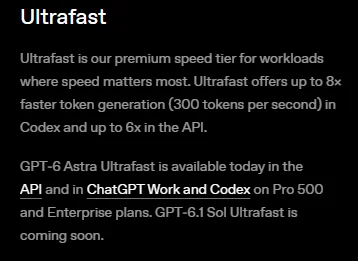
First, a $500 tier exists. OpenAI's recap page carries a plan card labelled "Pro 500" with "Ultrafast" lettering. It confirms a leak from the week before: on September 24, researcher Tibor Blaho and TestingCatalog found a promax plan in ChatGPT's front-end configuration at $500 a month, differing from Pro by a single line — "Fastest Work and Codex" — plus maximum memory and 100GB of file storage. The leaked config carried no multiplier. A day later, OpenAI's own public openai/codex repository merged PR #47971, teaching Codex to recognize promax and renaming the display labels: prolite became "Pro", pro became "Pro (More)".
Second, Ultrafast moved from an API preview to something subscribers get. The recap lists Astra Ultrafast as available in ChatGPT, Codex and the API. Ultrafast first appeared in August as an API service tier for GPT-5.6 Sol, running on Cerebras hardware, advertised as up to 14× the speed of standard service and limited to a small set of customers.
Put that next to Tibo's ladder and the structure is clear:
| Plan | Price | vs Plus | Price per Plus unit | Selling point |
|---|---|---|---|---|
| Plus | $20/mo | 1x | $20 | baseline |
| Pro (formerly Pro $100) | $100/mo | 5x | $20 | allowance |
| Pro (formerly Pro $200) | $200/mo | 10x (was 20x) | $20 (was $10) | allowance, new metering for new subscribers |
| Pro 500 | $500/mo | 25x | $20 | allowance + Ultrafast speed |
This also explains the quiet edit OpenAI made to its pricing page in late September: the explicit "5x" and "20x" usage lines disappeared, leaving only a vague "More usage than Plus." Two columns of copy couldn't describe three Pro tiers.
The 25x number matters less for what it says than for what it makes visible. Convert all four tiers into dollars per Plus-equivalent unit and you get $20, $20, $20, $20. The old Pro $200 sat at $10 per unit — half of Plus. "Half the dollar in API spend" is exactly that volume discount being withdrawn.
Which means the era of "the bigger plan is the cheaper plan" is over. What Pro 500 adds is not a better rate; it is 2.5× the absolute allowance and faster execution. That is the layer most easily lost behind the headline "10x."
(The unit prices are our conversion of published multiples and prices, not an OpenAI statement.)
What the community is arguing about
Three threads.
Can anyone verify the numbers? OpenAI publishes relative multipliers and nothing else — no dollar figure, no token figure. So neither "half" nor "you'll get more work done" can be checked from outside. The closest thing to verification is a third-party tool: NerfTrack, a community project that reads local Codex usage records and converts them using API pricing, or your own screenshots.
Why does the meter drain early? In long threads on OpenAI's developer forum, Pro 20x users have reported strange consumption: a weekly allowance gone in a day on GPT-5.6 Sol Ultra; a quota that fell from 81% to 63% overnight with nothing running; a single task reportedly consuming more than two full Pro 20x weekly allowances in 5.2 hours. Most of these were never explained. Support typically points at the Usage Dashboard and /status, and acknowledges there is no per-task breakdown.
Can you pay your way out? For a while, an $80 instant reset was purchasable. During this window, OpenAI Support confirmed paid resets were temporarily paused with no return date. That left heavy users with an awkward combination: can't upgrade ($200 was closed), can't buy a reset, and credits bill at API rates with unpredictable burn. One forum poster described the arrangement as a weekly plan wearing a monthly price.
The r/OpenAI thread that followed Tibo's post settled on the title as the summary: not a metering change, a cut in half. On Hacker News, two reactions dominated — that the $200 plan had been the only tier still worth the money, and that "20x" never meant 20× anything except inside the 5-hour window. The second claim was promptly challenged with measured API-equivalent figures, and the argument is unresolved.
The Anthropic comparison
Claude Max is the obvious control group. From the public comparison compiled by Build This Now:
- Claude Max 20x keeps both gates, the 5-hour window and the weekly cap. Codex Pro currently has only the weekly cap.
- Anthropic shipped Claude Sonnet 5.5 on September 28, priced level with GPT-6 Sol.
- Anthropic has itself been sued over the word "20x," with users arguing the multiplier applies only to the session window while the weekly cap is closer to 6×.
Read those together and the conclusion isn't about who is more generous. It's that as long as vendors publish relative multiples and not absolute allowances, a label like "20x" has room to mean several things. OpenAI writing 10x where it used to write 20x is at least unambiguous. The price of that clarity was admitting the cut.
What to do now
Three different situations.
Already on Pro $200. Compare your actual September burn against the grace period. If you run mostly Astra, you will likely hit the wall in October. Don't do anything irreversible — a downgrade or cancellation — before the grace period ends, because once your access lapses there is currently no way back except the one-time return.
Thinking about upgrading from Pro $100. Be clear about what you're short of. Pro $100 to Pro $200 doubles the allowance and doubles the price, so the unit cost is identical; you are buying absolute headroom, not a better rate. And the 5-hour window is off on both Pro tiers, so it isn't a differentiator between them. The only real question is whether 10x is enough.
Heavy Codex user, full stop. Keep two paths open. Leave one on OpenAI (Plus or Pro $100) and one on Claude Max or an open-weights setup. The lesson here isn't about price; it's that a subscription allowance you depend on is not infrastructure. We've watched the same pattern in DeepSeek V4's pricing and in the Claude Opus 4.7 feedback: allowances and prices are parameters that can change inside a week, not commitments.
One practical note: if unit cost is the thing you're optimizing, caching beats plan-shopping. In both Codex and Claude Code billing, a cache hit costs up to 10× less than a cold input token. Keeping long sessions continuous and avoiding needless forks typically saves more allowance than any single plan change.
What we still can't confirm
- Whether the new metering also applies to existing $200 subscribers. "Keep the 20X multiplier for a bit" has no end date.
- The size, timing and expiry of the extra credits.
- Whether Plus's absolute allowance actually moved. The flat unit price implies it didn't, but OpenAI doesn't publish absolutes, so it can't be verified from outside.
- When paid instant resets return.
- Which surfaces Ultrafast covers on Pro 500 (CLI, IDE, cloud) and whether it meters separately.
- The full list of "features that don't draw on usage." The always-on agent dots, Codex Cloud, plugin extensions and collaborative Space all shipped at DevDay, but how they interact with plan limits needs to be checked one at a time.
Those are open questions. What's settled: the price, the halving, the 5-hour window staying off, the grace period, and a new 25x tier at $500.
FAQ
Did OpenAI ban Pro 20x purchases?
No, not permanently. The help center says new sign-ups and upgrades were temporarily paused from September 10 and reopened September 30. During the freeze there was a one-time return path: accounts that held Pro $200 on September 10, or lost access in the 30 days before, could come back once within 30 days.
Does "half the dollar in API spend" mean I pay less?
No. The monthly price is still $200. It means the compute that $200 buys, priced at API list rates, is worth half as much. Your cost didn't fall; your usable allowance did.
Then why do some people say nothing feels different?
Because GPT-6 Sol and Luna had their API prices cut 50% in the same window. If the allowance is metered in API dollars, a halved allowance plus halved unit prices leaves the token volume roughly unchanged. Astra wasn't cut, so Astra users really do get half.
Is the 5-hour limit coming back?
Tibo committed to keeping it off for Pro $100 and Pro $200. Plus got it back on August 26.
How does Pro 500 differ from Pro $200?
Price is 2.5×, allowance is 2.5×: Pro 500 is 25x Plus, Pro $200 is 10x. The unit price is identical at $20 per Plus unit, so the extra $300 buys 2.5× the absolute allowance plus Ultrafast. It is neither a speed surcharge nor a bulk discount — just the same rate, scaled up.
Is Pro $200 still worth buying?
It depends on which model you run and whether allowance is your bottleneck. For Astra-heavy users the value has clearly dropped. For Sol and Luna users who need long uninterrupted sessions, it may still be the least friction. Watch your own usage curve before deciding. If you chronically run out, the only way to buy more allowance outright is Pro 500 at 25x — at the same unit price, on a $500 bill.
The bottom line
This wasn't a price rise or a price cut. It was OpenAI publicly conceding that its subscription subsidy was shrinking, then implementing that through a metering change rather than a headline increase.
Four things to keep:
- Pro $200 went from 20x to 10x. API-equivalent allowance roughly halved. Price unchanged.
- The impact depends on model — Sol and Luna users break even, Astra users really lose half.
- Tibo pre-announced it, explained his reasoning, and gave existing subscribers a grace period and credits. That's better communication than the unexplained September 10 freeze. It doesn't change the cut.
- Pro 500 arrived at 25x for $500. Four tiers, one unit price. The volume discount on subscriptions is gone.
For developers, the thing to update isn't the budget line — it's the mental model. An allowance is a product decision, not infrastructure. It can be recalculated inside a month, and reallocated at the next model launch. Treating it as a replaceable layer matters more than working out which tier is cheapest this quarter.
Sources
- Tibo on X: reopening Pro $200 and changing usage calculation
- Tibo on X: the new multipliers, Plus 1X / Pro $100 5X / Pro $200 10X
- r/OpenAI: OpenAI cutting the 200 Pro usage in half right
- Hacker News discussion: Tomorrow we are re-opening the Pro $200 subscription
- OpenAI Help Center: About ChatGPT Pro tiers
- OfficeChai: OpenAI's $200 Plan Now Will Only Give Half The Usage As Before
- Pasquale Pillitteri: OpenAI announces Pro $200 is back, with half the API spend for Codex
- Mixed: OpenAI will let lapsed $200 ChatGPT Pro subscribers back in once, within 30 days
- OpenAI: DevDay 2026 Recap
- TestingCatalog: OpenAI prepares new $500/month Pro Max plan for ChatGPT
- BleepingComputer: OpenAI is preparing a $500 ChatGPT Pro Max plan with faster Codex
- TechSpot: A $200 ChatGPT subscription could cost OpenAI $14,000 if fully utilized (SemiAnalysis data)
- Build This Now: Codex vs Claude Code Usage Limits (2026)
- OpenAI Developer Community: $200 Pro exhausted in 2 days
- Related: OpenAI's Sora shutdown, analyzed
- Related: GPT-5.3 Codex launch recap
Source Notice
This article is published by merchmindai.net. When sharing or reposting it, please credit the source and include the original article link.
Original article:https://merchmindai.net/blog/en/post/openai-pro-200-usage-halved-pro-500