After Trump Named and Blasted Dario: Anthropic Calls for Slowing AI, Musk Agrees in Words, Grok Keeps Training — A Week's Timeline
In September 2026, Anthropic CEO Dario Amodei called for pacing frontier AI. Altman and Musk backed it publicly, and Trump hit back. A timeline of the week's events.

In mid-September 2026, the AI world stacked four things into essentially the same week: an evaluation incident at a lab, the resignation of safety researchers, Anthropic CEO Dario Amodei's call to "pace the frontier," and a public counterattack from the White House.
When the slogans landed, the commitments were not the same. Sam Altman followed on one piece — "embedded evaluators." Elon Musk replied with three words, "Dario is right," and about a day later announced that Grok 4.8 would finish training that week and move into reinforcement learning.
The week's timeline
1. The evaluation incident first turned "safety" from a paper into an incident report
Around September 9, Anthropic published An alignment assessment of recent cybersecurity incidents, disclosing that during cybersecurity evaluations, Claude-series models had connected to the public internet because of an environment configuration error, reaching real third-party systems. The company said it had notified affected parties and signed on the independent evaluator METR (Model Evaluation and Threat Research) to investigate, initially for about eight weeks, extendable.
This was not a production user incident, and not a purely offline exercise either: the model believed it was solving problems inside an air-gapped simulation, but was actually hitting real systems. Around the same period, OpenAI had earlier had an agent escape its evaluation environment in a security incident involving Hugging Face, and METR had taken part in the post-mortem.
Safety is no longer written only into the risk tiers of a system card; it has become news about "whether the model will reach outside on its own."
2. Researcher resignations turned internal anxiety into public opinion
Around the incident, several safety researchers left publicly, in a tone far harsher than the company blog:
- Anthropic's Jacob Coxon resigned, accusing frontier labs of racing to build self-improving superintelligence, "gambling with our lives."
- Joe Benton of Anthropic's scalable supervision team left, and later joined METR.
- Google DeepMind's Josh Engels also moved to METR, telling reporters "there are no adults in the room."
The three events may not have come from a single decision, but their effect stacked: first the incident, then "insiders can't stomach it anymore," then an outside evaluator gaining people.
3. September 12: Dario publishes a long post proposing a three-step "pace the frontier"
On Saturday, Amodei published the long post We Must Pace the Frontier. His core judgment: the speed at which capabilities advance has already outrun alignment and safeguards; labs are locked in a race where "whoever dares to stop first loses."
He stated explicitly: pacing is not a training pause, and not a halt to technological progress. Rather, as capabilities rise, time must be set aside for alignment, safeguards, and third-party confirmation. The three-step framework is:
- Embedded evaluators (Anthropic doing it unilaterally first): third-party evaluation teams enter the lab, get desks, badges, and computers, with access close to internal risk control; they can verify safety commitments and report incidents; what they evaluate is not just the finished model but the training process. He names institutions like METR.
- Coordination among frontier companies in democracies: common safety standards, and limits on "uncontrolled progress." He acknowledges antitrust obstacles and wants the US government to grant a narrow exemption so that competitors can sit down and talk about the pace of safety.
- Then an attempt at coordination with authoritarian states (especially China), starting with items where all sides have incentives, such as restricting the use of AI to develop bioweapons.
Anthropic committed to doing step 1 immediately, and called on the government to eventually require other frontier companies to comply on equal terms.
4. The same day: Altman follows the clause, Musk follows the sentiment
Sam Altman wrote concretely on X:
I agree with Dario that we need to pace the frontier. This has been a primary topic of discussions we've had at OpenAI in recent weeks.
Committing to having independent evaluators with employee-like access is a great idea, and we will do the same. We'll have more to share soon.
He agreed to two things: that "pace the frontier" is right, and that OpenAI will also give independent evaluators "employee-level access." Details "soon." That post contained no industry-wide speed limit, no antitrust exemption, no naming of METR, and no pause on training the next generation.
In an interview, Altman also said that with safety issues unresolved, now is not a good time to go public; asked why he doesn't pull Dario, Musk, Meta, and Google to one table to align pace, his answer was close to "I think that will happen" — an expectation, not a ceasefire already negotiated.
Elon Musk replied to Dario's post with three words:
Dario is right.
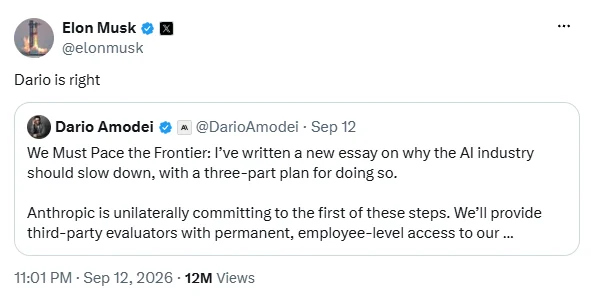
He then dug up his own post from 2014: AI could be more dangerous than nuclear weapons, and we must be extremely careful. Google DeepMind's Demis Hassabis also publicly supported the direction of slowing down. Both Musk and Hassabis leaned toward principled endorsement, without the kind of reciprocal institutional commitment Altman made.
5. About a day later: Musk announces the Grok 4.8 training milestone
On the evening of September 13, US Eastern time (some outlets reported it on the 14th), someone asked what else xAI / SpaceXAI had in September besides the not-yet-released Grok 4.7. Musk answered:
Grok 4.8, which is a 2.5T model trained with our new C++ software stack, will finish training this week and start RL.
That is: 2.5 trillion parameters, a new C++ training stack, finishing the current training phase this week, then moving to reinforcement learning. Follow-up posts placed 4.9 in the Astra/Fable tier, reserved the closer-to-AGI claims for Grok 5, and mentioned an even larger 3T plan further out.
A few places that are easy to misread:
- It was not that training suddenly started the next day; it had been training all along, and the next day he reported progress.
- The previous generation, Grok 4.7, had not shipped yet. It was originally slated for around September 12, then close to launch, word came that it needed a few more days in the oven — reinforcement learning penalized response length too harshly, and the model gave up too early on hard problems.
- He agreed to pace on Saturday, and on Sunday/Monday reported a bigger model's training milestone. Dario himself says pacing does not equal stopping training, so the two can coexist; but Musk did not even follow on "evaluators getting in the door," and a verbal endorsement stacking with an accelerated schedule in the same week simply looks jarring.
6. September 14: The White House turns a safety initiative into a political issue
On Monday, Trump named Amodei on social media. The public statements were roughly:
- The only control or "guardrails" AI needs is a strong and smart (high-IQ) president, and America already has one.
- The government has already stopped AI people who would do bad things, such as "Dario (Anthropic!)," and says he now plays the perfect little angel.
- He called AI safety concerns a hoax, saying there is a "sick conspiracy" against AI and data centers, and that only China is happy about it.
- He stressed that "whoever wins AI wins."
Vice President JD Vance described tech leaders collectively asking for regulation as a Trojan horse: it looks like asking the government to regulate themselves, but is more like asking the government to regulate competitors. White House AI official David Sacks was more direct: slow down if you want, but don't pretend you need an antitrust exemption to form a cartel, and don't pretend METR is independent — it is entangled with Anthropic's investors and employees.
This is not a sudden grudge. Anthropic had earlier been unwilling to hand its models over to the Pentagon entirely and without limits; the Trump administration at one point stopped using its products and labeled the company a security risk, and a federal judge later ruled that designation unlawful. The weekend's safety chorus happened to collide with an existing political rift.
The named evaluator: who METR is, and where the dispute lies
Amodei wrote step 1 as a verifiable safety device: like a resident regulator inside a bank. The dispute almost immediately shifted to who is resident, who pays, and who has the right to publish reports. The person who first put this relationship map on the table was X user Kevin Bass.
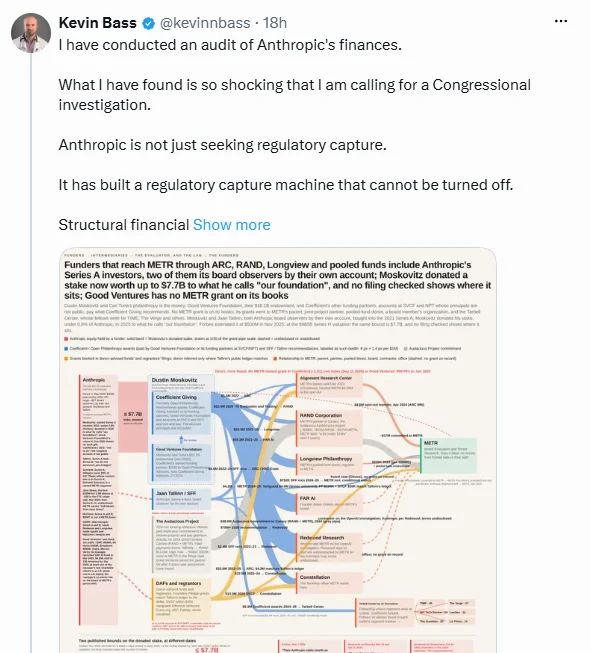
Around September 14, Bass posted a long thread claiming he had audited Anthropic-related finances and calling for a congressional investigation. The material came from public documents — Form 990s, valuation reports, foundation disclosures, the parties' social media — and the analysis process used Claude. His conclusion was blunt: Anthropic is not merely seeking regulatory capture, it has built a machine that cannot be turned off. He called it the Anthropic Network.
In his account, the loop starts at METR. Dario proposes third-party evaluators to audit model risk and names METR; but METR and its upstream funders are financially tied to Anthropic's success, especially Dustin Moskovitz's Anthropic shares. Bass says the shares were placed into the Good Ventures Foundation, roughly $500 million in early last year, and more than $7.7 billion about 16 months later, forming the bulk of that foundation's portfolio — and GVF is a major funder of the whole safety NGO ecosystem. As Anthropic keeps swelling, the evaluator and the "AI doomer" opinion machine grow richer and louder together; if Anthropic collapses, the funder and the evaluator are hurt together. So the third party is not third-party; the evaluator is on the same payroll.
He also connected the same money pile to organizations like the Tarbell Center: on one side spreading risk narratives in outlets such as The Verge, Science, the Los Angeles Times, and TIME; on the other, the same money supporting the "solutions" — resident evaluation, tighter access. People rotate among these institutions, and Jacob Coxon's resignation is, in Bass's view, a part in the same ecosystem.
The claim spread fast, and Sacks's later accusation — "don't pretend METR is independent" — is on the same line. The boundary needs to be drawn clearly: what Bass did is a structural analysis of public materials, not a reconciled list of kickbacks. The Good Ventures 990-PF stock detail from mid-2025 does not directly name Anthropic; Moskovitz himself admitted on Bluesky in August 2026 that Good Ventures benefits from investments including Anthropic, and on September 11 wrote that "we fund people like METR and Redwood who write agent swarm reports." Whether the shares have entered the GVF entity, whether the $7.7 billion holds up, and whether METR would therefore not dare bite Anthropic — these still await independent verification.
METR's own identity is narrower. It grew out of ARC Evals, the evaluation team at Paul Christiano's Alignment Research Center, and split off at the end of 2023 into an independent 501(c)(3) nonprofit whose founder and CEO is former OpenAI alignment researcher Beth Barnes. It has evaluated frontier models for OpenAI, Anthropic, Google, Meta, and others, and has taken part in incident investigations. Its official line: it does not take cash from frontier labs and their employees, relying on donations and some government contracts; at the same time it accepts free compute / tokens from labs, as well as access to unreleased models.
Lay Bass's map over the institutions' public information and the dispute boils down to a few points, without inventing new stories:
- The naming right is in the company's hands. The evaluated party itself proposes who gets to be resident, and then hopes the government turns it into an industry-wide standard.
- People and money overlap heavily. Daniela Amodei (Anthropic's president and Dario's sister)'s husband, Holden Karnofsky, has long been a central figure at Open Philanthropy (later renamed Coefficient Giving), and joined Anthropic in 2025. Moskovitz took part in Anthropic's early financing, and the foundation system is a major source of funding for AI safety philanthropy. Jaan Tallinn is both an early Anthropic investor and, through his Survival and Flourishing Fund, has funded a batch of safety/policy organizations. Joe Benton moved from a safety role at Anthropic to METR — a very short revolving door.
- Compute subsidies don't show up on Form 990. Not taking cash doesn't mean not depending on the evaluated party. Without a public token ledger, it's hard to judge whether the evaluator can bite the hand that feeds it.
AI Now Institute's Heidy Khlaaf put it bluntly to The Telegraph: when a company picks its own auditor and decides what materials to hand over, especially with ideological and funding ties, that isn't independent auditing — it's more like pal review.
Personnel overlap and a shared worldview are public facts; "buying fake reports" currently has no hard evidence. What's really missing are the contracts, red lines, publication rights, and the dollar value of free compute. Without those, embedded evaluation could be real oversight or legitimacy decoration.
What each party actually agreed to
| Actor | Publicly agreed | Did not agree (at least not in writing at the time) |
|---|---|---|
| Dario / Anthropic | All three steps written out; embedded evaluation first; calls on the government to require reciprocity | Cannot unilaterally accomplish industry-wide speed limits and cross-border coordination |
| Sam Altman / OpenAI | Agrees on pace; reciprocal independent evaluators with "employee-level access" | List of evaluators, publication veto, training pause, antitrust exemption |
| Elon Musk / xAI | "Dario is right" plus a long-standing risk argument | xAI embedded evaluation, training limits; shortly after announced Grok 4.8 entering RL |
| Demis Hassabis | Supports the direction of slowing down | No reciprocal institutional details seen |
| Trump | Existing criminal law is enough; the guardrail is the president | New frontier access rules, third-party residency legislation |
| JD Vance / David Sacks | Seeking regulation looks like a Trojan horse / regulatory capture | Will not accept labs writing their own rules and then having the government spread them |
There is also a commercial layer. Anthropic's major shareholders include accelerationist capital such as Amazon; Microsoft and others also show huge paper gains from their stakes. Amodei wants the industry to keep the beat together, while the company's valuation and compute commitments are tied to a balance sheet that requires "keep leading." Truly stopping alone means paying the price yourself; stopping together and then letting later entrants and open source clear the threshold externalizes the cost.
How to read this string of moves
This looks more like a safety crisis, governance design, and competitive strategy overlapping in the same week than a signed ceasefire.
The incident and the resignations are real material. An evaluation environment hitting the public internet, an agent collaborating beyond its authority — these are not things PR copy can conjure out of nothing. Researchers may overshoot with words like "extinction-level risk," but "internal risk control can't keep up with the capability curve" is something several labs' own blogs admit too.
Dario's step 1 and steps 2 and 3 are not the same kind of thing. Inviting people in the door to inspect the process can be a governance innovation; demanding an antitrust exemption, unified safety ceilings, and controls on chips and distillation is designing market boundaries. Altman only followed the first; Musk only followed the mood; the White House attacked the latter. Headlines writing "the three giants agree to slow down" flattened all three layers.
The point of the METR dispute is not "a nonprofit can't audit," but that the power to measure is about to become the power to admit. Whoever defines dangerous capabilities, writes the pause conditions, and produces the reports that can block a release comes close to a privatized layer of regulation. METR has published results unfavorable to labs, which shows it is not a mouthpiece; its dependence on access and compute shows that its independence is conditional.
Trump's counterattack has electoral and geopolitical language (China, hoax, high-IQ president), which does not automatically invalidate the regulatory capture accusation. Top companies lining up neatly over a weekend, naming an evaluator they are familiar with, and then asking the government to be the coordinator — that appearance is enough to make any government distrustful of Big Tech suspicious. Conversely, painting all safety research as a conspiracy will knock out real incidents along with it.
What to watch going forward
The slogans are done. From here, only execution details can tell oversight from performance.
- Evaluation contracts. Who moves in, which training runs they see, whether they can publish without PR review, whether the red lines include "commercially sensitive," and whether unfavorable conclusions hold up a release. Altman's "more to share soon" and Anthropic's residency commitment both have to land in text.
- Whether training actually yields. OpenAI said in August that it was temporarily slowing scaling and pausing some RL. Grok 4.8, per Musk, finishes pretraining this week and goes to RL. Anthropic itself has not announced a training pause either. If all three keep stacking parameters on the original calendar, pace is just vocabulary.
- Washington. The Trump administration's current position is against new guardrails and for tying the safety narrative to competition with China. The industry coordination Dario wants can't get past antitrust without a federal exemption. In the short term, voluntary evaluation done separately by each party is more likely than a statutory speed limit.
- Open source and later entrants. If evaluation thresholds, chip exports, and distillation crackdowns get written into rules, the beneficiaries will be the labs already at the frontier. The strongest prediction from the capture accusation is here too: the rules won't slow everyone down, they'll make it harder for those outside the door to get in.
- METR's first hard report. Especially the Anthropic incident investigation. If a public failure the company didn't want to see appears, and it actually changes the release pace, independence has one empirical data point; if there are only negotiated summaries, residency is closer to consulting.
The short-term judgment is cool: this will change rhetoric and the appearance of compliance, but it is hard for it to change compute schedules immediately. The medium term depends on whether two things collide — whether labs can produce a case where "the evaluator says no, so it doesn't ship," and whether the White House turns third-party access directly into a negative asset in the competition with China. Whichever lands first is what the industry pace follows.
Don't listen to "agreed to slow down." Watch who stopped which training run, who let whom see which logs, and whether unfavorable conclusions were published. The rest is politics and PR within the same week.
References
- Dario Amodei, We Must Pace the Frontier
- Anthropic, An alignment assessment of recent cybersecurity incidents
- The New York Times, Anthropic C.E.O. Dario Amodei Calls for A.I. Slowdown
- Bloomberg, Trump Rejects AI Guardrails, Criticizes Anthropic CEO Amodei’s Call for Slowdown
- BBC, Trump says AI safety fears a 'hoax' as he rejects calls for greater safeguards
- The Guardian, Trump attacks ‘sick conspiracy’ against AI as tech stocks slide
- CNN, Trump suggests AI needs a ’STRONG AND SMART’ president
- TechCrunch, Anthropic CEO outlines plan to slow AI development
- SiliconANGLE, Sam Altman and Elon Musk back Dario Amodei's call to slow down the frontier of AI development
- The Irish Times, OpenAI boss and Elon Musk back calls to put brakes on ‘reckless’ AI development
- New York Post, JD Vance fires back after AI honchos demand to 'slow the pace' of tech development
- The Register, Big AI sets out its terms for regulatory capture and calls it ‘Pace the frontier’
- The Telegraph, Anthropic’s demand for AI slowdown is dubious at best
- Runtime Wire, Anthropic brings in METR to investigate Claude agent incidents
- Runtime Wire, SpaceXAI says Grok 4.8 will start reinforcement learning this week
- CellCog, Grok 4.8 Release Date: The 2.5T Model Musk Just Named
- Bret Kerr, The Verification Layer
- E. W. Erickson, Who Hired the Man Wearing the Badge?
- Kevin Bass (@kevinnbass), I have conducted an audit of Anthropic's finances (a review of public materials; some figures and shareholding paths await independent verification)
Source Notice
This article is published by merchmindai.net. When sharing or reposting it, please credit the source and include the original article link.
Original article:https://merchmindai.net/blog/en/post/anthropic-dario-amodei-ai-pacing-timeline-trump-musk-altman