Why Fashion Commerce Brands Are Abandoning Static FAQs in 2026
Fashion Nova, Gymshark, Steve Madden, and Katy Perry Collections show why promo-heavy fashion storefronts now need contextual AI support instead of static FAQs.

Why Fashion Commerce Brands Are Abandoning Static FAQs in 2026
Static FAQs were built for stable catalogs. Fashion commerce now runs on moving targets.
The old support model assumed shoppers had simple, repeatable questions:
- What is your return window?
- How long does shipping take?
- Do you offer size exchanges?
- Where can I find my tracking number?
That model still works for the bottom 20% of questions. It fails on the other 80% now driving fashion conversion.
In 2026, the most valuable fashion traffic lands on storefronts full of moving variables: countdown timers, promo codes, shipping thresholds, member-only perks, launch windows, pop-ups, and localized merchandising. The shopper is not asking a generic FAQ question. They are asking a contextual question tied to the exact state of the page they are seeing right now.
That is the shift static FAQs cannot handle.
To make that concrete, I reviewed homepage captures from Fashion Nova, Gymshark, Steve Madden, and Katy Perry Collections taken on April 20, 2026. These are not random brands. Together they represent four different versions of fashion commerce pressure:
- high-velocity promotional retail,
- performance-led apparel,
- footwear and accessories with layered offers,
- and drop-oriented brand storytelling.
Their homepages look different. Their support problem is the same: the first customer question is now generated by page state, not by policy pages.
If the shopper sees a timer, a discount code, a shipping threshold, a rewards gate, or a pre-launch page, the support system must interpret those conditions instantly. A static FAQ library cannot do that without forcing the customer to browse, guess, or abandon.
That is why the smartest fashion brands are not replacing help content. They are replacing the assumption that help content alone can close the sale.
The benchmark numbers: what four storefronts reveal in one screen
Before we talk strategy, look at what these four captures reveal operationally:
- 4 out of 4 storefronts display a conversion-sensitive message above the fold.
- 3 out of 4 combine the hero experience with an interruption layer such as cookies, account prompting, or pop-up capture.
- 3 out of 4 make the shopper interpret a commercial condition immediately: a promo code, a shipping threshold, a loyalty state, or a gated discount.
- 0 out of 4 surface a visible FAQ-first support path in the hero area.
- 4 out of 4 create questions that depend on context rather than static policy text.
That last point matters most.
A shopper on a promo-heavy page is not asking “What is your shipping policy?” They are asking:
- Does the current discount combine with the shipping threshold?
- Does the countdown apply to my region?
- If I create an account now, do I unlock rewards on this collection?
- Is this drop live, paused, or still a teaser?
- If I leave because of the cookie wall or pop-up, what happens to the offer?
Those are revenue questions disguised as support questions.
And because they are contextual, brands that answer them with static FAQ pages create a hidden tax on conversion:
- the shopper must leave the shopping flow,
- the shopper must search for the right policy page,
- the shopper must interpret whether the policy applies to the current promotion,
- and if the answer is still unclear, the purchase stalls.
Fashion merchants usually measure this problem as “support volume.” That is too narrow. The real issue is support-mediated conversion friction.
Case study 1: Fashion Nova shows how urgency multiplies support demand
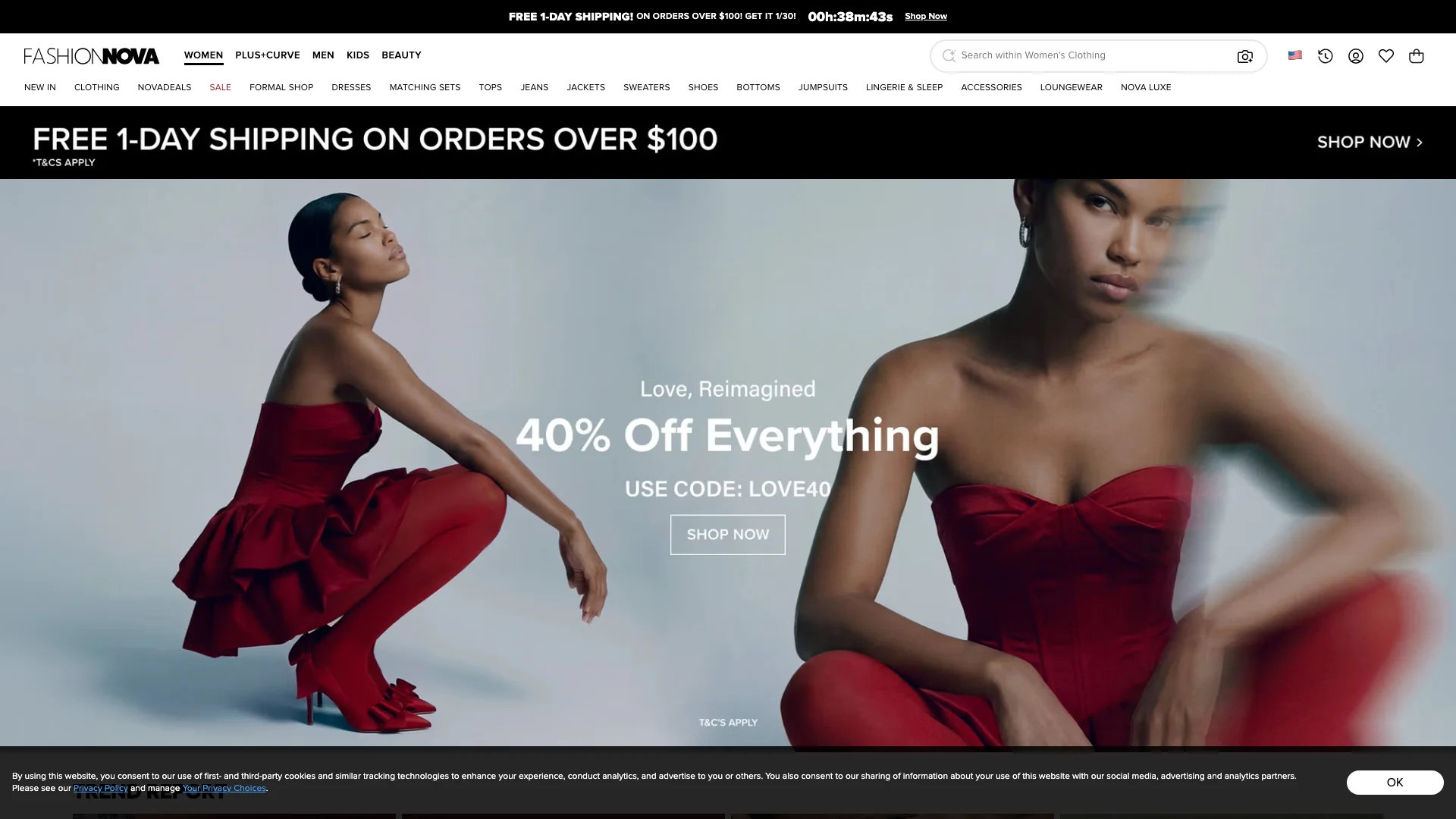
The Fashion Nova capture is a masterclass in modern promotional density.
On a single screen, the shopper sees:
- FREE 1-DAY SHIPPING ON ORDERS OVER $100
- a live countdown timer
- 40% Off Everything
- a required code: LOVE40
- category depth across women, plus, men, kids, beauty, accessories, and more
This is exactly the kind of homepage that drives fast intent, but it also creates a support queue before the first product click.
Every commercial condition introduces ambiguity:
- Does the code apply to sale items?
- Does the shipping threshold calculate before or after discount?
- Is one-day shipping available for my ZIP code?
- If I split my cart across categories, does the threshold still hold?
- If I miss the timer, does the cart keep the price?
Notice what is happening here. The questions are not about policy in the abstract. They are about policy plus page state plus cart logic.
That is why static FAQs underperform in promo-led fashion commerce. A generic “Shipping Policy” page can explain carrier windows. It cannot reassure a shopper in under five seconds that their current cart still qualifies after a 40% discount. A generic “Promotions” page can list exclusions. It cannot interpret the current code, current timer, and current basket value together.
For a brand like Fashion Nova, support therefore sits directly on the conversion path. If the answer comes too late, the customer does not merely become dissatisfied. They disappear to another tab.
The support implication is straightforward:
- promo-heavy apparel stores need real-time offer interpretation,
- real-time shipping qualification logic,
- and immediate handoff when the answer depends on destination or inventory state.
An FAQ page cannot execute that. A connected AI support layer can.
Case study 2: Gymshark proves identity and rewards are now first-screen support issues
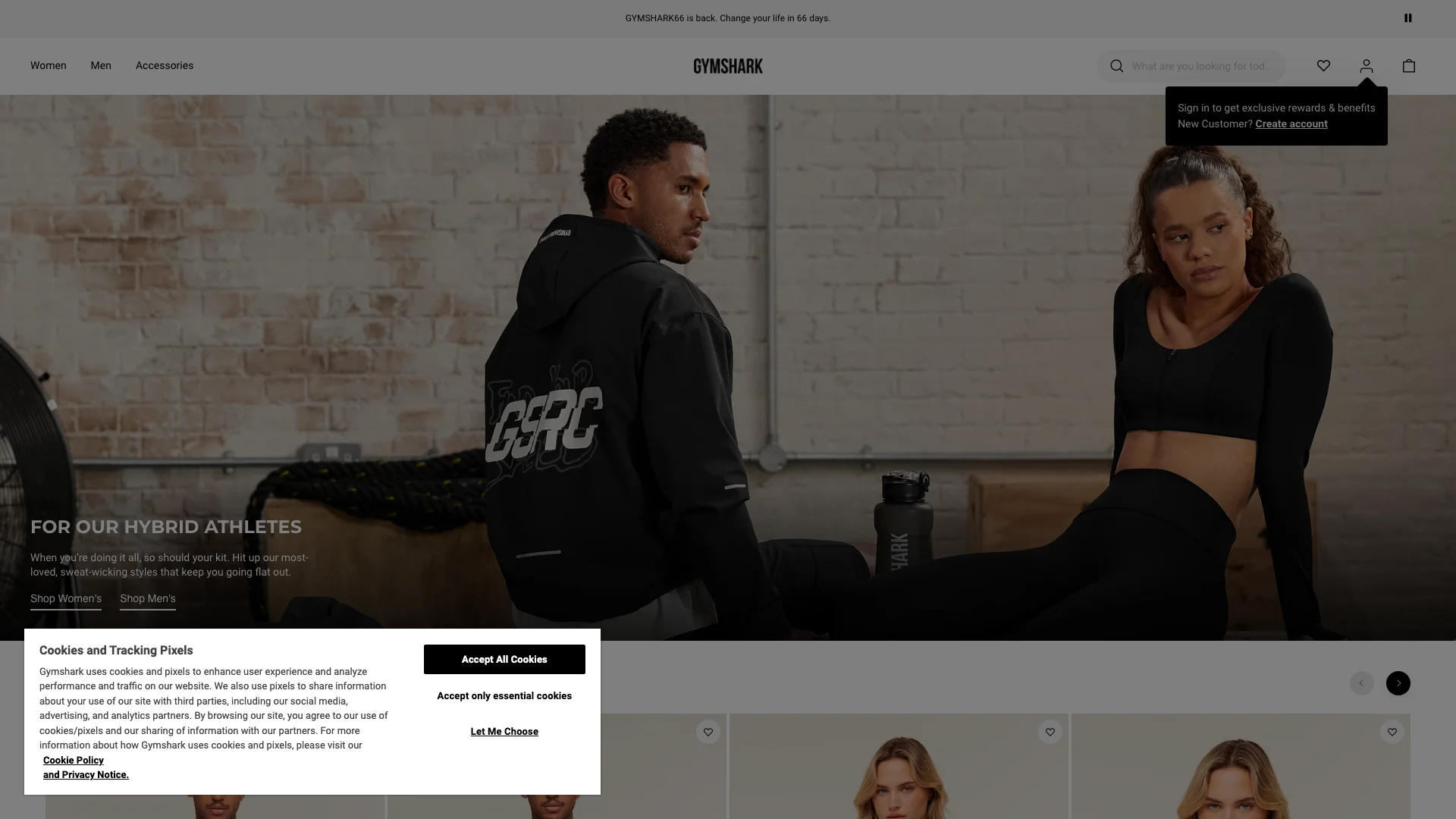
Gymshark’s homepage demonstrates a different version of the same problem.
The hero itself is clean: performance apparel, a campaign message, a straightforward shop path. But the screenshot also shows two critical layers:
- an account/rewards prompt: “Sign in to get exclusive rewards & benefits”
- a cookie-and-tracking banner occupying a large part of the lower viewport
That means the first friction is no longer only merchandising. It is identity resolution.
The shopper is immediately pushed toward questions like:
- What rewards do I unlock if I sign in?
- Will my discount or benefits apply to this collection?
- Do I need an account before checkout?
- If I decline cookies, what changes in my browsing or cart experience?
- If I am a returning shopper, where do I see my status or saved items?
Static FAQs struggle here for a simple reason: these are not knowledge questions. They are relationship questions. The answer depends on who the shopper is, what region they are in, and what state the storefront recognizes.
That distinction matters more every quarter. As fashion brands push higher lifetime value through loyalty, member benefits, early access, and personalized merchandising, support must do more than explain policies. It must explain entitlement.
That requires a system that can read signals across:
- account status,
- reward eligibility,
- collection rules,
- order history,
- and session context.
If the shopper has to go hunting through an FAQ article for “How does membership work?”, the brand has already introduced unnecessary cognitive load. And on mobile, that extra effort often kills the session entirely.
Gymshark’s capture makes the future obvious: the support layer needs to behave like a storefront-native concierge, not a document library.
Case study 3: Steve Madden shows why pop-up commerce breaks FAQ logic
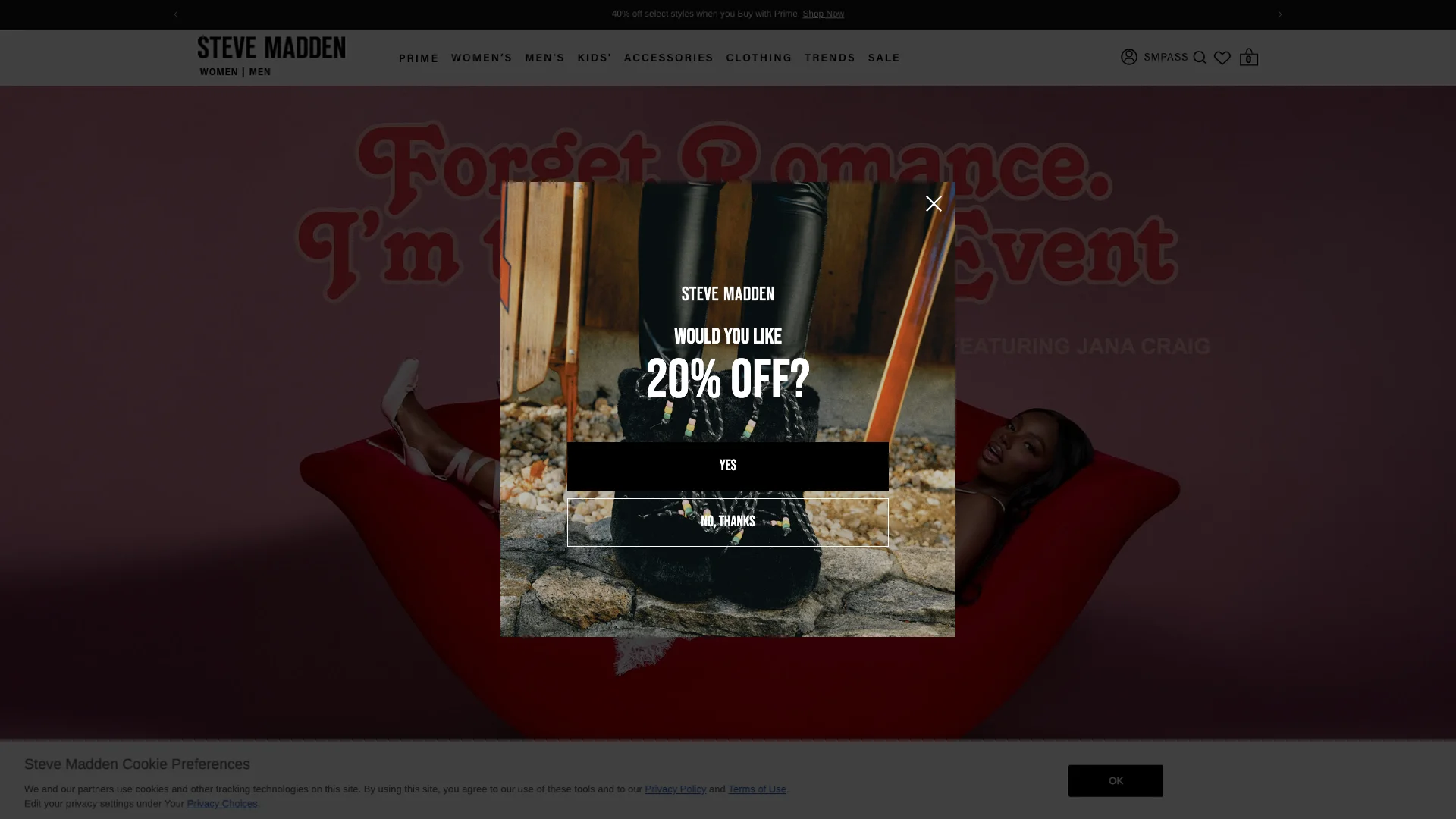
Steve Madden’s capture is especially useful because it shows a support problem many teams underestimate: offer capture before browsing.
The screen includes:
- a top-bar message tied to Prime
- fashion navigation across women, men, kids, accessories, clothing, and sale
- an email or discount capture pop-up asking: Would you like 20% off?
- visible account and loyalty cues through SMPASS
This combination creates an immediate interpretive burden:
- Is the 20% pop-up for first-time visitors only?
- Does it stack with Prime-linked offers?
- Will I lose the offer if I dismiss the modal?
- Can I apply it to sale items or only full-price product?
- Does SMPASS change shipping or returns expectations?
Again, a static FAQ page can document each rule separately. It cannot resolve them in the moment the shopper is deciding whether to hand over an email address, create an account, or continue browsing.
That is the operational flaw in old support architecture. It assumes the customer journey is linear:
- discover a product,
- read a policy,
- proceed to purchase.
Steve Madden’s homepage shows the actual journey:
- encounter layered offers,
- make a split-second decision about value,
- try to understand exclusions,
- question whether this is the best available incentive,
- stall if clarification is not immediate.
This is why fashion merchants increasingly need support systems that understand the commercial hierarchy of the page:
- hero promo,
- modal capture,
- loyalty state,
- shipping threshold,
- and sale exclusions.
Without that hierarchy, support becomes contradictory. One answer references the shipping policy. Another references loyalty. Another references promotion terms. The shopper sees inconsistency, not confidence.
Case study 4: Katy Perry Collections reveals the support burden of ambiguity
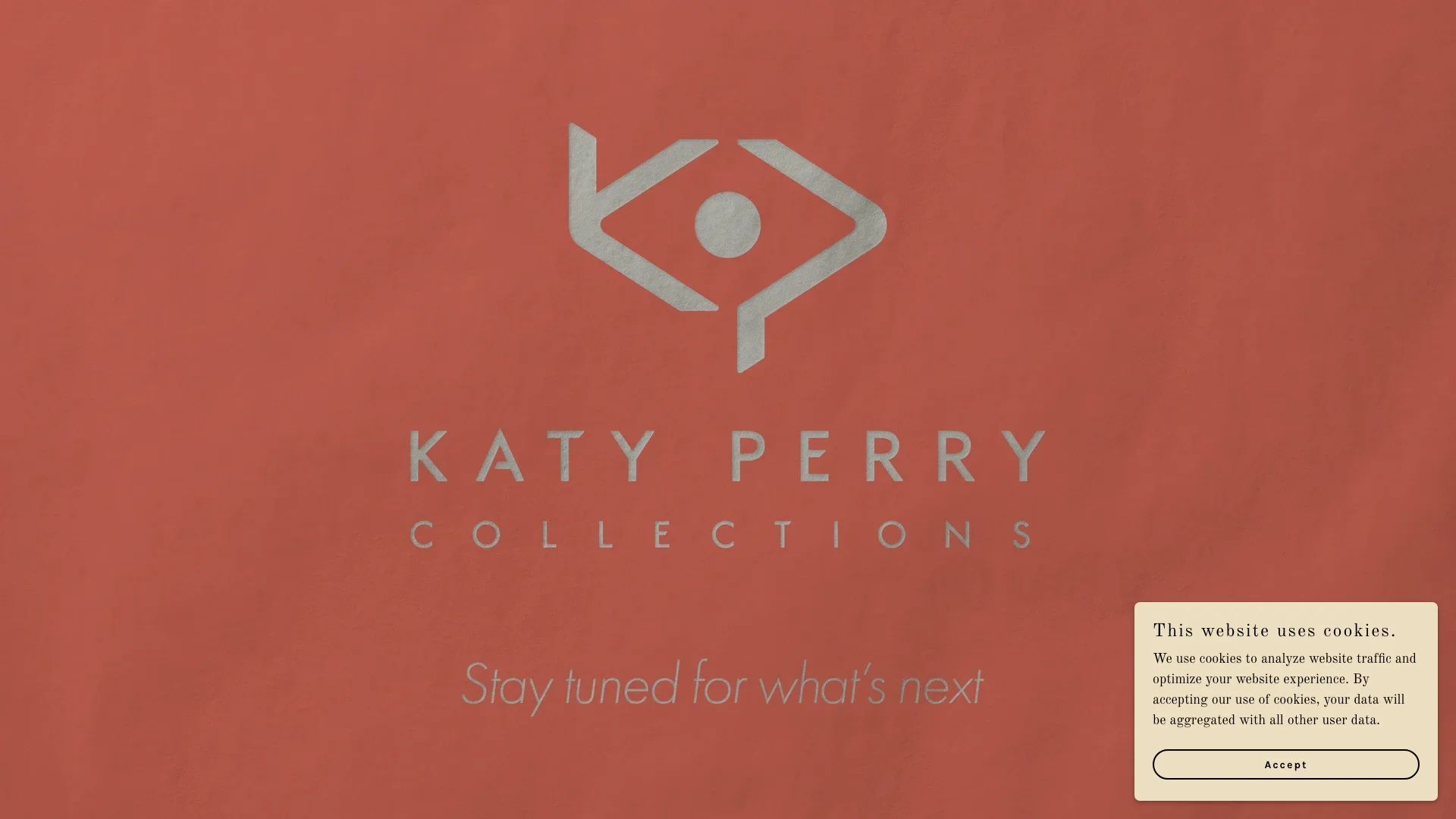
At first glance, the Katy Perry Collections page looks simpler than the others. It shows:
- a branded landing page,
- the message “Stay tuned for what’s next”
- and a cookie consent layer
But this simplicity creates a different support challenge: state ambiguity.
When a fashion or celebrity-led brand uses a page like this, shoppers immediately want to know:
- Is the store live or in transition?
- When is the next drop?
- Can I buy now or only sign up?
- If I placed an order earlier, where do I get help?
- Is there a product page behind this, or is the site still in teaser mode?
These are not traditional FAQ questions either. They are questions about storefront status.
And status questions are uniquely dangerous because they create silent abandonment. If shoppers cannot tell whether the brand is live, paused, pre-launch, or redirecting traffic elsewhere, many will not open a support ticket. They will simply leave.
That means the support layer has to clarify:
- current store status,
- next action for the visitor,
- expected timeline,
- and the right channel for existing customer issues.
A static FAQ titled “Orders” or “Shipping” cannot solve a front-door ambiguity problem. The visitor needs a conversational guide that understands the page they landed on and routes them accordingly.
For drop-driven fashion brands, this is crucial. Support is not only about resolving mistakes. It is about preserving momentum between hype and action.
Why static FAQs fail in fashion commerce now
Across these four brands, five failure patterns appear repeatedly.
1. Static FAQs cannot read live page conditions
The shopper’s question is generated by the page they are viewing right now: the timer, the code, the reward gate, the modal, the cookie banner, the launch message. A static article does not know which combination created the question.
2. Policy pages separate rules that the shopper experiences together
Brands usually publish shipping, promo, returns, and membership rules as separate documents. Real shoppers encounter them simultaneously. That gap forces customers to synthesize the answer themselves.
3. Search boxes assume the shopper knows what to ask
Most visitors do not search for “promotion stacking policy.” They search with natural uncertainty: “Will this still ship tomorrow if I use the code?” Static FAQ systems are weak at mapping that ambiguity to a clear answer.
4. Manual support is too slow for promo-led sessions
In fashion commerce, many high-value questions are asked during active shopping windows, not after purchase. If the customer must wait 20 minutes, the answer arrives after the commercial moment has passed.
5. Fashion questions are brand-tone sensitive
A support answer that is technically correct but robotic can still hurt conversion. Premium, hype, and performance brands all need answers that match tone while staying accurate. Static FAQ copy rarely handles that well.
What the winning support stack looks like instead
For this category, the goal is not “better FAQs.” The goal is contextual commerce support.
That means the support system should be able to do six things immediately:
- identify the page context the shopper is in,
- understand active offers and visible conditions,
- retrieve the correct policy logic,
- personalize the answer to account or region when allowed,
- escalate to human support when the issue becomes order-specific,
- and keep the shopper inside the buying flow.
This is where HeiChat fits the category especially well.
HeiChat is not just a chatbot layered on top of policy pages. For Shopify Plus merchants, it acts as an AI-native revenue and support agent that can connect merchandising context, support logic, and storefront behavior in one surface.
For fashion operators, that matters because the support system must answer questions such as:
- “Does this code still work with my current cart?”
- “If I sign in now, do I unlock extra benefits?”
- “What happens if the timer ends before I check out?”
- “Is this product eligible for fast shipping to my region?”
- “I already ordered during the last drop — where should I go for help?”
The correct answer is not one article. It is a contextual resolution flow.
That is the difference between help content and commerce infrastructure.
Implementation roadmap for fashion brands replacing static FAQs
If you are running a Shopify Plus fashion storefront, this is the practical rollout path.
Phase 1: Map the real conversion questions
- Pull 30 to 60 days of chat, email, and ticket logs
- Tag every inquiry tied to promo logic, shipping threshold, membership, order state, and drop timing
- Separate evergreen policy questions from session-context questions
- Quantify which question types appear before checkout versus after purchase
Phase 2: Connect support to storefront state
- Sync Shopify cart, customer, order, and promotion data
- Feed active campaign logic into the support layer
- Build answer templates for shipping, stacking, rewards, and launch-state questions
- Define fallback behavior when a question requires human review
Phase 3: Add brand-safe conversational guardrails
- Tune tone by brand segment: premium, hype, performance, or mass fashion
- Set rules for exclusions, uncertainty, and safe refusal
- Prevent the assistant from inventing promo combinations or shipping promises
- Ensure every answer can cite the policy source internally
Phase 4: Measure revenue impact, not just deflection
- Track assisted conversion rate
- Track time-to-answer during campaign windows
- Track abandoned carts after unresolved policy questions
- Track ticket reduction for repetitive contextual questions
Once brands measure support this way, the FAQ conversation changes completely. The question is no longer “How do we reduce tickets?” It becomes “How many purchases are we rescuing by answering the right question in the right moment?”
Key takeaways
- 📉 Static FAQs fail when shoppers face layered offers, timers, and gated benefits.
- 🧠 The real issue is contextual interpretation, not lack of policy content.
- 🛍️ In fashion commerce, support increasingly sits on the revenue path, not after it.
- ⚡ The winning experience answers in-session questions without forcing the shopper into document hunting.
- 🤖 AI support works only when it is connected to page state, cart logic, and storefront rules.
The bottom line
Fashion brands are not abandoning static FAQs because FAQs are useless. They are abandoning them because FAQ-first support no longer matches how modern storefronts sell.
Promotional fashion commerce now runs on dynamic conditions:
- changing offers,
- channel-specific incentives,
- membership logic,
- launch timing,
- and high-intent traffic that expects instant clarity.
When those questions are answered slowly, shoppers bounce. When they are answered generically, trust drops. When they are answered contextually, support becomes a conversion engine.
That is why the next support upgrade for fashion brands is not a prettier help center. It is an AI-native support layer that understands the storefront as it exists in real time.
If your team is still asking customers to “check our FAQ,” you are not reducing friction. You are pushing revenue decisions into a dead end.
Ready to replace static FAQ friction with storefront-aware AI support? HeiChat helps Shopify Plus brands turn promotional complexity into instant, conversion-safe answers.
Source Notice
This article is published by merchmindai.net. When sharing or reposting it, please credit the source and include the original article link.
Original article:https://merchmindai.net/blog/en/post/why-fashion-commerce-brands-are-abandoning-static-faqs-in-2026