The Melbourne Night Shift: How Fashion Brands Capture UK, EU, and US After-Hours Revenue
April 21, 2026 storefront captures from Otaa, The Oodie, Runaway The Label, and BlackMilk show how Australian fashion brands design for international shoppers long after Melbourne teams log off.
The Melbourne Night Shift: How Fashion Brands Capture UK, EU, and US After-Hours Revenue
On April 21, 2026, the real problem is not a catchy timezone headline. It is who answers when Melbourne sleeps.
Australian fashion operators sell into a brutal clock mismatch.
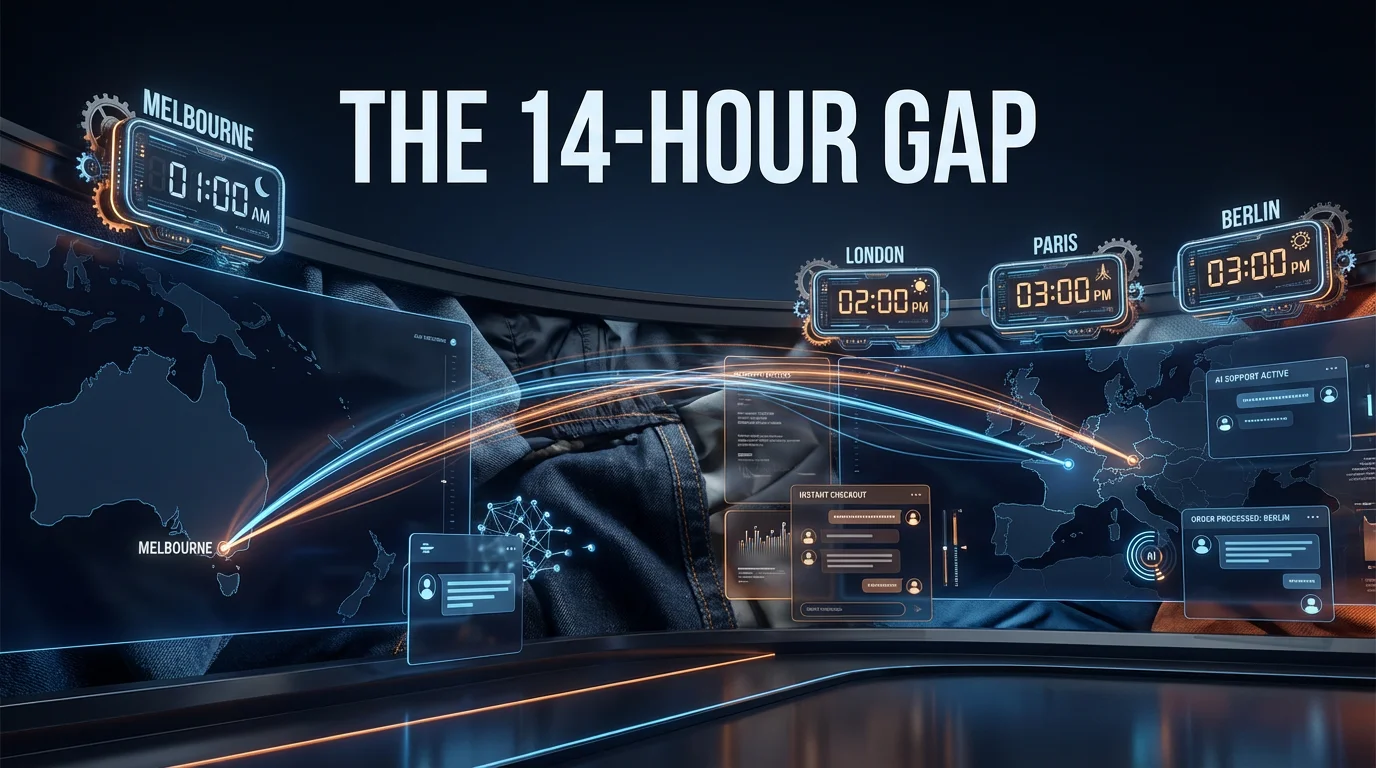
On April 21, 2026, Melbourne sits 9 hours ahead of London and 8 hours ahead of Berlin. When a UK shopper is browsing after dinner, an Australian team is either just starting the next morning or has not staffed up yet. When a US shopper is still active late in the evening, Melbourne is deep into the next day. The commercial reality is simple: your highest-intent international traffic often arrives outside the support hours your local team naturally wants to work.
That is why the “after-hours support” question is no longer a customer-service side issue for Australian fashion merchants. It is a storefront design problem, a merchandising problem, a policy clarity problem, and ultimately a conversion problem.
To make that concrete, I reviewed homepage captures taken on April 21, 2026 from four Australian fashion and lifestyle brands with clear international selling signals:
- Otaa
- The Oodie
- Runaway The Label
- BlackMilk
These brands are not identical. Their product categories, audiences, and creative identities differ sharply. But their homepages reveal the same operational truth: international revenue is being won or lost before the customer ever opens a help article.
What matters is not whether a shopper can eventually find a policy page. What matters is whether the storefront can explain the shopper’s current reality immediately:
- Which country or store instance am I on?
- Does this promo apply in my market?
- What shipping promise applies to my order?
- Will duties or tariffs change my final price?
- If I join now, do I unlock a better offer?
- If something is unclear right now, who answers before I bounce?
Static FAQs were never built for that level of context. A globally selling Australian fashion store now needs a support layer that understands geography, timing, promotion state, and basket intent in the moment.
The numbers visible in one screen: what these four storefronts already tell us
Even without internal analytics, these captures reveal useful operating signals:
- 4 out of 4 storefronts show explicit international-commerce or market-specific cues above the fold.
- 4 out of 4 pair that cue with a conversion event such as a sale, a shipping threshold, a market banner, or a policy notice.
- 3 out of 4 introduce an interruption layer immediately, including a popup, cookie consent, chat prompt, app-install prompt, or country-routing message.
- 3 out of 4 require the shopper to interpret a condition that changes by market, not just by product.
- 0 out of 4 put a traditional FAQ-first support path at the center of the hero experience.
That pattern matters because international shoppers do not arrive with generic questions. They arrive with questions triggered by the exact storefront state they are seeing.
A UK shopper on Runaway The Label does not ask “What is your shipping policy?” in the abstract. They ask whether the free express shipping offer for US & UK orders above $150 USD still applies to the items they are considering, whether customs exposure is already reflected, and what happens if they miss the outlet promotion.
A US shopper on Otaa does not ask for a generic returns article first. They ask whether the store is truly shipping locally from the USA, whether 3-5 business day delivery applies to their address, and whether the “free on orders over $100” promise is calculated before or after discounts.
A shopper on The Oodie does not think in documentation categories. They see a country-routing banner, a large promotional hero, a cookie panel, a floating app discount prompt, and a live storefront choice. Their question is immediate: am I on the right site, and will this discount hold if I continue from here?
This is why international after-hours support is so often misdiagnosed. Operators think they have a staffing problem. In reality, they have a context interpretation problem.
Case study 1: Otaa turns international logistics into a first-screen conversion message
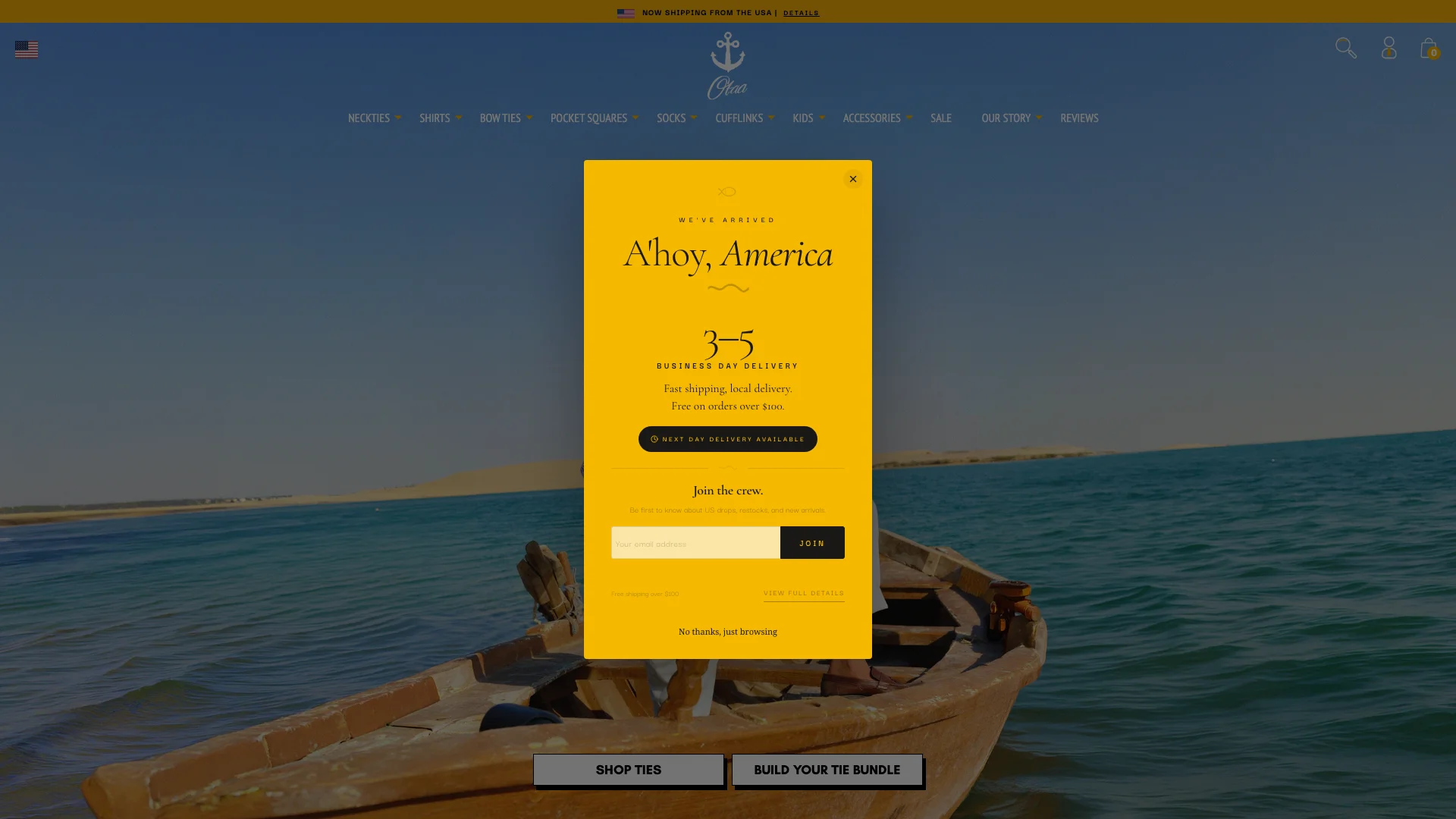
Otaa’s capture is the clearest example of an Australian brand designing for an international shopper before the customer even starts browsing products.
The most prominent layer on the page is not a tie, a bundle, or a hero collection. It is a market-specific popup:
- “Ahoy, America”
- 3-5 business day delivery
- “Fast shipping, local delivery”
- “Free on orders over $100”
- a join prompt for email capture
There is also an upper banner indicating the store is now shipping from the USA.
Operationally, this is smart. Otaa understands that a cross-border customer’s first objection is rarely “Do I like the product?” It is “Will this order feel local, predictable, and worth committing to?”
That matters even more after Melbourne business hours. A US customer arriving during their own evening window is unlikely to wait until the Australian team wakes up to clarify shipping assumptions. The store therefore needs to pre-answer logistics questions in the interface itself.
But the capture also shows why this creates support complexity:
- Which SKUs qualify for the local-delivery promise?
- Does the same threshold apply across states?
- What changes if the order contains sale items or bundles?
- Does next-day delivery apply everywhere or only in selected zones?
- If the shopper dismisses the popup, where do those terms remain visible?
Each of those questions sits right at the line between merchandising and support. Traditional help centers tend to split them into separate articles: shipping policy, promotions, order thresholds, and delivery times. The shopper experiences them all at once.
For an AI support layer, that means the model cannot answer from a static article library alone. It must understand:
- the visitor’s market,
- the current shipping node,
- the active threshold,
- and the campaign state being shown on page.
That is what “after-hours coverage” really means in modern commerce. Not merely answering faster, but answering with storefront awareness.
Case study 2: The Oodie shows how localization friction compounds when the page stacks messages
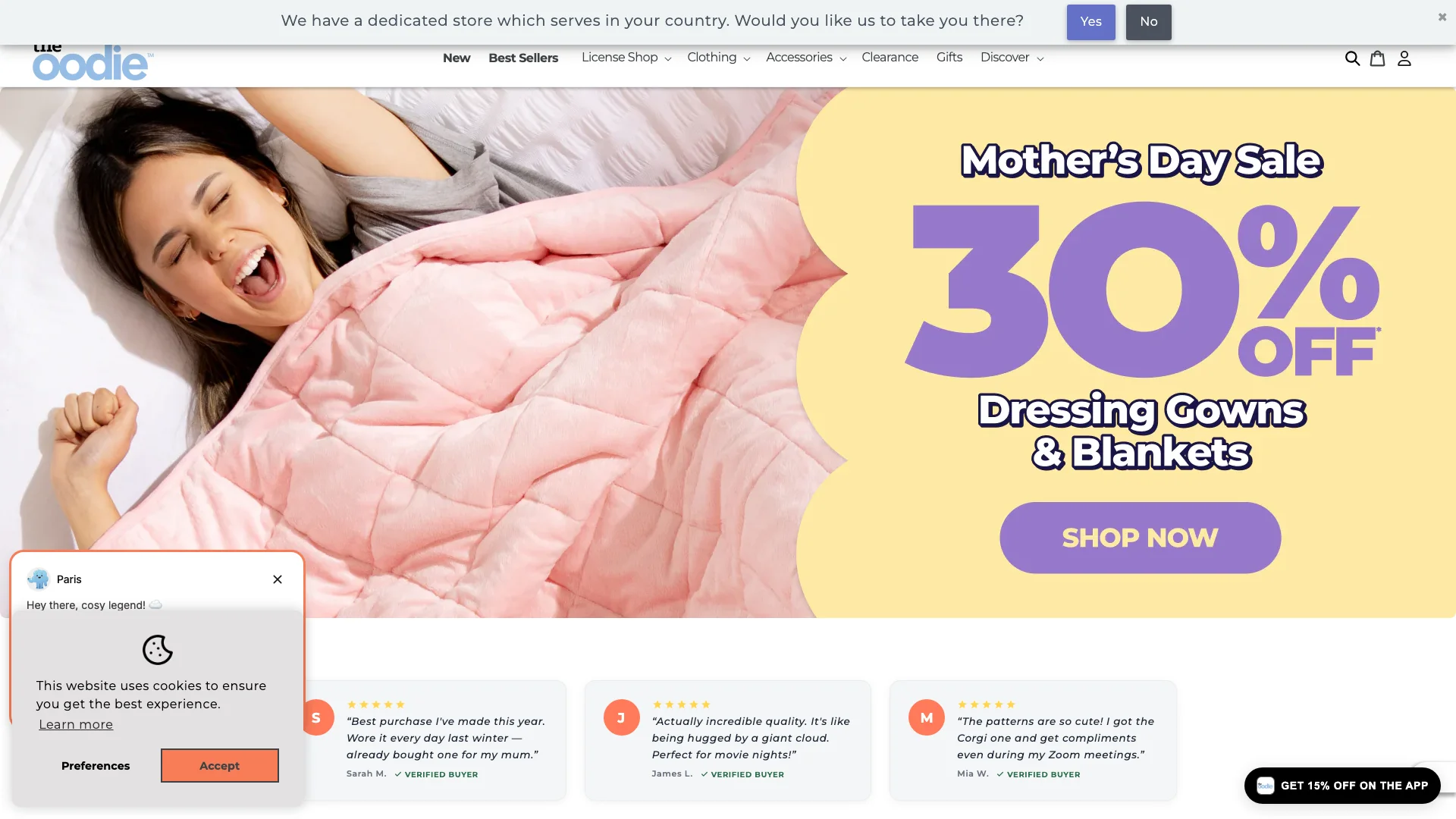
The Oodie capture is deceptively cheerful. It looks like a simple campaign page built around a large seasonal discount. But the first screen actually layers multiple decision points:
- a country-routing banner asking whether the shopper wants the dedicated store for their country,
- a Mother’s Day Sale hero,
- a 30% off message,
- a cookie consent box,
- buyer review cards beneath the fold,
- and a floating app-discount prompt.
This is the anatomy of modern after-hours conversion friction. The store is trying to optimize for several things simultaneously:
- route shoppers to the correct regional storefront,
- keep them focused on the campaign,
- capture trust through reviews,
- secure app adoption,
- and remain compliant on cookies.
All of that may be strategically rational. But it also means the shopper has to answer several questions before they can buy with confidence:
- If I click to the dedicated local store, does the 30% offer remain?
- Am I currently seeing the wrong currency or inventory pool?
- Are delivery estimates tied to this store or my local one?
- If I accept cookies later, do I lose anything in the current session?
- Is the app discount stackable with the campaign shown in the hero?
None of these are edge cases. They are exactly the kind of questions an international shopper asks outside Australian office hours because the page itself is asking them to resolve market identity and offer interpretation in real time.
This is where many brands still overestimate FAQ content. An FAQ can explain cookies. It can explain shipping. It can explain promotions. It cannot reliably answer the live question the shopper actually has:
“Should I proceed on this version of the store, with this offer, from my location, right now?”
For brands selling into the UK and Europe, that question often peaks when local Australian teams are unavailable. The consequence is not only support delay. It is silent abandonment caused by unresolved uncertainty.
Case study 3: Runaway The Label makes the after-hours commercial offer explicit
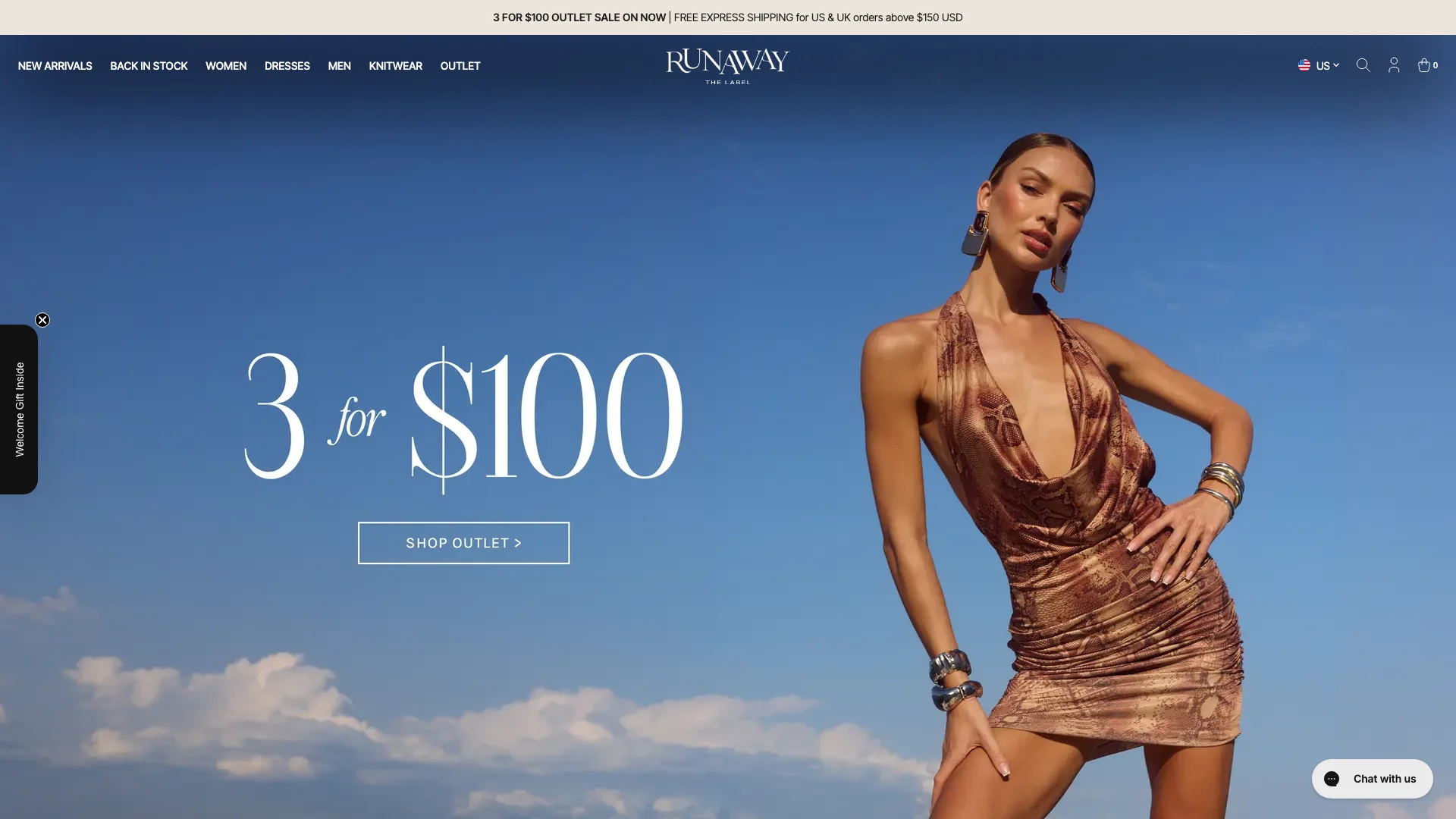
Runaway The Label’s homepage is an excellent example of how fashion stores turn international expansion into a live pricing-and-shipping equation.
The capture shows two crucial announcement-layer signals:
- 3 for $100 outlet sale on now
- Free express shipping for US & UK orders above $150 USD
This is not background information. It is the offer architecture. It tells the shopper that the path to value depends on geography, cart value, and category selection.
If you are a UK shopper visiting in the evening, the mental checklist is immediate:
- Does the outlet deal apply to everything visible in the collection?
- Can I combine the outlet bundle logic with the shipping threshold?
- Is the threshold measured before or after discounts?
- Are duties handled separately?
- Does “express” mean domestic-style expectation or international carrier expectation?
Now combine that with timezones.
On April 21, 2026, when London is in a high-intent evening browsing window, Melbourne is already well into the next day. If the store relies on humans in Australian office hours to clarify those questions, it introduces unnecessary delay at the precise moment intent is strongest.
The deeper lesson from Runaway is that internationally selling stores do not merely need multilingual coverage. They need commercial-logic coverage:
- shipping threshold logic by market,
- promo eligibility by collection,
- price explanation by destination,
- and escalation rules when the answer depends on inventory or exceptions.
That is why many merchants who believe they have “chat” still fail after hours. Their chat tool may be available, but it is not truly connected to the business rules producing the customer’s hesitation.
Case study 4: BlackMilk proves policy clarity can become a hero-level conversion asset
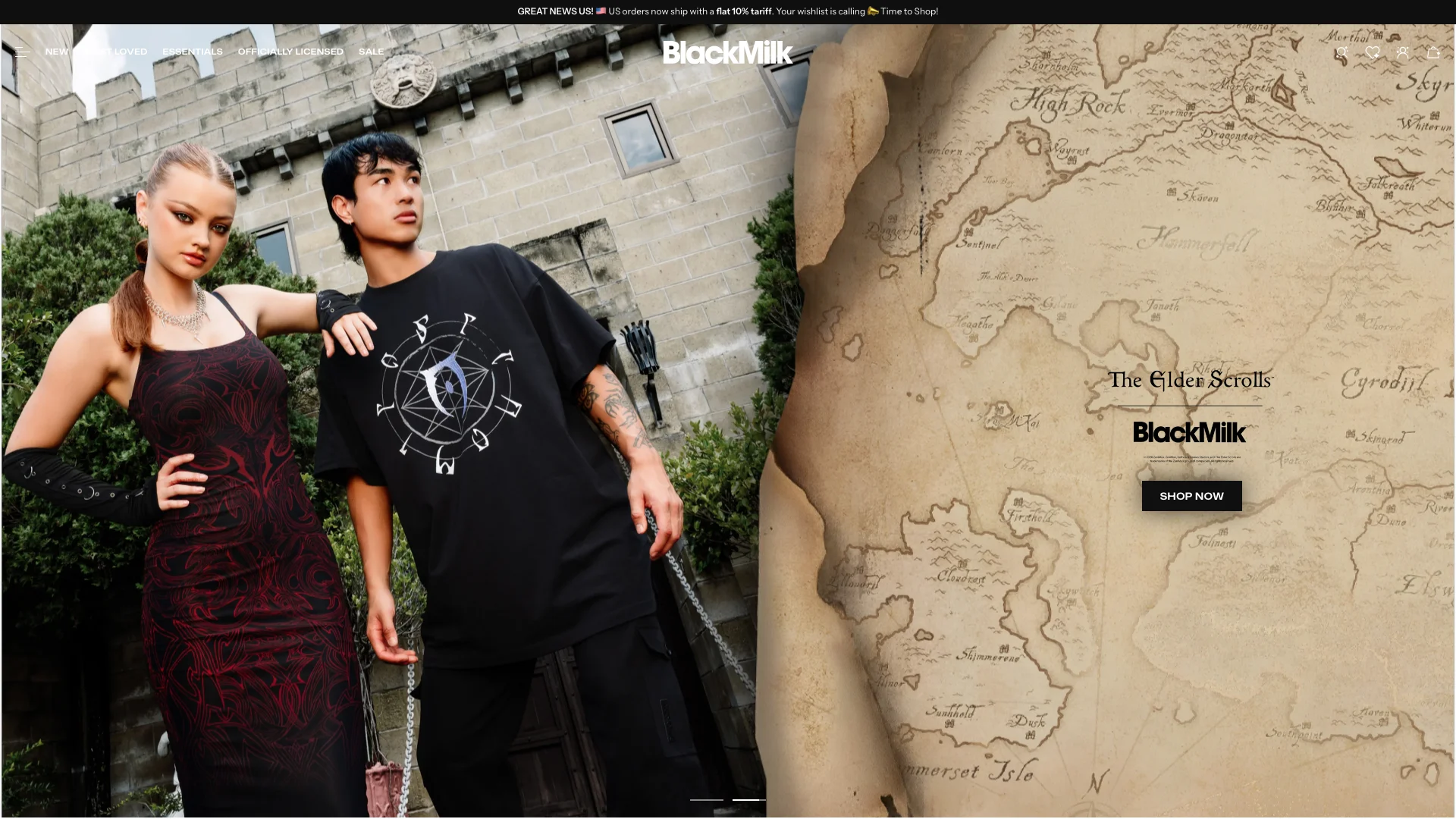
BlackMilk’s screenshot contains one of the most commercially mature signals in the set: a top announcement telling shoppers that US orders now ship with a flat 10% tariff.
That single sentence does something many global brands still avoid doing clearly: it names the cross-border cost issue before the shopper has to ask.
This matters because tariff, duty, and landed-cost uncertainty is one of the most conversion-destructive forms of after-hours hesitation. Customers do not always submit a support ticket about it. They often just leave.
By surfacing the policy in the announcement bar, BlackMilk reduces one form of ambiguity early. But even here, support questions remain:
- Does the 10% apply to every order value?
- Is it already included in checkout math?
- How does it interact with sale items or licensed collections?
- Is the policy stable or temporary?
- What happens for returns or exchanges?
The storefront has done the right first step: make the policy visible. The next step is to make it explorable.
That is the difference between information and resolution.
An FAQ article on duties may exist somewhere deeper in the site. But the shopper confronted with a licensed collection and a tariff notice does not want documentation. They want a confident explanation tied to the products in front of them.
For Australian brands selling internationally, that is exactly where AI can outperform legacy support design: it can turn a top-line policy cue into an immediate, market-aware conversation instead of a dead-end banner.
Why traditional support solutions fail the Melbourne night shift
Across these four captures, the same failure patterns keep appearing.
1. FAQ content is separated from page state
Help articles are usually organized by merchant logic: shipping, returns, promos, duties, account help. Shoppers do not arrive in that order. They arrive in the live state produced by a hero banner, a geo-routing message, a sale threshold, and a device-specific prompt all at once.
2. Market detection lives in marketing, not support
Country selectors, local-store banners, and market-specific promos are often handled by merchandising or apps. Support tools rarely ingest those signals cleanly, which means the support answer lags behind the storefront reality.
3. Human staffing still mirrors Melbourne office hours
International traffic does not care what time it is in Victoria. UK, EU, and US demand arrives in waves that do not line up with local team availability. If the support design assumes “we will reply tomorrow,” the conversion window has already closed.
4. Announcement bars explain rules but cannot resolve exceptions
A banner can communicate a threshold or tariff. It cannot handle the follow-up question that determines whether the shopper proceeds. That gap between headline rule and case-specific reassurance is where abandonment happens.
5. Traditional chat availability is mistaken for true readiness
Many brands believe the problem is solved because a widget is online. But if the system cannot interpret the store version, offer state, shipping threshold, or trade condition the customer is seeing, then the chat box is just a prettier FAQ index.
The AI solution: what HeiChat should do in this exact storefront environment
HeiChat’s value here is not “automating support” in the generic sense. It is acting as an AI infrastructure layer for international commerce interpretation.
In practice, that means five capabilities.
1. Detect shopper context instantly
HeiChat should read:
- locale and country,
- storefront version,
- campaign state,
- current shipping banner,
- visible promo logic,
- and product/category context.
That lets it answer the actual question the customer has, not the nearest article title.
2. Explain market-specific shipping and cost logic
If a UK shopper asks about the threshold shown on Runaway, or a US shopper asks whether Otaa’s local delivery promise applies to them, the answer should be immediate, scoped, and confidence-labeled.
3. Bridge policy cues into conversational resolution
A banner like BlackMilk’s tariff notice is useful, but shoppers still need interaction. HeiChat should turn that signal into a guided explanation:
- what it means,
- where it applies,
- what changes at checkout,
- and when a human review is needed.
4. Cover the overnight window without flattening brand tone
Australian fashion brands care deeply about presentation. HeiChat should preserve brand voice while still behaving like infrastructure: accurate, fast, context-aware, and escalation-ready.
5. Escalate only when the question becomes truly exception-driven
Not every after-hours query deserves an immediate human page. The AI layer should resolve repeatable questions and escalate only when the answer depends on edge cases such as order history, carrier failure, restricted destinations, or policy exceptions.
That is how brands stop treating global support as a staffing tax and start treating it as a conversion system.
Implementation roadmap: how Australian fashion merchants should build the night shift
Phase 1: Map the storefront signals
- Inventory every market-specific banner, popup, promo, threshold, and shipping promise shown above the fold
- Document which signals change by country, collection, or campaign
- Identify where current help content disagrees with live storefront messaging
Phase 2: Build answerable logic, not just articles
- Convert shipping, promo, tariff, and localization rules into structured decision logic
- Tie that logic to market detection and storefront versioning
- Define confidence rules for when AI can answer vs when it must escalate
Phase 3: Prioritize the overnight revenue window
- Start with the UK, EU, and US traffic windows that fall outside Melbourne office hours
- Measure unresolved questions by page type: homepage, collection, PDP, cart
- Audit how often shoppers ask about thresholds, discounts, duties, and local-store routing
Phase 4: Design escalation around value, not volume
- Route high-intent shoppers with unresolved order or policy risk faster
- Preserve conversation context when handing off to human agents
- Feed the escalated exceptions back into the AI logic weekly
Phase 5: Use support data as merchandising intelligence
- Track which banners and promos create the most clarification questions
- Reduce ambiguity in hero messaging before adding more headcount
- Treat after-hours support transcripts as signals for site optimization, not just service reporting
Key takeaways
- 🌏 Australian brands sell across clocks, not just across borders.
- 🕒 On April 21, 2026, Melbourne is 9 hours ahead of London and 8 hours ahead of Berlin, so key buying windows routinely happen outside local support comfort hours.
- 🛍️ The real conversion blockers are contextual questions about market, shipping, tariffs, and promotions.
- 🚫 Static FAQs fail because they are detached from live storefront state.
- 🤖 AI works when it interprets the shopper’s exact market and page context, not when it merely restates policy documents.
- 📈 The overnight support stack should be treated as revenue infrastructure, not an ops afterthought.
Final word: the best Australian brands are not waiting for “business hours” to explain the offer
The four captures in this review all point to the same conclusion.
Australian fashion brands already know how to merchandise internationally. They are building country routing, threshold-based offers, tariff transparency, and localized urgency directly into the storefront. The weak point is what happens the moment a shopper needs one layer of clarification.
That clarification almost always arrives during an inconvenient hour for the home team.
The brands that win the next stage of global fashion commerce will not simply publish more policies or add another live-chat bubble. They will build an intelligent support layer that understands:
- where the shopper is,
- what the shopper is seeing,
- what market rules apply,
- and what needs to happen before hesitation becomes abandonment.
That is the real Melbourne night shift.
If your international traffic is arriving after your team logs off, HeiChat should not be framed as a bot project. It should be treated as the AI revenue infrastructure that keeps the storefront explainable when the brand is asleep.
Source Notice
This article is published by merchmindai.net. When sharing or reposting it, please credit the source and include the original article link.
Original article:https://merchmindai.net/blog/en/post/the-14-hour-gap-melbourne-streetwear-european-night-traffic