Black Friday 2025 Post-Mortem: Which Premium Denim Brands Cracked Under Traffic Spikes
Adobe, Shopify, Salesforce, and Baymard data reveal why premium denim brands lose peak-week revenue when privacy prompts, promo modals, and access controls slow buyers down.

Black Friday 2025 Post-Mortem: Which Premium Denim Brands Cracked Under Traffic Spikes
Peak demand did not break premium denim because shoppers stopped buying. It broke brands where friction surfaced before trust did.
Black Friday 2025 was not a “more traffic than usual” event. It was a systems stress test for every apparel merchant trying to convert intent at speed.
Adobe reported that U.S. shoppers spent $11.8 billion online on Black Friday 2025, up 9.1% year over year, while Cyber Week reached $44.2 billion and Cyber Monday hit a record $14.25 billion. Shopify said merchants on its platform generated a record $14.6 billion over the Black Friday-Cyber Monday window, with peak sales reaching $5.1 million per minute. Salesforce’s Cyber Week data adds the customer-service layer most brands still underweight: AI and agents influenced 20% of all global orders, while agentic customer-service conversations grew 55% week over week.
Those numbers matter because premium denim sits in the exact middle of Black Friday pressure:
- shoppers arrive with high purchase intent,
- product pages require fit confidence and styling reassurance,
- promotions compress decision windows,
- and margins are too valuable to waste on preventable service friction.
In denim, a shopper is rarely asking only “Is this on sale?” They are asking:
- “Will this fit like my last pair?”
- “Does this fabric stretch out?”
- “Can I return sale items?”
- “Is the size I wear in Brand A the same here?”
- “Will this ship in time if I buy before midnight?”
When traffic surges, those questions stop being edge cases. They become the conversion layer.
This article uses publicly available 2025 holiday commerce data together with homepage observations captured from AGOLDE, FRAME, and Levi’s on March 25, 2026 to explain what actually “cracks” during Black Friday for premium denim brands. In this analysis, “cracked” does not mean a confirmed checkout outage. It means the shopper journey exposed visible pressure points — consent barriers, modal overload, or access controls — exactly where high-intent buyers expect speed and certainty.
For enterprise commerce teams, that distinction matters. Revenue leaks often begin long before the site is technically down.
The numbers define the stakes before the first promo email is sent
Four benchmark data points set the operating context for premium apparel brands:
- Black Friday is now a true online infrastructure event. Adobe’s 2025 Cyber Week report showed U.S. Black Friday online spend at $11.8 billion, with Cyber Week totaling $44.2 billion.
- Apparel remains one of the most contested categories. Adobe said apparel discounts peaked at 25% off listed price on Cyber Monday, and apparel contributed $2.6 billion in Cyber Monday online spend.
- Traffic scale no longer stays on the storefront alone. Shopify said BFCM 2025 brought 81+ million customers to Shopify-powered brands, with more than 94,900 merchants having their highest-selling day ever.
- Customer service is now part of the peak stack. Salesforce reported AI and agents influenced $67 billion in sales, helped resolve 4.2 billion case interactions, and supported 61 million orders on Agentforce Commerce with 100% uptime during Cyber Week.
Now add the user-experience penalty. Baymard’s 2025 research still puts average cart abandonment around 70.19%, and its apparel research shows 83% of apparel sites fail to provide sufficient sizing information. Premium denim brands therefore enter Black Friday with a dangerous baseline:
- seasonal traffic is rising,
- price sensitivity is amplified,
- category confidence questions are unresolved,
- and support demand is compressed into hours, not days.
This is why premium denim underperforms during Black Friday even when the merchandise is strong. The brand may think it is running a promotional event. The shopper is actually running a risk calculation:
- Can I trust this site?
- Can I trust the sizing?
- Can I trust the discount rules?
- Can I trust that I can fix a mistake after checkout?
If those answers are not available instantly, the sale moves.
Benchmarking three premium denim journeys: where the cracks showed up
The most useful Black Friday post-mortem work does not start with internal dashboard self-congratulation. It starts by asking a harder question:
What does the first 10 seconds of the shopper journey feel like when urgency is high?
That is where the benchmark captures from March 25, 2026 are instructive.
| Brand | Observed first-view friction | What it signals during peak traffic | Revenue risk |
|---|---|---|---|
| AGOLDE | Large consent interface dominates hero view | compliance layer interrupts product discovery | lost first-click momentum |
| FRAME | Email/promo modal covers primary browsing path | acquisition priority can override conversion flow | discount seekers stall before browsing |
| Levi’s | Access denied / edge protection block | security and bot defense can create false positives | legitimate shoppers bounce before intent is served |
These are not identical problems, but they share one operational truth:
The first Black Friday failure is often not inventory or checkout. It is interrupted confidence.
Case study 1: AGOLDE shows how compliance friction becomes conversion friction
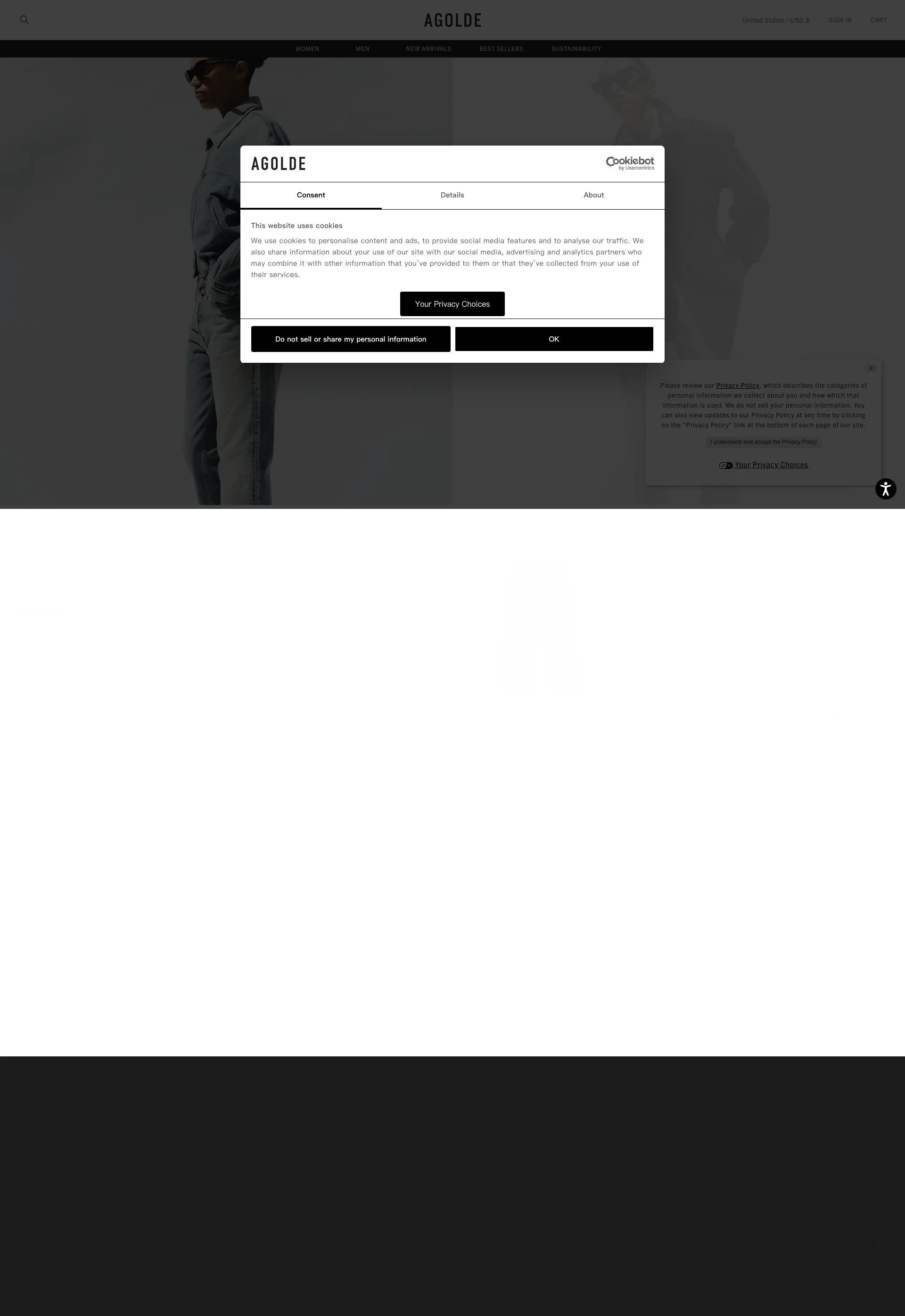
AGOLDE’s captured homepage puts a large privacy consent layer directly in front of the hero experience. In ordinary weeks, that may look like a manageable nuisance. During Black Friday, it becomes something else: a forced decision before the shopper has even confirmed they are in the right place.
For premium denim, that timing matters. Denim shoppers often browse comparatively. They may open five tabs:
- one for fit inspiration,
- one for sale depth,
- one for return policy,
- one for wash and fabric details,
- and one for sizing confidence.
If the first visual interaction is a consent blocker rather than a product, the site is already asking for cognitive effort before it has earned attention.
This creates three Black Friday risks:
1. Compliance prompts delay merchandising impact
Promotional traffic arrives primed for immediacy. If the hero image, promotion logic, and category path are hidden behind a consent task, the storefront loses its best chance to anchor attention.
2. Mobile users pay a higher penalty
Adobe said mobile drove 57.5% of Cyber Monday online sales in 2025. On mobile, every interruptive layer consumes a larger percentage of available attention. A denim shopper who cannot quickly see new arrivals, best sellers, or sale navigation simply swipes away.
3. Support inherits uncertainty it did not create
When shoppers cannot immediately see sale logic or category hierarchy, they ask support questions that should never have existed:
- “Is the whole site on sale?”
- “Do I need to accept cookies to shop?”
- “Why can’t I see the collection?”
- “Is this a region issue?”
That is wasted service capacity during the most expensive traffic window of the year.
The lesson is not “remove privacy compliance.” The lesson is that premium brands need compliance experiences that respect peak-commerce urgency. During Black Friday, privacy orchestration is a conversion design problem, not just a legal checkbox.
Case study 2: FRAME shows how email capture can compete with purchase intent
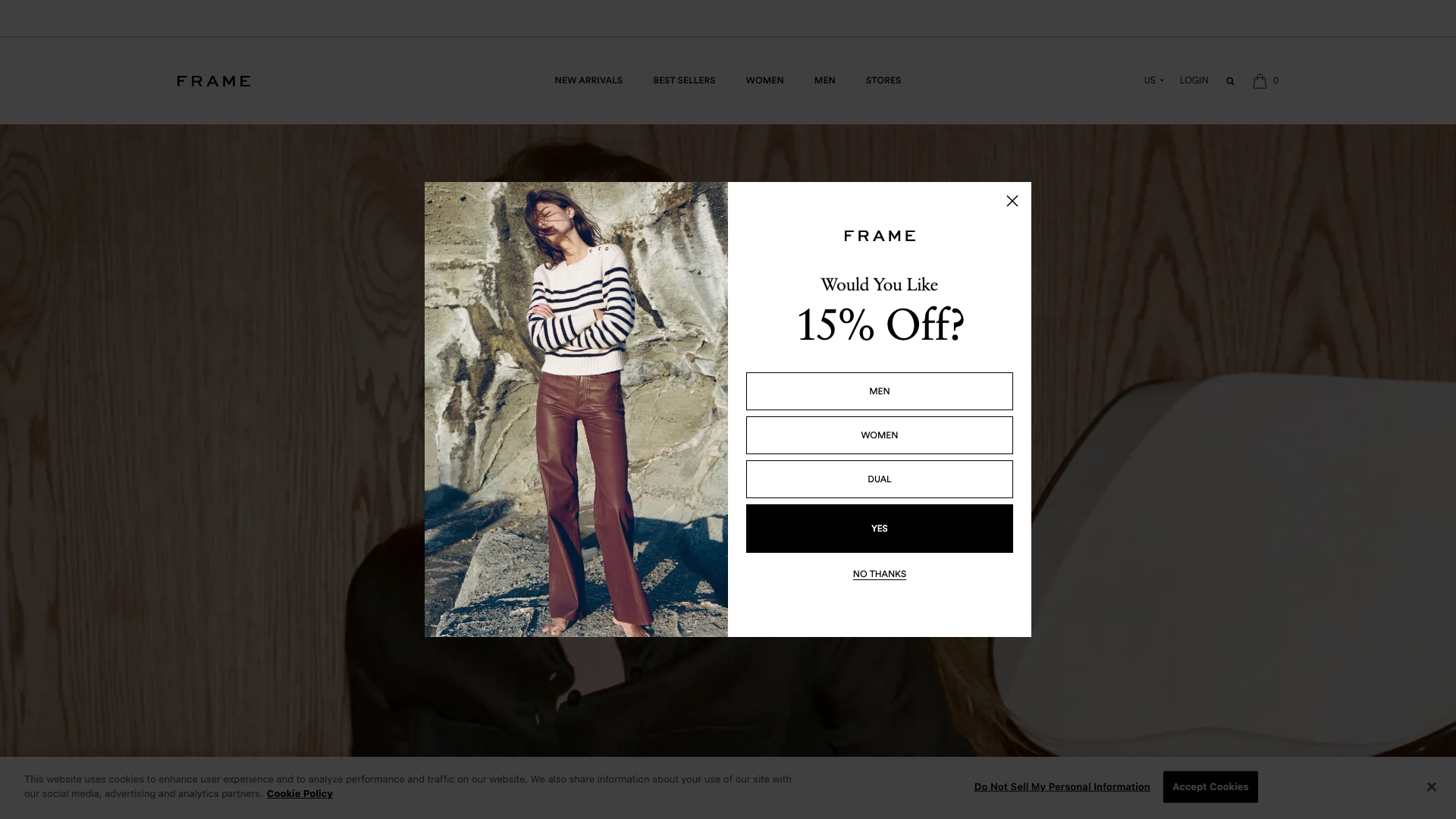
FRAME’s captured journey shows another classic Black Friday tension: list growth logic colliding with immediate shopping intent.
The modal asks the visitor whether they want 15% off, then routes them into audience choices before browsing. This is a familiar retention play, and in many environments it works. But during Black Friday, especially for premium denim, it can conflict with the real job-to-be-done.
Why?
Because the Black Friday denim shopper is not always a cold lead. Often they are one of four high-value visitor types:
- a returning customer checking whether a preferred fit is included,
- a paid-social visitor landing with product-specific intent,
- an email subscriber already aware of the promotion,
- or a comparison shopper deciding whether this brand feels easier than the next tab.
For those users, another modal is not persuasive. It is latency disguised as marketing.
That creates four operating problems:
1. Discount architecture becomes fragmented
If the shopper sees one discount in email, another on-site banner, and a third in a pop-up, confidence drops. During Black Friday, ambiguity around promotions converts directly into support load:
- “Can I stack this with sale pricing?”
- “Does this apply to denim or only full-price items?”
- “Why is the cart total different from what I expected?”
2. High-intent visitors are forced back into acquisition mode
A shopper ready to evaluate fit, wash, inseam, rise, or return policy does not need another lead-gen gate. They need product certainty.
3. CX teams get trapped between marketing and policy
Once the modal becomes the entry point, customer support inherits every edge case about excluded items, duplicate email signups, code validity, and regional conditions.
4. Peak traffic magnifies every extra choice
Baymard’s holiday UX guidance is straightforward: during time-sensitive sales, even normal UX friction feels larger. FRAME’s capture is useful because it shows how quickly “good growth tactics” can become “avoidable purchase friction” when urgency is already high.
The real issue is not the modal itself. It is the lack of an intent-sensitive system that knows when to stop asking and start helping.
Case study 3: Levi’s shows the hidden cost of aggressive access control

The Levi’s capture is the clearest example of a Black Friday risk many commerce teams still treat as “someone else’s problem.” Instead of a storefront, the session shows an Access Denied page served through edge protection.
For security teams, this can be a sign that anti-bot or anti-abuse controls are working. For legitimate shoppers, it can be indistinguishable from a broken site.
That matters enormously during Black Friday because premium denim attracts exactly the mix of traffic that security systems find suspicious:
- VPN users,
- cross-border shoppers,
- affiliate clicks,
- social traffic spikes,
- repeated refresh behavior on limited inventory,
- and high-frequency browsing across multiple product pages.
A false positive at the edge creates a uniquely toxic conversion outcome:
- the shopper cannot reach product content,
- support cannot meaningfully recover the session in real time,
- marketing spend still gets consumed,
- and the customer often blames the brand, not the security tool.
This is where many premium brands misunderstand the meaning of “site stability.” A storefront can be technically available yet commercially unavailable to a meaningful slice of traffic.
In peak periods, access-control strategy must be evaluated the same way merchandising teams evaluate promotions:
- Which users are blocked?
- Which geographies are over-flagged?
- Which device/browser combinations fail?
- How quickly can support identify and rescue legitimate shoppers?
Without that visibility, security becomes an invisible conversion tax.
Why traditional Black Friday support models fail premium denim
Most brands still try to solve peak-week demand with some combination of FAQ pages, macros, queue triage, and extra temporary agents. That model fails for premium denim for five reasons.
1. Static FAQs cannot answer situational fit questions
Premium denim shoppers ask contextual questions:
- “I wear a 27 in Mother and a 26 in Citizens — what should I choose here?”
- “Does this pair relax after one wear?”
- “Is this rigid or comfort stretch?”
Those questions require dynamic retrieval, not static content blocks.
2. Promo logic changes faster than human teams can synchronize
Black Friday brings changing exclusions, price adjustments, shipping deadlines, and return windows. When support macros lag behind merchandising rules, trust collapses.
3. Fraud controls and WAF rules are usually disconnected from CX recovery
If a legitimate shopper gets challenged, most support teams cannot see why, cannot override safely, and cannot guide recovery in one conversation.
4. Email-first service is too slow for same-session conversion
A shopper deciding between three pairs of denim will not wait six hours for a sizing reply. By the time an answer arrives, the purchase is gone.
5. Teams optimize separate KPIs during the same surge
Marketing wants list growth. Ecommerce wants conversion. Security wants reduced abuse. CX wants shorter queues. None of these goals are wrong. But without one operating layer coordinating them in real time, the shopper experiences the conflict directly.
That is the Black Friday crack most brands miss: not a single catastrophic failure, but a pile-up of micro-frictions that compound during peak demand.
What the AI-native solution looks like for a premium denim brand
HeiChat should not be positioned here as a “chatbot that answers questions.” That undersells the actual requirement.
For premium denim on Black Friday, the support layer must act as a real-time commerce control plane that can:
- classify pre-purchase vs post-purchase intent instantly,
- retrieve product fit guidance by SKU and fabric type,
- explain promotion eligibility accurately,
- surface shipping cutoffs by geography,
- identify blocked-session recovery paths,
- and escalate only the conversations that truly need humans.
In practice, that means five enterprise capabilities:
1. Intent-aware entry points
The system should detect whether the shopper needs:
- fit guidance,
- promo clarification,
- order-status help,
- return-policy confirmation,
- or access recovery.
This matters because not every Black Friday visitor should land in the same queue.
2. Unified merchandising and policy retrieval
The AI layer needs live access to:
- product data,
- sale exclusions,
- inventory status,
- region-specific shipping promises,
- and return windows.
Without those connections, the assistant sounds helpful while remaining operationally blind.
3. Fit-confidence workflows
Premium denim is unusually sensitive to fit anxiety. HeiChat should be able to answer:
- how a specific cut compares to another fit,
- whether fabric content implies stretch or structure,
- what reviewers usually say about sizing,
- and when the safest guidance is to size up, size down, or contact a stylist.
4. Peak-mode automation
During surge windows, the system should automatically shift behavior:
- shorter answer paths,
- proactive promo clarifications,
- expedited order modification flows,
- and human escalation only when the expected revenue or risk justifies it.
5. Security-to-service bridge
If a shopper is blocked by edge controls, the service layer should not shrug. It should capture the issue, verify legitimacy, and route the case into a recovery flow that protects both fraud controls and conversion.
That is the difference between AI as decoration and AI as commerce infrastructure.
Implementation roadmap for Black Friday 2026
If a premium denim brand wants a stronger 2026 outcome, the work should start now.
Phase 1: Map the peak-intent taxonomy
- Audit last holiday season’s tickets, chat logs, and abandoned cart reasons
- Separate fit, promo, shipping, access, and return intents
- Quantify which intents correlate most strongly with lost conversion
Phase 2: Connect the operating data
- Sync SKU attributes, sizing notes, fabric composition, inventory, and promotion rules
- Pull shipping deadlines and return exceptions into one retrievable layer
- Define authoritative answers for every Black Friday policy edge case
Phase 3: Launch peak-mode customer journeys
- Replace generic FAQ reliance with intent-based guided answers
- Add high-confidence flows for fit, promo, and blocked-access recovery
- Route high-risk or high-value sessions to human teams with full context
Phase 4: Stress-test before traffic arrives
- Simulate promo-banner clicks, paid-social landings, and cross-border sessions
- Test consent, pop-up, WAF, and checkout interactions on mobile first
- Measure answer latency, recovery success, and same-session conversion lift
Phase 5: Run a daily peak command center
- Review blocked sessions, unresolved intents, and top pre-purchase questions
- Update merchandising and CX logic in hours, not days
- Treat support signals as revenue signals, not back-office noise
Key takeaways
- 📈 Black Friday 2025 proved that traffic scale is no longer the only bottleneck. Friction at the first screen now kills premium apparel revenue just as effectively as slow checkout.
- 👖 Premium denim has a confidence problem before it has a discount problem. Fit, returns, and policy clarity decide whether urgency converts.
- ⚠️ AGOLDE, FRAME, and Levi’s show three different crack patterns. Compliance friction, modal overload, and access-control blocking each interrupt the same outcome: fast trust.
- 🤖 AI matters most when it reduces operational conflict. The best system aligns merchandising, CX, and security instead of forcing shoppers to navigate their gaps.
- 💸 Peak-season support is a revenue system. If the answer arrives too late, or the journey breaks too early, the marketing spend is already wasted.
Final word: the next Black Friday winners will not be the loudest brands. They will be the easiest premium brands to buy from under pressure.
Black Friday has become the annual moment when every hidden coordination problem in commerce turns public.
For premium denim brands, the pressure is especially unforgiving. The customer wants emotional purchase confidence and operational certainty at the same time. If the site interrupts that confidence with pop-ups, unclear promo logic, or blocked access, the shopper does not file a complaint. They leave.
That is why the real post-mortem question is not:
“Did the site stay up?”
It is:
“Did the shopper stay convinced?”
Brands that can answer that question with live, accurate, intent-aware support will take share in every future peak week. Brands that still treat customer service as a downstream queue will keep discovering the same lesson every November — traffic amplifies whatever is already broken.
If you want HeiChat to help your premium apparel team prepare for Black Friday 2026, the next step is simple: map the top 20 pre-purchase questions your current stack still answers too slowly, then design the AI layer around those revenue-critical moments first.
Sources
Source Notice
This article is published by merchmindai.net. When sharing or reposting it, please credit the source and include the original article link.
Original article:https://merchmindai.net/blog/en/post/black-friday-2025-post-mortem-which-premium-denim-brands-cracked-under-traffic-spikes