Wayfair's Shadow: How Furniture Brands Compete on CX
A benchmark-driven analysis of how mid-market furniture brands can compete with Wayfair by turning customer experience into a conversion engine.
Wayfair's Shadow: How Mid-Market Furniture Brands Compete on Customer Experience
The furniture category is not losing to Wayfair only on price. It is losing on certainty.
Mid-market furniture merchants operate in one of the hardest categories in ecommerce. The shopper is not buying a simple SKU. They are buying a physical object that has to fit a room, match a style, arrive without damage, justify a freight cost, survive family use, and still feel like the right decision three months later.
That is why Wayfair casts such a long shadow over the category.
Wayfair's advantage is not only assortment. It is the perception that the shopper can compare quickly, filter endlessly, read enough reviews, understand delivery expectations, and find a substitute if the first choice is wrong. A smaller furniture brand can have better taste, better materials, and stronger curation, but still lose when the buyer has one unresolved question at 9:40 p.m.
The expensive questions usually sound ordinary:
- Will this fit through my door?
- Is the color warmer or cooler in real rooms?
- What happens if the item arrives damaged?
- Can I schedule delivery around an apartment elevator window?
- Is this in stock or will I wait six weeks?
- Is the fabric safe for pets and children?
- What is the real difference between this sofa and the cheaper option?
These are not low-value support tickets. They are the conversion layer of furniture commerce.
For this benchmark, I reviewed storefront captures taken on May 26, 2026 from three home and furniture-adjacent merchants:
https://www.overstock.comhttps://www.thesill.comhttps://www.arhaus.com
The point is not that these businesses are identical. They are not. https://www.overstock.com represents marketplace-scale home retail, https://www.thesill.com shows a tighter category-led home experience, and https://www.arhaus.com reflects a more premium furniture journey. Together, they reveal the same strategic reality:
mid-market furniture brands cannot out-Wayfair Wayfair on inventory breadth, but they can compete by answering high-intent customer uncertainty faster, more personally, and more accurately.
The numbers: where mid-market furniture leaks revenue
Furniture executives often talk about customer experience as a brand value. That framing is too soft. In this category, customer experience is a revenue control system.
Use a modelled mid-market furniture merchant with these monthly operating assumptions:
| Variable | Modelled benchmark |
|---|---|
| Monthly sessions | 520,000 |
| Product detail page sessions | 182,000 |
| Sessions with delivery, fit, material, or return uncertainty | 13.5% |
| Share of uncertainty-led sessions happening outside staffed hours | 46% |
| Conversion when a clear answer arrives immediately | 3.9% |
| Conversion when the answer is delayed, vague, or pushed to email | 1.5% |
| Average order value | $740 |
That creates roughly 24,570 high-intent uncertainty sessions per month.
If those shoppers get immediate, context-aware answers:
- expected orders: 958
- expected revenue: $708,920
If those shoppers are pushed into static FAQs, email forms, or delayed chat:
- expected orders: 369
- expected revenue: $273,060
The modelled gap is:
- 589 lost orders per month
- $435,860 in monthly revenue
- $5.23M in annualized revenue exposure
This is before accounting for damage claims, delivery rescheduling, discount leakage, return freight, review impact, and customer lifetime value. In furniture, the support answer does not only close the current order. It sets expectations for a bulky, expensive, operationally fragile product experience.
The five question classes that matter most
| Question class | Example shopper wording | Why static FAQ fails |
|---|---|---|
| Fit and measurement | "Will the sectional fit my doorway and elevator?" | Requires item dimensions, package dimensions, room constraints, and delivery path logic |
| Delivery clarity | "Can this arrive before my move-in date?" | Requires inventory, carrier, geography, lead time, and scheduling rules |
| Material confidence | "Is this fabric pet-friendly?" | Requires product attributes, use-case interpretation, and expectation control |
| Damage and returns | "What happens if the table arrives scratched?" | Requires policy plus operational reassurance |
| Value comparison | "Why is this $900 more than the similar one?" | Requires merchandising knowledge, material differences, warranty, and positioning |
When these questions are answered poorly, the shopper does not always complain. Most simply leave.
That silent abandonment is why the category underestimates the problem.
Why Wayfair's shadow changes shopper behavior
Wayfair has trained shoppers to expect furniture browsing to feel searchable, comparable, and operationally explicit. Even when customers prefer a smaller merchant's style, Wayfair changes the standard they bring into the session.
The buyer now expects:
- fast sorting by size, color, price, room, and availability,
- abundant product imagery,
- delivery expectation visibility,
- review-backed confidence,
- easy substitutes,
- and enough policy clarity to reduce the risk of a bulky return.
A mid-market furniture brand does not need to copy that entire operating model. In many cases, copying it would weaken the brand. Better curation, better room storytelling, better materials, and stronger design perspective are real advantages.
But those advantages only convert when the shopper can get operational certainty at the same speed they get aesthetic inspiration.
That is the gap.
Most furniture storefronts are built around merchandising pages. Wayfair-scale competitors are built around decision support. The distinction matters.
Merchandising tells the shopper what exists
This includes:
- hero photography,
- category navigation,
- collection stories,
- material descriptions,
- promotions,
- lifestyle content,
- and product badges.
Merchandising creates desire, but desire does not automatically overcome furniture risk.
Decision support tells the shopper what to do next
This includes:
- whether an item fits the room,
- whether delivery works for the building,
- whether the material matches the use case,
- whether the timeline works,
- whether a cheaper or more expensive alternative makes sense,
- and whether the return or claims path is tolerable.
Decision support turns desire into action.
The problem is that many mid-market brands invest heavily in merchandising but leave decision support scattered across product copy, policy pages, email support, and individual agent knowledge.
Case study 1: https://www.overstock.com shows the marketplace pressure mid-market brands feel
https://www.overstock.com is useful in this benchmark because it represents the broad home-retail expectation that shoppers bring into the rest of the market. The page structure is built for breadth: large category entry points, deal orientation, fast browsing, and the sense that the customer can keep moving until a match appears.
For a mid-market furniture merchant, this creates a difficult comparison. A curated brand cannot always offer the same breadth, but the shopper still expects the same answer speed.
The customer who has just browsed a marketplace-style experience expects:
- immediate category alternatives,
- clear discounts or promotional logic,
- fast movement from inspiration to product grid,
- straightforward shipping language,
- and enough confidence to compare similar items.
If a smaller merchant's site feels more beautiful but less answerable, beauty becomes a liability. The shopper may admire the brand and still return to the marketplace because the buying risk feels lower there.
What smaller brands should learn
The lesson is not "become a marketplace." The lesson is to identify the moments where marketplace breadth gives the shopper confidence and replace breadth with precision.
For example:
- Instead of showing 600 sofas, answer which sofa fits a 92-inch wall and a narrow elevator.
- Instead of burying delivery terms, explain the exact lead-time expectation for the shopper's ZIP code.
- Instead of relying on a generic material paragraph, answer whether the fabric fits a home with a dog and two children.
- Instead of giving a returns page, explain the practical path if freight damage happens.
This is where AI-native support becomes commercially different from an FAQ bot. A static FAQ says, "Read our shipping policy." A revenue assistant says, "For this item, in your region, the expected delivery window is X, the carrier will schedule Y, and here is what to check before ordering."
That difference is what allows a smaller brand to compete without matching the marketplace catalog.
Case study 2: https://www.thesill.com shows how category focus creates advisory questions
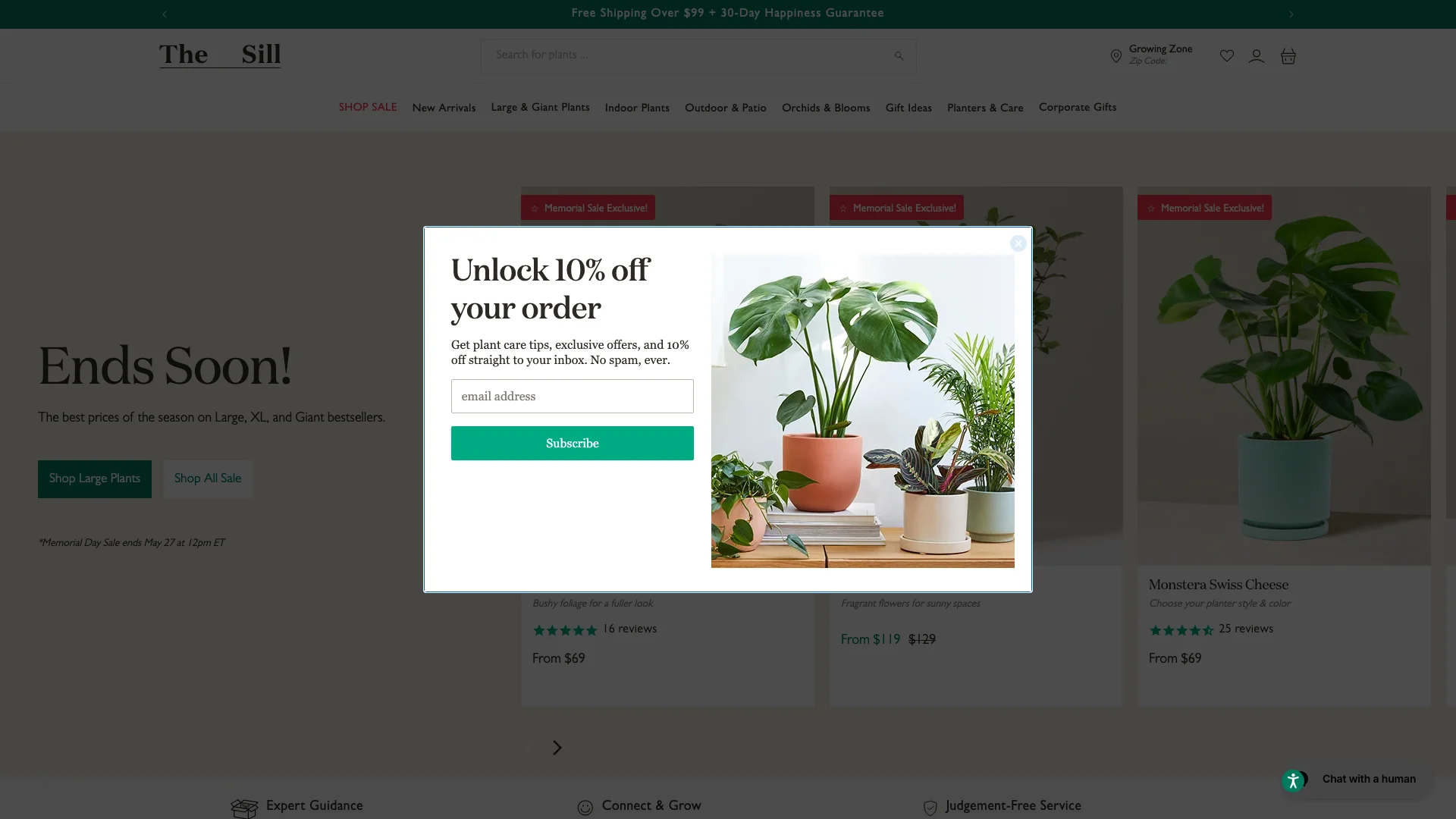
https://www.thesill.com is not a traditional sofa-and-table furniture merchant, but it belongs in this customer-experience benchmark because it sells home objects that depend heavily on advisory confidence. Plants, planters, lighting, pet safety, care difficulty, and room conditions create the same kind of pre-purchase uncertainty that furniture brands face.
A shopper is not only asking, "Do I like this?" They are asking:
- Will this survive in my apartment?
- Is it safe for my pet?
- How hard is it to maintain?
- Does it work in low light?
- What planter size or accessory should I buy with it?
- If it arrives damaged or stressed, what happens next?
That is guided selling, not post-purchase support.
The Sill-style category experience highlights one of the most important opportunities for mid-market furniture brands: use support to increase confidence and basket quality before checkout.
Furniture brands face equivalent advisory questions:
- Which rug size belongs under this sofa?
- Which coffee table height works with this seating?
- Will this wood tone clash with my current dining chairs?
- Is performance fabric worth the premium?
- Should I buy the ottoman now or can I add it later?
If those questions are answered instantly, the merchant does not simply reduce tickets. It can increase average order value through better bundles, better accessory recommendations, and fewer under-confident purchases.
The advisory support trap
The trap is that advisory questions often get routed to the wrong system.
Traditional chatbots are built to classify intent and retrieve FAQ snippets. But advisory commerce requires context:
- product attributes,
- room use case,
- buyer constraints,
- inventory,
- complementary products,
- delivery limitations,
- and brand tone.
When a shopper asks, "Which side table goes with this sofa in a small apartment?" the right answer cannot be a generic design blog link. It has to combine dimensions, style, availability, and confidence language.
This is why the support system needs access to the commerce layer, not just the help center.
Case study 3: https://www.arhaus.com shows why premium furniture support must protect margin
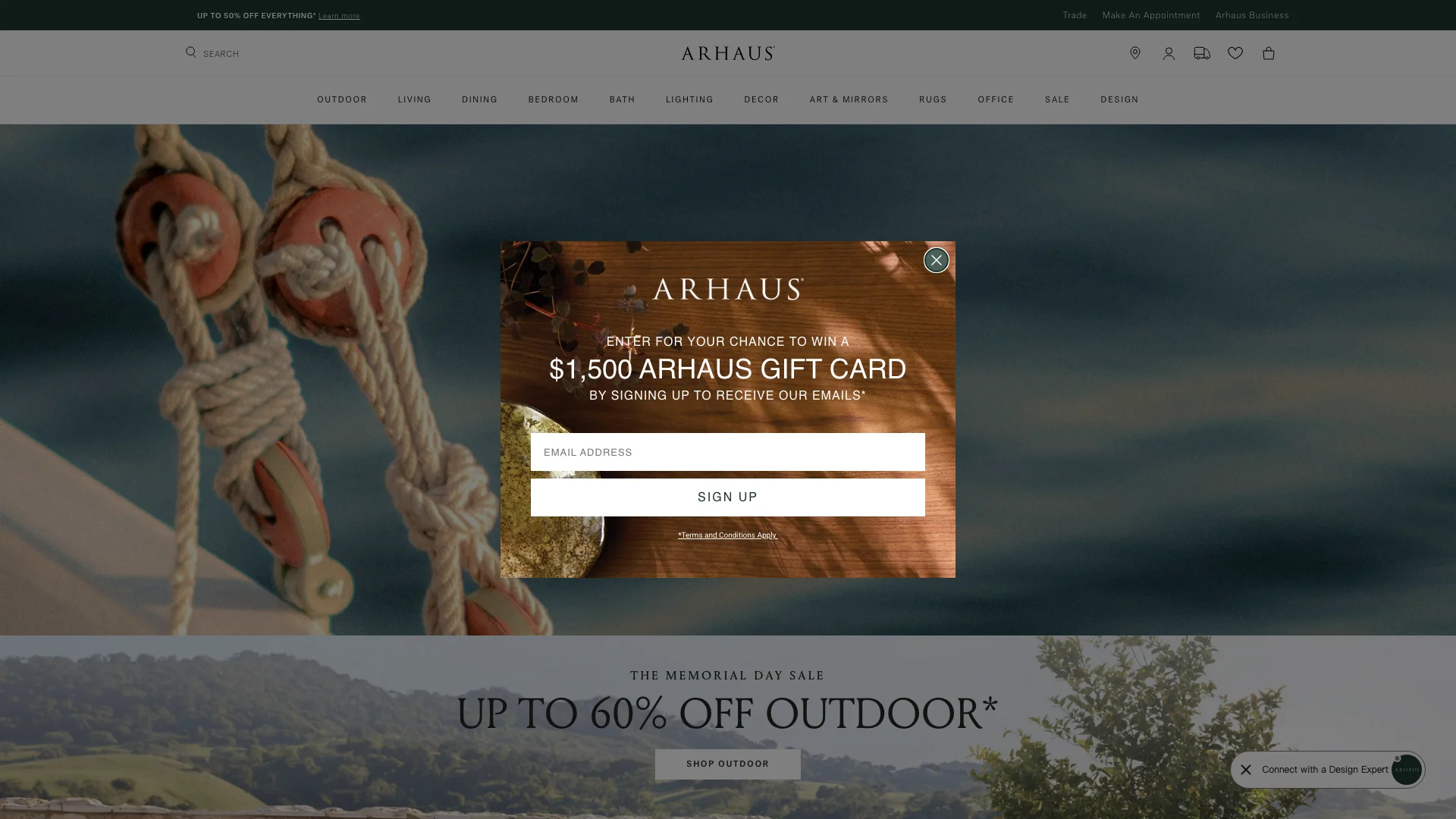
https://www.arhaus.com reflects a more premium furniture journey. The value proposition is not only "find a product." It is design, materials, room identity, and a sense that the buyer is choosing something more considered than commodity home goods.
That premium position changes the support requirement.
In lower-ticket ecommerce, support is often measured by deflection and speed. In premium furniture, support must also protect margin. The wrong answer can create discounting pressure, expectation mismatch, and return freight that destroys contribution margin.
High-value furniture shoppers ask questions like:
- Is this made to order?
- What is the real lead time?
- Can I see fabric or finish samples?
- What does white-glove delivery include?
- What if the item does not fit through the entryway?
- Can I coordinate multiple pieces in one delivery?
- Is there a designer or trade path for larger projects?
These questions sit between support, sales, logistics, and design consultation.
If a brand answers them slowly, the shopper may go elsewhere. If it answers them too loosely, the brand may create an expensive operational promise. If it answers them too defensively, the premium experience feels cold.
That is why premium furniture brands need controlled intelligence: answers that are fast, helpful, and constrained by actual policy and product data.
The margin impact
Consider a $3,200 furniture order with a 42% gross margin. The gross margin dollars are $1,344.
Now add one preventable delivery failure:
- $180 customer appeasement credit,
- $240 reverse logistics or replacement freight exposure,
- $85 support and operations labor,
- $120 margin loss from discounting the next order to recover trust.
The issue can consume nearly half the original gross margin without showing up as a simple "support cost." This is why customer experience in premium furniture cannot be managed like a low-ticket ticket queue.
The support answer must prevent operational ambiguity before the order is placed.
Why traditional solutions fail
Most mid-market furniture brands already have tools: help centers, live chat, email macros, product copy, review widgets, shipping pages, and sometimes a design consultation form. The issue is not tool absence. The issue is fragmentation.
1. Static FAQs are not SKU-aware
A furniture FAQ can explain general delivery policy, but it usually cannot answer:
- whether a specific dining table has lift-gate constraints,
- whether a modular sofa ships in multiple cartons,
- whether a finish sample exists,
- whether an item is excluded from returns,
- or whether a buyer should choose one configuration over another.
The highest-value questions are SKU-specific. Static FAQs are not.
2. Live chat does not scale across nights, weekends, and spikes
Furniture browsing often happens outside office hours. Shoppers compare room ideas at night, during moving deadlines, or while coordinating with a partner. If live chat is unavailable, the merchant loses the moment of intent.
Hiring enough specialists to cover every hour is expensive. Hiring generalists creates quality risk. Both approaches fail when traffic spikes during promotions, holidays, moving season, or interior design trend cycles.
3. Email destroys momentum
"Email us for help" sounds reasonable internally. To a shopper comparing a $1,400 sofa, it often means "pause the purchase."
Furniture intent is fragile because the buyer is juggling multiple constraints: room dimensions, partner approval, budget, delivery timing, and competing products. A delayed answer gives every objection more time to grow.
4. Human design consultation is too valuable to waste on repetitive questions
Human advisors should handle subjective, high-touch, high-value conversations. They should not spend their day repeating:
- delivery windows,
- swatch availability,
- assembly requirements,
- return exclusions,
- or package dimensions.
When AI resolves the repetitive uncertainty layer, human teams can focus on projects where their judgment actually changes the order size.
5. Generic chatbots flatten the brand
Furniture is emotional. A robotic answer can damage perceived value even when it is technically correct. The customer needs the answer to feel like it belongs to the brand: calm, precise, helpful, and aware of the room-level decision.
This is where many chatbot implementations fail. They retrieve information but do not sell confidence.
The AI solution: what HeiChat should do differently
HeiChat should not be deployed as "a bot on the website." For furniture brands, the correct model is an AI revenue assistant connected to product, policy, inventory, and order context.
The goal is not to automate every conversation. The goal is to resolve uncertainty before it becomes abandonment, escalation, or margin loss.
1. Build a furniture-specific knowledge graph
The system needs structured access to:
- product dimensions,
- package dimensions,
- materials,
- care instructions,
- swatch availability,
- assembly requirements,
- lead times,
- shipping regions,
- return exclusions,
- damage claim rules,
- complementary products,
- and designer/trade paths.
Without this layer, AI will sound fluent but act shallow. With this layer, it can answer the exact question the buyer is asking.
2. Turn product attributes into shopper language
A shopper may not ask, "What is the rub count of this upholstery?" They ask, "Will this survive my dog?"
HeiChat should translate product data into safe, useful buyer language:
- "This performance fabric is the better option for a pet-heavy household."
- "This item is larger than most apartment coffee tables; measure clearance around the sofa."
- "The item ships in multiple cartons, which reduces entryway risk compared with one oversized box."
The answer should be practical, not merely descriptive.
3. Use zero-touch resolution for operational certainty
The most scalable wins are operational:
- delivery timeline explanation,
- order status,
- damage claim steps,
- return eligibility,
- swatch requests,
- assembly clarification,
- and appointment routing.
These are high-volume and high-anxiety. They do not always require a human, but they do require accuracy.
4. Escalate design judgment, not basic logistics
When a shopper asks a subjective design question, HeiChat should gather context before escalation:
- room size,
- current furniture,
- preferred style,
- timeline,
- budget,
- constraints,
- and product shortlist.
Then a human designer receives a richer conversation, not a cold ticket. This preserves human touch while reducing wasted discovery time.
5. Maintain brand voice across languages and markets
Furniture brands often expand across regions before support quality catches up. HeiChat's native multilingual layer matters because translation cannot be separated from policy and product meaning.
The same answer about delivery, returns, or material care must remain accurate in every language while still sounding natural.
Implementation roadmap
Phase 1: Audit the top 100 uncertainty questions
- Export chat, email, search, and contact-form data.
- Tag questions by fit, delivery, material, policy, damage, comparison, and design advice.
- Identify questions that occur before checkout.
- Calculate AOV attached to those sessions.
- Separate repetitive operational questions from true design-consultation questions.
Phase 2: Structure the product and policy data
- Normalize dimensions and package dimensions.
- Add material and care attributes in machine-readable fields.
- Map delivery rules by product, region, and service level.
- Connect return exclusions and damage-claim rules to SKU categories.
- Define approved answer boundaries for high-risk topics.
Phase 3: Launch AI on high-confidence flows first
- Start with delivery, swatches, order status, returns, and care.
- Add product comparison only after attributes are clean.
- Keep human handoff visible for subjective design help.
- Measure containment, conversion lift, and escalation quality.
- Review transcripts weekly for policy drift and missed revenue moments.
Phase 4: Turn support into guided selling
- Add room-fit prompts for sofas, tables, rugs, and storage.
- Recommend compatible accessories and care products.
- Use shopper constraints to suggest alternatives.
- Capture project-level intent for design teams.
- Feed unanswered questions back into merchandising and product data.
Key takeaways
- Wayfair's advantage is not only catalog size. It is the confidence shoppers feel when comparing, filtering, and resolving uncertainty quickly.
- Mid-market furniture brands can compete by replacing marketplace breadth with precise, context-aware support.
- The most expensive questions are about fit, delivery, materials, returns, damage, and value comparison.
- Static FAQs fail because furniture questions are SKU-specific and situation-specific.
- Human advisors should handle design judgment, not repetitive logistics.
- HeiChat works best as AI commerce infrastructure connected to product, policy, inventory, and order data.
Call to action
If your furniture brand is trying to compete with marketplace-scale expectations, do not start by asking how many tickets AI can deflect.
Start with a sharper question:
Which unanswered pre-purchase questions are causing shoppers to leave before they trust the order enough to buy?
HeiChat helps Shopify Plus and enterprise commerce teams turn those moments into instant, accurate, brand-safe answers across languages, time zones, and high-volume traffic spikes. For furniture merchants, that means fewer abandoned carts, fewer preventable delivery issues, better use of human design teams, and a customer experience strong enough to compete in Wayfair's shadow.
Source Notice
This article is published by merchmindai.net. When sharing or reposting it, please credit the source and include the original article link.
Original article:https://merchmindai.net/blog/en/post/wayfairs-shadow-mid-market-furniture-customer-experience