J-Beauty Export Challenge: How Tokyo Brands Handle Ingredient Translation for Western Markets
A benchmark-driven look at how Japanese beauty merchants translate ingredient, usage, and safety language for US and EU shoppers without hurting conversion.
J-Beauty Export Challenge: How Tokyo Brands Handle Ingredient Translation for Western Markets
Ingredient translation is no longer a content task. It is a conversion system.
Japanese beauty brands usually win international attention for the right reasons: elegant formulation stories, disciplined product design, a strong texture-first product culture, and unusually loyal repeat buyers. The problem starts when that domestic strength has to cross language, regulation, and expectation boundaries.
An ingredient list that feels normal on a Japanese storefront can become a purchase blocker the moment a US or EU shopper arrives.
The questions come fast:
- Is this the same ingredient name I know in INCI format?
- Is this a moisturizing claim, a cosmetic benefit, or a medical-sounding claim?
- Does this product contain fragrance, alcohol, or common irritants?
- Is the translation literal, commercial, or compliance-safe?
- If I have sensitive skin, can I trust the label language enough to buy without asking support?
That is why J-beauty export friction is rarely caused by one bad translation. It is caused by a broken chain between product data, marketing copy, support logic, and market-specific terminology.
For this article, I reviewed Japanese-language beauty and beauty-tech storefront captures taken on May 25, 2026 from:
https://schick.jphttps://noseshop.jphttps://currentbody.jp
The point is not to claim these three sites run identical businesses. They do not. The value is that each one reveals a different translation problem that Tokyo and wider Japanese beauty operators face when they try to sell westward:
- domestic-first ingredient and product naming,
- sensory storytelling that does not map cleanly into Western purchase logic,
- and the higher localization bar shoppers now expect from modern beauty-tech commerce.
The benchmark conclusion is straightforward:
when a J-beauty merchant treats ingredient translation as a one-time copy project, conversion leaks into support, returns, and trust erosion almost immediately.
The benchmark: where the revenue leak actually begins
Most export teams think the problem starts when a customer opens a ticket. That is too late.
The leak starts earlier, at the exact moment a shopper sees a product claim or ingredient term they cannot confidently normalize into their own vocabulary.
Examples:
ヒアルロン酸Nais familiar to a Japanese buyer, but a US shopper may want to know whether that maps to sodium hyaluronate, hyaluronic acid, or a broader hydrating complex.敏感肌向けis clear enough in a domestic context, but Western shoppers often want to know whether that means fragrance-free, low-irritation, dermatologist-tested, or simply "marketed for sensitive skin."うるおい成分配合works as beauty language in Japan, but English translation has to avoid drifting into implied therapeutic language.- Fragrance storytelling can carry a sale domestically, but cross-border fragrance buyers often still need note structure, allergen visibility, shipping clarity, and alcohol-related questions answered explicitly.
This creates a category of support interaction that is easy to underestimate:
pre-purchase trust translation.
These are not generic FAQ questions. They sit between product education, compliance, and conversion:
- "What does this ingredient term mean in English?"
- "Is this claim safe to interpret the way I think it is?"
- "Can I compare this formula to the one I usually buy in the UK or US?"
- "Does this device or serum fit my routine, skin type, or regulatory expectations?"
If the storefront cannot answer those questions instantly, one of three things happens:
- the shopper abandons,
- the shopper creates expensive support work,
- or the shopper buys with uncertainty and becomes a higher-risk return or complaint later.
That is why ingredient translation belongs inside revenue operations, not just content localization.
A modelled numbers view: what the translation gap costs
To quantify the impact, use a modelled export-focused beauty merchant with these characteristics:
| Variable | Modelled benchmark |
|---|---|
| Monthly international sessions | 280,000 |
| Sessions that hit ingredient, usage, or safety ambiguity | 8.5% |
| Share of those questions that happen before first purchase | 64% |
| Conversion after an immediate clear answer | 4.8% |
| Conversion when the answer is vague, delayed, or pushed to email | 2.0% |
| Average order value | $82 |
That produces 23,800 ambiguity-led sessions per month.
If those sessions are handled with immediate, market-safe answers:
- expected orders: 1,142
- expected revenue: $93,644
If those same sessions are handled with static translation, slow support, or generic FAQ routing:
- expected orders: 476
- expected revenue: $39,032
The translation gap is therefore worth roughly:
- 666 lost orders per month
- $54,612 in monthly revenue
- $655,344 annually
That is only the direct conversion impact. It does not include:
- support labor spent re-explaining ingredient language,
- return risk created by expectation mismatch,
- lower repeat purchase from shoppers who do not fully trust the first order,
- or compliance exposure when support agents improvise answers to claim-sensitive questions.
Where the cost clusters
The most expensive question types usually look like this:
| Question class | Example | Why it is hard |
|---|---|---|
| Ingredient normalization | "What is this ingredient called in US labeling?" | Japanese naming, INCI naming, and consumer naming do not always match cleanly |
| Sensitivity and safety | "Is this okay for sensitive skin?" | High purchase intent, but legally and medically sensitive wording |
| Claim interpretation | "Does this mean it treats redness?" | Cosmetic copy can be misread as therapeutic copy |
| Routine fit | "Can I use this with acids, retinol, or devices?" | Requires product context, not just dictionary translation |
| Cross-border expectation | "Why is this description different from the English one?" | Trust breaks when market versions appear inconsistent |
This is why English-only translation is an incomplete solution. What buyers need is contextual interpretation.
Why this problem is structurally harder for J-beauty than many teams expect
The export issue is not just that Japanese and English are different languages. The deeper issue is that Japanese beauty commerce often organizes product meaning differently from Western beauty commerce.
That difference shows up in four places.
1. One ingredient can have three active identities
In cross-border beauty commerce, a single ingredient often lives in three naming systems at once:
- the domestic Japanese commercial name,
- the formal ingredient or INCI-style naming used in regulatory or comparison contexts,
- and the plain-English consumer phrase a shopper actually types into chat.
If those three layers are not connected, the merchant looks evasive even when the data technically exists.
A shopper does not care that the information sits in a spreadsheet, a PIM, or a packaging file. The shopper cares whether the storefront can answer the exact sentence they typed.
2. Japanese comfort language often reads differently in English
Many Japanese beauty pages rely on restrained, feel-based language:
- moisture,
- gentleness,
- smoothness,
- balance,
- comfort,
- and care.
That style works well domestically because buyers understand the genre of the promise. In English, the same language can become either too vague to convert or too strong if translated carelessly.
That creates a difficult balancing act:
- soften the language too much and the product sounds empty,
- translate it too literally and the answer becomes confusing,
- push it too hard and the brand risks drifting into regulated claim territory.
3. Western shoppers ask routine questions earlier
J-beauty export teams often underestimate how early US and EU shoppers start asking routine-fit questions:
- Can I use this with retinol?
- Is this before or after toner?
- Can I pair this with acids?
- Is this a daily-use product or a treatment product?
Those questions are not always spelled out on the page because domestic shoppers may already know the category logic. International buyers often do not.
That means the support layer has to translate both ingredients and usage sequencing.
4. The trust bar is higher when the user is buying across borders
Cross-border buyers naturally expect more uncertainty:
- longer shipping windows,
- harder returns,
- fewer chances to test physically,
- and less confidence that customer support will be easy after purchase.
Because of that, language ambiguity hurts more in export than in domestic commerce. The buyer is already taking a bigger leap. Any uncertainty in ingredient or claim language multiplies the perceived risk.
Case study 1: https://schick.jp shows why domestic terminology does not automatically travel
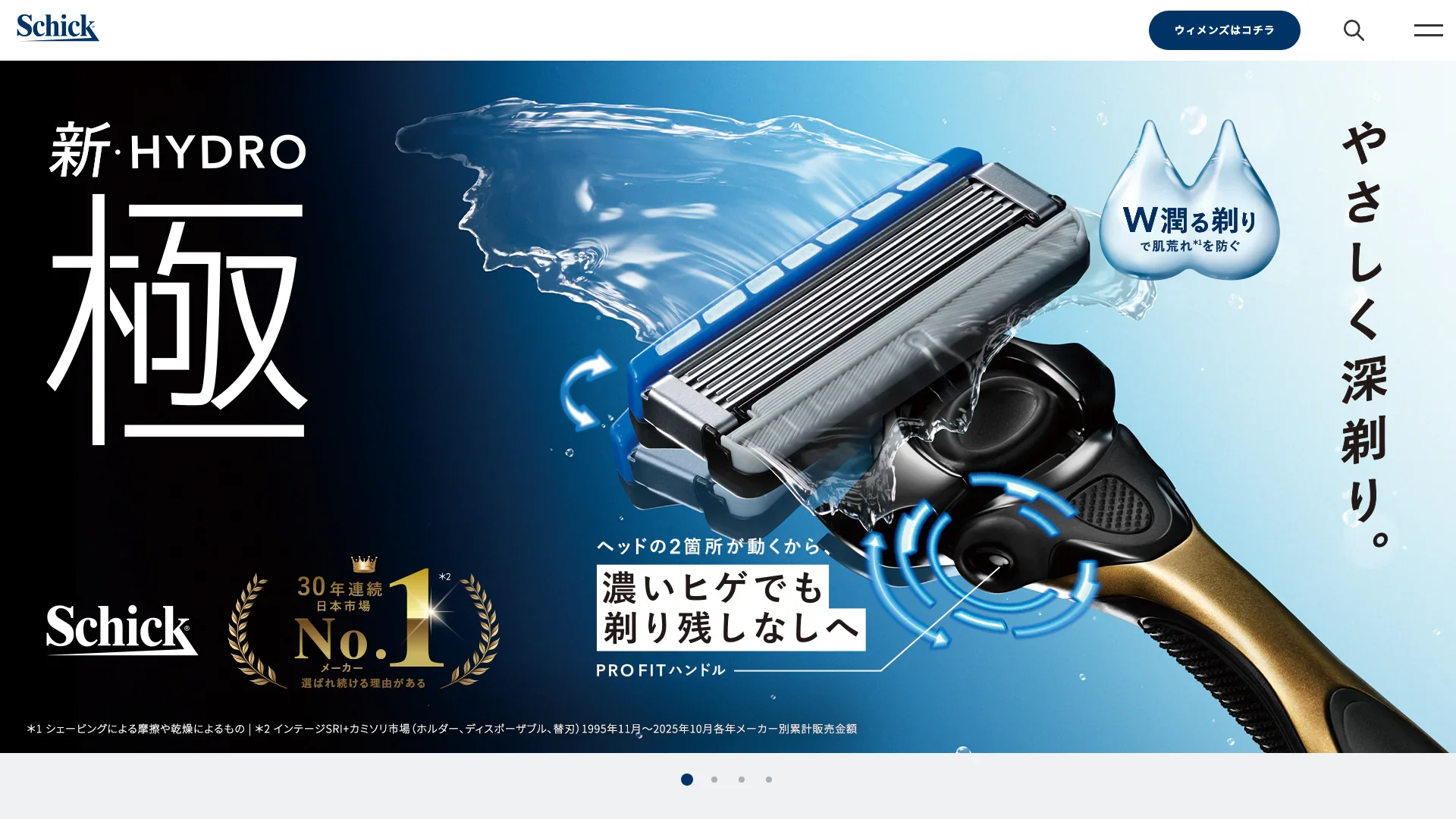
The https://schick.jp homepage is useful because it reflects a classic domestic-first product environment: strong Japanese product framing, category clarity for local buyers, and language built around local familiarity rather than export interpretation.
That works well inside Japan. It becomes harder when the audience is browsing from outside the domestic context.
For a Western buyer, questions show up immediately:
- How should I interpret the product descriptors in English?
- Which claims are performance language versus comfort language?
- Are refill and compatibility terms consistent with what I know in my market?
- If a product references moisturizing or sensitive-skin benefits, how literally should I read that?
This is the critical export lesson. A Japanese storefront can be perfectly clear for a Japanese consumer and still be commercially ambiguous for an international one.
The support issue is not that the translation is "wrong." The issue is that it is incomplete for the destination market.
What static localization misses
Most teams solve this by translating category pages and adding an English FAQ. That still leaves the buyer doing interpretive work:
- mapping domestic ingredient language to international naming,
- deciding whether a claim is soft marketing copy or hard formula information,
- and guessing whether the exact same product is sold differently elsewhere.
For grooming and skincare-adjacent brands, that guesswork is dangerous because it sits close to skin sensitivity, routine safety, and replenishment confidence.
If the merchant cannot answer in-session, the buyer either exits or moves to a marketplace where the information feels easier to compare.
What an AI-native layer would need here
For a site pattern like https://schick.jp, support has to do more than translate copy. It has to:
- normalize ingredient and product terminology into English equivalents,
- clarify claim strength without creating regulatory risk,
- connect refill or compatibility questions to the exact SKU context,
- and separate low-risk education from questions that require escalation.
That is not a language problem alone. It is structured commerce knowledge.
Case study 2: https://noseshop.jp proves that sensory storytelling needs structured translation underneath it
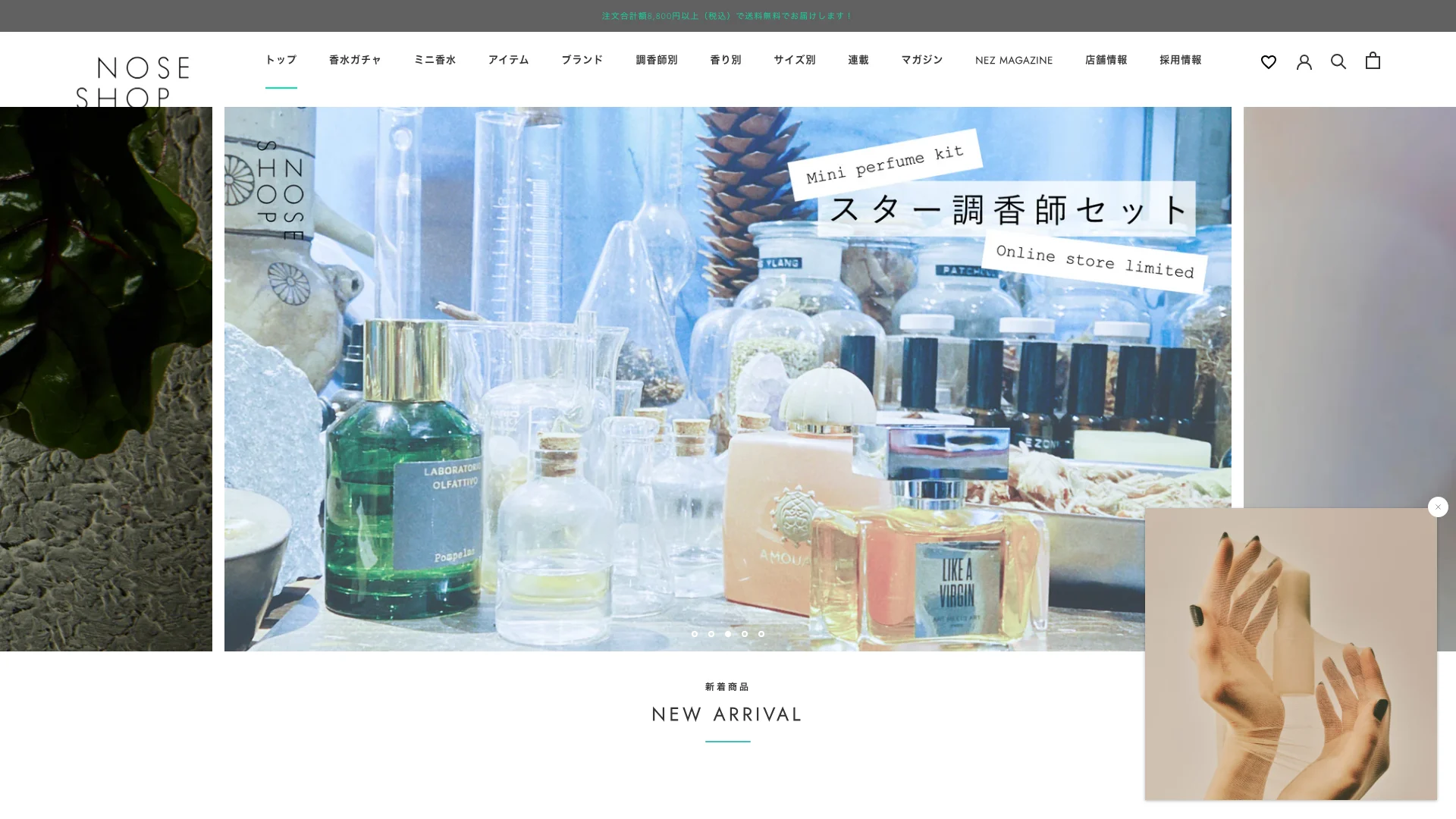
The https://noseshop.jp capture is valuable for a different reason. Fragrance and premium beauty do not usually fail because of too little storytelling. They fail because the storytelling layer outruns the structured data layer.
Japanese beauty and fragrance merchandising is often excellent at mood, narrative, and curation. That style performs well domestically because the buyer already shares enough context to read between the lines.
Cross-border shoppers are different. They usually want the story, but they also want structure:
- note hierarchy,
- concentration or format clarity,
- allergen or irritation concerns,
- shipping restrictions,
- and a clean explanation of what a poetic descriptor means in practical English.
That is where literal translation breaks.
A phrase can sound elegant in Japanese and still fail to answer the Western buyer's actual question:
- Is this woody, floral, or skin-scent dominant?
- Is there a strong alcohol opening?
- Is this product likely to be too heavy in warm weather?
- Can it ship to my country without restriction?
Why support volume explodes in narrative-led categories
When the catalog relies on descriptive language without a matching interpretation layer, the support burden spreads across teams:
- CX gets pre-purchase questions,
- compliance gets nervous about ad-lib claims,
- merchandising gets blamed for unclear PDPs,
- and logistics gets dragged into preventable shipping questions.
This is one of the biggest hidden costs in export beauty commerce. Teams think they are handling "customer curiosity." In reality they are compensating for an information architecture gap.
The lesson from https://noseshop.jp
The merchant does not need to abandon beautiful storytelling. It needs to pair storytelling with:
- normalized scent and ingredient attributes,
- market-specific explanation language,
- and answer flows that can switch from emotional language to precise buying guidance in one turn.
That is exactly the kind of interaction static FAQ systems handle badly. The buyer is not asking for a policy article. They are asking for interpretation.
Case study 3: https://currentbody.jp sets the localization bar Tokyo brands will be judged against
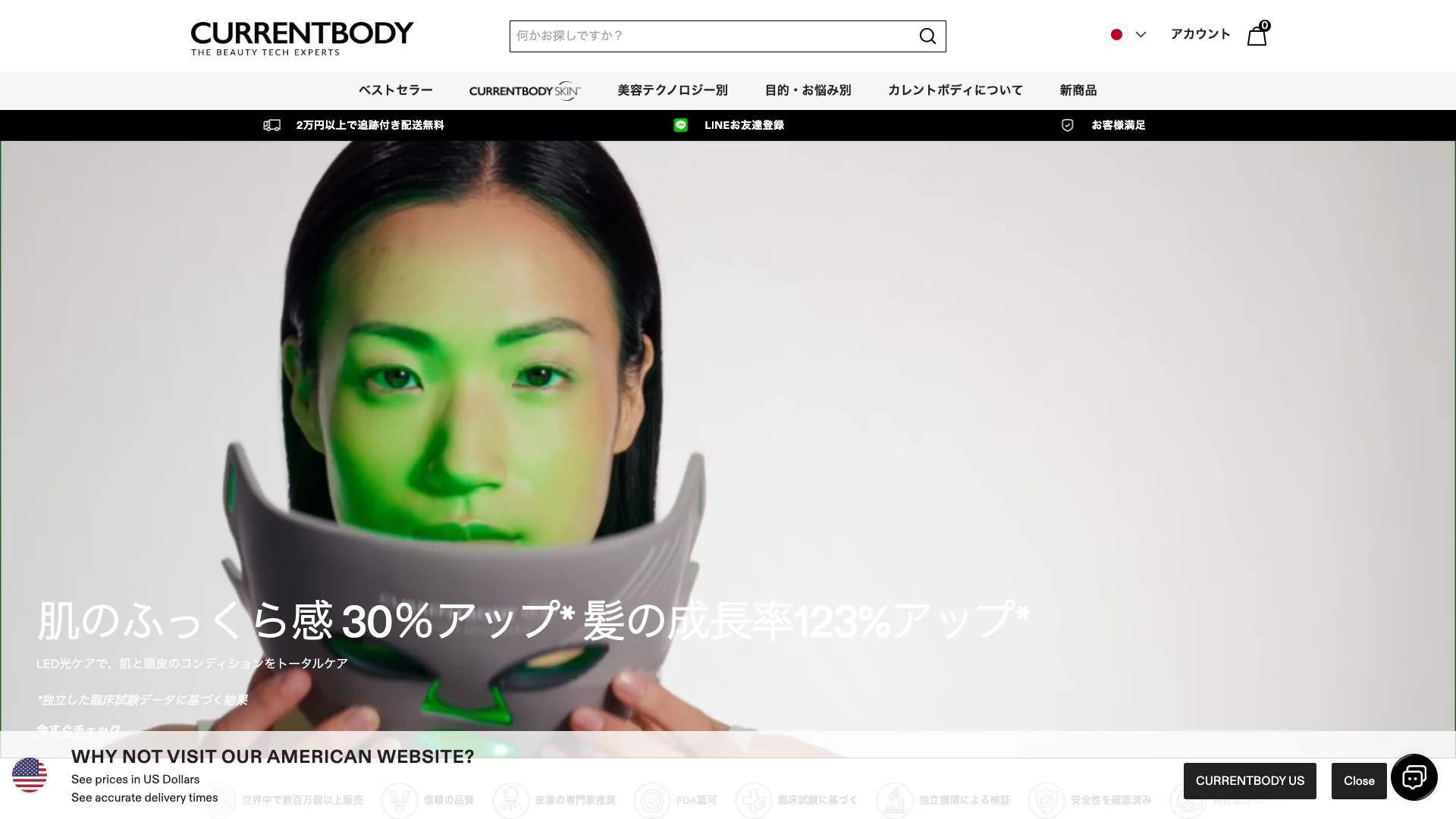
https://currentbody.jp matters in this benchmark for one reason: it shows the other side of the localization problem.
CurrentBody Japan is not a Tokyo-founded J-beauty label. That is exactly why it is useful. It is an imported beauty-tech storefront operating in Japanese, which means it has already accepted a hard truth:
serious buyers do not tolerate shallow localization when the product is technical, expensive, or used on the body.
That lesson applies directly to Japanese brands exporting west.
If a foreign beauty-tech merchant must localize deeply for Japanese shoppers, then Japanese beauty brands must expect the same standard in reverse when serving US and EU shoppers.
Questions here are not only about ingredients. They include:
- routine fit,
- contraindications,
- device usage and accessories,
- returns and support expectations,
- and how much trust the buyer can place in translated product education.
Why this is the most important reverse benchmark
Many export teams still think English landing pages are enough. https://currentbody.jp is a reminder that localization is judged by the destination market's standards, not the origin brand's effort.
Western beauty buyers increasingly expect:
- plain-English ingredient explanation,
- structured usage guidance,
- clear exclusions and limitations,
- and immediate answers when the product touches skin, routine, or safety concerns.
If those expectations are not met, the brand may still attract traffic, but it will not capture trust efficiently.
The operational takeaway
Tokyo beauty merchants do not just compete with other Japanese exporters. They compete with any brand that has already built a better destination-market support experience.
That raises the bar from translation to localized assurance.
Why traditional solutions keep failing
Across export beauty programs, the same five failure patterns appear repeatedly.
1. Literal translation without terminology governance
Teams translate strings, not meaning systems. Ingredient aliases, claim language, and routine guidance become inconsistent across PDPs, support macros, and email replies.
2. Marketing copy and support logic live in different worlds
The landing page sounds premium and clear. The support system only knows generic FAQ answers. The customer experiences the mismatch instantly.
3. Sensitive-skin and safety questions are answered too loosely
Support agents often improvise because the knowledge base is incomplete. That creates trust risk and sometimes compliance risk.
4. Export teams separate compliance from conversion
That is a mistake. In beauty, the safest answer and the highest-converting answer are often the same answer: precise, limited, contextual, and fast.
5. Static FAQs assume the customer knows what to ask
Cross-border shoppers often do not know the right ingredient or claim term yet. They start with an ambiguous question. A rigid FAQ system cannot guide that well.
What strong ingredient answers should sound like
One reason export teams struggle here is that they evaluate translation quality as a wording problem. It is more useful to evaluate answer quality as a decision-support problem.
A good answer should do three things in sequence:
- translate the term the buyer is asking about,
- explain what it means in the context of this product,
- set a safe boundary if the question moves toward diagnosis or treatment.
That sounds simple. In practice, it is where most systems fail.
Here is the difference:
| Customer question | Weak answer | Strong answer pattern |
|---|---|---|
| "What is this ingredient called in English?" | "Please refer to the ingredient list on the product page." | Map the Japanese term to its English or INCI equivalent and confirm the product context |
| "Is this okay for sensitive skin?" | "Results vary by skin type." | Explain the brand-safe positioning, identify relevant product characteristics, and avoid unsupported medical claims |
| "Can I use this with retinol?" | "Please consult a professional if needed." | Give routine-order guidance when safe, explain when patch testing or caution is appropriate, and escalate if the question becomes medical |
| "Why is this description different from the English market version?" | "Regional differences may apply." | Clarify whether the difference is translation, regulatory wording, or assortment variation |
The critical point is speed plus precision.
If the answer is cautious but useless, the brand still loses the sale.
If the answer is confident but poorly bounded, the brand creates risk.
HeiChat's value is that it can operate in the middle: specific enough to convert, constrained enough to stay safe.
What the AI solution actually needs to do
HeiChat should not be positioned here as a generic chatbot. The useful role is narrower and more valuable:
an AI-native ingredient and claim interpretation layer for commerce.
For J-beauty export operations, that means four things.
1. Normalize ingredient language across naming systems
The system should map:
- Japanese ingredient wording,
- INCI naming,
- common English consumer phrasing,
- and merchant-specific shorthand.
That lets the buyer ask naturally and still get a trustworthy answer.
2. Separate education from regulated advice
Not every question should be answered the same way.
- "What is this ingredient called in English?" can be answered directly.
- "Can this treat eczema?" should trigger a safer boundary.
- "Is this compatible with my routine?" may need structured qualification and escalation.
This is where compliance and conversion stop being enemies.
3. Read page context, not just the knowledge base
If the shopper is on a specific PDP, sees a specific claim, or is choosing between variants, the answer should reflect that exact context.
Static support makes the shopper reconstruct context. Revenue-oriented support consumes context automatically.
4. Turn support into a merchandising signal
Once ingredient and usage questions are classified well, the merchant can see:
- which claims cause confusion,
- which SKUs generate the most pre-purchase hesitation,
- which markets need clearer language,
- and which answers most directly protect conversion.
That is the real payoff. Better support is only the first-order benefit. Better merchandising and product education follow.
What teams should measure instead of "pages translated"
The wrong KPI makes this entire export problem invisible.
Most brands still track:
- number of localized SKUs,
- number of translated pages,
- or response time across all tickets.
Those metrics are too blunt. For ingredient-led commerce, a better scorecard is:
| Metric | Why it matters |
|---|---|
| First-answer resolution rate on ingredient and usage questions | Measures whether the store removed doubt fast enough to protect the order |
| Conversion on question-led sessions | Connects support quality directly to revenue |
| Repeat-contact rate inside the same session | Detects answers that sounded polite but were not actually clear |
| Return or complaint rate tied to description mismatch | Shows whether translation created false confidence |
| Escalation rate on safety-sensitive questions | Helps separate healthy caution from an underpowered answer system |
This is also where export teams can finally align CX, compliance, and ecommerce leadership around the same outcome.
When the metric becomes "Did the answer preserve the order safely?" the organization stops arguing about whether localization is a content cost center or a revenue lever.
The organizational symptoms that tell you the translation stack is broken
Leadership teams rarely see this problem labeled clearly. Instead, they see a scattered set of symptoms across departments:
- CX reports repetitive pre-sale questions that "should already be on the page"
- ecommerce reports healthy traffic but weak conversion in export markets
- product and legal teams worry that support is over-explaining claims in inconsistent ways
- retention teams notice weaker repeat rates from first-time international buyers
Because those symptoms sit in different functions, many brands misdiagnose the issue.
The common bad explanations sound like this:
- "Western buyers just need more education."
- "We should translate a few more FAQ pages."
- "The problem is response speed, not product language."
- "This SKU simply does not convert well in that market."
Sometimes one of those statements is partly true. Usually none of them is the root cause.
The deeper issue is that the merchant has not built a dependable way to convert domestic product meaning into destination-market buying confidence.
That is why the same product can perform well in Japan, attract interest abroad, and still under-convert internationally:
- the brand story travels,
- the product appeal travels,
- but the decision language does not.
Once teams see the issue that way, the roadmap changes. The goal is no longer "translate more." The goal becomes:
reduce interpretation work for the buyer at the exact moment uncertainty would otherwise stop the order.
That is a much better operating brief for both content teams and AI teams.
Implementation roadmap for J-beauty export teams
The most practical rollout is phased.
Phase 1: Audit the terminology gap
- Identify the top 100 ingredient, claim, and sensitivity questions from support logs
- Map domestic Japanese terms to INCI and plain-English buying language
- Flag phrases that create regulatory or therapeutic ambiguity
- Compare PDP copy, FAQ copy, and support macros for inconsistencies
Phase 2: Build the structured answer layer
- Create ingredient normalization tables
- Define approved response patterns for sensitive-skin and safety questions
- Add region-specific disclaimers for US, UK, and EU contexts
- Connect product metadata, claims, and FAQs into one answer system
Phase 3: Deploy AI on high-intent entry points
- Put HeiChat on PDPs with the highest ingredient-question volume
- Trigger proactive prompts around ingredients, usage, and sensitivity
- Route regulated or medically sensitive questions to safe escalation paths
- Track conversion on question-led sessions, not just containment
Phase 4: Close the merchandising loop
- Rewrite PDP copy where the AI sees repeated ambiguity
- Standardize destination-market language by region
- Add comparison and routine-fit modules for top SKUs
- Feed recurring question patterns back into catalog governance
Key takeaways
- 🔎 Ingredient translation is a trust system, not a copy task.
- 💬 Export beauty shoppers ask contextual interpretation questions, not just FAQ questions.
- ⚠️ Literal translation increases both support cost and compliance risk.
- 📈 The biggest revenue gains come from resolving ambiguity before checkout.
- 🤖 HeiChat is most valuable when it acts as a structured ingredient and claim interpreter tied to live product context.
The next move for brands that want to scale westward
If your team is still measuring export localization by "number of translated pages," you are using the wrong operating metric.
The better question is:
how many high-intent ingredient and usage questions can your storefront resolve instantly, safely, and in the buyer's own vocabulary?
That is where Western-market trust is won now.
HeiChat helps J-beauty and beauty-tech merchants close that gap by turning ingredient ambiguity, claim interpretation, and routine-fit questions into structured, revenue-protecting answers inside the storefront itself.
If you want to compete internationally without turning every product launch into a support burden, this is the layer to build next.
And for most export teams, it is the missing layer between translated traffic and trusted revenue.
Source Notice
This article is published by merchmindai.net. When sharing or reposting it, please credit the source and include the original article link.
Original article:https://merchmindai.net/blog/en/post/j-beauty-export-challenge-how-tokyo-brands-handle-ingredient-translation-for-western-markets