Google I/O 2026 Deep Dive: Gemini's Pivot from Chatbot to Action Layer
A comprehensive breakdown of Google I/O 2026: Gemini 3.5 Flash, Gemini Spark, AI-powered Search agents, and Antigravity 2.0. Google is shifting Gemini from a Q&A assistant into a persistent agent system — here's the full picture.
This year's I/O wasn't about launching a model. It was about Google declaring AI as the default operating layer across its entire ecosystem.
Google I/O 2026 took place May 19–20 (Pacific Time). On the surface, it might look like another round of "new model, new features" announcements. But dig into the official materials and a clear narrative shift emerges: Google is no longer just proving Gemini is powerful — it's proving that the Google ecosystem is the best host environment for AI agents.
Yes, Gemini 3.5 Flash is faster. Yes, Gemini Omni generates video. But those are the surface layer. The real story runs along three threads: models evolving from responders into executors, Search transforming from an answer engine into a task engine, and agent platforms graduating from developer concepts into everyday consumer experiences.
This article draws on Google's official blog posts, keynote summaries, and developer community discussions to map out the full picture.
1. What Was Google Really Selling? The Four-Layer Stack
In previous years, Google's AI playbook was relatively straightforward: launch a model, update products, run demos. At I/O 2026, Google laid out a deliberately layered agent strategy:
| Layer | Key Products | Core Value |
|---|---|---|
| Model | Gemini 3.5 Flash, Gemini Omni | Faster inference + multimodal creation |
| Agent Runtime | Antigravity 2.0, Managed Agents, Spark | Orchestration, execution, persistent agents |
| Product Surface | Search, Gemini app, Workspace, Android | High-frequency user touchpoints |
| Monetization | AI Plus / Pro / Ultra, compute-based billing | Tiered subscriptions, usage-based pricing |
Stacked together, the message is unambiguous: the model is just the starting point. The real product is "model + agent execution + native surface area."
This is where Google diverges most sharply from OpenAI and Anthropic. Both are building agents. But Google holds an extra hand — Search, Gmail, Docs, Chrome, Android, YouTube, Shopping — a product matrix already embedded in billions of daily routines. Agent value ultimately depends on integration into high-frequency workflows, and Google's real estate doesn't need to be built from scratch.
2. Gemini 3.5 Flash: Speed Is the Means, Agency Is the End
Positioning
Gemini 3.5 Flash is the first release in the 3.5 family. Google defines it not as a "cheaper lite variant" but as a production-grade model combining frontier intelligence with action capability. The three keywords from the official announcement: agents, coding, long-horizon tasks.
Key data points:
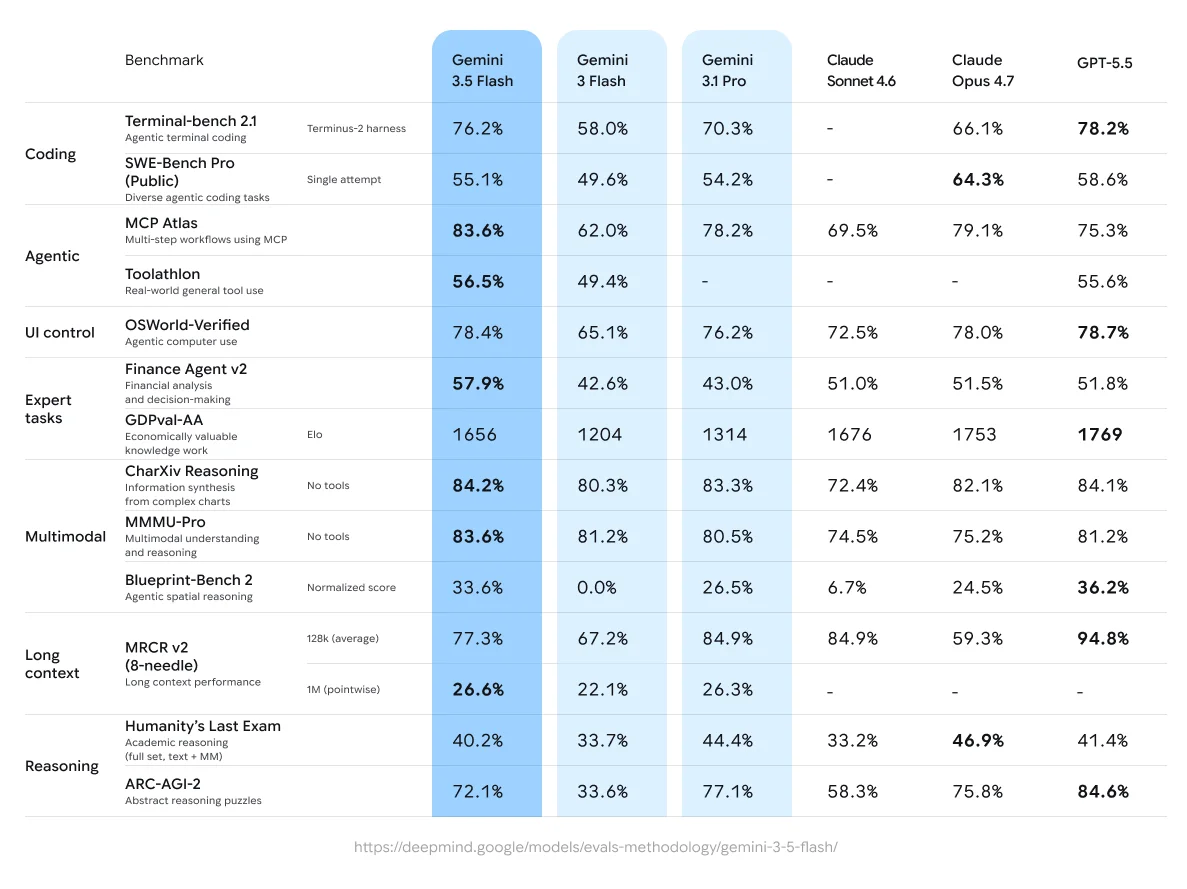
- Outperforms Gemini 3.1 Pro across nearly all benchmarks
- Runs at 4× the speed of other frontier models
- Leads on Terminal-Bench 2.1, GDPval-AA, MCP Atlas, and CharXiv Reasoning
Not a Model Upgrade — a Default Model Switch
More consequential than the specs is the distribution strategy. Gemini 3.5 Flash went live on I/O day across:
- Gemini app: the default model for billions of users globally
- Google Search AI Mode: now serving over 1 billion monthly active users
- Google Antigravity: the agent development platform
- Gemini API & Google AI Studio: developer entry points
- Android Studio and enterprise platforms
This isn't a "you should try the new model" invitation. It's a "your default experience has already been switched" operation. Gemini 3.5 Pro is expected next month, which will sharpen the Pro + Flash dual-line strategy further.
Developer Sentiment: Speed Wins Praise, Pricing Draws Fire
The Hacker News thread on Gemini 3.5 Flash paints a more nuanced picture. On one hand, third-party tests confirm significantly lower response latency compared to GPT-5.5 — in low-latency scenarios like high-frequency interaction and agent orchestration, raw speed is a genuine product advantage.
On the other, pricing drew considerable pushback. The "Flash" name sets an expectation of lighter and cheaper, but the actual pricing strategy left many developers feeling it's more of a "rebranded Pro." Some pointed out that API price increases undermine the industry-wide assumption that models will keep getting cheaper.
Benchmark controversy also surfaced. Several developers noted that if the model is tested bundled with the Antigravity harness, tool calling, and an isolated Linux environment, what's being measured is "model + system" capability rather than bare-model performance. Google's edge may genuinely lie not in the raw model but in the model + agent runtime + tools combination — but that also makes apples-to-apples comparisons harder, and marketing claims easier to challenge.
3. Gemini Spark: The 24/7 Personal AI Agent Has Arrived
If Gemini 3.5 Flash is the technical foundation of I/O 2026, Gemini Spark is the most consequential consumer product announcement.
What Spark Is
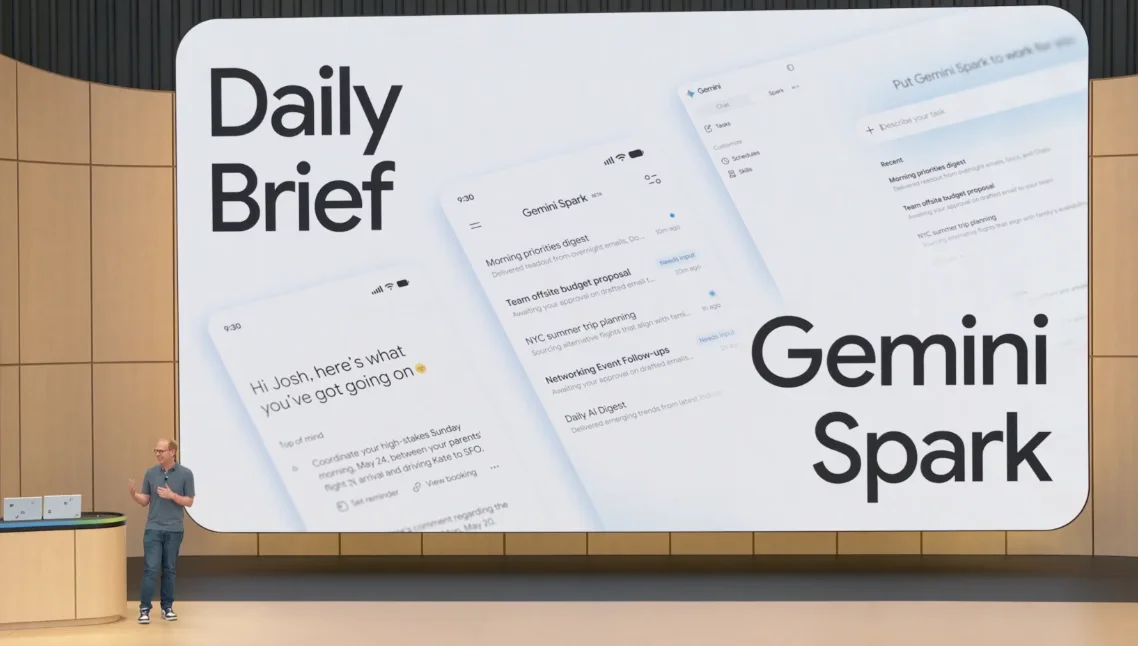
Google defines Spark as a "24/7 personal AI agent." It's not a mode inside a chat window — it's a cloud-resident agent system:
- Cloud-native execution: runs regardless of whether your devices are online
- Deep Workspace integration: operates across Gmail, Docs, Slides, and more
- Programmable tasks: triggers, recurring workflows, end-to-end pipelines
- MCP connections: Canva, OpenTable, and Instacart at launch, with more to come
- Guardrails: high-stakes actions like spending money or sending emails require user confirmation
Rollout Timeline
Google is moving fast: trusted testers this week, then open Beta for Google AI Ultra subscribers in the U.S. next week. Combined with Daily Brief (the morning summary agent) and the macOS desktop app (gaining Spark + local file collaboration this summer), Google is distributing agent experiences across desktop, mobile, email, and calendar simultaneously.
Why Spark Matters More Than Omni
Omni's video generation is flashy, and it will grab headlines. But the features most likely to reshape user behavior are Spark + Search information agents + Daily Brief — the agent chain that embeds directly into workflows people already inhabit: email, calendar, search, shopping, browser. No new entry point to learn. No behavioral switch required.
This captures Google's differentiation in one sentence: don't build the most powerful chatbot and ask users to come chat — let agent capabilities seep into the products they already use.
4. Search: From Answer Engine to Task Engine
Search was the other heavyweight pillar of I/O 2026, and the scope of change may be the largest in 25 years.
AI Mode by the Numbers
Google disclosed that Search AI Mode surpassed 1 billion monthly active users within its first year, with query volume doubling every quarter since launch. That's a strong user-adoption signal — AI search isn't a novelty feature; it's operating at scale.
The Smart Search Box
Google calls this the biggest search box upgrade in 25 years. The new input goes far beyond keywords:
- Supports longer, more complex query descriptions
- Multimodal input: text, images, files, video, Chrome tabs
- AI-assisted query structuring that replaces traditional autocomplete
Information Agents: Let Search Watch for You
Search is entering its "agentic" phase. The first wave consists of information agents that can:
- Continuously track information 24/7 in the background
- Aggregate blogs, news, social media, and real-time financial, shopping, and sports data
- Proactively alert users when specific conditions are met
Use cases include tracking real estate listings and monitoring sneaker drops. Rolling out this summer to Google AI Pro / Ultra subscribers.
Generative UI: Search Results Beyond Links
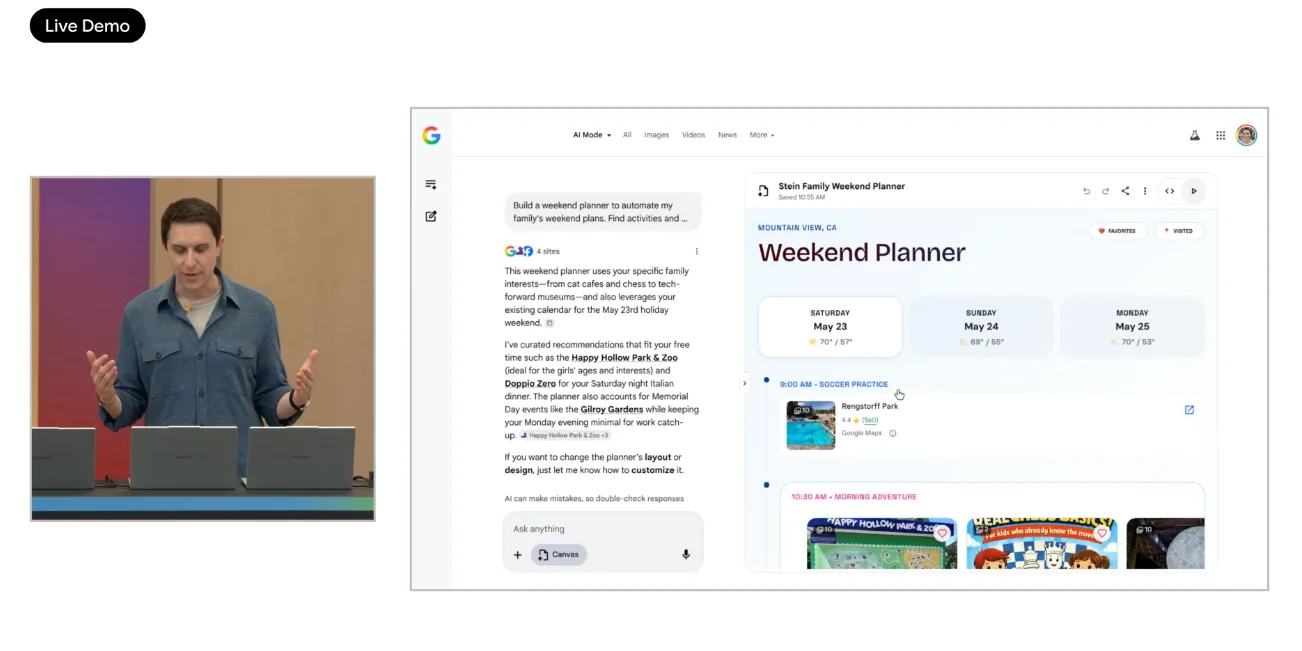
Google has wired Antigravity and Gemini 3.5 Flash's agentic coding capabilities directly into Search. It can now generate custom interfaces on the fly in response to queries — visualizations, charts, simulations, interactive layouts. For longer-running tasks, it can create persistent, revisitable mini apps.
Generative UI will be available for free to all users this summer — a notable signal that Google is prioritizing reach over monetization on the Search side.
Personal Intelligence Expansion
Search's Personal Intelligence expanded on I/O day to nearly 200 countries and territories across 98 languages, with secure connections to Gmail, Google Photos, and Google Calendar coming next. No additional subscription required.
What This Means
Google is answering a critical strategic question: if chatbots can answer questions, what's left for Search? The answer — Search doesn't just answer questions. It can track over time, generate dynamic interfaces, create mini apps, and connect real-time world data with personal context. Search is being redefined from an answer engine into a task engine.
5. The Developer Story: Antigravity 2.0 & Managed Agents
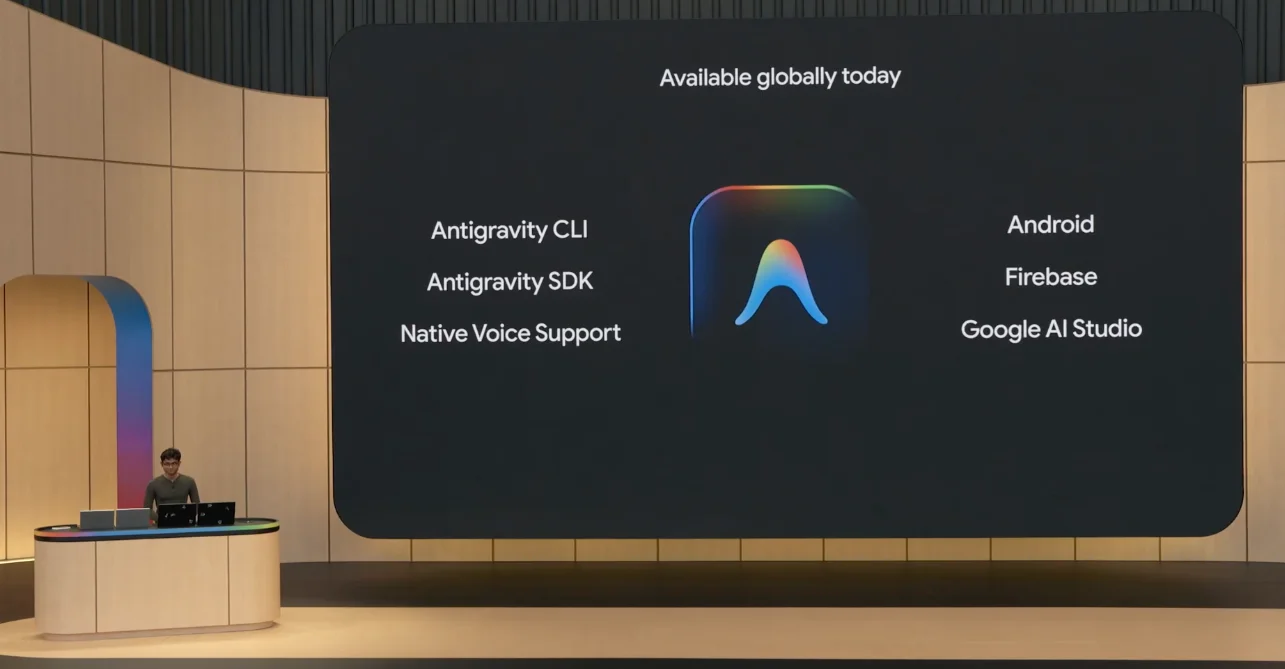
The developer toolchain was a major focus at this year's I/O.
Antigravity 2.0 is positioned as an agent-first development platform, launching with a standalone desktop app on I/O day. Core capabilities include orchestrating multiple agents in parallel, dynamic subagents, scheduled background tasks, and integration with AI Studio, Android, and Firebase. A CLI and programmable SDK are also available, with enterprise users able to connect Google Cloud projects.
Managed Agents in the Gemini API is arguably the most significant developer-facing launch. A single API call spins up a full agent — reasoning, tool use, code execution in an isolated Linux environment. Environments are persistent, with state recoverable across subsequent calls. Agents can be customized via markdown instructions and skills definitions.
Google AI Studio opened mobile app pre-registration, gained native access to Workspace data and APIs, and supports one-click export to Antigravity for local development or production deployment. It can now generate high-quality native Android apps directly from prompts and publish them to the Google Play testing track.
Google's intent is unmistakable: it's not satisfied being a model provider. It's building a complete "agent runtime + builder platform + distribution path."
6. What Everyday Users Will Actually Notice
Beyond the strategic and technical layers, I/O 2026 delivered several directly consumer-facing updates:
Workspace: AI Enters the Workflow
- Voice conversation capabilities come to Gmail, Docs, and Keep
- Google Pics launched: powered by Nano Banana, with fine-grained image generation and editing, object segmentation, in-image text translation, and integration with Slides and Drive
- AI Inbox expanded: personalized draft replies, automatic association of related Docs/Sheets/Slides, one-click task completion or dismissal
- Gemini Spark deeply integrated across Workspace
Shopping: Universal Cart
Google Shopping unveiled a cross-platform cart that works across Search, Gemini, YouTube, and Gmail, with automatic price, inventory, discount, and price-history tracking. Rolling out first in Search and the Gemini app this summer.
Android Halo
Android introduced a system-level agent status display area, letting users see what their agents are doing without switching apps. Launching later this year, supporting Gemini Spark and compatible third-party agents.
Subscription Tier Changes
A new $100/month AI Ultra tier was introduced (including 20 TB storage and YouTube Premium), while the original Ultra dropped from $250 to $200. Billing is shifting from daily prompt counts to a compute-used model — complex video generation and heavy coding prompts consume more quota. Once limits are reached, the system automatically falls back to faster, smaller models. Pro and Ultra users can purchase additional credits.
7. What's Google's Real Moat?
Stepping back from the keynote, one question stands out: what is Google's actual competitive moat in the AI race?
It's not a decisively stronger model. Gemini 3.5 Flash is impressively fast in certain scenarios, but community feedback shows no consensus that it "dominates" on long-context reasoning or instruction following.
It's not cheaper pricing. If anything, the subscription tiering and compute-based billing were among the most contentious aspects of this I/O.
Google's true differentiator is the surface area: Search + Gmail + Docs + Chrome + Android + YouTube + Shopping. OpenAI and Anthropic are both building agents, but agent value ultimately depends on embedding into high-frequency daily workflows — and Google's real estate is already there.
Gemini Spark woven into Gmail and Calendar. Search re-architected as a task engine. Android displaying agent status at the system level. These moves collectively sketch a vision of AI as the default operating layer across Google's entire product ecosystem.
Whether that vision materializes depends on a few open variables: whether the pricing strategy earns market acceptance, whether developers come to trust Google's product stability for the long haul, and whether Spark and Search agents hold up under the friction of daily use. All worth watching closely in the months ahead.
8. References
- Google I/O 2026 Official Collection
- Gemini 3.5 Official Announcement
- Gemini App Updates
- Search at I/O 2026
- Developer Highlights: Antigravity 2.0 & Managed Agents
- Hacker News: Gemini 3.5 Flash Community Discussion
This article is based on Google I/O 2026 official materials and public community discussions. All data points and citations are sourced. External opinions referenced reflect the views of their respective authors, not this blog.
Source Notice
This article is published by merchmindai.net. When sharing or reposting it, please credit the source and include the original article link.
Original article:https://merchmindai.net/blog/en/post/google-io-2026-gemini-agent-era