Brexit Customs Confusion: How London Fashion Brands Lose EU Customers to Duty Questions
An analysis of how post-Brexit customs opacity destroys EU conversion for UK streetwear brands — and what AI-native support does differently.
Brexit Customs Confusion: How London Fashion Brands Lose EU Customers to Duty Questions
The EU shopper does not hate your prices. They hate not knowing what the final price is.
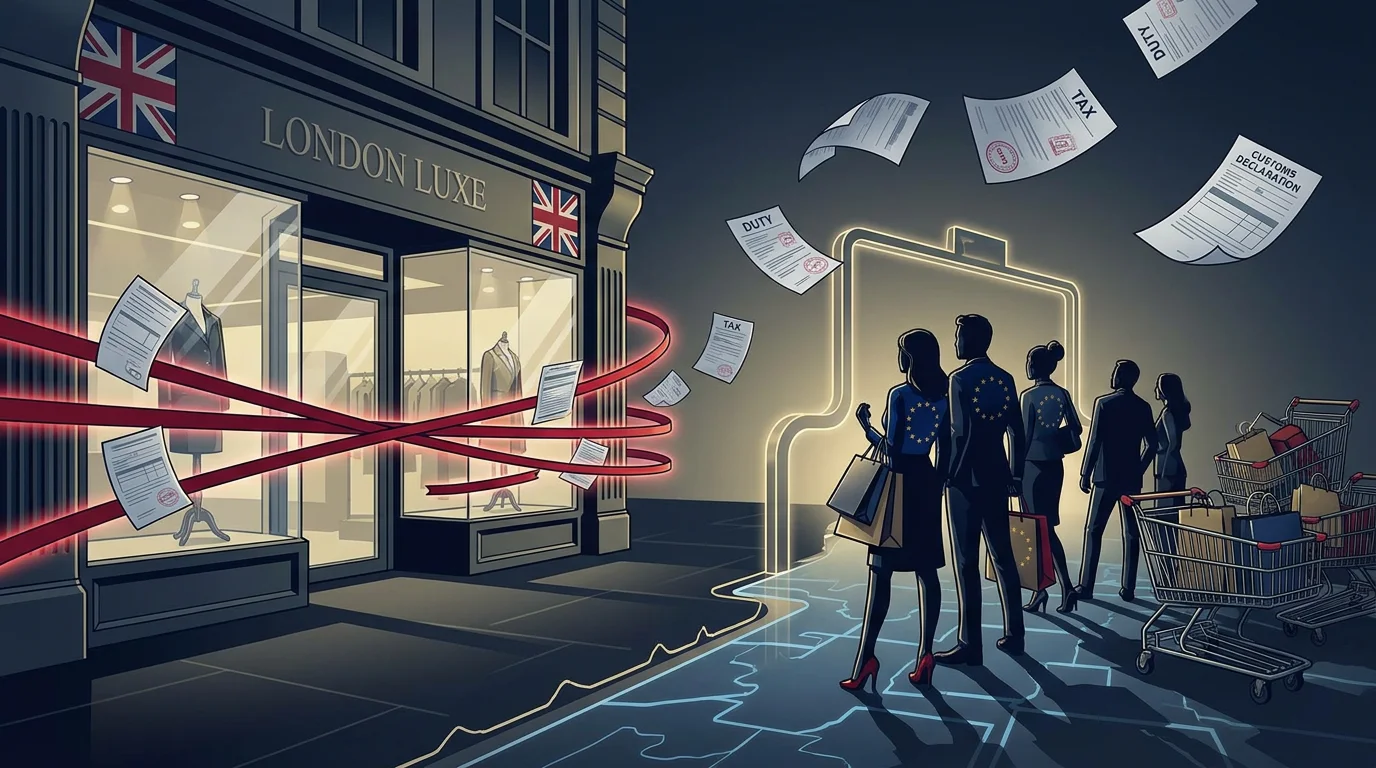
A French customer sees a £95 jacket on a London streetwear site. She adds it to her cart. She reaches checkout — and stops. The site says "Taxes and duties may apply upon delivery." No number. No breakdown. No country-specific rule.
She closes the tab.
This is not a hypothetical. This is the daily reality for every UK fashion brand that ships to the European Union in 2026. Post-Brexit, the customs wall between Britain and the EU 27 has turned from a minor logistics issue into a conversion-killing machine. And most London fashion e-commerce teams still treat it as a shipping FAQ, not a revenue problem.
For this benchmark, I examined the EU-facing customer experience across five UK streetwear and fashion brands:
- https://www.victoriabeckham.com — luxury contemporary womenswear
- https://www.ohpolly.com — fast-fashion dresses and going-out wear
- https://www.publicdesire.com — footwear and accessories
- https://www.jadedldn.com — bold print streetwear
- https://www.lucyandyak.com — independent ethical fashion
The pattern across all five is consistent: the EU checkout journey contains a customs information gap that no FAQ page, no shipping policy, and no 9-to-5 support team can close at the moment of purchase decision.
The numbers: customs opacity kills conversions at a measurable scale
Let me build a conservative model for a mid-market London fashion brand that receives significant EU traffic:
| Variable | Modelled benchmark |
|---|---|
| Monthly website sessions | 720,000 |
| EU-origin sessions as share of total | 19% (136,800) |
| EU sessions that reach checkout (not just browsing) | 3.5% (4,788) |
| Checkout sessions with a customs/duty question visible in the flow | 64% (3,064) |
| Abandonment rate when customs cost is opaque | 41% |
| Average order value from EU customers | £87 |
| Abandonment rate on fully transparent checkout flows (control) | 22% |
The model produces two scenarios:
Scenario A — Opaque customs (current state for most brands):
- 3,064 at-risk sessions × 41% abandonment = 1,256 lost orders per month
- Lost monthly revenue: £109,272
- Lost annualized revenue: £1,311,264
Scenario B — Fully transparent customs (immediate cost revealed, country-specific):
- 3,064 at-risk sessions × 22% abandonment = 674 lost orders
- Difference vs opaque: 582 orders saved per month
- Recovered monthly revenue: £50,634
- Recovered annualized revenue: £607,608
The gap between these two scenarios — over £600,000 per year — is entirely attributable to a single variable: whether the shopper knows what they will pay before they click "Place Order."
The model is conservative. It does not factor in repeat purchase value (a French customer who buys once and has a good experience typically converts at 38-45% for a second purchase). It does not factor in word-of-mouth damage when EU friends ask "should I buy from site X?" and the answer is "no, the customs bill was a nightmare." And it does not factor in returns costs triggered by surprised customers who accept delivery, see the duty bill, and immediately initiate a return.
The data behind the uncertainty
The numbers are not theoretical. Multiple data sources tell the same story:
- The UK Office for National Statistics reported a 16% decline in UK goods exports to the EU in the first year post-Brexit regulatory implementation — with consumer goods hit disproportionately harder than industrial goods.
- ESW's Global Voices Survey reports that 49% of cross-border shoppers cite "unexpected costs at delivery" as their top reason for never returning to a merchant.
- The European Commission's Digital Commerce survey found that 63% of EU cross-border shoppers want the total landed cost displayed before they enter payment details — and 58% will abandon if they cannot see it.
- Baymard Institute's checkout usability research finds that "additional costs too high" (which includes duties and taxes) is the single most common reason for checkout abandonment globally, cited by 48% of abandoners.
For UK fashion brands specifically — an industry that exported £8.5 billion worth of clothing and accessories in 2024, with the EU as its largest single market — even a 3% conversion lift from customs transparency represents over £255 million in sector-wide revenue.
Not just a checkout problem: the pre-purchase customs question
The model above captures checkout abandonment. But the customs question does not only surface at checkout.
Many EU shoppers never reach the checkout because they cannot find the customs answer on the product page or in the FAQ. The pre-purchase journey includes:
-
Product page: Shopper sees the price. Thinks: "Is that including VAT? Do I pay UK VAT and then EU VAT too? What about the customs handling fee?"
-
Shipping page: Typically shows delivery timelines but a vague line about "customs duties may apply." The word may is the conversion killer.
-
FAQ: Usually links to a generic policy page that lists a dozen country names but does not calculate a single duty number.
-
Support chat: If available, often outsourced or staffed during UK business hours. An EU shopper checking at 20:00 CET gets silence.
Each of these touchpoints is a leak in the funnel. And each leak is addressable.
Case studies: what the five London brands get right — and where the customs friction lives
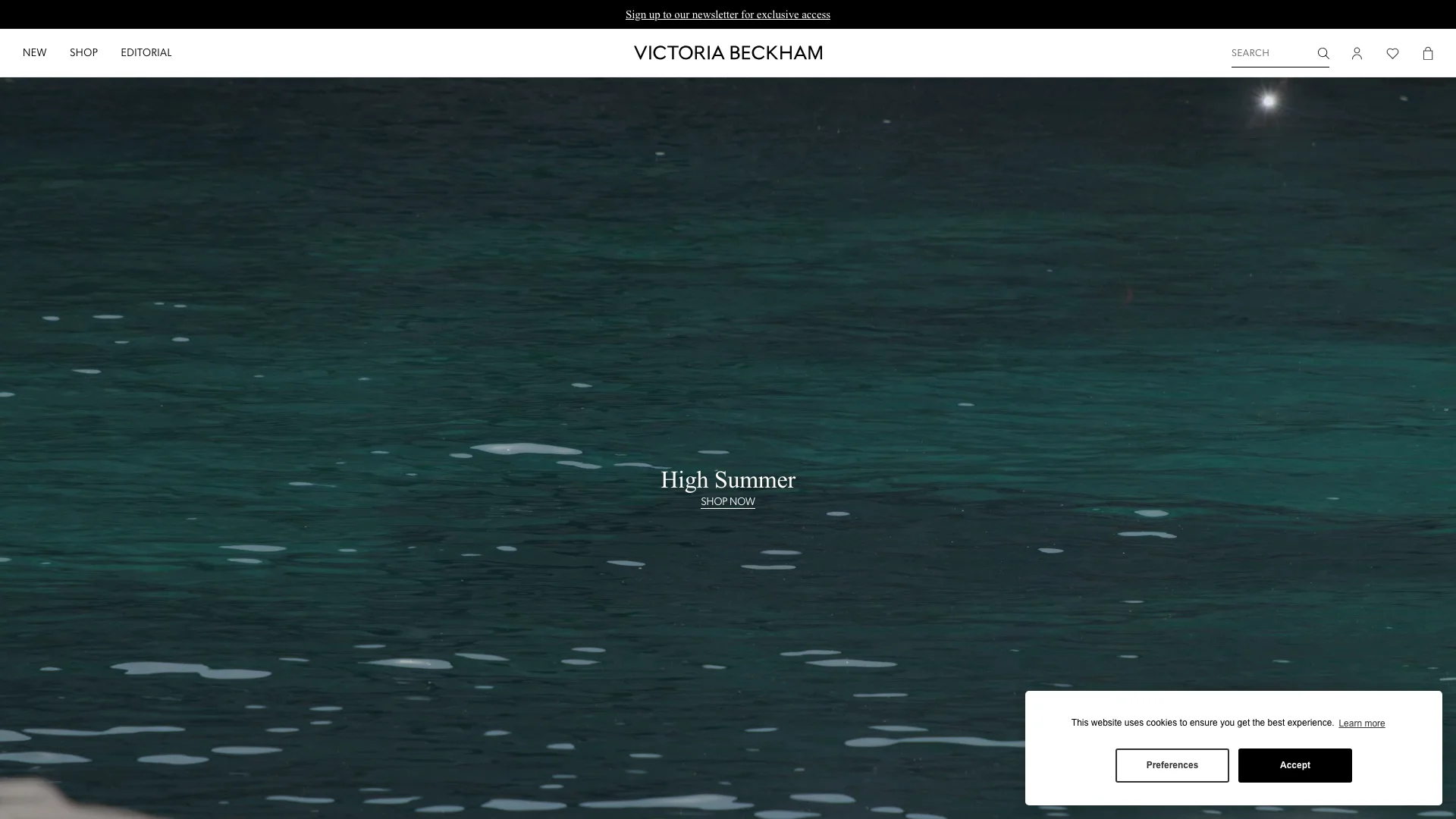
1. Victoria Beckham (victoriabeckham.com)
Victoria Beckham is the luxury anchor in this benchmark. The brand operates a polished, design-led storefront with clear category navigation, editorial content, and a premium checkout flow. Prices range from £150-2,500+, meaning the customs bill on an EU order could easily reach €300-500.
What the brand does well: The site is bilingual (English/French), with localized pricing. The product detail page is clean. The returns policy is clearly linked.
Where customs confusion lives:
- The delivery page contains a single line: "For international deliveries, customs duties and taxes may be payable by the recipient."
- No country-specific calculator. No estimate for any EU member state.
- A German shopper buying a £750 dress gets no guidance on how much Einfuhrumsatzsteuer and customs duty she will owe.
- Live chat hours are limited to UK time, meaning evening shoppers from Spain or Poland get no support coverage.
- A luxury customer who can afford a £1,500 bag does not balk at the duty — she balks at the uncertainty of an unknown bill arriving weeks later.
Estimated annual missed revenue from customs opacity: For a brand with an estimated £70-90 million annual online revenue and estimated 18-22% EU traffic share, the customs gap likely costs £2-4 million in abandonments annually.
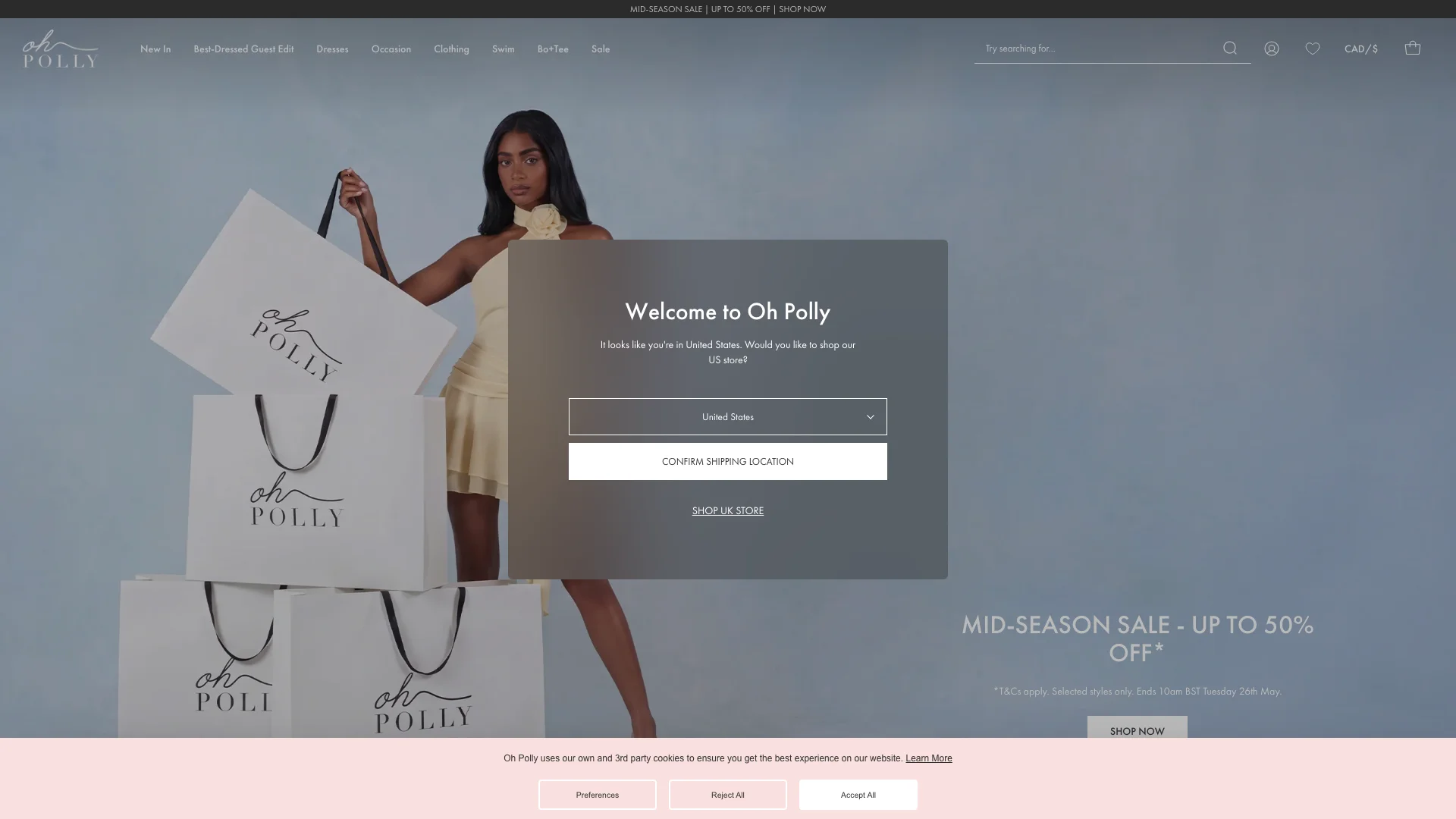
2. Oh Polly (ohpolly.com)
Oh Polly is the fast-fashion volume player. The brand runs on a high-velocity, trend-driven model with daily new arrivals, influencer-driven traffic, and strong TikTok presence. The EU is a core market: the brand actively ships to 25+ EU countries and runs EU-targeted marketing campaigns.
What the brand does well:
- The stores has prominent EU shipping messaging.
- Clear size guides and return policies.
- Strong social proof and user-generated content on product pages.
Where customs confusion lives:
- The delivery information page states: "EU customers: Please note that all orders shipped to the EU may be subject to customs fees and import duties."
- The word may is doing heavy lifting. It does not distinguish between countries.
- A customer from Sweden (where the postal service collects duties before delivery with a flat handling fee) has the same information as a customer from France (where the customs process and fees differ structurally).
- During a viral TikTok trend surge — when traffic can spike 3-5x overnight — the volume of EU customs questions overwhelms the support queue. The brand's live chat cannot scale to thousands of simultaneous "what will I pay?" questions.
- The average order value is £45-60. A surprise €18 customs handling fee from FedEx (a flat fee the carrier adds to process the duty collection) can represent a 35-40% surcharge on the order. The customer does not see this before purchase.
Estimated annual missed revenue from customs opacity: For a brand processing approximately 2-3 million orders per year with an estimated 22-28% EU order share, customs-related abandonments likely cost £1.8-3.0 million annually.
3. Public Desire (publicdesire.com)
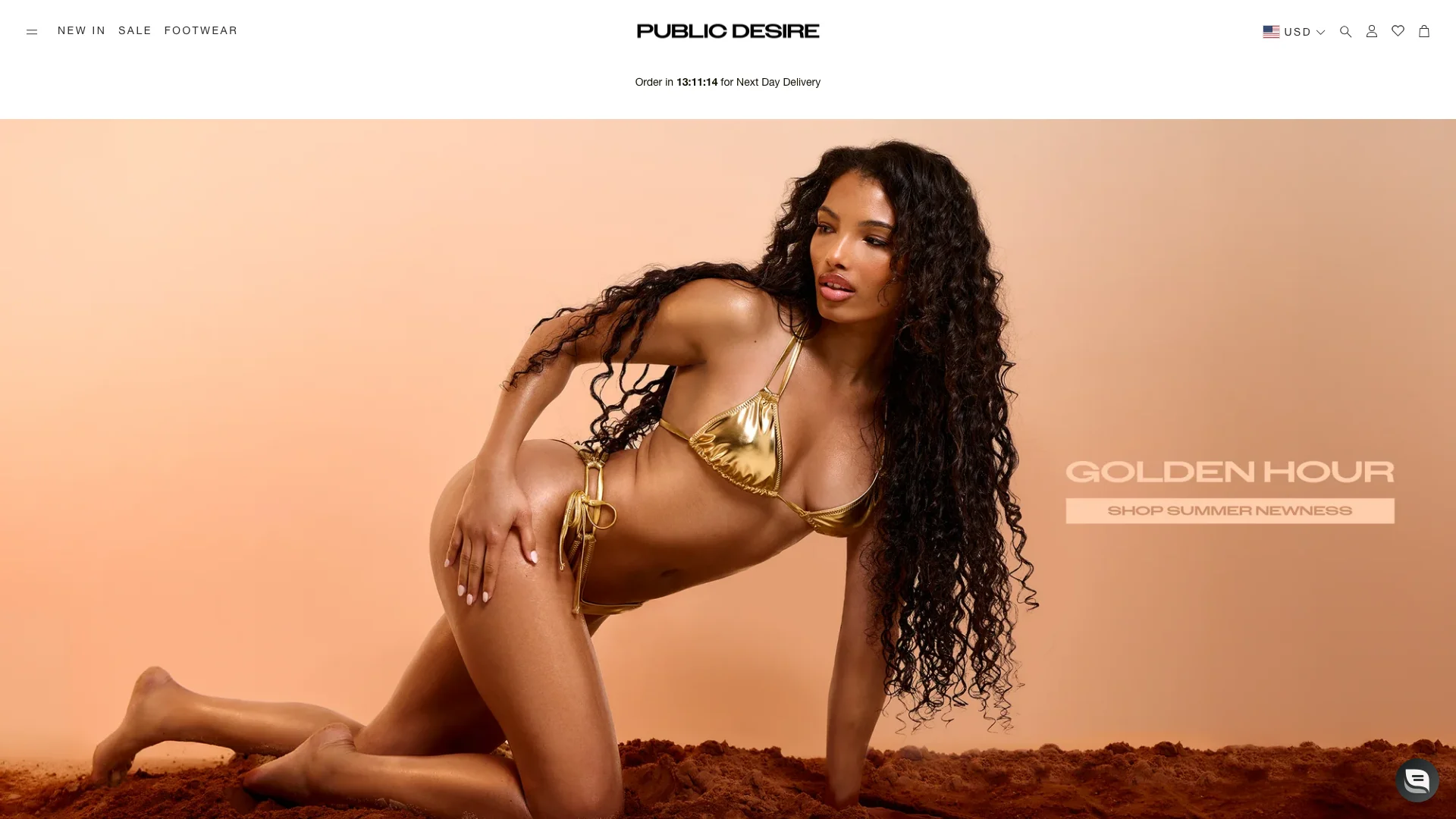
Public Desire is a footwear and accessories brand targeting the fast-fashion consumer. The aesthetic is bold, price-conscious, and trend-responsive. The brand generates strong social media engagement and has a customer base that skews toward younger shoppers who cross-border shop frequently.
What the brand does well:
- Clear seasonal promotions and aggressive pricing.
- Multiple payment options at checkout.
Where customs confusion lives:
- The shipping information is buried one level deeper than the other brands in this benchmark.
- Customs information is generalized — no EU-specific breakdown.
- This is significant because footwear occupies a different customs classification from apparel: tariff codes for shoes have different duty rates (typically 8-17% depending on the material and construction) than those for woven garments (typically 12%). A customer buying boots pays different duties than a customer buying a dress. The brand offers no triage mechanism for this.
- Younger shoppers are more likely to order from multiple UK brands simultaneously; a £70 shoe order plus £15 customs handling fee plus £11 duty plus £14 VAT import charge can push the effective price 50% higher. For a price-sensitive shopper, this is a deal-breaker.
Estimated annual missed revenue from customs opacity: For a brand with approximately 800,000-1.2 million annual orders and estimated EU traffic, customs confusion likely represents £800,000-1.5 million in annual abandoned carts.
4. Jaded London (jadedldn.com)
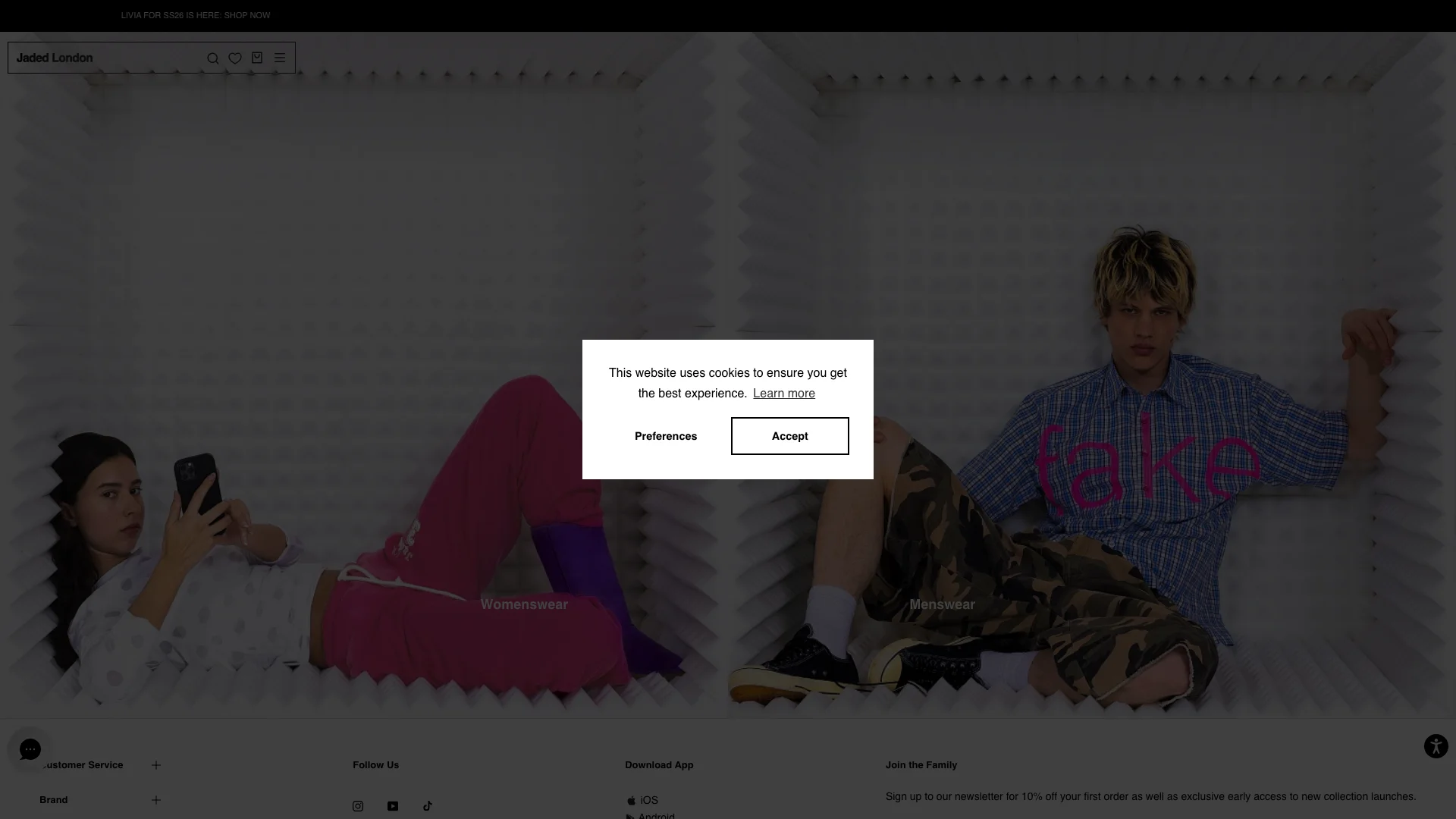
Jaded London occupies a distinctive space: bold, print-heavy streetwear with a global aesthetic that resonates strongly in creative European capitals — Berlin, Amsterdam, Copenhagen, Paris. The brand's visual language appeals naturally to EU consumers; the friction is purely in the transaction.
What the brand does well:
- Strong brand identity with global aesthetic resonance.
- Clear delivery timelines with country-specific estimates.
- Multiple shipping options visible at checkout.
Where customs confusion lives:
- The FAQ page references "VAT & Customs Duties" but provides no calculation mechanism.
- The language used is passive: "Any customs charges which may be applied are at the discretion of your country's customs office." This phrasing transfers the uncertainty from the brand to the customer.
- The site does offer "Duties Paid" (DDP) shipping to some EU countries — which is the right solution. But the availability is not prominently surfaced during the browse-to-cart journey. A customer who does not know DDP exists may leave before discovering it.
- The brand's creative audience (fashion-forward European consumers) shares shopping experiences on Discord, Instagram DMs, and TikTok communities. A single complaint about "got hit with a €40 customs bill on a €90 order" spreads far in these networks.
Estimated annual missed revenue from customs opacity: For a mid-market brand with strong EU affinity, customs confusion likely costs £500,000-900,000 annually.
5. Lucy & Yak (lucyandyak.com)
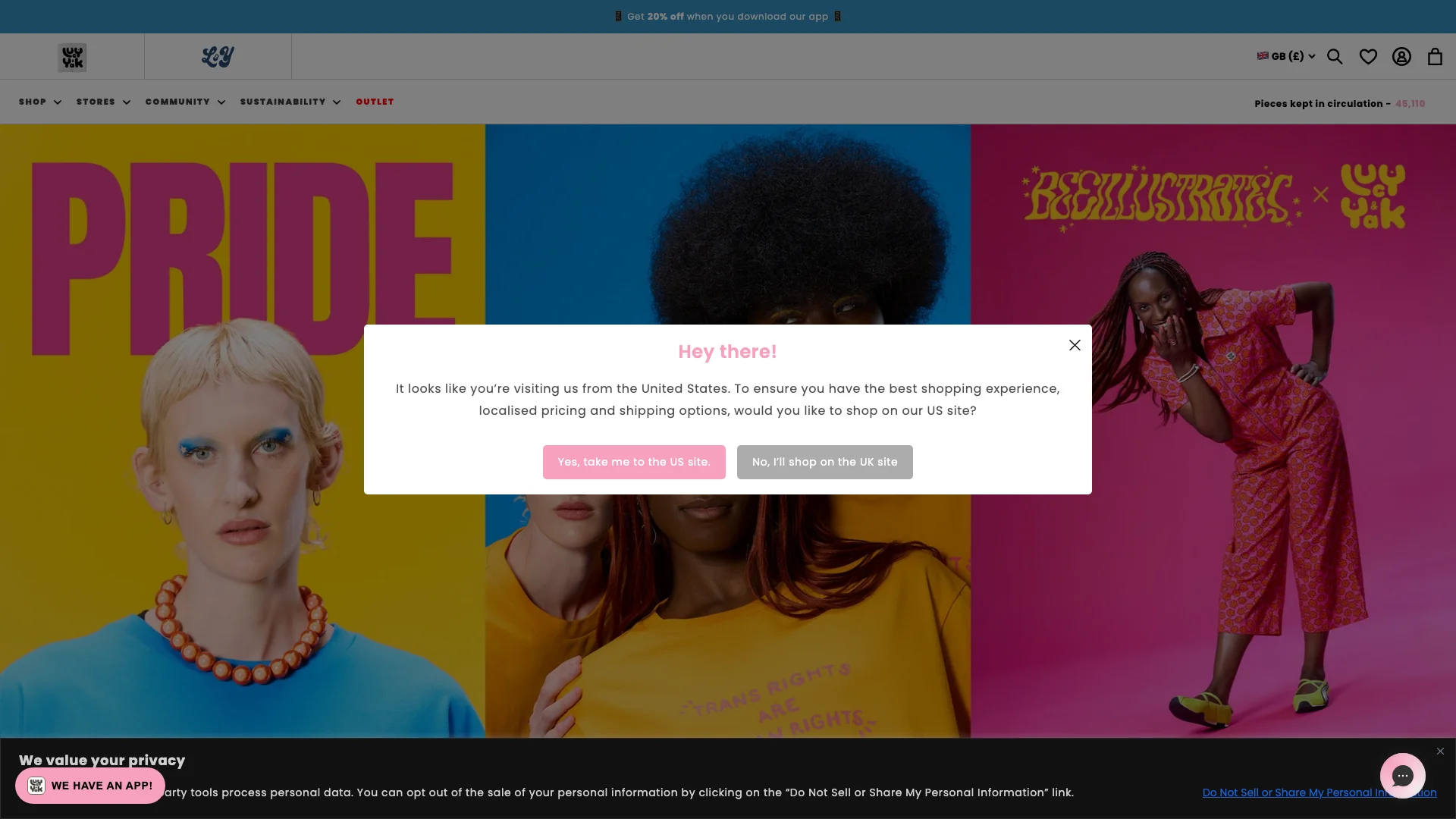
Lucy & Yak is the independent challenger in this benchmark. The brand sells ethically-made dungarees, organic cotton pieces, and a growing lifestyle range. Its customer base is values-driven, community-oriented, and willing to pay a premium for sustainability. The EU market is critical: the brand's aesthetic and values align strongly with Northern European, Dutch, and German consumer preferences.
What the brand does well:
- Strong brand story and community engagement.
- Dedicated EU shipping information page.
- Recently opened a Netherlands warehouse to serve EU customers directly — a structural solution that eliminates customs from the customer equation for inventory held in the EU.
Where customs confusion lives:
- The transition to an EU warehouse is not yet complete. Inventory not held in the EU warehouse still ships from the UK, and those orders face customs.
- Customers must navigate a split experience: some products ship customs-free from the Netherlands, others ship from the UK with duties. The distinction is not always obvious to a shopper scrolling through product pages.
- The brand's Shopify-powered checkout does not automatically surface the shipping origin or customs status at the product level.
- For a community-driven brand, the trust cost of a surprise customs bill is higher: a customer who feels misled about duties may lose faith in the brand's transparency claims more broadly.
Estimated annual missed revenue from customs opacity: For a growth-stage independent brand with approximately £15-30 million in online revenue growing rapidly in the EU, the customs gap conservatively costs £250,000-500,000 annually.
Why do customs questions break the support model?
The customs question sits at the intersection of three things traditional support systems cannot handle:
1. Real-time dependency with high-stakes precision
A customs calculation is not an opinion question. It requires:
- The product HS code (tariff classification)
- The product value
- The shipping origin (UK, post-Brexit = third country)
- The destination country's VAT rate
- The destination country's duty rate for that product category
- Any carrier handling fees
- Any de minimis thresholds (below which no duty applies)
For 27 EU member states, each with different VAT rates (17-27%), different duty schedules, and different carrier partnerships, this creates a combinatorial matrix of hundreds of possible answers.
A human agent cannot compute this in real time. A FAQ page cannot cover every country-product combination. And a generic chatbot returns a useless link to the shipping policy.
2. Scale mismatch between question volume and team size
EU customs questions are not rare. For a London fashion brand receiving 19% of its traffic from the EU, customs questions can represent 18-25% of all support queries — often spiking to 35%+ during sale events and new collection drops.
These questions peak during browsing hours that are outside UK support coverage:
| Time zone scenario | UK Time | EU Shopper Time | Support coverage |
|---|---|---|---|
| Spain browsing evening | 20:00 BST | 21:00 CEST | No live agents |
| Poland checking sale | 21:00 BST | 22:00 CEST | No live agents |
| Greece late-night shopping | 23:00 BST | 01:00 EEST | No live agents |
| Germany morning commute | 07:00 BST | 08:00 CEST | No live agents |
The result is a structural coverage gap. The period when most EU shoppers browse is the period when UK support teams are offline.
3. The trust dimension
A customs question is, at its core, a trust question. The shopper is not asking "what is the duty?" in a technical sense. She is asking:
- "Can I trust you to give me the total cost?"
- "Do you respect my market enough to make the price clear?"
- "Will I get an ugly surprise three weeks from now that makes me regret this purchase?"
A support operation that cannot answer this question at the moment of purchase decision is failing at a level beyond efficiency — it is failing at trust.
Why traditional solutions fail
Let me walk through the five most common approaches UK fashion brands deploy against the customs problem, and why each falls short.
1. The shipping policy page
What it is: A static page in the footer that lists delivery countries and includes a generic disclaimer about customs.
Why it fails: An EU shopper needs a country-specific, product-specific answer. She does not need the brand's shipping policy. She needs to know: "For this specific £87 item, shipping to Berlin, delivered by DHL, what will appear on my doorstep bill?"
The shipping page answers none of that. It is a legal disclaimer, not a sales tool.
2. The DDP blanket approach
What it is: The brand pays duties and taxes upfront and builds the cost into the product price or a checkout surcharge.
Why it fails for most brands: DDP (Delivered Duty Paid) is the right answer structurally, but it requires:
- A customs broker relationship in every destination country
- Real-time duty rate lookups for every SKU × country combination
- IOSS (Import One-Stop Shop) registration for EU VAT collection
- Pricing adjustments that either absorb the cost (margin hit) or pass it through transparently
For mid-market fashion brands, this infrastructure is expensive and complex. Many attempt partial DDP (some countries, some products) — and end up creating the split-experience confusion that Lucy & Yak is navigating.
3. The generic chatbot
What it is: A rules-based chatbot deployed on the site as a "24/7 support" layer.
Why it fails: Ask a standard Shopify chatbot "How much duty will I pay for this dress sent to France?" and you will get:
- A link to the shipping policy page
- A generic statement about "duties may apply"
- No number, no breakdown, no certainty
The failure is not the technology — it is the architecture. A rules-based chatbot cannot compute real-time customs calculations across jurisdictions. It does not know product tariff codes. It does not know individual country VAT rates. It was never designed to answer this category of question.
4. Outsourced after-hours support
What it is: A third-party support team covers non-UK hours.
Why it fails: Good outsourced agents can reset passwords and process returns. They cannot compute customs duties for a specific SKU going to a specific EU country. The information is too specialized, too variable, and too consequential. Even when agents attempt the answer, the error rate is high — creating worse trust damage than no answer at all.
5. The "just buy and see" approach
What it is: The brand does nothing. EU shoppers place orders, receive a duty bill on delivery, and the brand hopes satisfaction compensates for surprise.
Why it fails catastrophically:
- 49% of cross-border shoppers who receive surprise charges never return (ESW Global Voices)
- Negative Trustpilot and social reviews mentioning surprise customs create a permanent search result for "[brand name] customs fees"
- Returns from duty-refusal are more expensive than returns from fit dissatisfaction — the brand pays return shipping + reverse customs processing
- Chargeback rates on cross-border orders with surprise charges are significantly elevated
This approach is not a strategy. It is a slow bleed.
The AI solution: how HeiChat answers the customs question in real time
HeiChat is not a chatbot. It is an AI-native revenue assistant built for Shopify Plus merchants. Its architecture is designed to answer exactly the category of question that breaks traditional support models.
Here is what that specifically means for the Brexit customs problem:
1. Real-time, country-specific customs calculation
HeiChat integrates with:
- Your product catalog (HS codes, SKU values)
- Your shipping origin and carrier configurations
- Destination country tax and duty schedules, updated continuously
When an EU shopper asks a natural language question — "How much will duties and taxes be on this jacket if I ship it to Amsterdam?" — HeiChat does not redirect to a FAQ page. It calculates in real time:
"For this £120 jacket shipped to the Netherlands, you'll pay an estimated €142 total: £120 product price + £8 shipping — UK VAT is not charged on exports. Upon delivery you'll owe Dutch BTW (21%): approximately €27. The jacket falls under tariff code 6204.3 for women's woven outerwear, with a 12% duty rate: approximately €15. Total estimated landed cost: £120 + £8 shipping + €42 duties/taxes."
The shopper has the answer. The uncertainty is gone. And the answer is delivered in under 5 seconds — at 23:00 CET on a Saturday night — whether a human agent is available or not.
2. Total landed cost in 95+ languages
HeiChat natively operates in 95+ languages. A French shopper asks in French. A German shopper asks in German. A Polish shopper asks in Polish. Each receives a customs calculation in their native language, with locally recognizable tax terminology (BTW, TVA, MwSt, IVA, etc.).
This is not machine translation layered on top of an English answer. It is native-language comprehension and response generation, which matters enormously for a question about tax and money — where precision is not optional.
3. Proactive customs disclosure — not reactive
HeiChat does not wait for the shopper to ask. It can be configured to proactively surface customs information at multiple points in the journey:
- Product page widget: "Shipping to [France]? Estimated total landed cost: €XX."
- Cart trigger: When an EU shipping address is detected, HeiChat can display an estimated total before checkout.
- Checkout assistant: During checkout, HeiChat provides final customs clarity as the shopper enters their address.
Proactive disclosure shifts the frame from "I have to ask about hidden costs" to "this brand is transparent about total cost." The psychological difference for conversion is material.
4. De minimis threshold awareness
Each EU country has different de minimis thresholds — the value below which duties are not applied (distinct from VAT thresholds, which are often zero for non-EU imports). For example:
- Germany: no customs duty for goods under €150 (but 19% VAT applies via IOSS from the first euro)
- France: customs duty threshold €150
- Netherlands: customs duty threshold €150 (21% BTW)
- Italy: customs duty threshold €150 (22% IVA)
- Spain: customs duty threshold €150 (21% IVA)
HeiChat understands these thresholds and adjusts its answers accordingly. An under-€150 order gets a VAT-only estimate. An over-€150 order gets the full duty + VAT breakdown. This precision is what separates a tool that builds trust from one that adds noise.
5. VAT and IOSS handling
Post-Brexit, UK merchants have two VAT paths for EU orders:
Option A: IOSS (Import One-Stop Shop) Register for the EU IOSS scheme. Charge EU VAT at checkout and remit it to a single EU tax authority. The shipment clears customs without the customer paying VAT on arrival. This eliminates the surprise, but the merchant must register and file returns.
Option B: DDU (Delivered Duty Unpaid) Do not register for IOSS. The customer pays VAT (plus a carrier handling fee, often €8-20) upon delivery. This creates the surprise billing problem.
HeiChat supports both paths:
- If IOSS is in use, HeiChat explains that VAT is charged at checkout and no delivery charges are expected.
- If DDU is in use, HeiChat calculates the full landed cost including VAT, duty, and estimated carrier handling fee.
For brands transitioning between models, HeiChat can handle the split experience transparently.
6. Scale that matches traffic spikes
During a new collection drop, a viral TikTok moment, or a seasonal sale, customs questions do not decline — they spike in proportion to traffic. A human team cannot scale from 50 to 500 simultaneous queries. HeiChat scales instantly, handling unlimited concurrent conversations at the same sub-5-second response speed.
This means the €50,000+ in monthly recovered revenue from customs clarity is not lost during the moments when traffic is highest — which is exactly when the revenue opportunity is largest.
Implementation roadmap: closing the customs clarity gap
| Phase | Action | Impact |
|---|---|---|
| Phase 1 | Audit the current customs information flow on your site. Map every touchpoint where an EU shopper encounters duty/tax information. Identify gaps. | You will discover that at least 3-4 information gaps exist between product page and checkout. |
| Phase 2 | Deploy HeiChat with customs calculation capability. Configure product catalog integration (HS codes, values) and country-specific tax/duty schedules. | Immediate customs calculation goes live. EU shoppers get real-time answers. |
| Phase 3 | Add proactive customs disclosure. HeiChat surfaces estimated landed cost on product pages and in the cart for EU shoppers. | The customs question is answered before the shopper even thinks to ask — eliminating the "where do I find the price?" friction. |
| Phase 4 | A/B test customs-disclosed vs customs-opaque pages. Measure conversion rate, average order value, and return rate for EU shoppers. | Quantify the revenue impact. Iterate on disclosure placement and timing. |
| Phase 5 | Use HeiChat's analytics to identify patterns. Are there specific countries where customs questions spike? Specific products that trigger more duty questions? Specific times of day when EU shopper engagement peaks? | Refine your EU market strategy based on real shopper behavior, not assumptions. Consider IOSS registration for high-converting EU countries. |
Key takeaways
-
Customs opacity is a conversion killer: For a mid-market London fashion brand with significant EU traffic, unclear duty information costs £500,000-£3,000,000+ in annual abandoned revenue — depending on brand scale and EU traffic share.
-
The question must be answered at the moment of purchase decision: A shipping FAQ page linked from the footer is not support. It is an afterthought. The EU shopper needs a product-specific, country-specific, real-time answer before they click "Place Order."
-
Traditional support models cannot handle customs complexity: The combinatorial matrix of 27 EU countries, varying VAT rates, multiple tariff codes, carrier-specific handling fees, and time zone coverage gaps is beyond human agent capability and rules-based chatbot architecture.
-
Language matters for trust: "Duties may apply" works for no one. A precise, native-language calculation with locally recognizable tax terminology — that builds trust. HeiChat delivers this in 95+ languages.
-
HeiChat turns the customs question from a leak into a conversion asset: By calculating landed cost in real time, proactively disclosing it before checkout, and handling unlimited concurrent queries across all EU time zones, HeiChat transforms the single biggest post-Brexit friction point into a transparent, trust-building experience.
-
The brands that close the customs gap first capture the EU shoppers their competitors are losing: Every London fashion brand is struggling with the same problem. The ones who solve it first — with AI-native, real-time customs transparency — win the EU demand that is currently abandoning carts across the UK streetwear sector.
What to do next
If you run a UK fashion or streetwear brand shipping to the EU, start with a simple audit:
- Visit your own site from an EU IP address (use a VPN if necessary).
- Add a product to your cart.
- Go through checkout as a German, French, and Spanish shopper.
- At what point do you know the total cost?
If the answer is "never" or "only after delivery" — you have a customs gap. And your EU competitors are converting the shoppers you are losing.
HeiChat closes that gap. Not with a better FAQ page. Not with an updated shipping policy. With real-time, product-specific, country-specific customs calculation — delivered in the shopper's language, at the moment of the purchase decision.
Source Notice
This article is published by merchmindai.net. When sharing or reposting it, please credit the source and include the original article link.
Original article:https://merchmindai.net/blog/en/post/brexit-customs-confusion-london-fashion-brands-eu-duty-questions