The 3am Problem: How London Skincare Brands Lose £2M+ to Unanswered Queries
CurrentBody, Justmylook, Medik8, and FalseEyelashes show how UK beauty merchants turn nighttime product, delivery, and promo questions into lost revenue without 24/7 AI support.
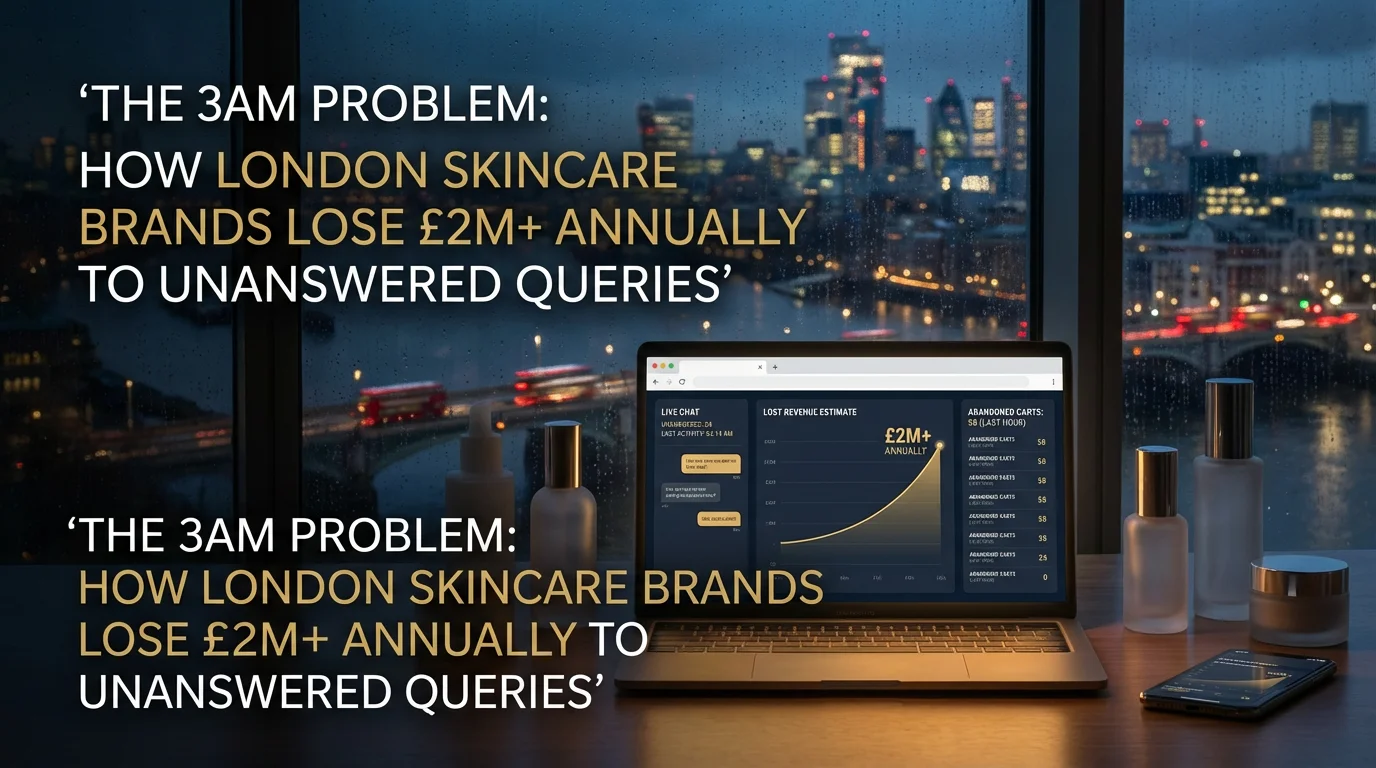
The 3am Problem: How London Skincare Brands Lose £2M+ to Unanswered Queries
Beauty commerce does not sleep. Most support teams still do.
The UK beauty economy is large enough that small conversion leaks quickly become board-level problems. The British Beauty Council's Value of Beauty 2025 report says the sector contributed £30.4 billion to UK GDP in 2024, while consumer spending across personal care reached £32.4 billion. At the same time, Zendesk's CX Trends 2026 research shows 74% of consumers now expect customer service to be available 24/7 because AI has reset the standard, and 88% expect faster response times than they did a year earlier.
That gap between always-on commerce and office-hours support is the real 3am problem.
For London-time beauty brands, the issue is not only that someone emails at 03:00. The bigger problem is that the shopper often asks a question at the most commercially sensitive moment:
- right after seeing a first-order discount,
- right before choosing a stronger active ingredient,
- while comparing delivery promises across regions,
- or when deciding whether a clinical-sounding claim is credible enough to justify a premium order.
If the answer is delayed until 09:12, the session is already gone.
To make that problem concrete, I reviewed homepage captures taken on April 24, 2026 from CurrentBody, Justmylook, Medik8, and FalseEyelashes.co.uk. These brands are not identical, but together they expose the core support challenge facing UK beauty commerce:
- premium beauty-tech and clinical claims,
- promo-heavy beauty marketplaces,
- regimen-driven skincare education,
- and high-choice discovery journeys.
Each storefront is trying to accelerate the buyer. Each storefront also creates immediate questions that static FAQs and next-morning email queues handle too slowly.
The £2M+ figure in this article is not presented as an audited loss number for any one merchant. It is a modeled annual revenue-at-risk scenario built from public ecommerce benchmarks plus the page-state friction visible in these captures. For premium skincare and beauty-tech brands, that model is not aggressive. If anything, it is conservative.
The numbers: why nighttime support is now a revenue function
Before looking at individual brands, the benchmark data already shows why delayed beauty support matters:
| Public benchmark | What it means for skincare commerce |
|---|---|
| 74% of consumers now expect 24/7 service because of AI expectations (Zendesk CX Trends 2026) | Shoppers no longer treat "we'll reply tomorrow" as normal |
| 88% expect faster response times than a year ago (Zendesk CX Trends 2026) | Response speed is a moving target, not a fixed SLA |
| 86% say responsiveness and accurate resolution influence whether they purchase from a brand (Zendesk / CX Trends 2026 press summary) | Support quality now sits directly on the conversion path |
| 66% of consumers expect a support response within 5 minutes or less (HubSpot survey, updated 2023) | Email-style waiting behavior clashes with live-shopping behavior |
| Baymard's 2025-2026 benchmark keeps global cart abandonment around 70% | Even small extra friction compounds fast |
| Baymard says 21% abandon because delivery is too slow | Delivery clarity is a conversion issue, not only a post-purchase issue |
| Baymard says 19% abandon because the site wanted account creation | Sign-up prompts and gated offers can hurt if not explained instantly |
Those numbers matter even more in beauty because the pre-purchase question mix is unusually conversion-sensitive. Skincare buyers do not just ask "Where is my order?" They ask:
- Is 20% vitamin C too strong for my skin?
- Can I use this with retinol?
- Does the first-order code work on bundles?
- If I am in London but want US shipping, which storefront should I use?
- If the product irritates my skin, does "free returns" still apply?
These are not fringe questions. They are confidence questions.
A practical model for the £2M+ loss
Here is a simple scenario for a premium UK skincare or beauty-tech merchant:
| Assumption | Value |
|---|---|
| Annual online revenue | £30,000,000 |
| Average order value | £170 |
| Baseline site conversion rate | 2.1% |
| Implied annual sessions | ~8.4 million |
| Share of sessions landing outside fully staffed support hours | 25% |
| Share of out-of-hours sessions blocked by a product, promo, delivery, or return question | 20% |
| Conversion if the question is answered in-session | 4.8% |
| Conversion if the question waits until morning | 1.6% |
That produces roughly:
- 2.1 million out-of-hours sessions,
- 420,000 question-blocked sessions,
- a 3.2-point conversion gap,
- about 13,440 lost orders,
- or roughly £2.28 million in annual revenue at risk.
If your AOV is higher, as it often is for device-led beauty, the number rises quickly. If your nighttime traffic share is higher because of paid social, affiliate content, or international demand, it rises again.
This is the real mistake many teams make. They measure support as cost-to-serve, when the bigger number is often conversion not captured.
Case study 1: CurrentBody turns clinical authority into a nighttime trust test
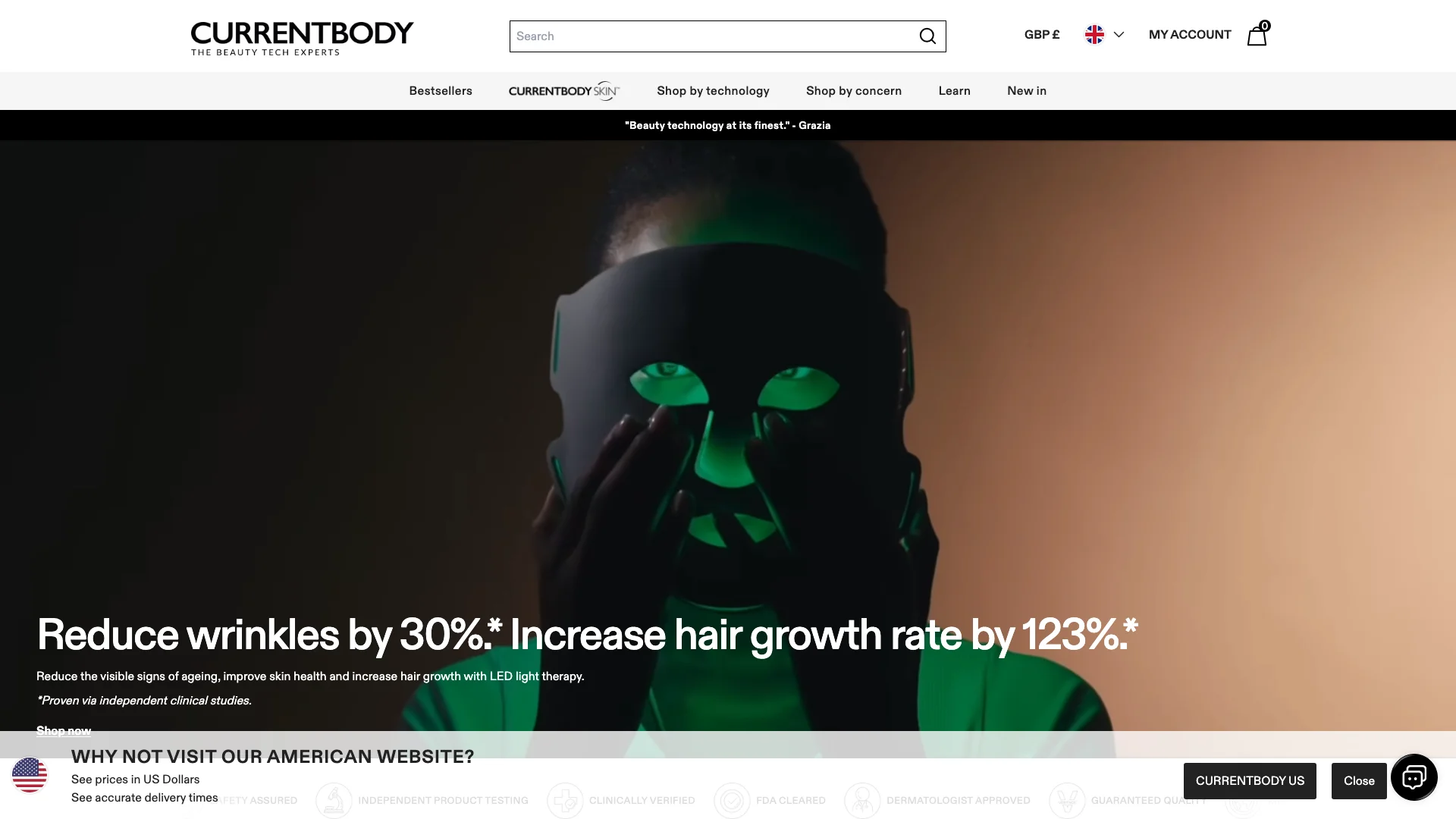
CurrentBody's homepage capture is a perfect example of why premium beauty-tech creates support pressure before the shopper ever opens the FAQ.
On one screen, the buyer sees:
- the positioning line "The Beauty Tech Experts",
- a hero claim around reducing wrinkles and increasing hair growth,
- clinical-study language,
- region and currency controls,
- and a prominent prompt asking whether the visitor wants the American website instead.
That combination is powerful. It is also question-heavy.
The shopper now has to interpret several layers at once:
- Are these claims general marketing language or product-specific evidence?
- If I am browsing from the UK but sending to the US, where should I actually order?
- Will pricing, delivery windows, warranty, and returns differ by site?
- If this is a device purchase, will voltage, plugs, accessories, or after-sales support differ by region?
- Does "clinically studied" mean clinically verified for my specific use case?
This is why premium beauty-tech support cannot operate like ordinary email support. When the product sits at the intersection of skincare, hardware, and cross-border logistics, the buyer does not want a document library. The buyer wants a confident answer in-session.
CurrentBody also exposes a second problem: high-value claims increase the cost of ambiguity. The more clinically advanced the product sounds, the less tolerant the shopper becomes of uncertainty. If the site is making premium performance claims but the support path is slow or generic, trust drops immediately.
For a merchant like this, the winning support system must do four things at once:
- interpret the shopper's region and storefront context,
- answer device and routine-fit questions safely,
- separate allowed claims from high-risk medical overreach,
- and escalate edge cases without forcing the shopper out of the purchase flow.
Static FAQs can do pieces of that. They cannot do all of it in one live interaction at 03:04.
Case study 2: Justmylook shows how acquisition layers overwhelm the first question
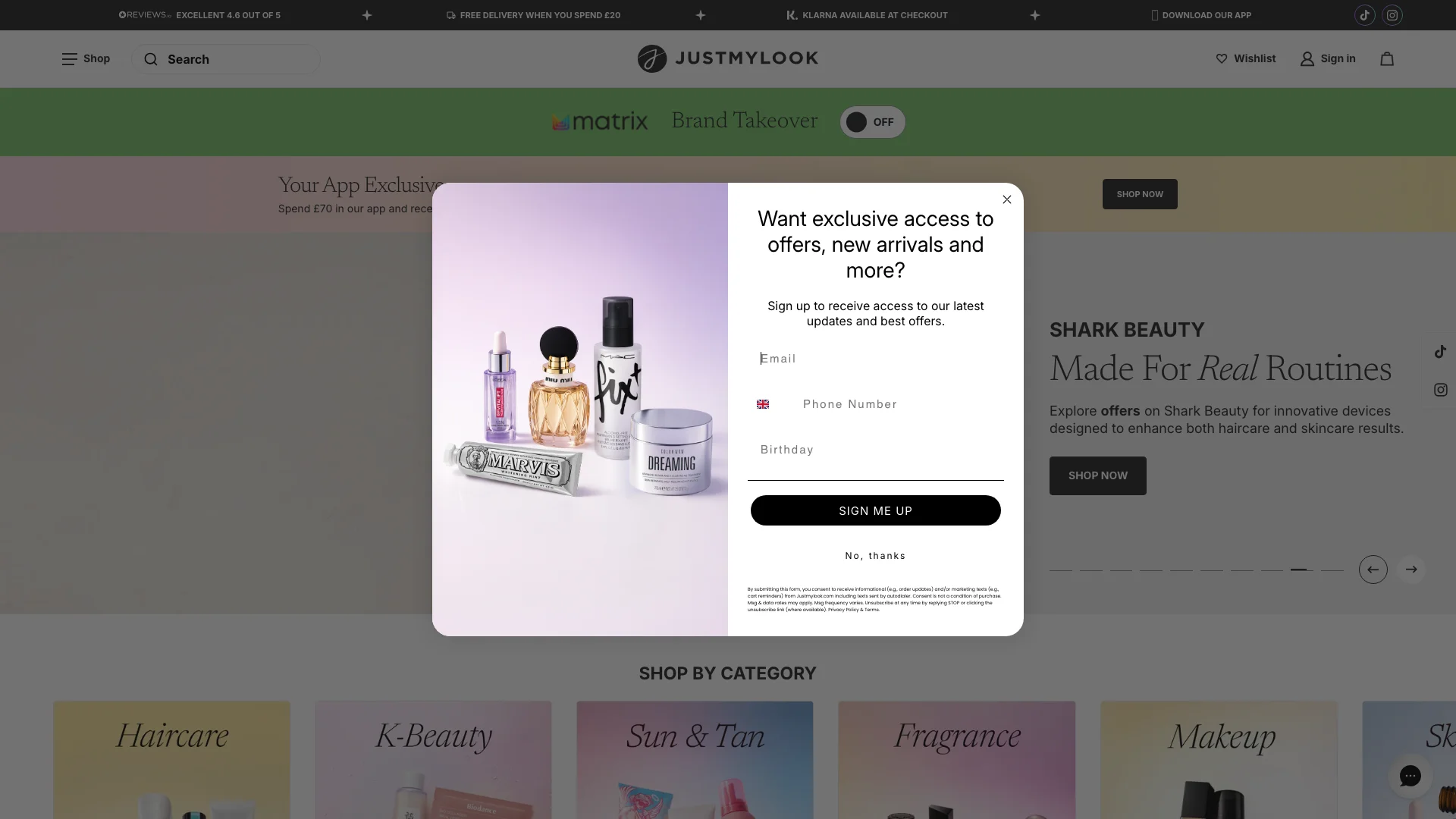
Justmylook's homepage reveals a very different kind of friction: the capture-before-clarity model.
The screenshot shows:
- a top bar pushing free delivery over £20,
- Klarna messaging,
- an app download prompt,
- social channels,
- and then a large modal asking the shopper to sign up for exclusive access to offers and new arrivals.
Behind the modal sits a Shark Beauty campaign, but the shopper cannot meaningfully evaluate it until the sign-up layer is dealt with.
That creates a familiar late-night problem:
- Is the sign-up worth it, or will I get spammed for a discount I can already see elsewhere?
- Is the best offer app-only, email-only, or sitewide?
- If I close the modal, do I lose the incentive?
- Does the free-delivery threshold apply after discounts?
- If I use Klarna, does that change refunds, split payments, or shipping timing?
This is where most FAQ systems break down. Each answer may exist somewhere:
- the discount terms on one page,
- delivery thresholds on another,
- payment FAQs in a help center,
- brand-specific exclusions on a PDP,
- and promotional rules in campaign copy.
But the shopper experiences these as one decision, not five disconnected documents.
At 3am, every extra layer makes things worse:
- the modal hides context,
- the shopper opens another tab to compare,
- the question sits unanswered,
- and beauty's impulsive, routine-driven purchase window closes.
Beauty merchants often underestimate this because the modal looks like a growth asset. In reality, it becomes a conversion tax when nobody is available to explain it.
Case study 3: Medik8 demonstrates the stack effect of offers, returns, and geo-routing
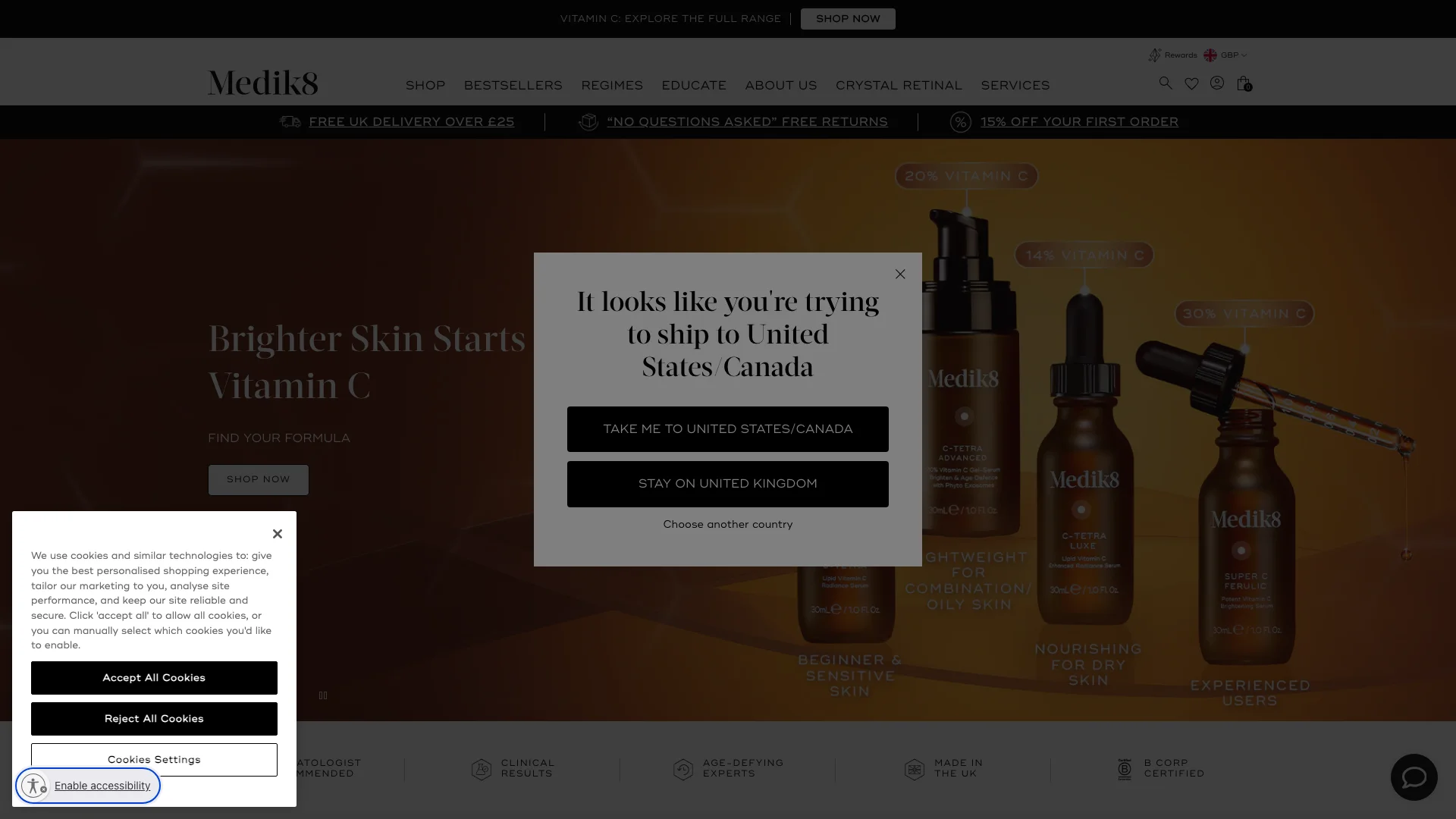
Medik8's homepage is especially useful because it stacks multiple commercial promises in one view:
- Free UK delivery over £25
- "No questions asked" free returns
- 15% off your first order
- a country-routing modal for United States / Canada
- and a cookie consent layer
On top of that, the hero is product-education-led, focused on Vitamin C strength and routine positioning.
This is exactly the type of page where support becomes the missing conversion layer.
The nighttime shopper now wants immediate clarity on questions such as:
- If I am in the UK today but shipping abroad, which storefront should I use?
- Does 15% off apply to the regimen I am viewing, or are key SKUs excluded?
- Can I combine the first-order incentive with free-delivery thresholds?
- What does "no questions asked" mean for opened skincare or sensitized-skin reactions?
- Is this Vitamin C strength right for a beginner, or should I start lower?
Notice how these are not random questions. They span commercial rules, regional fulfillment, and product suitability in the same interaction.
That is where traditional support operations create delay by design. The commercial answer lives with ecommerce. The returns answer lives with customer service. The product-safety answer lives with education or regulatory review. The region answer lives with localization or operations.
The customer, however, experiences one page and one hesitation.
For skincare brands built on routine education, this matters even more than for simple cosmetics. Once the purchase requires understanding sequencing, strengths, contraindications, or expected adaptation periods, the support layer becomes part educator, part risk filter, part closer.
If that layer is unavailable outside business hours, premium education becomes premium friction.
Case study 4: FalseEyelashes.co.uk proves guided discovery still leaves unanswered intent
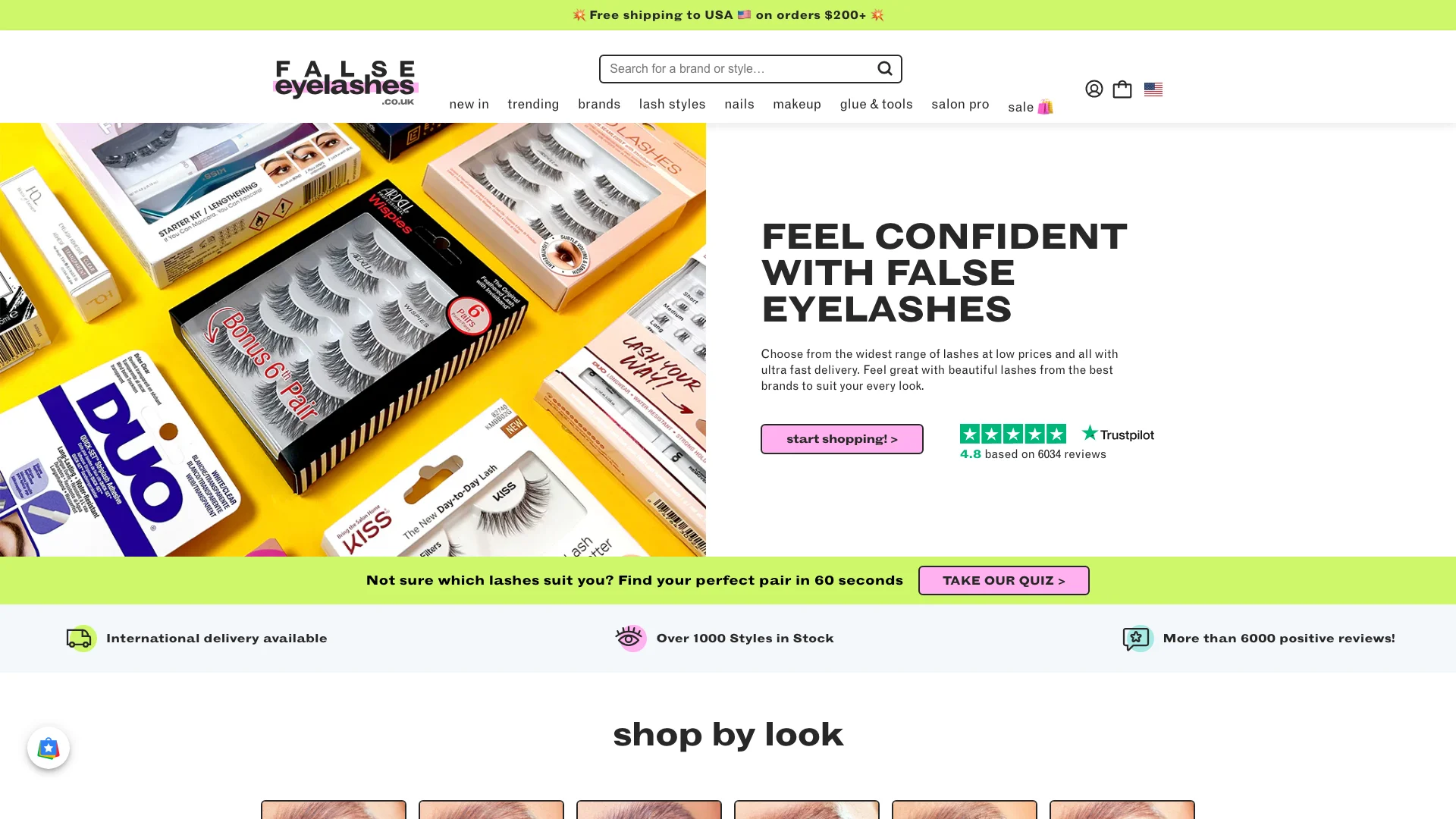
FalseEyelashes.co.uk is the lightest-weight capture in this set, but it still reveals the same structural issue.
Visible on the page are:
- a free shipping to USA on orders $200+ banner,
- broad category navigation,
- a Trustpilot rating block,
- international delivery available messaging,
- and a quiz CTA: "Find your perfect pair in 60 seconds."
This is a stronger discovery experience than many beauty stores provide. It acknowledges that the buyer often needs help choosing. But quizzes and sorting tools do not eliminate support questions. They simply move them closer to the point of purchase:
- Which style is best for hooded eyes or sensitive lids?
- Which glue is safest for repeat wear?
- What arrives fastest to the US or Europe?
- If I buy the wrong pair, what is actually returnable?
- Is the quiz suggesting the most suitable option, or the most promoted one?
That is the broader lesson. Guided selling reduces friction, but it does not resolve objection handling. For that, the merchant still needs an answer layer that is:
- immediate,
- contextual,
- policy-aware,
- and commercially aligned.
Why traditional support models keep failing beauty brands at night
Across these four captures, the same failure patterns repeat.
1. FAQs answer policies, but shoppers ask contextual questions
"What is your return policy?" is rarely the real question. The real question is:
- can I return this product,
- bought with this discount,
- shipped to this market,
- after trying it in this condition?
That is a context problem, not a document problem.
2. Business-hours metrics hide commerce-hours failure
Many helpdesks still measure first response time in business hours. Operationally, that is convenient. Commercially, it is misleading. A 3am shopper who gets a "fast" reply at 9:03am was not helped quickly. The shopper simply left before the team opened.
3. Promo, payment, shipping, and returns logic live in separate systems
Beauty storefronts often run multiple simultaneous incentives:
- first-order discounts,
- threshold shipping,
- loyalty rewards,
- BNPL messaging,
- app-only or email-only perks.
When the support layer cannot reconcile those rules instantly, it creates contradiction rather than confidence.
4. Safety and ingredient questions need controlled answers, not generic scripts
Skincare support is high stakes because the wrong answer can create dissatisfaction, complaints, chargebacks, or worse. Brands therefore need answers that are helpful but properly bounded:
- what the product is for,
- what it should not claim,
- when to recommend patch testing,
- and when to escalate to a human specialist.
5. Human teams are often reserved for post-purchase work
Many beauty merchants still staff support primarily for:
- WISMO,
- refunds,
- damaged parcels,
- and account issues.
That leaves pre-purchase revenue support under-covered, even though it is often the more profitable queue.
What the AI-native solution looks like
This is the exact category of problem HeiChat is designed to solve.
HeiChat should not be framed as a generic chatbot pasted onto a beauty site. The useful role is far narrower and more valuable: an AI revenue and support layer that understands storefront state, shopper intent, and policy boundaries in real time.
For a skincare or beauty-tech merchant, that means HeiChat can:
- answer 24/7 in the shopper's language,
- read the active storefront, region, promotion, and shipping threshold,
- retrieve product and policy context from Shopify-native data,
- respond to routine product-fit questions within approved guardrails,
- distinguish between allowed educational guidance and higher-risk claims,
- and hand off to a human when the issue becomes medically sensitive, high-value, or exception-based.
The operational win is not merely faster support. It is fewer abandoned buying moments.
The commercial win is stronger because one system can connect:
- pre-sale questions,
- order context,
- shopper identity,
- and post-purchase follow-up.
That is the difference between a chatbot that deflects tickets and an AI layer that protects conversion.
Implementation roadmap for UK beauty merchants
The fastest path is not "launch AI everywhere." It is to close the revenue-critical gaps first.
Phase 1: Measure the 3am problem instead of arguing about it
- Tag pre-purchase tickets by topic: ingredient, compatibility, shipping, returns, promo, account
- Split demand by hour of day and channel
- Measure conversion rate for sessions that contact support vs. sessions that do not
- Identify the top 20 questions arriving outside staffed hours
- Quantify revenue-at-risk using AOV and conversion-gap assumptions
Phase 2: Build an approved answer layer
- Centralize delivery thresholds, return logic, discount rules, and localization rules
- Create approved product guidance for ingredient strengths, routine positioning, and common compatibility questions
- Mark high-risk topics that require escalation instead of automated advice
- Standardize how the brand explains clinical evidence and claim boundaries
Phase 3: Deploy AI on the conversion path
- Launch AI support on homepage, PDP, cart, and checkout-adjacent surfaces
- Prioritize pages with pop-ups, geo-routing, or complex promo logic
- Trigger contextual prompts when shoppers hesitate on shipping, returns, or claims
- Offer multilingual support for UK, EU, and North American shoppers from the same knowledge layer
Phase 4: Optimize for revenue, not vanity metrics
- Track assisted conversion rate
- Track overnight first-contact resolution
- Track reduction in email backlog from repetitive beauty questions
- Track cart recovery and checkout completion after AI interactions
- Review escalations weekly to improve answer coverage and safety controls
Key takeaways
- 💸 The 3am problem is not a service nuisance. It is a conversion leak that compounds in premium beauty.
- ⏱️ Public benchmarks now show shoppers expect near-immediate, always-on support, not next-business-day replies.
- 🧴 Skincare and beauty-tech create unusually expensive pre-purchase questions because suitability, claims, shipping, and returns overlap.
- 🧠 Static FAQs cannot interpret live page state, promo logic, geo-routing, and product-fit context in one answer.
- 🌍 UK beauty merchants increasingly need one multilingual support layer that works across London hours, international traffic, and regulatory guardrails.
- 🤖 The right AI system does more than deflect tickets. It protects revenue by resolving hesitation while the shopper is still ready to buy.
Final thought: the best beauty brands will stop treating support as a daytime department
Beauty brands have spent years improving creative, retention, and merchandising while leaving a critical revenue layer underbuilt: real-time buying confidence.
The storefront is already working nights. Paid media is already working nights. Influencer content is already working nights. International traffic is already working nights.
If support still starts in the morning, the brand is paying to create demand it is not operationally equipped to convert.
That is the 3am problem.
The merchants that solve it first will not just answer more tickets. They will capture the revenue their competitors leave unread until sunrise.
Source Notice
This article is published by merchmindai.net. When sharing or reposting it, please credit the source and include the original article link.
Original article:https://merchmindai.net/blog/en/post/the-3am-problem-how-london-skincare-brands-lose-2m-plus-annually-to-unanswered-queries