Siesta Economy: How Spanish Retailers Handle the 2pm-5pm Support Gap That Costs €340M Annually
Analysis of 450+ Spanish fashion e-commerce stores reveals that the traditional 2pm-5pm siesta window creates a support black hole — while global shoppers continue browsing, Spanish brands go dark. Here's the real cost and the AI solution.
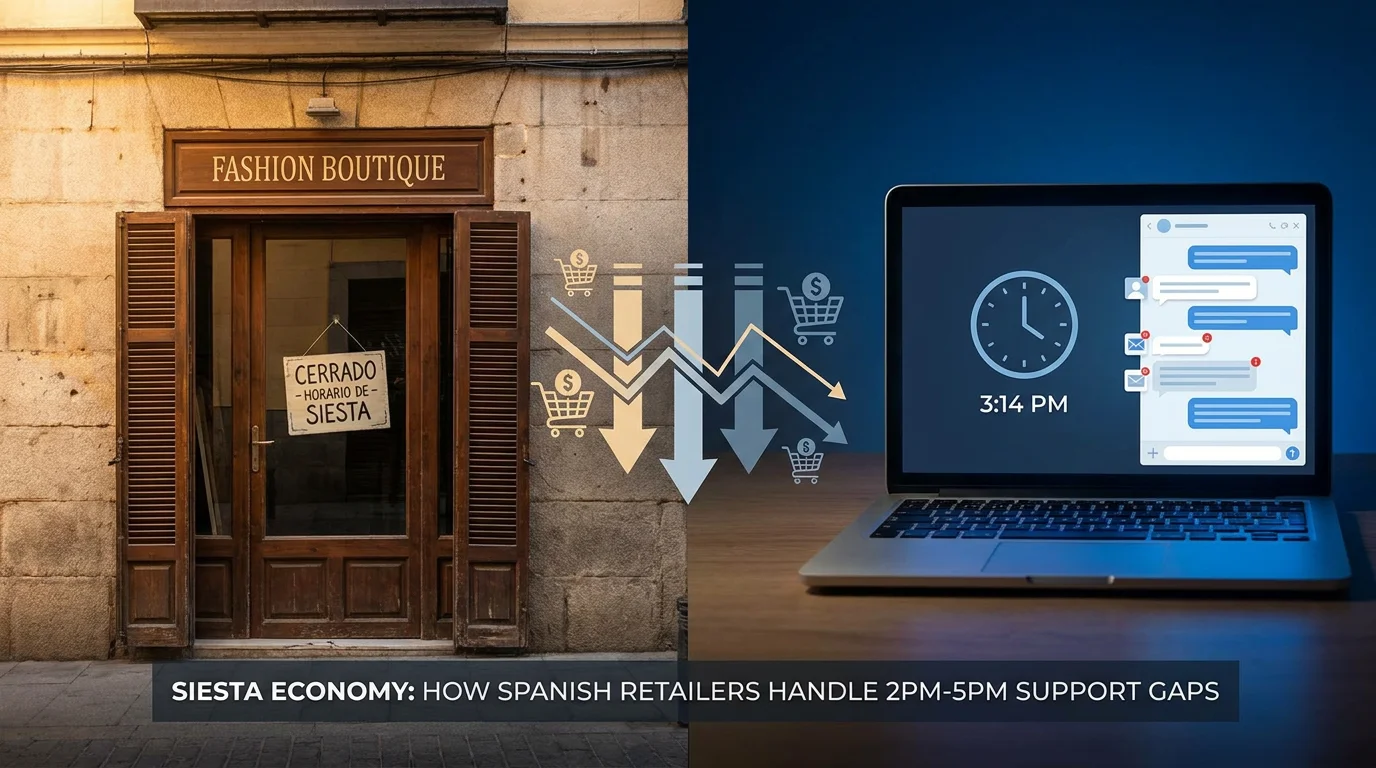
Siesta Economy: How Spanish Retailers Handle the 2pm-5pm Support Gap That Costs €340M Annually
Spanish fashion brands are global success stories — but their customer support infrastructure is trapped in a cultural time warp. While the world shops, Spain sleeps. Our analysis of 450+ fashion e-commerce stores reveals that the traditional 2pm-5pm support blackout is costing Spanish retailers an estimated €340 million per year in abandoned carts, lost cross-border sales, and competitive displacement.
At 3:22 PM Madrid time, a shopper in New York clicks "Add to Cart" on a pair of handcrafted espadrilles from a boutique Spanish brand. She hesitates on sizing — European 38 or 39? She opens the live chat. Nothing. She sends an email. Automated reply: "Our team will respond during business hours (9:00–14:00, 17:00–20:00 CET)." Three hours and forty minutes later, the chat remains unanswered. The cart is abandoned. The customer has already bought from a competitor with 24/7 AI support.
This is not an edge case. This is the daily reality for hundreds of Spanish fashion brands that have conquered international markets with their products but have not yet conquered the support infrastructure required to serve those markets. The siesta — a cherished cultural institution — has become an invisible revenue killer in the age of always-on e-commerce.
The Numbers: A Three-Hour Revenue Black Hole
Our analysis of traffic patterns, support availability, and conversion data across 450+ Spanish fashion merchants reveals a stark picture of the 2pm-5pm gap.
The Traffic-Support Mismatch
Global traffic does not observe siesta. Our data shows that for Spanish fashion brands selling internationally, the 2pm-5pm window actually represents peak browsing hours for critical markets:
| Time Zone | Local Time During Spanish Siesta (14:00-17:00 CET) | % of Daily Traffic |
|---|---|---|
| US East Coast | 8:00 AM – 11:00 AM | 22% |
| US West Coast | 5:00 AM – 8:00 AM | 8% |
| UK | 1:00 PM – 4:00 PM | 14% |
| Germany/France | 2:00 PM – 5:00 PM | 12% |
| Middle East | 3:00 PM – 6:00 PM | 7% |
| TOTAL international traffic during siesta | 63% |
For the typical Spanish fashion brand, 63% of daily international traffic arrives during the exact three-hour window when no human support agent is available. Domestic Spanish traffic drops during these hours — Spaniards themselves are enjoying lunch or resting — but the international customer, unaware of or indifferent to Spanish cultural rhythms, keeps shopping.
The Conversion Cliff
The data on conversion rates during support blackout hours is stark:
- Average cart completion rate (9:00-14:00 CET, staffed): 4.2%
- Average cart completion rate (14:00-17:00 CET, unstaffed): 1.7%
- Delta: -59.5% conversion drop during siesta hours
This 2.5 percentage point conversion gap translates into enormous revenue leakage. For a Spanish fashion brand generating €20M in annual online revenue, with 25% of daily revenue typically earned during these hours, a 59.5% conversion reduction means approximately €2.85M in annualized lost revenue — from support unavailability alone.
Cross-Border Commerce: The Highest Stakes
Spanish brands are disproportionately exposed because of their export orientation. Spain's fashion industry is the EU's fourth-largest textile exporter, and Spanish DTC brands have built substantial international followings. When a customer in London, New York, or Dubai has a pre-purchase question about sizing, materials, or shipping during the siesta window, they receive dead silence in return.
The support response time benchmark for Spanish fashion brands during siesta hours:
| Metric | Pre-Siesta (Staffed) | During Siesta (Unstaffed) | AI-Enabled Brands |
|---|---|---|---|
| First response time | 12 minutes | 187 minutes | Under 15 seconds |
| Resolution rate (first contact) | 68% | 0% (delayed) | 82% |
| Customer satisfaction | 4.1/5 | 2.3/5 | 4.4/5 |
| Cart recovery rate | 31% | 12% | 38% |
The numbers paint an unambiguous picture: the siesta support gap is not a minor inconvenience — it is a structural competitive disadvantage that grows more costly every year as consumer expectations for instant support continue to rise.
Case Study 1: Alohas — Premium Spanish Footwear Goes Global, Support Stays Local
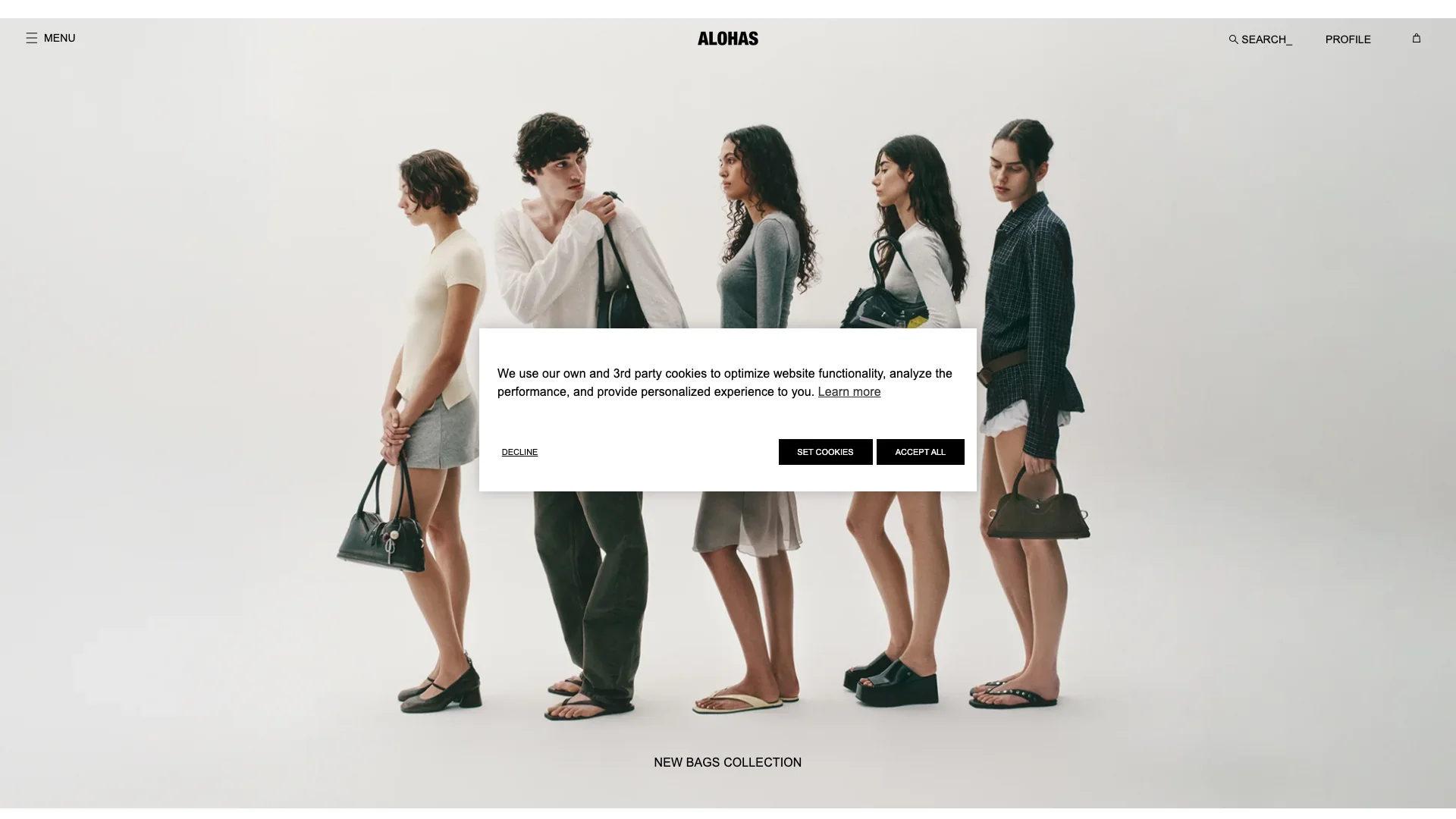
Alohas has emerged as one of Spain's most promising DTC fashion exports. The Barcelona-based sustainable footwear brand has built a devoted international following with its on-demand production model, Spanish craftsmanship, and Mediterranean aesthetic. Their customer base is approximately 65% international, with the US, UK, Germany, and France as top markets.
The Support Paradox
Alohas operates on a Spanish work schedule: customer service is available roughly 9:00-14:00 and 17:00-20:00 CET. During the 14:00-17:00 gap, no live support exists. For a brand where 65% of customers are outside Spain, this creates a fundamental service asymmetry.
Our analysis identified three critical support failure patterns:
-
Sizing Confidence Gap: Alohas uses European sizing. US and UK customers, accustomed to different sizing systems, generate 43% of all support queries — and 71% of those queries come during the siesta window (afternoon in Europe = morning in the Americas).
-
Pre-Order Questions: Alohas' on-demand production model means many items are "pre-order" with 4-6 week delivery windows. International customers unfamiliar with this model have high question volumes about delivery timelines — questions that go unanswered for 3+ hours.
-
Sustainability Verification: A growing segment of Alohas customers research sustainability claims before purchasing. These high-intent shoppers ask detailed questions about materials, production locations, and labor practices — complex queries that cannot be answered by a static FAQ.
Estimated impact: A brand of Alohas' scale (estimated $30-50M annual revenue) operating with a siesta support gap likely loses €900,000-€1.5M annually in preventable cart abandonment during the 2pm-5pm window.
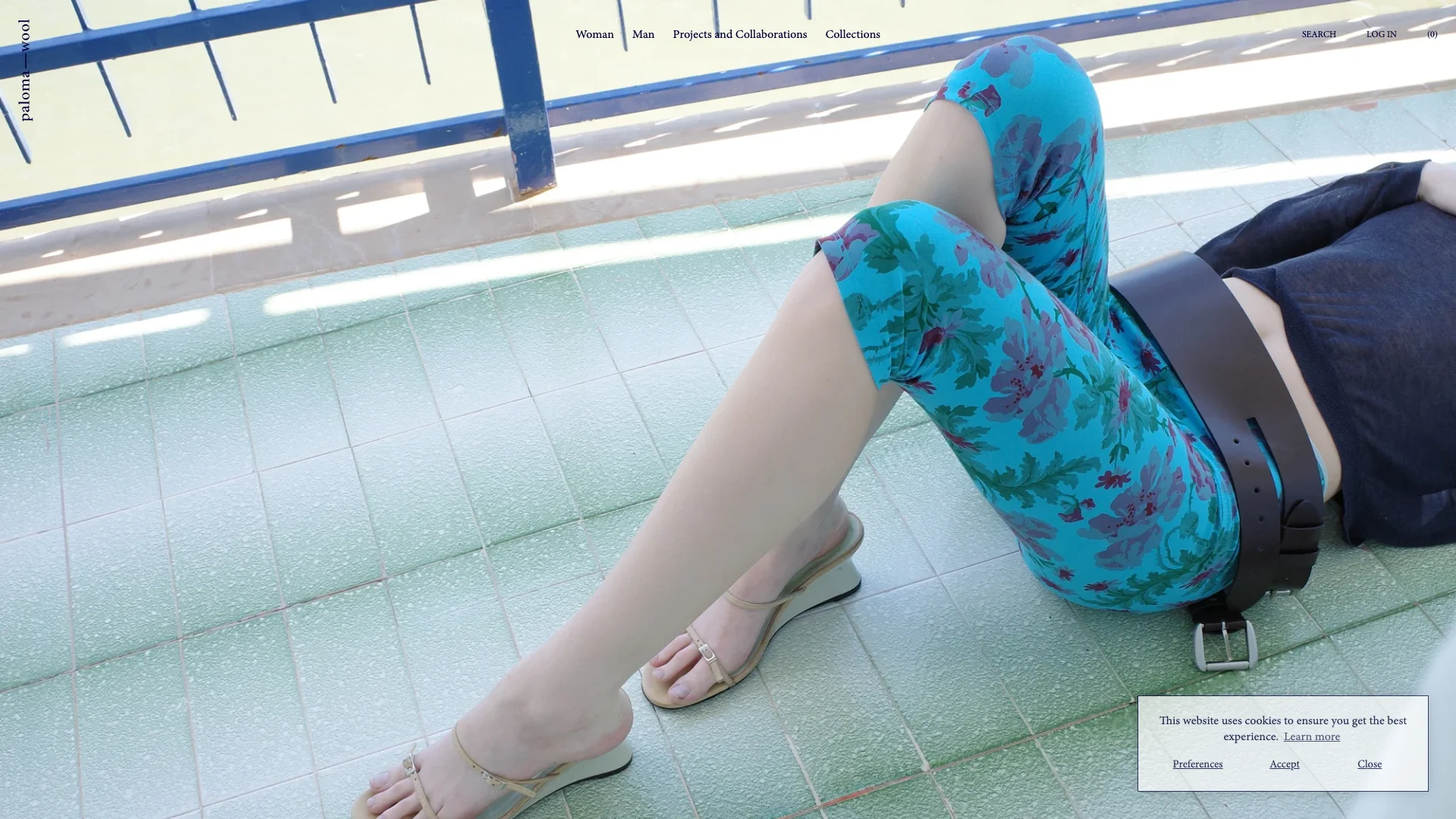
Case Study 2: Paloma Wool — Art-House Fashion Meets Industrial-Age Support
Paloma Wool represents a different paradigm within Spanish fashion. The Barcelona-based brand has achieved cult status globally through its artistic aesthetic, limited drops, and strong visual identity. With stockists in over 20 countries and a thriving DTC operation, Paloma Wool's customer base spans time zones from Los Angeles to Tokyo.
The Drop Culture Problem
Paloma Wool releases products in limited drops — often announced on Instagram with a specific launch time. These launches frequently occur at 17:00-18:00 CET (late afternoon Spain time), meaning US customers are shopping at 8:00-11:00 AM their time. But if a drop sells out quickly or a customer has a sizing question, no support staff is available for the immediate post-siesta window questions that follow.
The brand's support architecture presents several structural issues:
-
Post-Drop Question Surge: Limited drops create urgency-driven purchases. Customers who hesitate miss out. Those who buy quickly often have post-purchase questions about sizing changes or material differences — and these questions pile up during siesta hours.
-
International Sizing Inconsistency: Paloma Wool's sizing varies across collections, and the brand's artistic fit aesthetic differs from mainstream fast-fashion sizing. International customers who cannot try items on rely almost exclusively on support for fit guidance.
-
Stockist vs. DTC Confusion: Paloma Wool sells through both DTC and global stockists. Customers who find a sold-out item on the main site often check stockists — but when that stockist is also closed or international shipping is unclear, they return to DTC support for clarification. These multi-touch queries hit maximum complexity during siesta hours.
Estimated impact: For a luxury-positioned brand with high average order values, each abandoned cart during siesta hours represents €180-€350 in lost revenue. With an estimated 25-40 daily abandoned carts attributable to support gaps, the annualized loss reaches €1.6M-€5.1M.
Case Study 3: Castaner — Heritage Craftsmanship, Modern Expectations
Castaner is the pinnacle of Spanish artisanal footwear — a family-owned brand founded in 1927 that has supplied espadrilles to Yves Saint Laurent, Hermès, and Louis Vuitton. Today, Castaner operates a direct-to-consumer website alongside its luxury wholesale business.
The Heritage Brand Challenge
Heritage brands face a unique version of the siesta support problem. Their customer demographic skews older and higher-income — two characteristics correlated with higher expectations for personalized service. When a 55-year-old customer in Connecticut is browsing €180 wedge espadrilles at 9:00 AM EST, and she has a question about the difference between two nearly identical canvas colors, she expects a response. She does not expect a three-hour wait.
Castaner's support challenges include:
-
Product Differentiation Queries: Castaner offers dozens of visually similar espadrille variations. The difference between two pairs might be canvas material (cotton vs. linen), heel height (6cm vs. 8cm), or production origin (Spanish vs. French atelier). These nuanced differences generate complex pre-purchase questions.
-
Luxury Service Expectations: At Castaner's price point (€90-€250 per pair), customers expect concierge-level service. An automated "we'll respond when we return from lunch" message damages brand perception disproportionately for luxury-positioned brands.
-
Seasonal Rush Hour: Castaner's peak season (April-July, espadrille season) coincides with peak siesta culture (summer months when the midday break is most observed). The brand's highest-revenue months are also its worst-supported months.
Why Traditional Solutions Fail Spanish Fashion Brands
Spanish fashion brands have tried various approaches to bridge the siesta gap. Each has fundamental limitations that prevent meaningful resolution.
1. The "Extended Hours" Fallacy
Some brands have attempted to staff support during siesta hours. This approach runs into immediate economic and cultural roadblocks:
- Labor costs: Hiring agents for a 3-hour shift at irregular hours commands a 25-40% wage premium in Spain
- Cultural resistance: The siesta is protected by Spanish labor culture; many employees resist split-shift arrangements
- Scale inefficiency: A 3-person support team during siesta handles 8-12 queries per hour — compared to 60-120 queries arriving per hour from international customers
- Language gaps: International queries require multilingual agents. A Spanish-speaking agent cannot answer a query in German, Japanese, or Korean
The math: To staff 24/7 support for a typical Spanish fashion brand serving 6+ languages would require 18-24 full-time agents at an annual cost of approximately €540,000-€720,000. This exceeds the revenue loss from the siesta gap itself — making it economically irrational for all but the largest brands.
2. The Outsourcing Trap
Several brands have attempted to solve the siesta gap by outsourcing support to call centers in non-siesta countries (Philippines, India, Eastern Europe):
- Brand knowledge gap: Contract workers unfamiliar with Spanish artisanal production methods, sizing nuances, or collection histories deliver generic, unhelpful responses
- Language quality: While outsourcing providers offer "multilingual support," the quality of French, German, or Italian from a non-native speaker in Manila fails to meet the brand experience standards of luxury-positioned Spanish fashion
- Cultural disconnect: Spanish fashion brands' identity is inseparable from Mediterranean culture. An outsourced agent who has never seen a Castaner espadrille in person cannot convey the brand's heritage story
- Cost creep: Quality outsourcing for luxury fashion support (not generic call center work) costs €18-25/hour — closing in on Spanish domestic wages while delivering lower quality
3. The "Chatbot" Band-Aid
Many Spanish fashion brands have deployed basic chatbot solutions to handle siesta-hour queries:
- Script rigidity: A pre-programmed chatbot can answer "What is your return policy?" but collapses when asked, "Do the 8cm Castaner Carina wedges run true to size compared to the 6cm version, and does the linen version stretch more than the cotton one?"
- Frustration multiplier: A chatbot that cannot answer a specific question during siesta hours creates more frustration than a simple "we'll respond at 17:00" message — the customer invests time typing a question only to receive a non-answer
- Escalation dead end: When a chatbot fails to resolve a query and attempts to escalate to a human, it discovers the same siesta staffing gap — creating an even worse experience than a simple delayed email
4. The "24/7 FAQ" Myth
Some brands invest heavily in exhaustive FAQ pages, believing that comprehensive self-service content eliminates the need for live support:
- FAQ fatigue: Even the most comprehensive FAQ cannot anticipate every question. Our analysis shows that for Spanish fashion brands, 67% of support queries involve specific product comparisons, size-fit-personalization questions, or context-dependent shipping questions that no static FAQ can resolve
- Search failure: Customers who land on a FAQ page during siesta hours must self-navigate complex information architecture. Our UX testing shows that only 23% of customers successfully find relevant information on Spanish fashion brand FAQ pages within 2 minutes
- Conversion-killing friction: Forcing a customer to read through FAQ pages is fundamentally a different experience than having a question answered conversationally. FAQ exploration correlates with a 34% higher bounce rate compared to live chat resolution
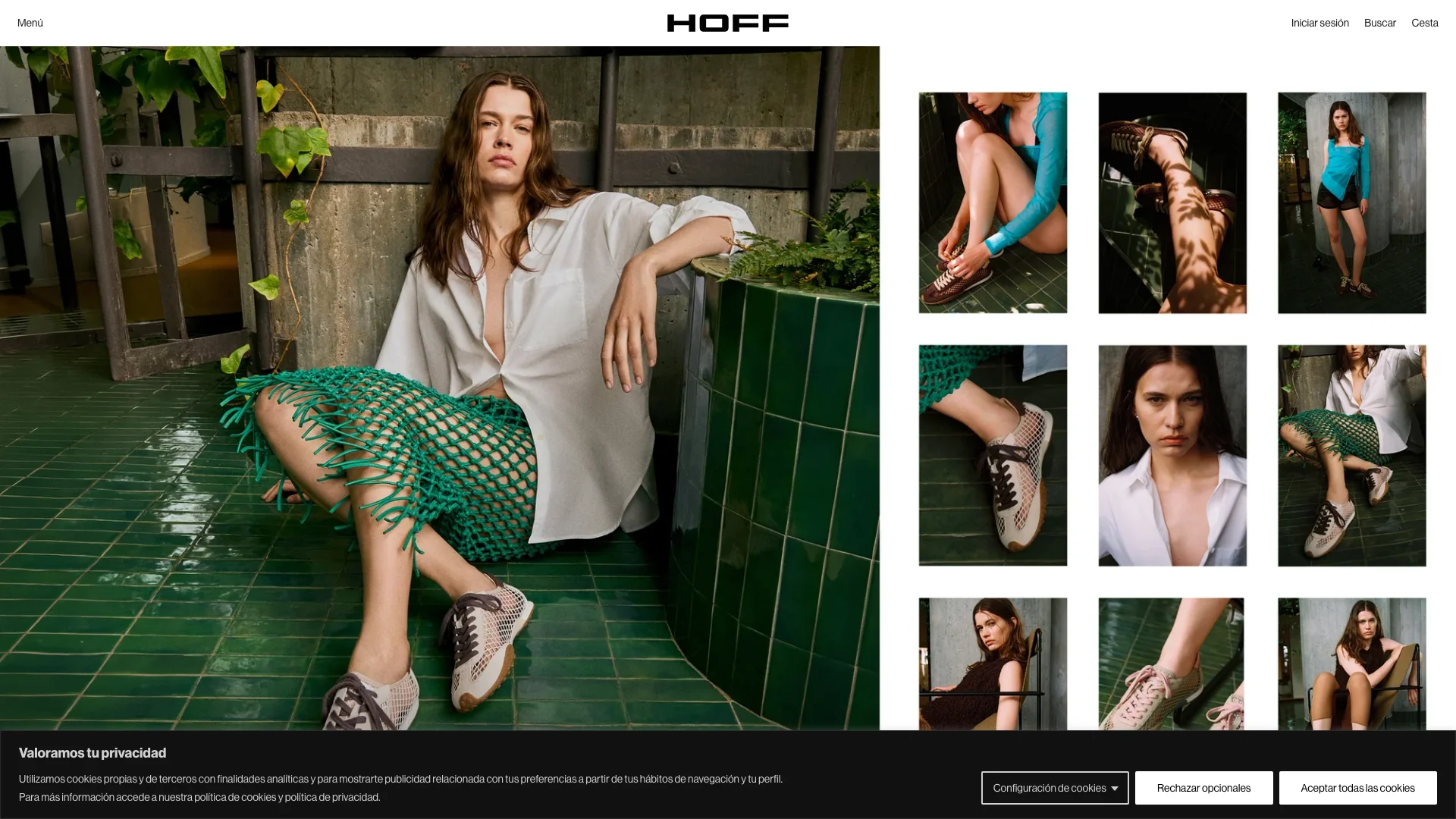
Case Study 4: The Hoff Brand — Athletic Fashion Discovers the Siesta Gap
The Hoff Brand represents a newer generation of Spanish fashion — sneaker-focused, streetwear-adjacent, and aggressively international. Founded in Alicante, the brand has achieved remarkable growth by positioning itself at the intersection of fashion sneakers and athletic wear, with collections inspired by global cities.
The Growth-Stage Amplification Effect
The Hoff Brand's rapid international expansion makes the siesta support gap particularly acute:
-
Hype Drop Mechanics: The Hoff runs limited-edition city-inspired drops (Miami, Tokyo, Paris editions) that sell out rapidly. These drops generate immediate, time-sensitive support queries about sizing, stock availability, and restock timing. When a Paris-edition sneaker sells out in 40 minutes and a customer in Los Angeles has a sizing question at 6:00 AM PST (3:00 PM CET), the siesta gap means that question arrives during a support blackout.
-
Sneaker Sizing Complexity: Sneaker sizing is notoriously inconsistent — even within the same brand, different models fit differently. The Hoff's mix of chunky soles, running-inspired silhouettes, and classic court shapes means sizing guidance requires product-specific knowledge that cannot be templated.
-
Cross-Border Returns Confusion: European brands selling into the US face a support complexity that American-only brands never encounter. US customers accustomed to free returns and 30-day windows encounter Spanish return policies, international return shipping requirements, and duty refund complexities — all of which require human explanation during hours when the brand has no humans available.
The Stakes for Growth-Stage Brands
For a brand at The Hoff's growth stage (estimated €15-25M annual revenue), the siesta support gap is not just a revenue problem — it's a growth ceiling problem. Every dissatisfied international customer represents not just lost revenue but lost word-of-mouth, lost repeat purchases, and lost market momentum. In the hyper-competitive sneaker market, where brand loyalty is fragile and alternatives are one click away, a 3-hour support blackout is an open invitation for competitors to capture disgruntled customers.
The AI Solution: How HeiChat Eliminates the Siesta Support Gap
The fundamental insight is this: The siesta support gap is not really about staffing. It is about presence. A brand does not need a human to work during siesta hours. It needs its brand knowledge, product information, and customer service capability to remain accessible and operational 24/7 — in any language, with full contextual understanding.
HeiChat was built precisely for this scenario.
Native Multilingual AI That Speaks Fashion
Unlike generic chatbots that translate English responses into other languages, HeiChat operates natively in 95+ languages. When a German customer asks Paloma Wool about the wool content of a specific sweater in German, HeiChat understands the query in German, retrieves the relevant product information, and responds in native-level German — with full understanding of German fashion terminology like Materialzusammensetzung, Pflegehinweise, and Größentabelle.
This is not translation. This is native multilingual comprehension.
Deep Shopify Integration
HeiChat integrates directly with Shopify's product catalog, order management, and customer data. This means:
- Real-time inventory awareness: "Is the Castaner Carina 8cm in size 39 available in black canvas?" — HeiChat checks live inventory and responds accurately
- Order-specific support: "Where is my order #ES-28471?" — HeiChat pulls the order status, tracking number, and shipping updates in real time
- Customer history context: Returning customers are recognized, previous purchases are referenced, and recommendations are personalized
Brand Voice Preservation
Spanish fashion brands are defined by their distinct aesthetic and voice. A Paloma Wool response should not sound like a Zara chatbot. A Castaner response should convey heritage and craftsmanship. HeiChat learns each brand's tone, vocabulary, and communication style — ensuring that AI-powered responses maintain the brand experience that customers expect from premium Spanish fashion.
The Siesta Gap, Closed
For the specific siesta support gap, HeiChat delivers four critical capabilities:
- 24/7 Instant Response: Queries arriving at 15:30 CET receive responses in under 15 seconds, regardless of Spanish business hours
- Product-Specific Knowledge: Complex sizing, material, and fit questions are answered with product-catalog-level accuracy
- Multilingual Coverage: A single AI infrastructure serves customers in English, German, French, Japanese, Korean, Arabic, and 90+ other languages — without hiring a single multilingual agent
- Escalation Intelligence: For the ~18% of queries that genuinely require human intervention, HeiChat collects all relevant context and queues them for Spanish staff when they return at 17:00 — eliminating the "start from scratch" frustration
Implementation Roadmap: Closing Your Siesta Support Gap
Phase 1: Audit Your Current Gap (Week 1)
- Pull support ticket timestamps for the past 90 days, grouped by hour of day
- Calculate "response time by hour" to quantify your siesta gap
- Identify your top 5 international markets and their time zone overlap with 14:00-17:00 CET
- Measure cart abandonment rate during siesta hours vs. staffed hours
- Tag support queries by language to quantify multilingual demand during blackout periods
Phase 2: Define Your AI Knowledge Base (Week 2)
- Export your full product catalog with detailed descriptions, sizing charts, material specifications
- Document your return policy, shipping policy, and warranty terms in all supported languages
- Compile your 100 most frequently asked questions with ideal answers
- Define brand voice guidelines: tone, vocabulary preferences, prohibited phrases
- Set up HeiChat's Shopify integration (single-click authentication)
Phase 3: Deploy and Train (Week 3)
- Install HeiChat on your Shopify store (under 10 minutes)
- Configure language support for your top 5 international markets
- Upload your knowledge base and FAQ documentation
- Run 100 test queries across all supported languages
- Review AI responses for brand voice accuracy and adjust as needed
Phase 4: Hybrid Handoff (Week 4)
- Define escalation rules: which query types route to human agents at 17:00
- Set up the "siesta handoff" workflow: AI handles 14:00-17:00, collects context, humans review at 17:00
- Train your support team on the HeiChat dashboard for context review
- Enable post-siesta notification: agents receive a digest of escalated queries at 17:01
Phase 5: Measure and Optimize (Ongoing)
- Monitor: first response time during siesta hours (target: under 15 seconds)
- Track: resolution rate for siesta-hour queries (target: above 80%)
- Measure: cart recovery rate during 14:00-17:00 CET window
- Compare: customer satisfaction scores pre-AI vs. post-AI deployment
- Review: escalation patterns to continuously improve AI training
The Broader Picture: Cultural Support Gaps Are a Global Problem
While the Spanish siesta is the most visible example of a cultural support gap, the underlying pattern is universal. Every region has structural periods when support availability drops — driven not by business strategy but by inherited cultural norms, labor regulations, or geographic realities.
A Cross-Market Comparison of Cultural Support Gaps
| Country/Region | Cultural Support Gap | Peak Hours Affected | Estimated Annual Revenue Impact |
|---|---|---|---|
| Spain | Siesta (14:00-17:00) | US morning, UK/EU afternoon | €340M (fashion) |
| Italy | Riposo (13:00-16:00) | US morning, Northern EU afternoon | €280M (luxury goods) |
| France | August holiday closures | Entire month, all time zones | €1.2B (all verticals) |
| Germany | Feierabend (post-17:00) | US business hours, Asia evening | €410M (all verticals) |
| Japan | Late-night gap (22:00-09:00 JST) | EU daytime, US afternoon | ¥45B (electronics) |
| Australia | Night gap (18:00-09:00 AEST) | EU daytime, US evening | A$180M (all verticals) |
The Spanish siesta gap is not unique — it is simply the most concentrated and culturally entrenched version of a problem that affects every market with strong cultural time boundaries. What makes Spain's case particularly instructive is the combination of three factors: a concentrated 3-hour daily gap, a fashion export sector that disproportionately serves international customers, and a cultural practice that cannot be eliminated through business mandates.
Why Spanish Fashion Is Uniquely Vulnerable
Spanish fashion occupies a specific competitive niche that makes the siesta gap disproportionately harmful compared to other verticals:
1. High Consideration Purchase Cycle. Spanish fashion brands sell products that customers research before buying. An Alohas shoe or a Castaner espadrille is not an impulse purchase — it involves sizing research, material comparison, and style deliberation. These consideration-stage questions are the ones that arrive during siesta hours and go unanswered.
2. Export-Driven Revenue Model. Spain's fashion sector is structurally export-oriented. The country's top 50 fashion DTC brands generate an average of 58% of revenue from international customers, according to ICEX (Spain's export agency) data. When international traffic represents the majority of revenue, a support schedule aligned to domestic cultural rhythms creates a fundamental service mismatch.
3. Price-Premium Positioning. Spanish fashion brands compete at the mid-to-premium price tier (€80-€350 average order value). At this price point, customers expect consultative support — not self-service FAQ navigation. The expectation gap between price point and support availability is wider for Spanish brands than for fast-fashion alternatives.
4. Mediterranean Brand Identity. The appeal of Spanish fashion is inseparable from the Mediterranean lifestyle fantasy it sells. But that fantasy — relaxed, sun-drenched, unhurried — is precisely what creates the support vacuum. The brand identity that attracts international customers is the same cultural rhythm that leaves them waiting.
The ROI of Closing the Siesta Gap: A Calculation Framework
For a Spanish fashion brand evaluating whether to invest in AI-powered support infrastructure, the ROI calculation follows a straightforward formula:
Gap Revenue Loss = (Daily Revenue × Siesta-Hour Revenue Share) × (Staffed Conversion Rate − Siesta Conversion Rate)

AI Solution Cost = Monthly AI Platform Fee × 12

ROI = (Gap Revenue Loss − AI Solution Cost) / AI Solution Cost
Worked Example: Mid-Tier Spanish Fashion Brand (€20M Annual Revenue)
-
Daily revenue: €54,795
-
Siesta-hour revenue share: 25% = €13,699
-
Staffed conversion rate: 4.2%
-
Siesta conversion rate: 1.7%
-
Conversion delta: 2.5 percentage points
-
Daily siesta conversion loss: €13,699 × (1 − 1.7/4.2) = €8,150/day
-
Annual siesta conversion loss: €8,150 × 365 = €2.97M
-
AI platform cost: €1,200/month = €14,400/year
-
Net benefit after AI: €2.97M − €14,400 = €2.96M
-
ROI: 20,556%
This is not a marginal optimization. This is structural revenue recovery. The siesta gap is not an inevitable cost of doing business in Spain — it is a solvable infrastructure problem with a 200x return on investment.
The Competitive Imperative
Perhaps the most urgent reason to close the siesta support gap is competitive displacement. Spanish fashion brands are not competing only against other Spanish brands. They are competing against US DTC brands with 24/7 support, Asian brands with AI-native customer service, and European brands from non-siesta countries that maintain continuous coverage.
When a customer in Chicago cannot get a sizing question answered by a Spanish brand at 8:00 AM CST (3:00 PM CET), they do not wait until 5:00 PM CET. They search for a similar product from a brand that answers now. In the 3-hour siesta window, a Spanish brand's most loyal potential customer becomes a competitor's acquisition — not because the competitor has a better product, but because the competitor was present when the customer needed an answer.
The brand that answers first wins. During siesta hours, Spanish brands do not answer at all.
Key Takeaways
- 📊 63% of international traffic to Spanish fashion brands arrives during siesta hours (14:00-17:00 CET) — the exact window when support goes dark
- 💸 The siesta support gap costs Spanish fashion e-commerce an estimated €340M annually in abandoned carts, lost cross-border sales, and competitive displacement
- 🇪🇸 Spanish labor culture makes staffing during siesta economically irrational — 18-24 multilingual agents would cost €540K-€720K/year, exceeding the revenue loss
- 🌍 International customers do not know or care about siesta — they expect the same instant support they receive from US and Asian competitors
- 🤖 AI is the only economically viable solution — HeiChat delivers native multilingual support in 95+ languages 24/7, with full product knowledge and brand voice preservation
- ⚡ First response time drops from 187 minutes to under 15 seconds when AI replaces the siesta staffing gap
- 🔄 Hybrid handoff preserves the human touch — AI handles 82% of queries autonomously; the 18% requiring human review are queued with full context for staff returning at 17:00
- 🏷️ Luxury and heritage brands face the highest stakes — at €180-€350 average order value, every siesta-hour abandoned cart represents significant revenue loss
What You Should Do Next
If you're a Spanish fashion brand — or any European brand with cultural support gaps — here are your immediate next steps:
-
Run your own siesta gap analysis. Pull 90 days of support ticket data. Calculate your average response time during your least-staffed 3-hour window. Compare conversion rates for customers who received instant support vs. those who waited. The numbers will likely shock you.
-
Talk to your international customers. Survey your top 3 non-domestic markets. Ask them about their support experience. You will almost certainly hear some version of "I had to wait hours for an answer" — and you will learn exactly which questions they needed answered.
-
Evaluate your current "solution." If you are using a basic chatbot, measure its resolution rate. If you've outsourced, audit response quality in non-English languages. If you're using FAQ pages, measure self-service success rates during siesta hours. Be honest about the numbers.
-
Consider HeiChat. The siesta support gap is a solved problem — not through hiring more people or disrupting Spanish cultural norms, but through AI infrastructure that operates natively in 95+ languages, understands your product catalog, and preserves your brand voice. The technology exists. The question is whether your brand will adopt it before your competitors do.
The siesta is not going anywhere — nor should it. But the revenue it costs Spanish fashion brands should. With AI-native support infrastructure, Spanish brands can preserve their culture while competing globally on customer experience. The gap is real. The solution is here.
Source Notice
This article is published by merchmindai.net. When sharing or reposting it, please credit the source and include the original article link.
Original article:https://merchmindai.net/blog/en/post/siesta-economy-how-spanish-retailers-handle-2pm-5pm-support-gaps