Kiwi Export Playbook: How NZ Skincare Brands Serve 24/7 Global Demand with 5-Person Teams
June 8, 2026 storefront captures from Emma Lewisham, Trilogy, Dermalogica NZ, and Life Pharmacy show how New Zealand skincare brands handle time zones, education-heavy support, and global demand.
Kiwi Export Playbook: How NZ Skincare Brands Serve 24/7 Global Demand with 5-Person Teams
On June 8, 2026, the hard part is not getting international traffic. It is supporting it while Auckland sleeps.
New Zealand skincare brands face a structural disadvantage that most US and European operators do not.
In early June, Auckland runs on NZST (UTC+12). That means it sits 11 hours ahead of London, 16 hours ahead of New York, and 19 hours ahead of Los Angeles. When a UK customer is browsing after dinner, a New Zealand team is already into the next workday. When a US shopper is comparing products late at night, Auckland is often deep into the following afternoon. The traffic is welcome. The support load is brutal.
For beauty and skincare, that gap hurts more than it does in low-consideration categories. Customers do not just ask where an order is. They ask:
- which routine fits their skin concern,
- whether a serum can be layered with active ingredients,
- if the current promotion applies in their currency,
- whether shipping thresholds change by market,
- and whether the brand can still answer safely when no local agent is online.
To understand how New Zealand merchants are handling that pressure, I reviewed homepage captures taken on June 8, 2026 from four representative storefronts:
https://www.emmalewisham.comhttps://www.trilogyproducts.comhttps://www.dermalogica.co.nzhttps://www.lifepharmacy.co.nz
These brands operate in different business models. Emma Lewisham leans premium and education-first. Trilogy sells internationally with explicit currency handling. Dermalogica New Zealand combines professional skincare, loyalty, and subscription signals. Life Pharmacy runs a much broader beauty-and-health retail surface with store finder, click-and-collect, and catalogue complexity.
The common pattern is clear: the best-performing New Zealand skincare brands do not solve global demand with headcount alone. They solve it with better storefront context, stronger self-service structure, and AI coverage that can safely resolve high-intent questions outside local support hours.
The Numbers: What a 5-Person Team Is Actually Up Against
To ground the discussion, model a mid-size New Zealand skincare merchant with strong export traffic:
| Variable | Modelled benchmark |
|---|---|
| Monthly sessions | 410,000 |
| International traffic share | 58% |
| Monthly orders | 12,600 |
| Average order value | $94 |
| Share of pre-purchase sessions with a support-triggering question | 8.7% |
| Share of support demand arriving outside NZ business hours | 43% |
| Average live-agent cost per resolved beauty question | $7.90 |
| Share of questions that require product, routine, or ingredients context | 61% |
| Team size | 5 FTE support/CX staff |
That produces roughly 35,670 question-bearing sessions per month, and around 4,800 to 5,400 direct support interactions when onsite friction, chat starts, tickets, email replies, and repeat contacts are combined.
The painful number is not the total volume. It is the timing.
If 43% of that demand hits outside normal Auckland coverage, a 5-person team has only three options:
- staff expensive early-morning and late-night shifts,
- accept delayed responses and lost conversion,
- or install a support layer that can answer most routine questions instantly and safely.
What delayed answers cost
Here is the annualized exposure for that modelled merchant:
| Cost category | Annualized impact |
|---|---|
| Labor spent on repetitive product, shipping, and promo questions | $455,000 |
| Lost conversions from unanswered after-hours questions | $684,000 |
| Discounts or appeasement required after delayed order/service replies | $96,000 |
| Churn from poor first-order experience | $241,000 |
| Total annualized revenue exposure | $1.48M |
That does not require a support disaster. It only requires a merchant to answer too slowly when a high-intent customer wants reassurance about routine, shipping, or compatibility.
Why skincare support is especially expensive
Skincare creates a more complex support mix than apparel or accessories because one question tends to branch into five:
| Question type | Share of inquiries | Why it is costly |
|---|---|---|
| Product/routine fit | 29% | Requires context, not canned policy text |
| Ingredient or sensitivity concern | 18% | Needs careful language and brand-safe guardrails |
| Promotion/currency/shipping threshold confusion | 21% | Changes by market and campaign state |
| Order status, delivery, click-and-collect | 17% | Requires operational data access |
| Subscription, loyalty, refill, account help | 15% | Crosses multiple tools and policies |
That is why “just add a FAQ” keeps failing. A customer on the edge of purchase is rarely asking a static question. They are asking a question created by the exact page, offer, market, and basket state they are seeing right now.
The geography of the problem
For New Zealand merchants, support demand does not just spread across channels. It spreads across incompatible working hours.
| Market | Typical high-intent shopping window | Auckland equivalent |
|---|---|---|
| New Zealand | 7pm-10pm local | 7pm-10pm same day |
| Australia East Coast | 7pm-10pm local | 5pm-8pm Auckland |
| United Kingdom | 7pm-10pm local | 6am-9am Auckland next day |
| US East Coast | 7pm-10pm local | 11am-2pm Auckland next day |
| US West Coast | 7pm-10pm local | 2pm-5pm Auckland next day |
At first glance that looks manageable. The UK morning overlap and US midday overlap appear to give NZ teams enough coverage. In practice, they do not, for three reasons:
-
Domestic and export peaks stack instead of replacing each other.
By the time Auckland hits its own afternoon operational load, US browsing and post-purchase traffic often starts climbing. The team is not covering one market at a time. It is covering several. -
Beauty questions take longer than simple retail questions.
A shipping question may take 40 seconds. A routine-building question can take 6 minutes if the agent must read product notes, cross-check actives, and draft safe language. -
The highest-value sessions are concentrated in narrow windows.
It is common for evening traffic to carry stronger conversion intent than daytime informational browsing. Missing the evening question is not just a service miss. It is a revenue miss.
That is why response-time targets copied from general ecommerce are too weak for skincare exporters. A New Zealand brand can technically answer in four hours and still lose the sale. The customer did not need “same day.” The customer needed confidence before leaving the session.
Storefront Signals From Four NZ Beauty Operators
Emma Lewisham shows what premium global skincare support really looks like
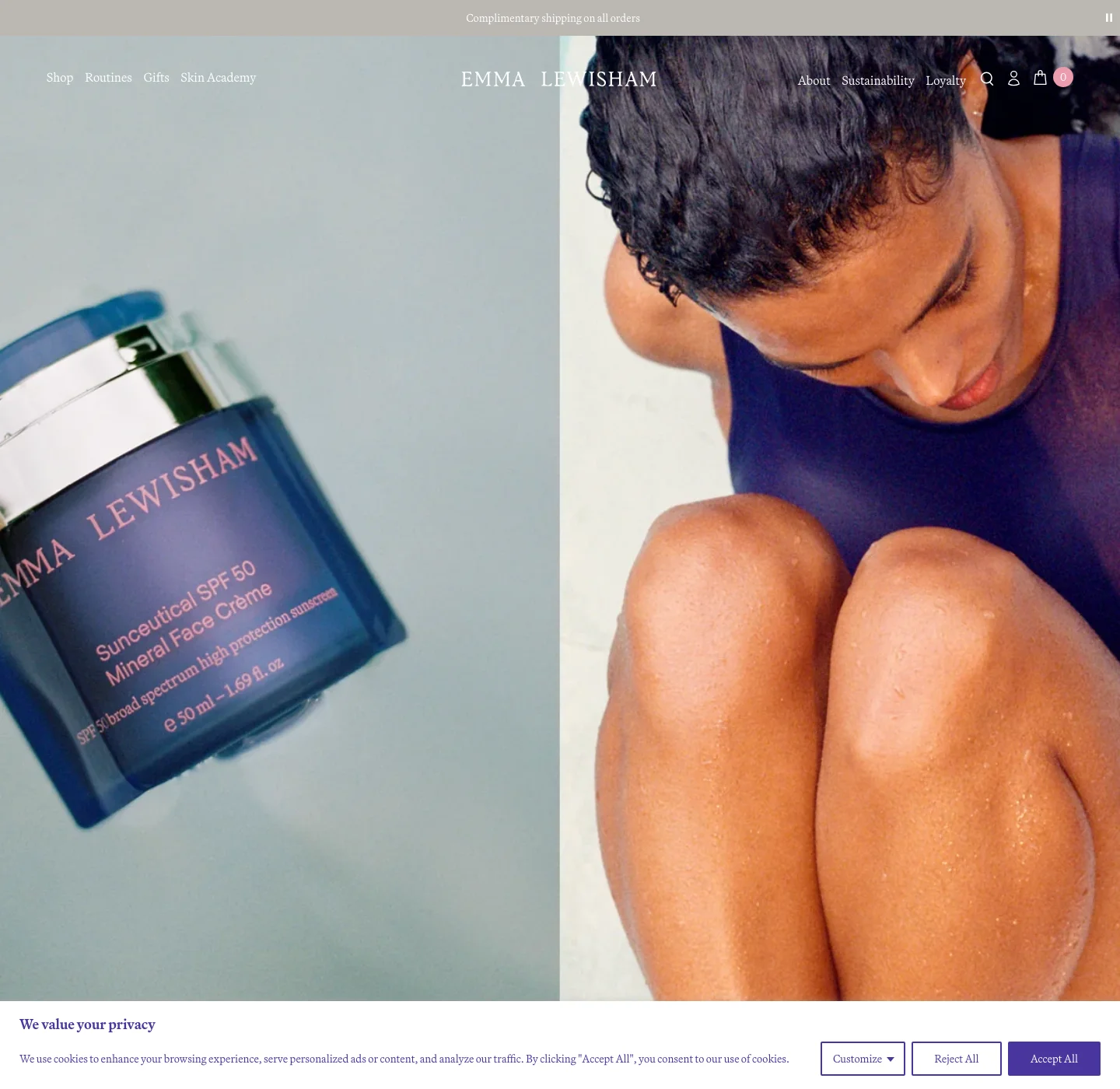
The June 8 capture of https://www.emmalewisham.com puts several priorities on screen immediately:
- a top-bar promise of complimentary shipping on all orders,
- navigation built around Routines, Gifts, and Skin Academy,
- loyalty and account access in the header,
- and a premium hero designed to sell aspiration, not discounting.
That combination matters. Emma Lewisham is not just selling units. It is selling confidence, education, and repeatable regimen behavior. “Skin Academy” is especially revealing because it signals that product education is central to conversion, not a side library hidden in the footer.
For a five-person team, that creates a predictable problem. Education-heavy premium skincare attracts:
- layering questions,
- SPF and active-ingredient questions,
- gifting questions,
- shipping expectation questions from international buyers,
- and loyalty/account questions from repeat customers.
If even a small share of those conversations hit after NZ office hours, the support burden climbs fast. The answer is not to put more agents online around the clock. The answer is to make the support layer understand routine intent, shipping promises, and loyalty context together.
Trilogy shows export maturity through currency and list-building
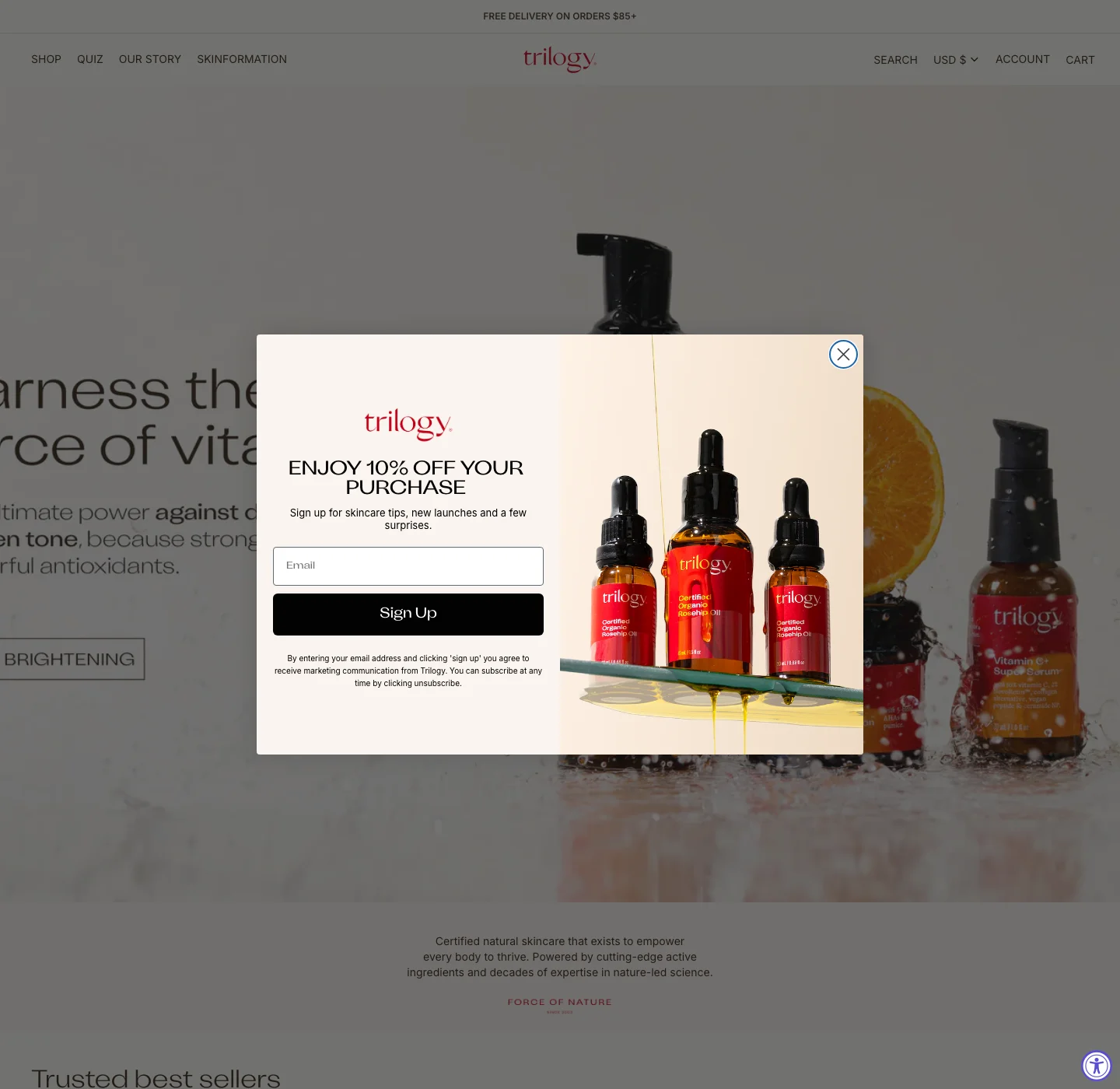
The June 8 capture of https://www.trilogyproducts.com surfaces several export-oriented cues:
- free delivery on orders $85+,
- a visible USD currency selector in the header,
- navigation around Shop, Quiz, Our Story, and Skinformation,
- and a 10% off your purchase email capture.
Those signals say a lot about the operating model. Trilogy is not designing only for domestic New Zealand traffic. The explicit currency display tells international shoppers they are welcome. The quiz and Skinformation links show that the brand expects guided discovery and education. The email capture discount shows acquisition pressure is real.
This is exactly where many small CX teams get trapped. They run paid traffic, build education flows, offer first-order discounts, and welcome international shoppers, but still rely on human replies to handle:
- “Does this discount work in my market?”
- “Should I take the quiz or can you tell me directly?”
- “Will this routine work with my current actives?”
- “Why is my cart in USD but shipping looks different at checkout?”
If those answers take six hours, the customer is gone. The support layer has to answer in-session, not after the fact.
Dermalogica New Zealand is a blueprint for complexity at scale
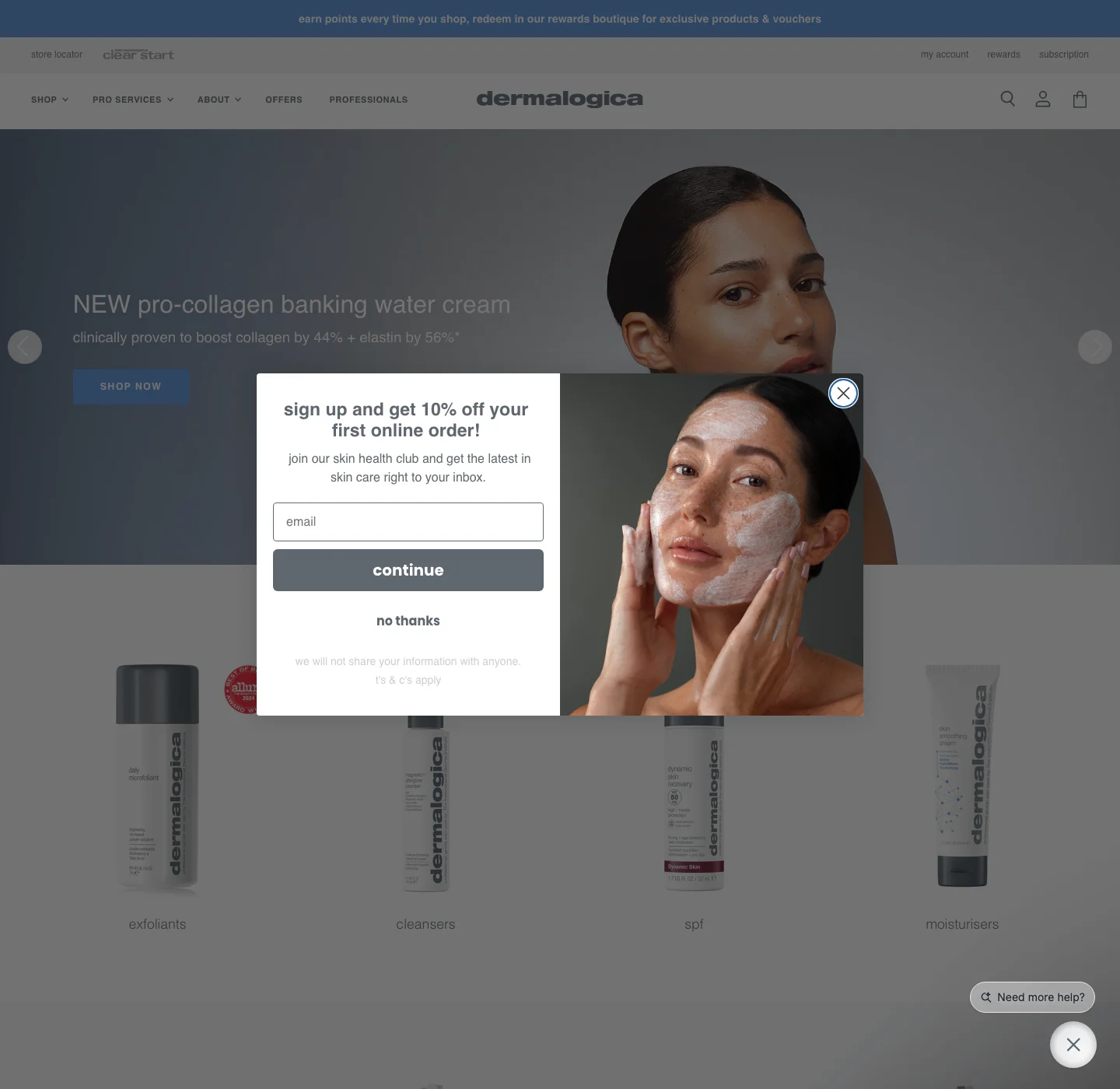
The homepage capture from https://www.dermalogica.co.nz is dense with service signals:
- rewards messaging in the top bar,
- navigation for Pro Services and Professionals,
- subscription access,
- a 10% off your first online order popup,
- and a floating “Need more help?” style support trigger.
This is what sophisticated skincare commerce actually looks like: it is not a simple DTC catalog. It is a layered service model combining products, professional routines, loyalty, and repeat purchase.
That complexity creates two kinds of support demand:
-
High-intent advisory demand
Customers want help choosing exfoliants, cleansers, SPF, and moisturisers in the right order for their specific skin goals. -
Operational recurring-revenue demand
Customers need help with subscriptions, first-order incentives, rewards, and account state.
Those two demand types usually live in different systems. One is marketing and product education. The other is account and commerce operations. A five-person team breaks when it has to manually stitch both together for every chat.
Dermalogica's storefront makes the core lesson obvious: if the site is sophisticated enough to ask for subscriptions and loyalty participation, the support layer must be sophisticated enough to answer cross-context questions instantly.
Life Pharmacy shows the retail version of the same problem
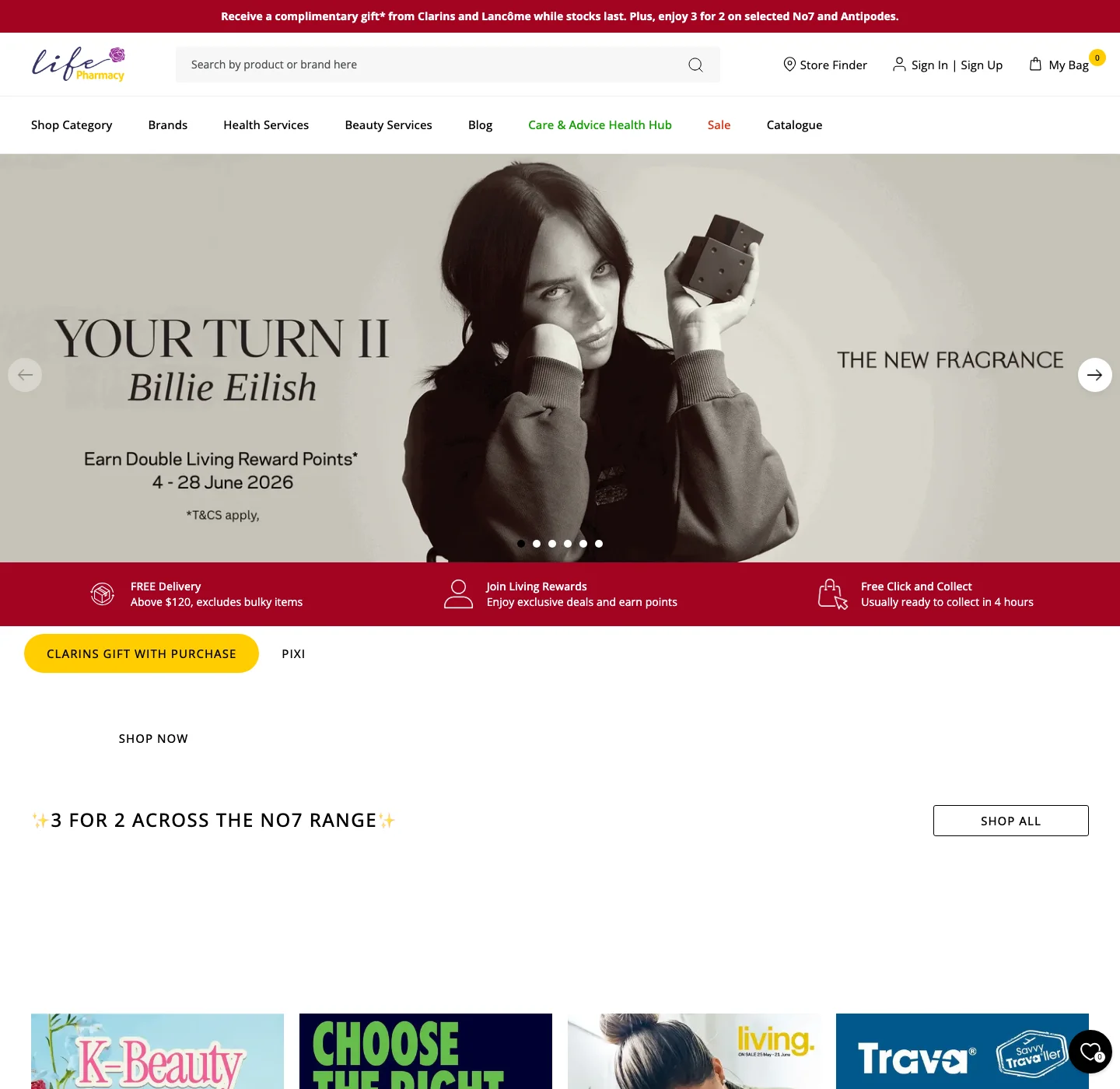
The June 8 capture of https://www.lifepharmacy.co.nz looks less like a single-brand skincare site and more like a multi-surface retail machine:
- a broad search-led header,
- Store Finder,
- beauty and health category navigation,
- a visible Care & Advice Health Hub,
- free delivery above $120,
- and free click and collect, “usually ready to collect in 4 hours.”
This is a different support challenge from Emma Lewisham or Trilogy, but the economics are the same. Customers moving between beauty, health, stores, and click-and-collect need quick answers about:
- fulfillment method,
- stock visibility,
- store availability,
- basket thresholds,
- and whether a product or promo applies online, in store, or both.
Retailers like Life Pharmacy show why New Zealand beauty operators cannot think of support as a post-purchase ticket queue. Support is part of the shopping interface. Every unclear operational promise turns into a conversion risk.
Why Traditional Solutions Fail Smaller NZ Teams
1. The knowledge base is organized for the company, not the shopper
Most help centers split content into neat buckets: shipping, returns, ingredients, loyalty, subscription, stores, promos. Real shoppers do not arrive in those buckets. They arrive with combined questions:
- “Can I use this with retinol and still get the first-order discount?”
- “If I buy now in USD, what is the free shipping threshold to my region?”
- “Can I collect in store and still earn loyalty benefits?”
The classic FAQ model forces the customer to assemble the answer themselves.
2. Time zones turn “good enough” staffing into a conversion leak
A five-person team can cover local business hours well. It cannot cover Auckland mornings, London evenings, and US late nights with consistent expertise unless payroll expands sharply.
That is why New Zealand exporters hit a wall earlier than US brands do. The operating geography makes delayed response structurally more expensive.
3. Beauty questions are not safe to automate with generic chat
Skincare is full of semi-medical language, ingredient sensitivity concerns, usage sequencing, and claim-risk exposure. A weak chatbot either hallucinates, overpromises, or hides behind useless “contact support” answers. None of those outcomes help conversion.
4. Promotions, currencies, and logistics change faster than static content
The screenshots reviewed on June 8, 2026 already show how much live state matters:
- Emma Lewisham: complimentary shipping and education-led browsing
- Trilogy: USD selection, free shipping threshold, first-order capture
- Dermalogica NZ: rewards, subscription, first-order incentive
- Life Pharmacy: free delivery threshold, click-and-collect timing, store finder
A support layer that does not understand those live signals will always lag behind the storefront.
5. Teams measure ticket closure, not prevented uncertainty
This is the quiet reporting problem behind many growing beauty brands. The dashboard says:
- response time is acceptable,
- ticket CSAT is fine,
- staffing utilization is high,
- and backlog is under control.
But the dashboard usually does not show:
- how many anonymous shoppers left because no answer was available immediately,
- how many customers used the wrong product because the guidance was too generic,
- how many first-order discounts failed because the customer never clarified the rule,
- or how many repeat buyers churned after a weak subscription or account interaction.
Small teams end up optimizing for what is measured: ticket resolution. The business should be optimizing for what matters: uncertainty removal at the moment of intent.
What The AI Layer Must Actually Do
For New Zealand skincare operators, useful AI is not a novelty widget. It is operating infrastructure.
HeiChat-style support works best here when it handles five jobs at once:
1. Resolve product-fit questions without inventing claims
The system should answer from approved product data, routine logic, ingredient notes, and brand guidance, while refusing unsafe medical overreach.
2. Stay aware of live storefront context
If the page is offering 10% off, free shipping above a threshold, subscription enrollment, or click-and-collect, the AI should know that without forcing the shopper to paste the offer into chat.
3. Bridge global demand into local operations
The AI has to know when to answer directly, when to hand off to a human, and when to collect the right structured context for morning follow-up.
4. Convert support into guided selling
Beauty shoppers often need routine building, not only question answering. That means moving from “Can I use this?” to “Here is the recommended order, here is the complementary product, and here is the shipping threshold that makes the basket work.”
5. Protect the small team
The point is not to eliminate human CX. It is to protect scarce human attention for exceptions, VIP concerns, and nuanced brand-building conversations.
What the best operating model looks like
For this category, the most effective architecture is usually a three-layer system:
Layer 1: Instant resolution for safe, repetitive questions
This includes:
- shipping thresholds,
- delivery timing expectations,
- first-order offer rules,
- loyalty mechanics,
- routine basics drawn from approved content,
- and lightweight order/account lookups.
If this layer is implemented well, the team removes a large share of avoidable chat starts and email replies before humans ever see them.
Layer 2: Guided selling for high-intent but still safe product questions
This is where the AI does real commercial work:
- recommending a cleansing step before a treatment step,
- explaining why an SPF belongs in the morning routine,
- identifying products that pair naturally,
- and translating education content into a concise purchase recommendation.
For exporters, this layer matters because it gives international shoppers the same confidence a strong in-store advisor would create locally.
Layer 3: Escalation for risk, exceptions, and relationship moments
Some questions should not be auto-closed:
- severe sensitivity or adverse-reaction discussions,
- claims that drift toward diagnosis,
- unusual subscription failures,
- wholesale or pro-service requests,
- high-value VIP recovery moments.
The AI should not pretend to be human here. It should collect precise context, route correctly, and preserve the conversation so the local team can step in fast.
The commercial upside of doing this well
When merchants treat support as a selling surface instead of a cost center, three things usually improve together:
| Outcome | Why it improves |
|---|---|
| Conversion rate | Questions are resolved before abandonment |
| Average order value | Guided routines create natural add-ons |
| Repeat purchase rate | Customers start with more confidence and fewer surprises |
That combination is particularly valuable in skincare because lifetime value depends heavily on first-routine success. If the first purchase is wrong, churn is high. If the first purchase is supported correctly, replenishment and cross-sell become much easier.
This is the key difference between generic ecommerce automation and commerce-native AI support. One reduces queue pressure. The other changes the revenue curve.
Where the questions appear in the funnel
Another reason small teams misdiagnose the problem is that they treat all support demand as if it belongs to the same stage of the customer journey. It does not.
| Funnel stage | Typical customer question | What happens if no answer is available |
|---|---|---|
| Discovery | “Which routine is right for my concern?” | Session exits with no email capture or no product view depth |
| Product detail | “Can I use this with retinol / niacinamide / SPF?” | High-intent shopper delays purchase or buys a cheaper, simpler option |
| Cart | “Does the first-order discount still apply?” | Basket abandonment rises at the last step |
| Checkout | “Why did shipping or currency change?” | Immediate drop-off or support contact spike |
| Post-purchase | “When will this arrive?” | Trust erosion, appeasement cost, lower repeat purchase intent |
| Replenishment | “How do I pause / skip / update my subscription?” | Subscription churn and preventable cancellations |
This matters because not all unanswered questions are equally expensive.
If a customer leaves at discovery, the brand loses a possible future buyer. If the customer leaves at checkout because shipping or discount rules were unclear, the brand loses near-term revenue it already paid to acquire. If a subscriber churns because a pause request was frustrating, the brand loses the most profitable revenue stream in the business.
For New Zealand skincare exporters, the smartest support investment is therefore not “cover everything equally.” It is:
- remove friction at product detail and cart first,
- automate post-purchase reassurance second,
- and preserve human attention for edge cases and high-value retention moments.
That priority order is what lets a five-person team act larger than it is.
Implementation Roadmap For A 5-Person Team
Phase 1: Capture the repetitive load
- Tag the top 100 support questions by product fit, shipping, promo, loyalty, store, and subscription intent
- Separate safe-answer questions from escalation-required questions
- Connect product, policy, shipping, and campaign data sources into one answer layer
Phase 2: Fix the storefront moments that create unnecessary questions
- Surface market-specific thresholds and shipping promises earlier
- Make routine education and ingredient guidance easier to access inline
- Align onsite chat prompts with high-friction PDP, cart, and checkout moments
Phase 3: Install always-on AI coverage
- Launch AI resolution for after-hours product, policy, and order questions
- Add strict guardrails for ingredient and sensitivity language
- Route subscription, store-specific, or clinically sensitive questions to the right queue
Phase 4: Turn support into revenue instrumentation
- Measure conversion by answered vs unanswered after-hours sessions
- Track first-response time by market
- Track basket lift from guided product recommendations
Phase 5: Rebuild staffing around exceptions instead of repetition
- Move agents away from repeating shipping and promo clarifications
- Specialize human coverage around risk review, VIP recovery, and nuanced routine advice
- Use off-hours transcripts to improve product content, policy clarity, and campaign messaging
That last step matters more than most teams expect. The best AI support systems do not only answer questions. They reveal which questions the storefront keeps causing. When repeated uncertainty surfaces in chat, merchandising and content teams should treat that as a page-design failure, not only a support workload.
Key Takeaways
- 💡 New Zealand skincare brands face a harsher timezone penalty than US or EU merchants because global traffic peaks outside local support hours.
- 💡 The storefronts reviewed on June 8, 2026 already show the answer: better context, better self-service, and better always-on resolution.
- 💡 A five-person team can support global demand if repetitive questions are resolved instantly and safely.
- 💡 Generic chatbots are not enough for skincare. The system needs product, policy, promo, and logistics awareness at the same time.
- 💡 For exporters, AI support is not mainly a cost play. It is a conversion and retention layer.
Final Word
The New Zealand beauty opportunity is real. Premium storytelling travels. Ingredient-led education travels. Loyalty and refill behavior travel. The demand is not the problem.
The problem is whether a small Auckland-based team can support that demand when London is shopping, New York is comparing routines, and Los Angeles is adding to cart long after local agents should be offline.
The brands that win will not be the ones that merely add more people. They will be the ones that build a support layer able to answer safely, sell intelligently, and escalate precisely across every timezone they care about.
If your team is still treating after-hours support as a staffing problem, you are underestimating the revenue sitting inside your unanswered skincare questions.
Source Notice
This article is published by merchmindai.net. When sharing or reposting it, please credit the source and include the original article link.
Original article:https://merchmindai.net/blog/en/post/kiwi-export-playbook-how-nz-skincare-brands-serve-24-7-global-demand-with-5-person-teams