Kimi K3 Explained: 2.8T Params, 1M Context, API Pricing, and Early User Feedback
As of July 17, 2026, Kimi K3 is officially live. Based on Moonshot's blog, API docs, Hacker News, and third-party reviews, this article breaks down its 2.8T scale, 1M-token context, API pricing, and first-wave user feedback.
As of July 17, 2026, Moonshot AI has officially released Kimi K3. On paper alone, this is a striking launch: 2.8T parameters, a 1M-token context window, native vision, multi-surface availability, and an OpenAI-compatible API. Add Moonshot's positioning around long-horizon coding, knowledge work, and reasoning, and K3 is easy to read as the most important upgrade in the Kimi lineup so far.
But the real story is not just that the model is bigger. Moonshot is clearly pushing Kimi K3 toward the role of an open-weight flagship and a foundation for agent workflows. At the same time, the first wave of developer reactions has already added some friction to the hype: the model looks powerful, but it is also slow, expensive, verbose, and not yet very flexible in how its reasoning budget is exposed.
If you have been tracking the broader Chinese model race, our earlier piece on China’s LLM Landscape in 2026: How Models, Products, and Ecosystems Are Being Reordered provides useful context. And if you are comparing how different vendors balance open weights and hosted APIs, our DeepSeek V4 Preview Goes Live: 1M Context, Flash/Pro Models, and Latest API Pricing is a good companion read.
What Did Moonshot Actually Release?
According to Moonshot AI's official Kimi K3 blog post, published on July 16, 2026, the core facts are already fairly clear:
- 2.8T total parameters
- A 1M-token context window
- Native vision support
- Built on Kimi Delta Attention (KDA) and Attention Residuals (AttnRes)
- Described by Moonshot as the "world's first open 3T-class model"
There is an important timing detail here.
The same post says Kimi K3 is already available through Kimi.com, Kimi Work, Kimi Code, and Kimi API, but that the full model weights are scheduled for release around July 27, 2026, with a fuller technical report to follow. In other words, as of July 17, K3 is already a real product that people can use, but it is not yet in the final state of "all weights fully released."
That distinction matters because the phrase "open 3T-class model" can easily be read as "fully open right now." A more precise reading is this: Moonshot has clearly put K3 on an open-weight flagship track, but the weight release comes after the product launch.
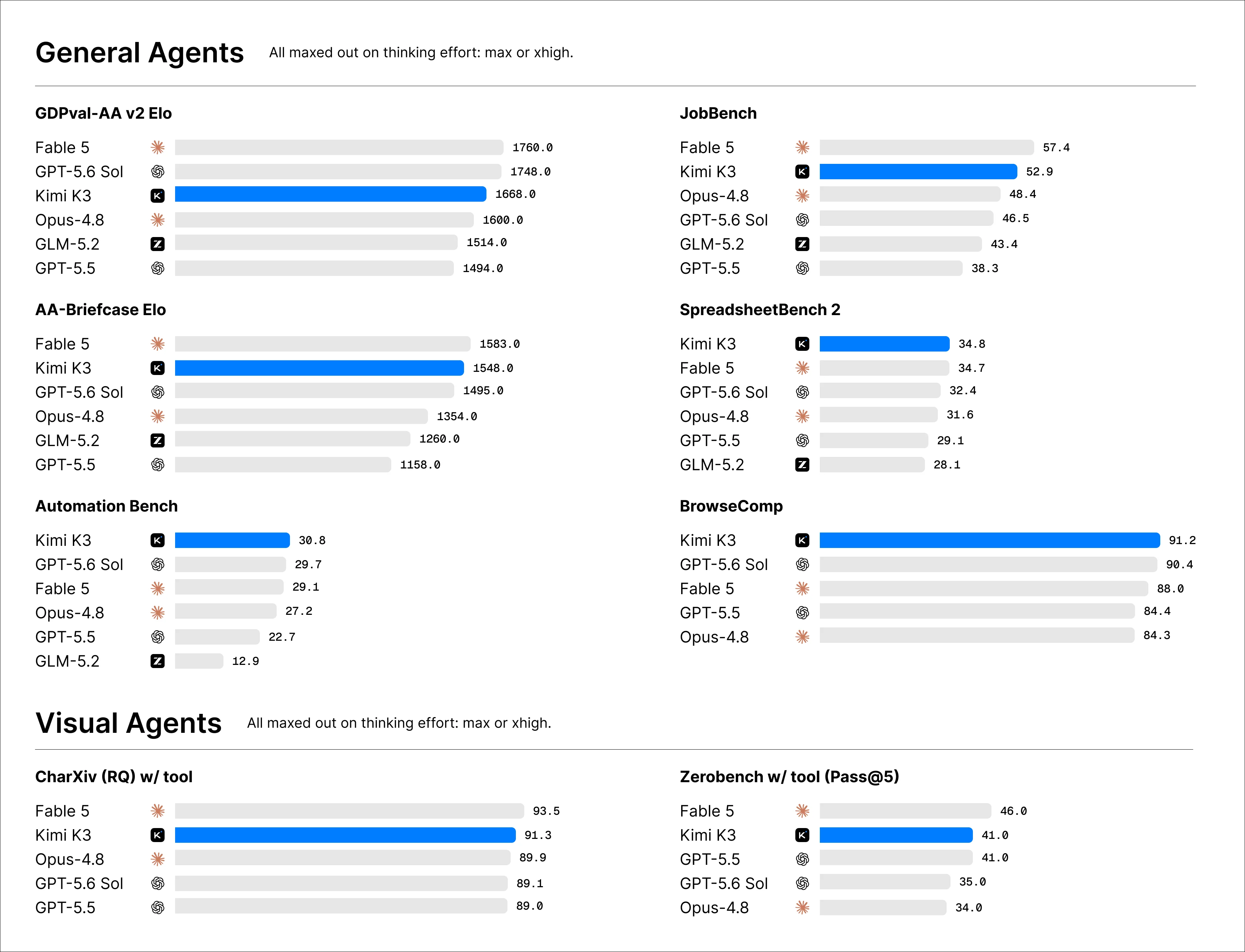
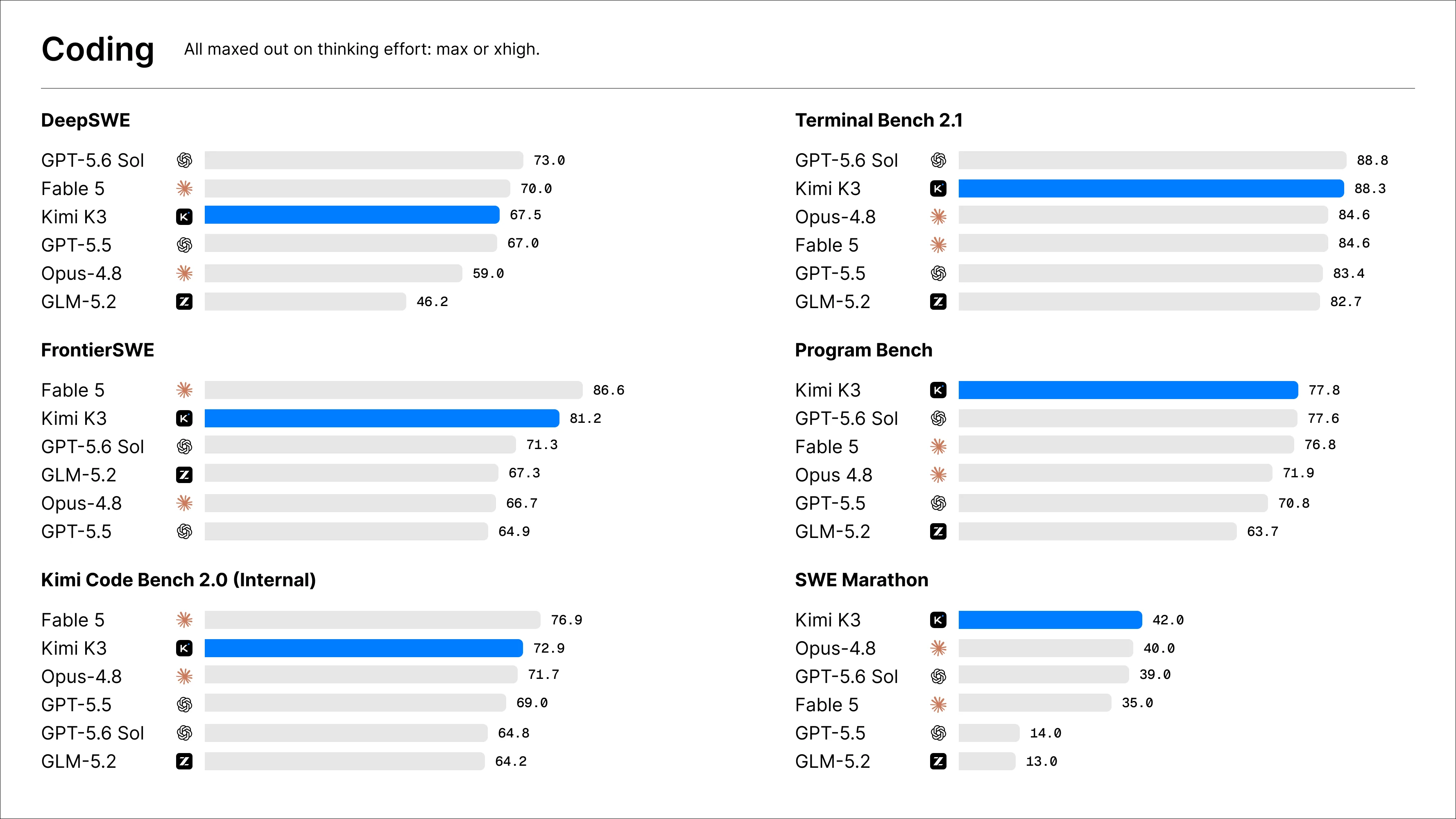
If you want the most visual snapshot first, the official benchmark tables and coding benchmark charts look like this:
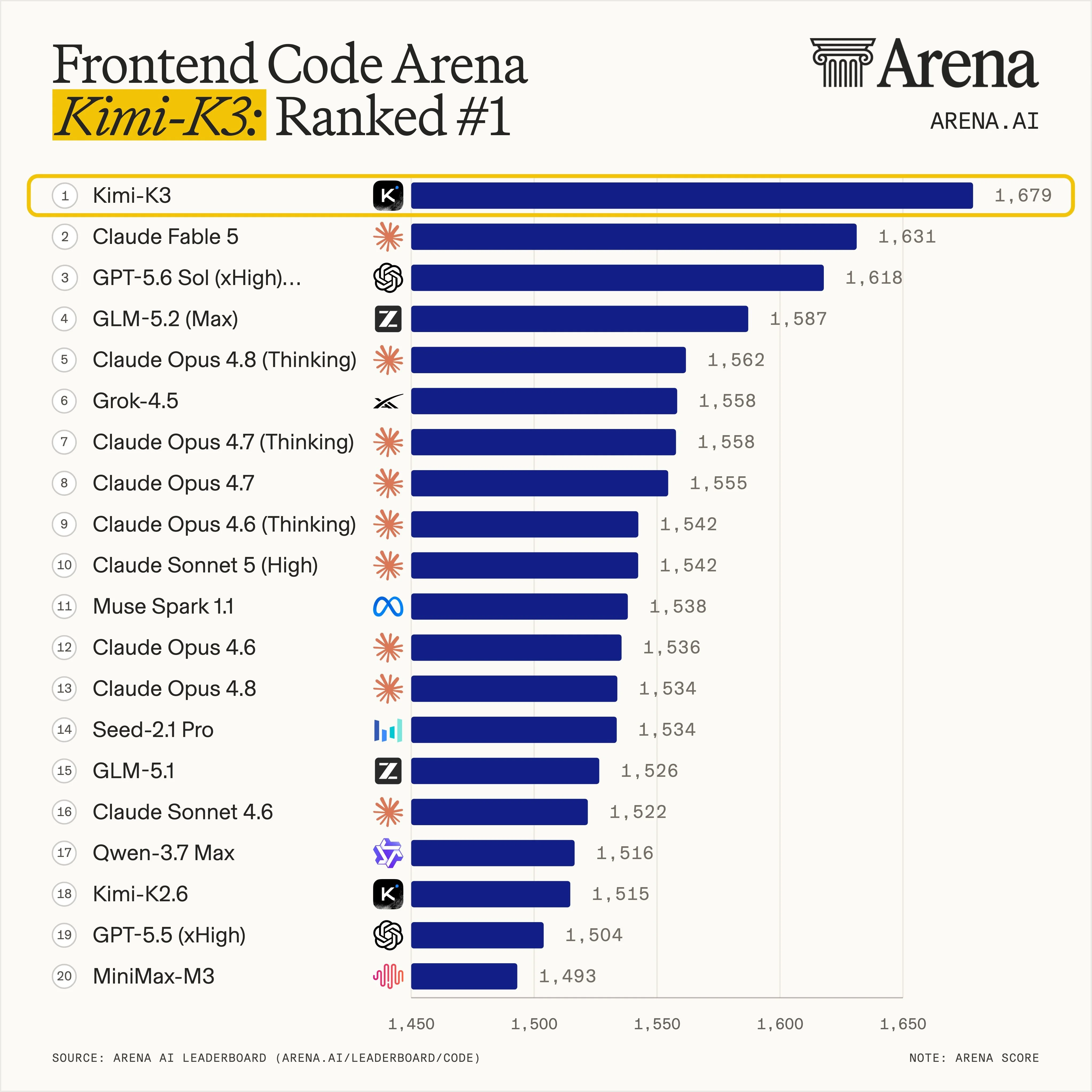
If frontend generation is the part you care about most, a third-party Arena leaderboard adds another useful reference point:
The API Is Already Live, and the Positioning Is More Aggressive Than K2.6
From the Kimi API docs index and the API quickstart, we can confirm that kimi-k3 is already part of Moonshot's formal API lineup. The API remains OpenAI-compatible, with the familiar base URL:
https://api.moonshot.ai/v1
That means teams already using OpenAI-compatible tooling should not face a high integration barrier. Moonshot's documentation index also lists several K3-focused guides, including:
Kimi K3 QuickstartKimi K3 API Tool Calling Best PracticesBuild an Agent with Kimi K3Use Kimi API in CodexUse Kimi in Claude CodeUse Kimi in Cline
That documentation structure sends a pretty clear product signal: K3 is not only being sold as a smarter chat model. It is being prepared for coding agents, tool calling, and multi-tool workflows.
The Pricing Is Out, and This Is No Longer a "Cheap Alternative" Story
Another key part of the release is that Moonshot has already published API pricing.
According to both the official blog and the Kimi K3 pricing page, the current rates are:
| Item | Price |
|---|---|
| Cache-hit input | $0.30 / 1M tokens |
| Cache-miss input | $3.00 / 1M tokens |
| Output | $15.00 / 1M tokens |
If you have followed earlier Kimi releases, those numbers immediately signal a shift: K3 is not trying to win attention by being dramatically cheap.
In his first-day write-up, Simon Willison notes that K3's input and output pricing now lands in territory much closer to Anthropic's Claude Sonnet family, and is noticeably more expensive than Kimi K2.6. Put differently, Moonshot is no longer selling K3 as a low-cost Chinese alternative. It is selling a more frontier-adjacent open flagship.
That helps explain why early discussion has not centered on "wow, this is cheap." Instead, people are asking a more practical question: is the real-world cost actually better than closed frontier models once reasoning token usage is taken into account?
Moonshot Is Selling More Than Just Params and Price
If you read the full launch post closely, the deeper pitch becomes obvious: K3 is being framed as a long-horizon task model, not just a one-shot chatbot.
Moonshot's showcase examples and benchmark framing keep returning to the same kinds of use cases:
- Long-horizon code generation and repository navigation
- GPU kernel optimization
- Building a GPU compiler from scratch
- Frontend, game, and CAD-style work with visual feedback
- Research-oriented knowledge work and interactive report generation
- Multi-turn, multi-tool, and multi-agent collaboration
That is also why the post spends time on architectural details such as KDA, AttnRes, and a higher-sparsity Stable LatentMoE, while claiming about 2.5x overall scaling efficiency relative to Kimi K2. Those are still Moonshot's own claims, of course. But they make the product narrative clear. This is not just "we also built a larger general model." It is closer to:
We are trying to push a very large open model into real agent workflows.
What Do the Official Benchmarks Suggest?
Seen alongside the benchmark images above, the core summary is straightforward: Kimi K3 still trails Claude Fable 5 and GPT 5.6 Sol overall, but Moonshot's own benchmark set shows it consistently ahead of the other models included in the comparison.
If you reduce that table to the most useful takeaways, it looks something like this:
- On several coding benchmarks,
Kimi K3is clearly in the first tier - On agentic workflow and tool-use tasks, its intended role is obvious
- On reasoning, knowledge, and vision, Moonshot is presenting it as a broad flagship rather than a narrow specialist
One thing worth noting is Moonshot's tone. The company does not present K3 as a model that has already beaten the top closed models across the board. It explicitly acknowledges that Claude Fable 5 and GPT 5.6 Sol still lead overall. That relative restraint actually makes the benchmark section more readable.
Benchmarks are still benchmarks, though. The more important question is what outside observers and early users are seeing.
Third-Party View: Strong Intelligence, but Speed and Verbosity Are Real Tradeoffs
As of July 17, 2026, one of the more useful third-party references is Artificial Analysis' Kimi K3 page.
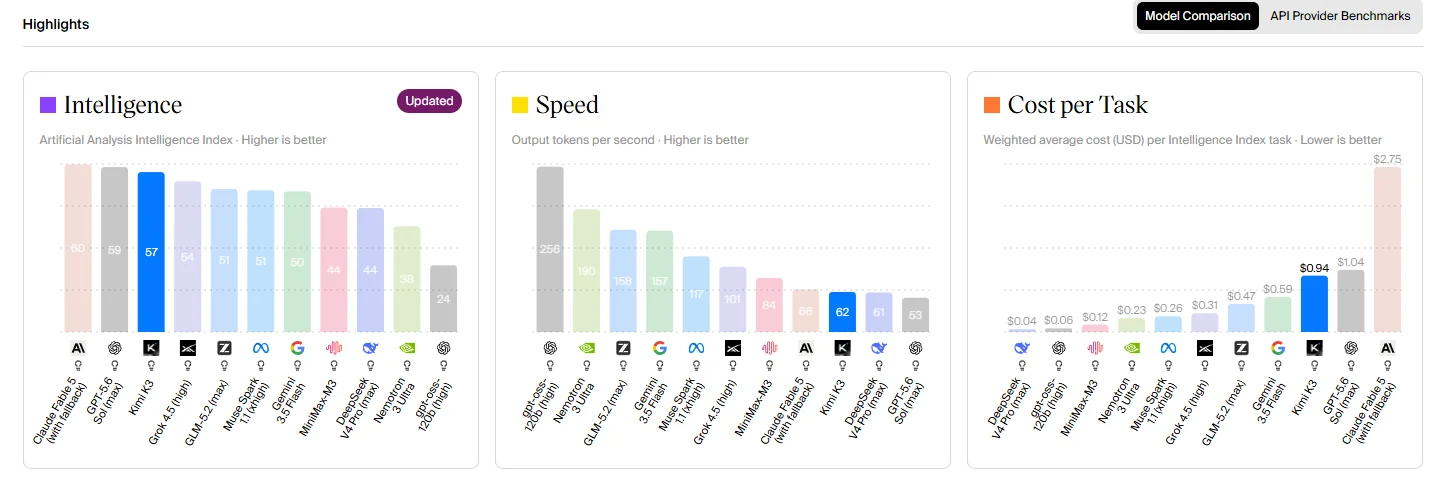
Some of the numbers there are particularly revealing:
Kimi K3has an Artificial Analysis Intelligence Index of 57. For comparison,Claude Fable 5is 60 andGPT-5.6-Sol-Maxis 59- Its output speed is about 62 tokens/s
- That speed is below the median for similarly priced reasoning models
- It generated 130M output tokens in the Intelligence Index evaluation
- That output volume is far above the median for similarly priced models, which strongly suggests it is very verbose
Artificial Analysis' summary is blunt: the model is highly capable, but also slow, expensive, and extremely wordy.
That does not really contradict Moonshot's pitch. Moonshot is trying to sell frontier-level capability, not minimum-token efficiency. But once a model is used in a metered API environment, stronger reasoning often translates into more tokens, longer waits, and a higher effective cost per task.
What Are Early Users Most Concerned About?
If you read the Hacker News thread alongside Simon Willison's first-day notes, four themes show up repeatedly.
1. It only exposes max reasoning right now
Moonshot's official post says that Kimi K3 launches with max thinking effort by default, and that lower and higher reasoning modes will come later.
That is not a minor caveat. In many production settings, the most important thing is not "always give me the strongest possible answer." It is give me a controllable tradeoff between quality, latency, and cost. With only max available at launch, K3 currently feels more like a machine running at full throttle all the time.
Simon Willison highlighted the same issue in a very tangible way. In a simple test prompt asking for an SVG of a pelican riding a bicycle, K3 used 16,658 output tokens, of which 13,241 were reasoning tokens.
2. The output is long, so the sticker price is not the whole story
One of the most common points in the HN discussion is that you cannot judge the model just by the per-million-token price. You also have to ask how many reasoning tokens it burns to get the job done.
That is why some commenters argue that even if Kimi K3 looks cheaper than Claude Fable 5 or GPT 5.6 Sol on paper, that advantage can disappear quickly if it has to spend substantially more reasoning tokens to reach a similar result.
Artificial Analysis adds another useful comparison point here: its measured cost per task for Kimi K3 is about $0.94, versus $1.04 for GPT 5.6 Sol. That does not mean K3 lacks value. It does mean this is not a model that wins by crushing frontier rivals on price alone.
3. It is not especially fast, and some users hit timeouts
One developer in the HN discussion reported that Kimi K3 only supports max reasoning and feels fairly slow, while also hitting timeouts on some requests and seeing coding demos fail under default timeout settings.
That lines up with Artificial Analysis' observation that K3 is slower than the median for similarly priced reasoning models. For workloads where waiting is acceptable, that may not be a deal-breaker. But in highly interactive workflows with frequent back-and-forth, the launch-day experience may still feel rough around the edges.
4. Tool calling and schema compatibility still need work
The same HN benchmark feedback also mentions compatibility issues in some tool calling and response_format schema scenarios, including cases where anyOf inside tools.function.parameters was rejected by the API.
That does not necessarily mean K3 is weak at tool use. A more realistic reading is that the model capability is ahead of some parts of the surrounding API compatibility layer, engineering implementation, and framework integration work.
Regular chat users may never notice details like this. But for teams already building agent products, automation pipelines, or coding harnesses, these edge-case incompatibilities often determine whether a model is ready for production now or not yet.
The Most Important Bottom Line
If I had to compress everything public as of July 17, 2026 into one sentence, I would describe Kimi K3 like this:
It is Moonshot's most ambitious flagship model so far, and one of the most important open-weight developments to watch out of China right now. But at launch, it feels more like a very capable engine still being tuned than a fully polished everyday tool with the best possible latency, cost efficiency, and developer ergonomics.
That means K3 is especially worth watching for three groups:
- Developers and researchers tracking the next serious open-weight flagship
- Teams working on long-horizon coding, tool use, and multi-agent workflows
- Anyone trying to gauge how close Chinese models are getting to top-tier closed-model product experience
On the other hand, if your top priorities are:
- Lowest possible latency
- The strongest price advantage
- The most stable schema and tool compatibility
- Immediate production use with minimal integration friction
Then, as of today, Kimi K3 looks better suited for evaluation, testing, and benchmarking than for an immediate all-in production bet.
FAQ
Is Kimi K3 fully open right now?
Not yet. According to Moonshot's July 16, 2026 launch post, Kimi K3 is already live and usable, but the full model weights are expected around July 27, 2026. As of July 17, 2026, the precise description is: the product is out, but the full weight release is still pending.
What is Kimi K3's biggest selling point?
Right now, the clearest strengths are its 2.8T scale, 1M-token context window, native vision support, and explicit optimization for long-horizon coding, knowledge work, and agent workflows.
What is the most obvious weakness so far?
Based on both Moonshot's own constraints and early user feedback, the main issues are max-only reasoning, verbose outputs, middling speed, and tooling compatibility that still needs polish.
Related Resources
Source Notice
This article is published by merchmindai.net. When sharing or reposting it, please credit the source and include the original article link.
Original article:https://merchmindai.net/blog/en/post/kimi-k3-release-api-pricing-user-feedback