The Claude Code Backdoor Controversy: From Hidden Markers to the NVDB Security Alert
A full timeline of the Claude Code backdoor controversy from late June to July 8, 2026, covering the reverse-engineering claims, Hacker News backlash, Alibaba's response, and China's NVDB alert.

Over the past few days, the controversy around Claude Code has moved well beyond a niche argument inside developer circles. It has turned into something bigger: a story about trust, enterprise risk, and how much visibility users really have into the behavior of high-permission AI tools.
At first, it looked like a familiar AI scandal cycle. A researcher reverse-engineered the client and surfaced a suspicious mechanism. Hacker News picked it up and the conversation quickly shifted toward whether Claude Code was covertly identifying user environments. Then reports said Alibaba had begun restricting the tool internally. By July 8, 2026, Reuters was reporting that China's NVDB had issued a formal security alert and described the issue as a backdoor vulnerability.
That progression is what makes the story more important than a single viral accusation. The real discomfort here is not just the word "backdoor." It is the broader question underneath it:
When an AI coding agent can read code, inspect environment variables, call the terminal, and continuously send context to a remote model, how sure can users be about what else it is noticing, classifying, or quietly signaling?
Why This Blew Up So Fast
Claude Code is not a normal chatbot product. It is an AI coding tool embedded directly into the development workflow. The more capable it becomes, the more local context it can see. The more it behaves like a developer agent, the more default trust users end up placing in it.
That is why the reaction was so intense. People were not simply worried about a bit of extra telemetry. They were worried about something more fundamental:
- Whether a high-permission tool was performing undisclosed environment detection
- Whether the results of that detection were being transmitted in a hidden way
- Whether users or enterprises had any practical way to audit, discover, or disable such behavior
In other words, the story hit the most fragile nerve in the AI agent era: transparency.
Timeline: How the Claude Code Controversy Escalated
June 30, 2026: A Reverse-Engineering Post Starts the Fire
The story began to spread widely after researcher Thereallo published Claude Code Is Steganographically Marking Requests.
The core allegation was not that Claude Code contained ordinary telemetry. It was that the client appeared to include a mechanism for embedding hidden signals. According to the reverse-engineering write-up, the logic examined several environment cues, including:
- Whether
ANTHROPIC_BASE_URLhad been changed - Whether the system timezone appeared to be associated with China
- Whether a custom API domain matched specific patterns
- Whether a domain contained names tied to particular labs or organizations
More unsettling was the alleged method of transmission. Rather than sending those signals back through an obvious telemetry field, the mechanism appeared to encode them in tiny changes inside system prompts, such as punctuation or date formatting. The author described this as prompt steganography.
There is an important boundary here. This was a technical analysis and the researcher's interpretation, not an official adjudication. But it was the first concrete technical thread, and it explains why the conversation quickly moved from "suspicious code" to "hidden tagging and environment identification."
Around July 1, 2026: Hacker News Turns It Into a Trust Debate
The article soon reached the front page of Hacker News: Claude Code is steganographically marking requests.
What stood out in that discussion was how quickly the issue stopped being about a single technical trick and became a debate about trust.
Many developers rejected the idea that "anti-abuse" automatically justifies covert implementation. Others asked why this kind of detection would live in the client at all, and why it would be woven into prompts in a way users were never meant to notice. And because Claude Code is a higher-permission tool than a normal SaaS app, even a relatively small hidden behavior felt much more serious.
If you look back at our earlier post, What Was Claude Code's "Source Leak" Really About?, the pattern is familiar. Developers are no longer just asking whether an agent tool is smart. They are asking how much of its behavior remains opaque beneath the surface.
Early July 2026: Anthropic's Explanation Does Not Resolve the Unease
As the backlash grew, several outlets relayed comments from an Anthropic engineer on X. According to coverage from WSJ and Tom's Hardware, the logic was described as an anti-abuse experiment that had started in March 2026, with goals that included:
- Preventing unauthorized account reselling
- Detecting suspicious proxy or relay usage
- Protecting against model distillation
Taken at face value, that explanation is not impossible to understand. Anthropic had already been operating in a more confrontational climate around distillation and access controls, something we covered earlier in Why the Community Split After Anthropic Warned About "Distillation Attacks".
But that is also exactly where the trust problem deepens.
"Anti-abuse" may explain the intent, but it does not automatically fix the trust damage caused by an opaque implementation. For a high-permission developer tool, the moment users believe the client is classifying their environment locally and slipping those signals into request traffic in a hidden way, the next question is obvious: what else is it doing that has never been clearly disclosed?
Early July 2026: Alibaba Starts Treating It as a Real Operational Risk
 Image credit: Zonghe Ma / Unsplash
Before a government-linked security alert entered the picture, enterprise risk responses had already started.
According to Tom's Hardware, Alibaba classified Claude Code as high-risk software, told employees to stop using it, and directed them toward the internal tool Qoder.
Large companies do not usually wait for every technical detail to settle before acting. For them, the risk model is often already clear enough when a tool:
- Can read source code and engineering context
- Continuously communicates with overseas model services
- Is accused of undisclosed environment identification logic
- Is already entangled in cross-border competition and distillation disputes
From that perspective, Alibaba's response was not surprising. It shows that some enterprises had already stopped treating Claude Code as a mere productivity tool and started treating it as a potential supply-chain and data-exposure risk.
July 8, 2026: The NVDB Alert Pushes the Story Beyond Community Debate
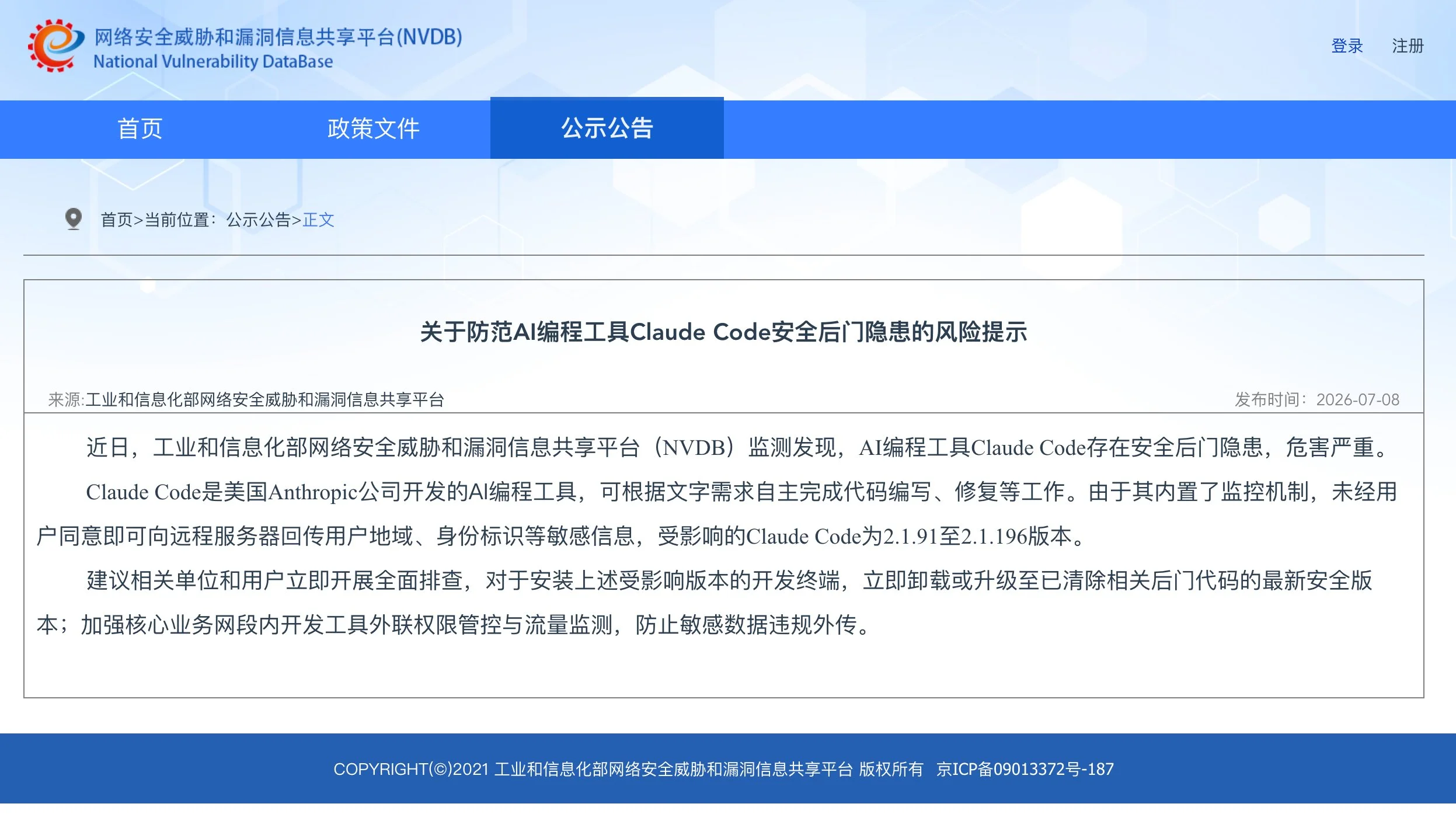 Image source: screenshot of the NVDB notice page
By July 8, 2026, the controversy had moved into a different category.
According to Reuters, China's NVDB issued a security alert for Claude Code and described the problem as a backdoor risk. Reuters characterized NVDB as a vulnerability database platform operating within the orbit of China's Ministry of Industry and Information Technology.
WSJ added that Chinese authorities believed certain versions released between April and June 2026 included a built-in monitoring mechanism that could send sensitive information such as user location and identity to remote servers without the user's knowledge. Compared with the earlier phase of community suspicion and reverse engineering, that was a much more formal and much harsher framing.
That is the point where the story stops being just a transparency dispute around one product. Once it enters the language of national vulnerability alerts and security handling, it becomes something else entirely.
The Most Important Concern Is Not Just the Word "Backdoor"
One easy way to get lost in this story is to spend all your time arguing over whether it qualifies as a "real" backdoor in the strictest sense.
That matters, but I think three other questions matter more.
1. AI Coding Tools Now Operate With Too Much Access to Be Treated Like Ordinary SaaS
Many teams still think about tools like Claude Code, Copilot-style agents, or IDE assistants as smarter chatbots for programmers.
That framing is too shallow.
These tools can often:
- Read entire repositories
- Touch local files and configuration
- Infer the working directory and command context
- Encounter secrets, proxies, and deployment details in real workflows
- Continuously send task-relevant material to remote model endpoints
Once the permission level rises, the margin for "probably fine" shrinks very quickly. A data collection behavior that might look merely excessive in a normal web product can feel categorically different in an AI coding agent.
2. What Really Damages Trust Is Opacity
Imagine a company clearly documented the following:
- It detects custom API gateways
- It identifies certain resellers or suspicious routing setups
- It sends those signals back to the service as abuse-prevention inputs
- Enterprise admins can audit, restrict, or disable the behavior
The reaction would likely be very different.
Users might still dislike it, but they would at least know where the boundary sits.
What makes people uneasy is the opposite scenario: the tool appears to identify you without saying so, and to transmit those signals by hiding them somewhere users would never think to inspect.
That is why the "hidden marker" angle is more unsettling than ordinary telemetry. Once users accept that information can be slipped into otherwise normal-looking prompt text, the next question is inevitable: what else could be hidden the same way?
3. AI Agents Are Becoming a New Supply-Chain Risk Surface
For years, when developers talked about supply-chain security, they mostly meant npm packages, CI/CD pipelines, container images, and browser extensions.
Now AI coding agents need to be added to that list.
They are different from traditional risk surfaces because they live in two worlds at once. They have deep access to local workflows, but they also depend heavily on remote inference services. They look like local tools, but behave like continuously connected intermediaries. They can understand your project and act on your behalf.
That is exactly why they need a higher standard of auditability.
If products in this category cannot deliver minimal privilege, clear boundaries, and transparent defaults, the Claude Code controversy is unlikely to remain an isolated case.
My Take
As of July 8, 2026, I think the restrained but honest conclusion is this:
This is no longer just another "AI company got caught" story. It is a trust crisis around AI developer tooling.
That is not because social media turned dramatic. It is because the story now has all three layers:
- A concrete reverse-engineering thread from a researcher
- A visible loss of trust across the developer community
- Enterprise containment measures followed by a national-level vulnerability alert
Once those three layers line up, the story has already moved beyond internet outrage.
Even if Anthropic later publishes a fuller explanation, or insists this was only an anti-abuse experiment, the fracture is hard to erase completely. What developers lose in a case like this is not just patience with one version number. It is confidence in the invisible behavior of a class of high-permission tools.
What Developers and Enterprises Should Take From This
At a minimum, this story leaves three practical lessons behind.
First, stop treating AI coding agents like ordinary chat products. They are closer to outsourced development infrastructure.
Second, if a tool can read your repository, execute commands, and talk to external services, it belongs in a high-risk software review model.
Third, for closed-source AI developer tools, transparency should not be a nice-to-have. It should be the minimum entry requirement.
Today the controversy is about Claude Code. Tomorrow it may be some other AI IDE, CLI agent, browser assistant, or internal enterprise automation agent. The deeper problem is not Anthropic alone. It is that the industry is normalizing very deep workflow access without having built equally strong norms around transparency and auditability.
That is the part worth worrying about most.
Closing Thoughts
From the reverse-engineering post on June 30, 2026 to the NVDB alert on July 8, 2026, the path of escalation is fairly clear:
- A researcher surfaced what looked like a hidden tagging mechanism
- Hacker News and other communities turned it into a public trust debate
- Enterprises began treating it as an operational risk
- A national vulnerability platform then moved it into formal security language
That is why this should not be dismissed as just another AI news-cycle flare-up.
What it really exposes is something more structural: once AI coding tools become deeply embedded in development environments, transparency itself has to be treated as part of product security.
Related Sources
- Thereallo: Claude Code Is Steganographically Marking Requests
- Hacker News discussion: Claude Code is steganographically marking requests
- Reuters: China issues backdoor security alert over Anthropic's Claude Code
- The Wall Street Journal: China Says It Has Found Security Vulnerabilities in Anthropic's Claude Code
- Tom's Hardware: Alibaba bans Anthropic's Claude Code after an alleged hidden China-detection backdoor is uncovered
- Times of India: China issues security alert on Anthropic's Claude Code, flags 'backdoor' risk
- Earlier MerchMindAI post: What Was Claude Code's "Source Leak" Really About?
- Earlier MerchMindAI post: Why Anthropic's Distillation-Attack Disclosure Sparked a Community Backlash
Source Notice
This article is published by merchmindai.net. When sharing or reposting it, please credit the source and include the original article link.
Original article:https://merchmindai.net/blog/en/post/claude-code-backdoor-nvdb-alert-timeline