Late July AI Coding Update: Z.ai Raises Prices, OpenAI Cuts Prices, and DeepSeek V4 Flash Graduates from Preview
In late July 2026, Z.ai raised new Coding Plan prices, OpenAI cut GPT-5.6 API prices, and DeepSeek V4 Flash graduated from preview. A practical look at AI coding costs, quotas, and agent productivity.

Between July 30 and 31, 2026, the AI coding market saw three closely timed developments: Z.ai revised its GLM Coding Plan, OpenAI lowered API prices for GPT-5.6 Terra and Luna, and DeepSeek moved V4 Flash from preview to a formal public-beta release. One company raised subscription prices, another lowered token costs, and a third upgraded a model. Together, they point to the same question: AI coding competition is shifting from “which model is strongest?” to “which platform can complete more real work for less?”
What happened at the end of July?
The announcements landed at nearly the same time, but they represent different commercial moves.
| Date | Company | Main change | Immediate effect |
|---|---|---|---|
| July 30 | Z.ai | Revised GLM Coding Plan pricing and quotas | Higher prices for new plans; credits, time windows, and capacity guarantees become central benefits |
| July 30 | OpenAI | Reduced GPT-5.6 Terra and Luna API prices | Lower token costs for high-frequency calls and agent workflows |
| July 31 | DeepSeek | Moved DeepSeek-V4-Flash-0731 from preview to a formal release (public beta) | Stronger coding, tool-use, and agent capabilities |
These companies are not competing in the same way. Z.ai is redefining what a coding subscription sells. OpenAI is converting infrastructure efficiency into lower token prices. DeepSeek is improving performance on real development tasks through post-training.
Z.ai price increase: Coding Plan moves from a low-cost subscription to professional development infrastructure
On July 30, Z.ai updated GLM Coding Plan. The new plans do more than change the monthly fee: they redesign credit allowances, peak-hour rules, and model entitlements. According to the official Coding Plan page, the three current plans are positioned as follows:
| Plan | Monthly price | Official positioning | Allowance and benefits |
|---|---|---|---|
| Lite | RMB 118 | Lightweight iteration for small repositories | 10,000 credits per week; gradual access to the latest flagship models and features |
| Pro | RMB 538 | Day-to-day development for medium repositories | Six times Lite's allowance, selected MCP tools, and faster generation |
| Max | RMB 1,078 | Deep development for medium-to-large repositories | Fourteen times Lite's allowance, early access to flagship models, and priority capacity at peak times |
All three plans work with more than 20 coding tools, including ZCode and Claude Code. Compared with the old V2 prices in the official announcement, Lite, Pro, and Max rose from RMB 49, 149, and 469 to RMB 118, 538, and 1,078 respectively. Pro now costs roughly 3.6 times its former price—an increase of about 261%, the sharpest change among the three tiers. The official notice also says existing users keep their previous plan rules and benefits.
From a product-design perspective, Z.ai is no longer selling only “how many model calls you can make each month.” It is selling three levels of development resources: Lite for lighter projects, Pro for regular work, and Max for early flagship-model access and peak-hour capacity protection.
The plan is not unlimited: five-hour quotas, weekly quotas, and model multipliers
GLM Coding Plan has both a five-hour credit cap and a weekly cap. Lite, Pro, and Max receive 2,000, 12,000, and 28,000 credits per five hours, plus 10,000, 60,000, and 140,000 credits per week. The five-hour allowance refills dynamically: credits consumed by a request return after five hours. The weekly allowance resets every seven days from the time the plan was purchased. Once plan credits are exhausted, users must wait for the next five-hour window; the system does not automatically draw from another resource pack or account balance.
Credits are not simply charged “per call.” The official usage guide gives this formula:
Credits consumed = (input tokens × input coefficient + cached-input tokens × cached-input coefficient + output tokens × output coefficient) ÷ 10,000
The main model coefficients are currently listed as follows:
| Model | Input | Cached input | Output |
|---|---|---|---|
| GLM-5.2 | 6.9 | 1.7 | 24 |
| GLM-5-Turbo | 5.7 | 1.5 | 21 |
| GLM-4.7 | 4.6 | 1.2 | 16 |
| GLM-4.6V | 1.2 | 0.3 | 2.7 |
This matters for coding agents. Code generation and debugging often produce many output tokens, while repeatedly reading the same codebase can create a high cache-hit rate. With GLM-5.2, for example, the output coefficient is much higher than the input coefficient, while cached input is much cheaper. In practice, the amount of code generated and the effectiveness of context caching both affect how long a plan lasts.
What do the official token estimates mean in practice?
Time of use changes the effective allowance. Weekdays from 14:00 to 18:00 (UTC+8) are peak hours; outside those hours, model calls consume credits at 50% of the base rate. Using GLM-5.2 exclusively and a 90.9% cache-hit rate as assumptions, Z.ai gives these weekly token ranges:
| Plan | Official estimated usage | More suitable development intensity |
|---|---|---|
| Lite | 43–87 million tokens/week | Code questions, focused changes, bug fixes, and a small number of agent tasks in small repositories |
| Pro | 263–526 million tokens/week | Daily work in medium repositories, multi-turn debugging, code review, and continuous agent workflows |
| Max | 613 million–1.226 billion tokens/week | Deep work in medium-to-large repositories, long-context tasks, multi-file changes, and frequent tool calls |
These figures provide a useful rule of thumb. Lite is closer to a plan for light development and personal projects. Pro is the tier where a coding agent can become part of everyday work, though consumption rises quickly when a task repeatedly reads a large codebase, generates substantial code, runs tests, and fixes the resulting failures. Max suits long, multi-turn sessions and parallel work across projects, but it is still bounded by both the five-hour and weekly caps.
The ranges are not a fixed guarantee. They are official estimates based on a particular model, cache-hit rate, and usage window. Heavy peak-hour use puts consumption near the lower end; making full use of off-peak time moves it closer to the upper end. Z.ai also says that making full use of off-peak time can save up to about 92% versus pay-as-you-go GLM-5.2 standard API pricing.
These credits can be used only in the supported tools and product environments. Direct API calls outside the specified tools do not draw from Coding Plan allowances. OpenClaw can connect, but it uses secondary scheduling and best-effort delivery, so queues or rate limiting may occur under heavy load. Before buying a plan, it is worth checking not only the monthly price, but also whether your tools, calling pattern, and working hours fit the rules.
That is why the new pricing cannot be summarized simply as “a price increase.” New users do face much higher monthly fees, but the more significant change is a move from a low-cost subscription to tiered resource management. Reliable peak-hour access, early access to newer models, and tool ecosystem coverage are now part of the product value.
OpenAI price cut: turning model efficiency into lower API costs
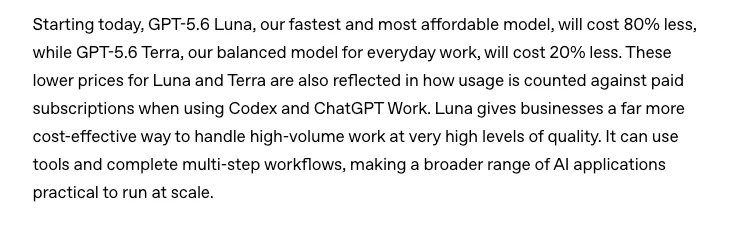
On July 30, OpenAI published “Advancing the price-performance frontier with GPT-5.6” and formally lowered prices for GPT-5.6 Terra and Luna.
According to the announcement, Terra fell 20% to $2 per million input tokens and $12 per million output tokens. Luna fell 80% to $0.20 per million input tokens and $1.20 per million output tokens. For automated scripts, code review, and backend agents that call models at scale, cuts like these directly change the cost of each task. In addition, OpenRouter's discounted-models page currently lists a 50% channel-side discount for GPT-5.6 Terra and Luna. That offer applies only to the OpenAI provider. To avoid falling back to another provider and losing the discounted price, set provider.order to ["openai"] and provider.allowFallbacks to false; see the OpenRouter Provider Routing documentation for the exact request format.
For the original release context—Sol, Terra, and Luna positioning, initial pricing, and how Codex was folded into ChatGPT—see our earlier article, GPT-5.6 Is Public: Pricing, Performance, and Codex Merging into ChatGPT. This price cut came after that model and product structure had already been made public, and further adjusts Terra and Luna pricing.
OpenAI's point is not simply to discount a model. The company says GPT-5.6's price-performance gains come from combined improvements in the model, inference systems, agent harnesses, hardware utilization, and production software. Lower model costs, in other words, do not come only from training a smaller model; they also depend on the efficiency of the full serving system.
OpenAI also introduced Fast mode. It targets latency-sensitive use cases by offering faster processing at a higher price. OpenAI says Sol can run at up to roughly 2.5 times the speed in Fast mode, which costs twice as much as standard mode. The product segmentation is therefore clearer: standard API users optimize for unit cost, while high-concurrency and low-latency workloads pay more for speed.
This distinction matters. Lower API prices do not mean every capability becomes “free.” OpenAI is separating the market along several dimensions: standard mode competes on token price, Fast mode competes on response time, and model variants still differentiate task capability. Developers should compare more than input and output pricing: retries, tool calls, time to completion, and the business impact of latency all belong in the calculation.
DeepSeek V4 Flash: graduating from preview without making the model bigger
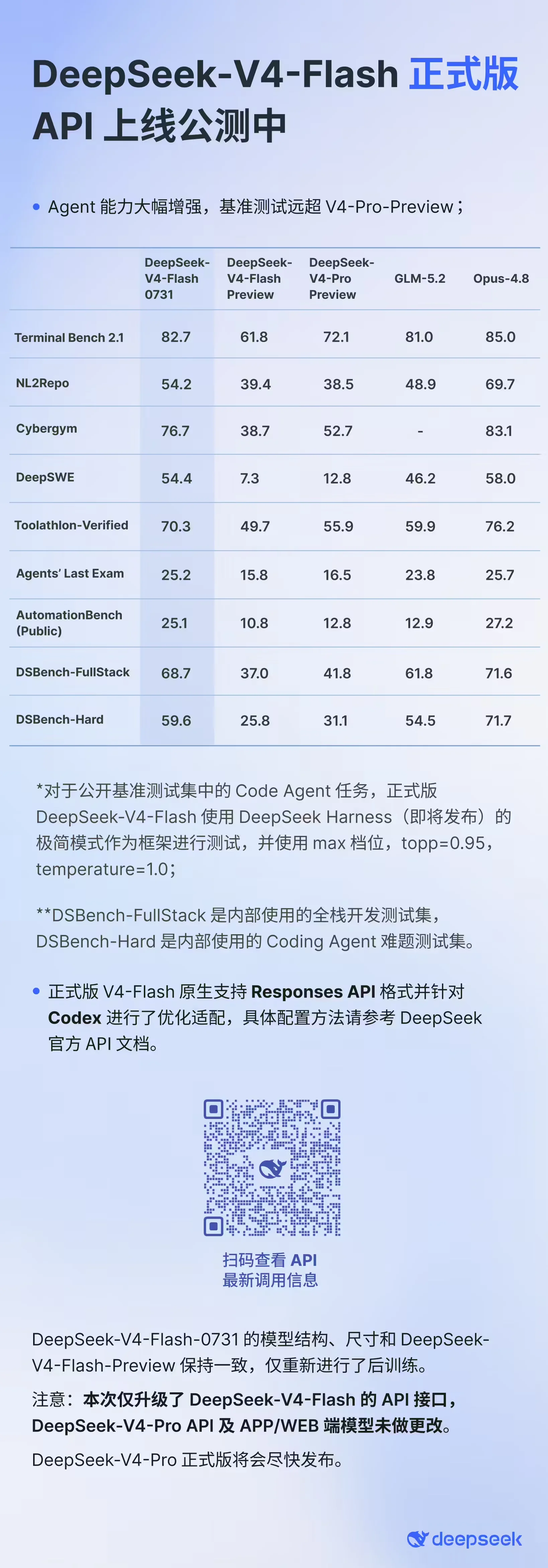
On July 31, DeepSeek announced in its official changelog that DeepSeek-V4-Flash-0731 had moved from preview to a formal public-beta release. This was not V4 Flash's first appearance: the series had already been available in preview. The key change is that the preview version graduated to a formal release, with stronger coding, tool-use, and agent-workflow capabilities—not simply a larger model.
For the V4 preview timeline, the Flash/Pro model lineup, a 1M-token context window, and API pricing, see DeepSeek V4 Preview Goes Live: 1M Context, Flash/Pro Models, and Latest API Pricing.
DeepSeek says V4 Flash keeps the preview version's architecture and scale, with gains coming primarily from further post-training. Its published results include 82.7 on Terminal-Bench 2.1, 54.2 on NL2Repo, 54.4 on DeepSWE, and 70.3 on Toolathlon Verified.
These results illustrate why completing real software-engineering tasks increasingly depends on post-training, tool use, and context management—not just parameter count. For a coding agent, understanding an unfamiliar repository, breaking down a task, calling tools, editing files, and continuing after test feedback often matter more than one-shot code generation.
Benchmark results should not be compared in isolation from their evaluation configuration. Harnesses, prompts, tool settings, and concurrency can all affect outcomes. A more accurate reading is that DeepSeek's own testing shows V4 Flash improved on several coding and agent tasks; it does not establish that the model leads every development scenario.
Graduating from preview also does not mean that every production question has been settled. DeepSeek still describes the release as a public beta. Developers can begin integrating and testing it, but judgments about reliability, long-task success rates, and compatibility with complex projects still require more real-world evidence.
The shared trend: AI coding is entering an efficiency race
Taken together, the three announcements show three distinct directions.
1. Subscriptions are starting to sell capacity assurance
Z.ai's Max plan now costs RMB 1,078 per month. Its main selling points are not merely more calls, but early flagship-model access, priority capacity at peak times, and an experience aimed at larger repositories. Coding Plan is moving from an ordinary subscription toward a development-resource service.
Agent workflows create long sequences of calls: reading files, searching code, changing files, running tests, analyzing failures, and iterating. A high-frequency user can consume far more resources than a conventional chat user. Fixed monthly pricing therefore needs quotas, time windows, and tiers to manage capacity.
2. API prices increasingly reflect infrastructure efficiency
OpenAI represents a different route: when model and inference efficiency improve, a provider can pass some of the gain to API users through lower unit prices and expand usage.
For developers, this matters. If model quality is stable enough, lower token prices reduce the barrier to code review, bulk migrations, automated testing, and backend agents. Competition can move from “who released the stronger model?” toward “who can complete more work on the same budget?”
3. Model evaluation is moving from one-shot answers to task completion
DeepSeek V4 Flash is framed around combined performance in coding and agent scenarios, rather than a single chat capability. Developers will increasingly ask different questions: Can a model complete an issue independently? Can it modify multiple files within a limited context? Can it keep repairing code after test feedback? How many tool calls does a completed task require?
Those measurements are closer to real productivity than a leaderboard rank. They also help explain why the same model can produce very different costs and outcomes for different developers.
How should developers interpret these changes?
For individual developers and small teams, evaluate coding tools on four dimensions:
- Project size: Small repositories do not necessarily need Max-level quotas. Larger repositories require closer attention to long-task reliability and continuous-call capacity.
- Usage pattern: A fixed monthly plan suits high-frequency interactive development. APIs are a better fit for automation and metered production systems.
- Latency requirements: A few extra seconds may not matter for code generation, but real-time completion, online review, and high-concurrency services may justify paying for speed.
- True cost to completion: Do not look only at input and output pricing. Track retries, tool calls, repeated context transmission, and final task-success rates.
A more reliable test is to prepare a set of real tasks close to your own work and record each model's token consumption, call count, elapsed time, and required human editing. The meaningful comparison is not “which model tops the leaderboard?” but:
With the same budget, which model reliably completes more real work?
Conclusion: the next AI coding contest is cost per completed task
The three late-July announcements represent three directions in AI coding: Z.ai raised subscription prices while strengthening resource tiers; OpenAI lowered GPT-5.6 Terra and Luna API prices; and DeepSeek graduated V4 Flash from preview while improving coding and agent capability through post-training.
One price increase, one price cut, and one upgrade may look like opposite moves. They all point to efficiency. Providers need to use compute and model capacity more efficiently; developers need to complete more work with smaller budgets; and models must move beyond answering questions toward reliably completing complex workflows.
The next stage of AI coding may therefore be less about asking “which model is strongest?” and more about three practical measures: cost per task, reliability of task completion, and the time developers actually save.
Related resources
Source Notice
This article is published by merchmindai.net. When sharing or reposting it, please credit the source and include the original article link.
Original article:https://merchmindai.net/blog/en/post/ai-coding-zhipu-openai-deepseek-v4-flash-july-2026