APAC Tech Hub: How Singaporean Merchants Balance Chinese, Malay, Tamil, and English Support
Using June 22, 2026 storefront observations and Singapore official language data, this article shows why multilingual support has become a conversion and operations priority for Singapore electronics merchants.
APAC Tech Hub: How Singaporean Merchants Balance Chinese, Malay, Tamil, and English Support
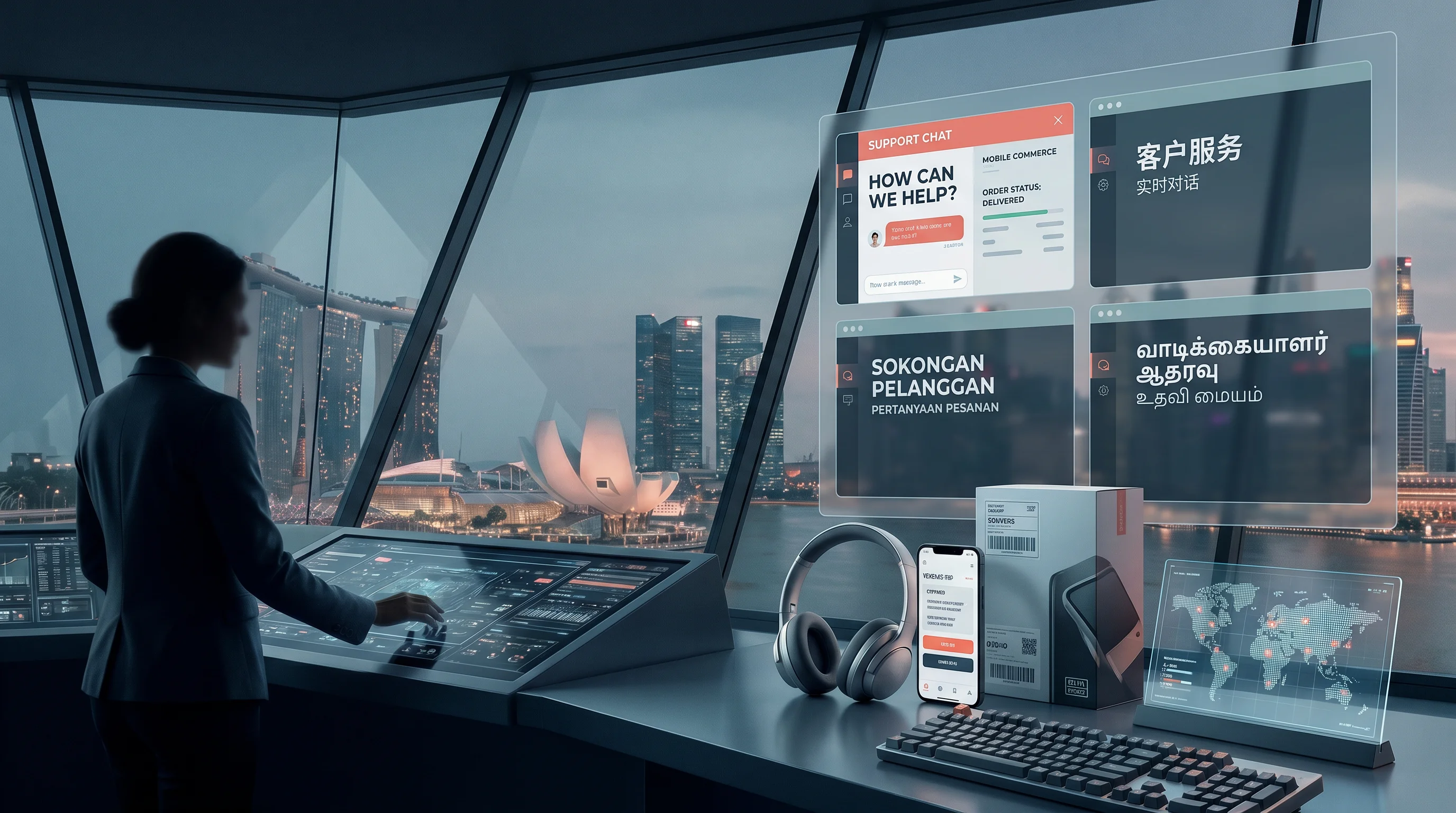
On June 22, 2026, Singapore electronics support was not just a staffing problem. It was a language-routing problem tied directly to conversion.
Singapore is one of the clearest examples of why multilingual support can no longer be treated as a nice-to-have localization layer.
For consumer electronics merchants, the problem is sharper than in many other categories. Product questions are more technical, support windows are more urgent, and hesitation is expensive. A customer buying a phone case, gaming PC, monitor arm, keyboard, audio device, or chair is often only one unanswered compatibility question away from dropping out of checkout.
In Singapore, that question may arrive in English. It may arrive in Mandarin Chinese. It may start in English and switch into Malay for clarification. It may include Tamil terms when the customer wants certainty rather than generic sales talk. Even when the final order is placed in English, the trust-building path often is not.
That is the operating challenge.
To ground the analysis, I reviewed live storefront captures taken on June 22, 2026 from:
https://rhinoshield.iohttps://sony.com.sg
I also used current Singapore official and quasi-official references to anchor the language and retail context:
- Singapore language data published via
https://data.gov.sg/ SingStat and updated on May 5, 2026 - Ministry of Trade and Industry materials at
https://www.mti.gov.sgupdated in 2025 - IMDA business and service materials at
https://www.imda.gov.sgupdated through June 2026
The result is straightforward:
Singapore electronics merchants are not balancing four languages because it looks inclusive in a brand deck. They are balancing four languages because product complexity, trust expectations, and regional traffic patterns make monolingual support operationally irrational.
The structural reason Singapore is different
Singapore's support problem is not simply "many people speak more than one language." It is that language preference changes by context.
A shopper may:
- browse category pages in English,
- ask a pre-purchase question in Mandarin,
- ask family decision-makers in Malay,
- and expect the order follow-up in English again.
That is normal in Singapore commerce.
Official population language datasets published on https://data.gov.sg from Singapore Department of Statistics material show why the support model gets complicated. In the Census 2020-derived language tables surfaced on May 5, 2026, large segments of the resident population are bilingual, including combinations such as:
- English and Mandarin
- English and Malay
- English and Tamil
This matters more than raw "official language count." A merchant is not serving four totally separate monolingual markets. It is serving one high-density, bilingual, context-switching customer base.
For electronics retail, that changes support design in three ways.
1. Technical terms do not always localize cleanly
A customer may understand marketing language in English but prefer diagnostic explanation in another language.
Examples:
- charging compatibility
- wireless standard confusion
- keyboard layout differences
- warranty exclusions
- shipping timelines
- gaming PC component substitutions
These are not broad brand questions. They are precision questions. Precision is where language confidence matters most.
2. High-intent buyers do not tolerate support lag
Electronics shoppers often come with urgency:
- "Will this fit my model?"
- "Can this ship today?"
- "Does this include local warranty?"
- "What is the return condition if seal is broken?"
If the merchant answers slowly, the customer usually does not wait. They compare elsewhere.
3. Singapore acts as an APAC trust benchmark
Singaporean shoppers are used to polished interfaces, fast fulfillment expectations, and high information density. A vague support flow looks amateur quickly.
That is why multilingual support is not only a service issue. It is part of brand credibility.
Benchmark math: what a language mismatch costs an electronics merchant
Use a conservative model for a Singapore or Singapore-led regional electronics merchant.
| Variable | Modelled benchmark |
|---|---|
| Monthly sessions | 410,000 |
| Sessions landing on technical or compatibility-sensitive pages | 38% |
| Share of those sessions that generate a support-needed question | 18% |
| Share of those questions where language confidence affects clarity | 42% |
| Average order value | S$128 |
| Conversion when the question is resolved clearly in preferred language | 4.9% |
| Conversion when the answer is delayed or handled only in generic English | 2.8% |
That yields roughly 11,780 sessions per month where language-sensitive support quality directly influences checkout confidence.
If the merchant resolves those questions well:
- orders: about 577
- revenue: about S$73,856
If the merchant resolves them poorly:
- orders: about 330
- revenue: about S$42,240
The monthly gap is about S$31,616, or S$379,392 annually, from this affected segment alone.
That excludes:
- refund requests caused by misunderstood product details,
- support escalations from incomplete first replies,
- abandoned corporate or family purchases,
- and lost repeat purchases from customers who decide the merchant is not reliable enough for expensive products.
Why the penalty is especially high in electronics
Language mismatch hurts all categories, but electronics gets hit harder because the questions are harder to fake your way through.
In apparel, a weak answer may still leave room for a speculative purchase.
In electronics, the customer often wants one of the following:
- compatibility confirmation,
- configuration explanation,
- usage setup confidence,
- delivery certainty,
- or warranty clarity.
If the answer sounds imprecise, the risk feels immediate.
A second-order cost most teams ignore
The direct revenue gap is only the first layer. The second layer is operational drag.
When merchants fail to answer clearly in the customer's confidence language, they create:
- repeated contacts from the same customer,
- longer average handling time for live agents,
- more screenshots and copied links sent back and forth,
- more post-purchase dissatisfaction framed as "I thought you meant...",
- and higher escalation rates on otherwise simple questions.
A multilingual support system should therefore be judged not only on conversion lift, but also on its ability to compress support effort per resolved order.
What the June 22 storefronts reveal
1. https://rhinoshield.io: accessory-led commerce still creates heavy support interpretation load
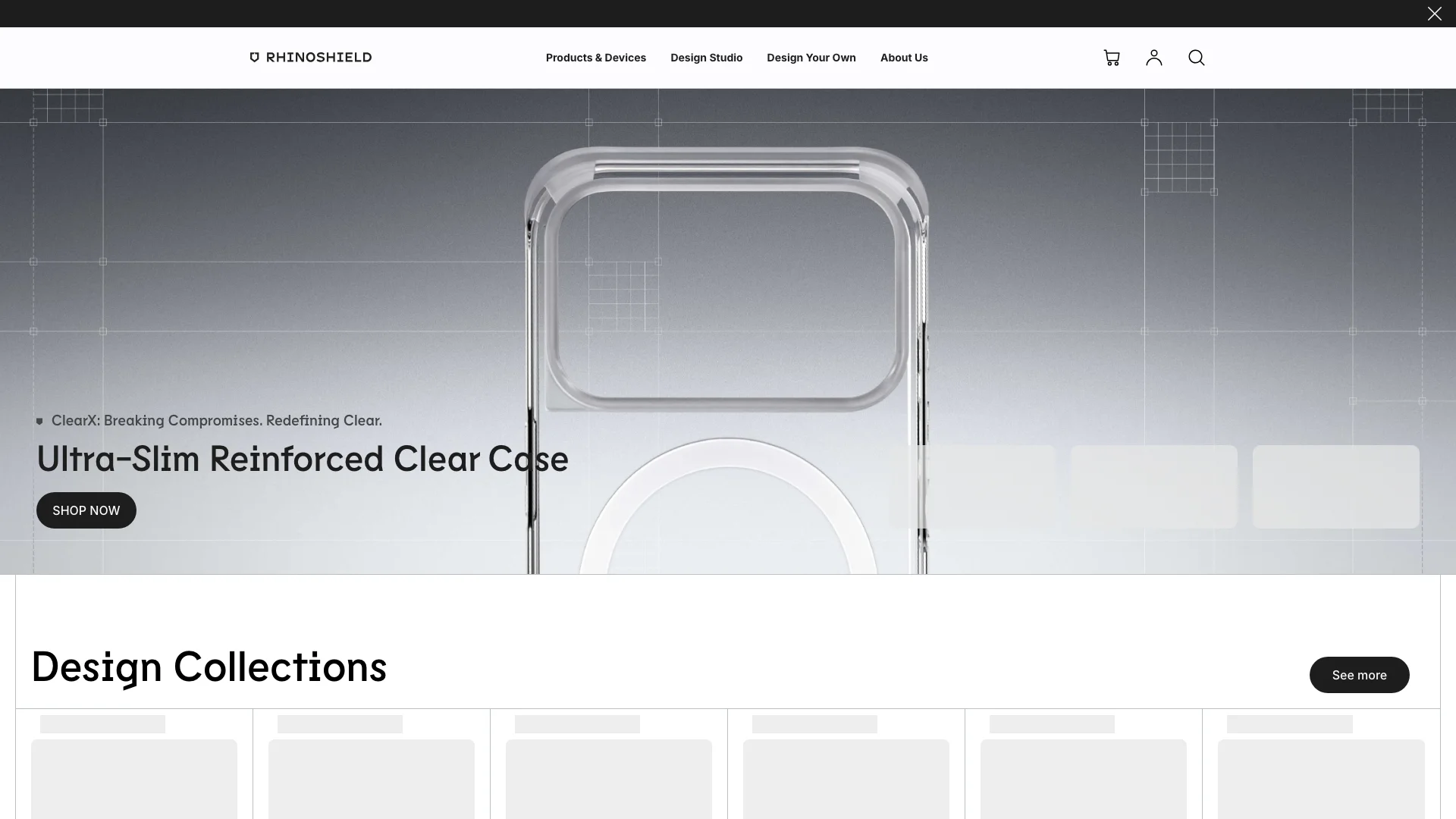
The June 22 capture of https://rhinoshield.io shows a modern, visually strong mobile-accessory storefront. The category is relatively simple compared with custom PCs, but support demand is still intense because "simple" accessories generate exact-fit anxiety.
Customers do not ask whether a phone case exists. They ask:
- whether it fits the exact device generation,
- whether MagSafe alignment is supported,
- whether button feel differs by model,
- whether a camera ring clearance changes with protector combinations,
- and whether regional stock or delivery timing differs.
This is where multilingual support becomes economically relevant. A shopper may read product merchandising in English, but when they need certainty around fit or returns, they shift into the language where they are least likely to misunderstand details.
For RHINOSHIELD-style merchants, language support quality affects:
- model-selection confidence,
- accessory-bundle attachment,
- fewer wrong-item purchases,
- and lower return friction.
2. https://sony.com.sg: broad catalog depth multiplies language-routing complexity
The June 22 capture of https://sony.com.sg highlights a different operational pattern: category breadth.
Sony's Singapore storefront spans multiple support-intense product classes:
- audio,
- cameras,
- displays,
- consoles,
- accessories,
- and ecosystem products with setup dependencies.
A broad catalog changes the support challenge because one routing model rarely fits every question.
For example:
- a headphone buyer asks about codec support,
- a camera buyer asks about lens compatibility,
- a TV shopper asks about delivery and installation,
- and a PlayStation buyer asks about warranty or account-region nuance.
These questions may all originate from the same chat entry point, but they require different levels of technical specificity and different tolerance for ambiguity.
When merchants add Singapore's multilingual reality on top, the support operation must do more than "translate." It must route intent correctly before the answer is even drafted.
3. Why these two examples matter together
https://rhinoshield.io and https://sony.com.sg represent two ends of the electronics-support spectrum.
https://rhinoshield.io shows how even a relatively focused catalog can create high support stakes when the product is model-dependent.
https://sony.com.sg shows how a wider catalog turns the language problem into an orchestration problem, where the system must know not just what language the customer prefers, but what answer framework the category requires.
Together, they reveal a larger point: Singapore merchants do not need multilingual support because they sell "internationally." They need it because even domestic purchase journeys are multi-context and precision-dependent.
The four support patterns Singapore merchants have to manage
1. English-first merchandising, multilingual reassurance
Many Singapore merchants still operate with English as the primary merchandising language because it is efficient for catalog maintenance and aligns with regional commerce norms.
That is reasonable.
The mistake is assuming English-first merchandising means English-only support is sufficient.
In practice, support often needs:
- English product source of truth,
- multilingual clarification layer,
- and clear escalation paths for technical or policy issues.
2. Bilingual customers who change language by risk level
Customers often switch language not because they cannot understand English, but because they do not want to take risk in English.
This is a critical distinction.
A shopper may comfortably browse a hero page in English and still ask the decisive support question in Mandarin or Malay because the downside of misunderstanding is higher at that moment.
3. Family-influenced purchase decisions
In Singapore consumer electronics, purchases are often discussed across households:
- parents and children,
- spouses,
- multi-generation families,
- or office teams buying on behalf of others.
That means the support answer is not always consumed by the same person who initiated the session. Multilingual clarity improves internal forwarding and decision confidence.
4. Cross-border APAC spillover
Singapore merchants frequently serve or influence a wider Southeast Asia audience. A Singapore storefront may attract traffic from Malaysia, Indonesia, or travelers comparing availability and warranty logic.
That means merchants are not building multilingual support only for domestic optics. They are building it because Singapore is a regional commerce node.
Three case-study patterns enterprise operators should pay attention to
Case study pattern 1: accessory merchants lose margin when fit answers stay generic
For accessory-heavy merchants similar to https://rhinoshield.io, the highest-value support moments often happen before the customer even opens chat.
The shopper has already narrowed to:
- a specific device,
- a specific finish,
- a specific accessory bundle,
- and a specific delivery expectation.
At that point, one unresolved fit question can destroy the bundle, not just the base item.
A merchant selling:
- a case,
- a screen protector,
- a grip add-on,
- and a charger-compatible attachment
does not lose one order when support fails. It loses a multi-item basket.
The support system therefore needs to answer with:
- model-specific language,
- bundle-aware logic,
- and confidence-preserving phrasing in the customer's preferred language.
If the answer is too vague, the shopper often simplifies the basket or exits entirely.
Case study pattern 2: broad-catalog merchants need category-specific answer templates
For merchants with Sony-like breadth, a multilingual layer is not enough unless the answer logic changes by category.
A camera answer should not sound like a gaming-accessory answer. A TV-delivery explanation should not sound like a headphone-spec explanation.
The support architecture has to distinguish between:
- spec-driven questions,
- logistics-driven questions,
- warranty-policy questions,
- and account or subscription questions.
That distinction becomes even more important across languages because customers detect canned, category-agnostic answers quickly.
Case study pattern 3: Singapore teams need regional readiness without regional chaos
A Singapore merchant often uses the market as a regional proving ground. That creates a hidden tension.
The team wants:
- local precision,
- regional scalability,
- and centralized operations.
But if they centralize too aggressively, support starts sounding generic. If they localize too heavily, cost explodes.
The winning pattern is not full human coverage in every language at every hour. It is:
- structured source-of-truth content,
- language detection at message level,
- AI first response for high-frequency questions,
- and human escalation for policy or technical edge cases.
That is the practical middle path.
Why traditional support stacks fail here
Static FAQ fails because intent is too specific
Electronics questions often include model names, bundle logic, timing, or exception handling. Static FAQ pages cannot keep up with these variations.
Human-only support fails because coverage becomes expensive
To cover English, Mandarin, Malay, and Tamil across business hours with product-competent staff, costs rise fast. Coverage gaps then appear exactly when customers need fast answers.
Generic translation bots fail because terminology is brittle
Literal translation is not the same as support accuracy. Product, warranty, and logistics terms need operational grounding, not word substitution.
Ticket queues fail because urgency is immediate
For pre-purchase electronics questions, a delayed answer is often equivalent to no answer.
Channel fragmentation makes everything worse
Many merchants split support across:
- site chat,
- email,
- marketplace messages,
- WhatsApp,
- social DMs,
- and store-locator contact forms.
Once that happens, the same customer may ask the same question in different languages across different channels and receive inconsistent answers.
That inconsistency does more damage than a slow answer because it undermines the merchant's perceived competence.
What an AI-native support layer should do instead
This is exactly where HeiChat's positioning makes sense if it is implemented as commerce infrastructure rather than a widget.
The useful model is:
- ingest product data, shipping rules, and return policies,
- classify the question by intent and product family,
- detect the customer's preferred language dynamically,
- answer in that language using the English source of truth,
- and escalate only when confidence is low.
In Singapore, the win is not just "support in more languages." The win is:
- lower first-response friction,
- fewer mistranslated technical answers,
- fewer wrong purchases,
- and higher confidence on high-consideration items.
The minimum viable multilingual support architecture
- English remains the canonical catalog and policy source.
- Customer language is detected at message level, not account level.
- Answers are generated from structured product and policy knowledge, not freestyle text.
- Confidence thresholds determine when human escalation is required.
- Merchants audit failure patterns by language and by intent, not only by CSAT.
That last point matters. If a merchant only tracks average support satisfaction, it misses where the real loss happens. The real loss usually clusters around:
- compatibility queries,
- delivery promises,
- warranty claims,
- and product-specific setup confusion.
What "structured knowledge" should include
For Singapore electronics operators, the source layer should contain at least:
- product-to-model compatibility mappings,
- shipping SLA language by region,
- warranty coverage and exclusions,
- return conditions by product type,
- payment and installment clarifications,
- and approved phrasing for sensitive policy edge cases.
Without that structure, multilingual AI becomes fast but unreliable. With it, the system becomes operationally defensible.
Implementation roadmap for Singapore electronics merchants
Phase 1: Map the question inventory
- Identify the top 50 pre-purchase and post-purchase question types.
- Separate technical, policy, fulfillment, and account questions.
- Mark where language switching happens today.
- Quantify which questions most often lead to cart exits.
Phase 2: Create language-safe source content
- Normalize product compatibility data.
- Normalize warranty exclusions and timelines.
- Normalize delivery and return language.
- Remove contradictory phrasing between product pages and support macros.
Phase 3: Deploy multilingual AI routing
- Detect English, Mandarin, Malay, and Tamil at message level.
- Route by intent first, then by language.
- Use human escalation for edge-case technical or policy ambiguity.
- Log low-confidence responses for weekly review.
Phase 4: Measure revenue outcomes
- Track conversion after chat by language.
- Track return and refund causes by question type.
- Track first-contact resolution on compatibility queries.
- Track where English-only answers underperform.
Phase 5: Expand from support to revenue assistance
Once the merchant has confidence in multilingual support accuracy, the same system can start assisting with:
- bundle recommendation,
- accessory attachment,
- installation add-on explanation,
- pre-order expectation setting,
- and waitlist capture when stock is limited.
That is where the operational model moves from "cost control" to "revenue leverage."
The numbers section executives should watch every week
If this article is being read by a CTO, Head of CX, or E-commerce Director, the KPI set should be narrow and unforgiving.
Track these seven metrics weekly:
| Metric | Why it matters |
|---|---|
| Conversion after support interaction by language | Reveals whether multilingual answers are actually lifting revenue |
| First-contact resolution by intent category | Shows whether routing is good enough |
| Escalation rate by language | Exposes low-confidence languages or weak knowledge coverage |
| Return rate tied to compatibility misunderstandings | Measures whether support accuracy is reducing wrong purchases |
| Average response time for high-intent pre-purchase questions | Indicates whether the team is winning the session window |
| Repeat-contact rate on the same order or product | Signals answer clarity problems |
| Revenue recovered from language-sensitive sessions | Ties the support layer back to board-level economics |
The point is not to create a giant reporting dashboard. The point is to force clarity on whether multilingual support is operating as a real system or just a translation veneer.
What failure looks like in the first 90 days
Many teams understand the theory of multilingual support and still fail in implementation because they optimize the wrong layer first.
The most common first-90-day failures are predictable.
Failure pattern 1: the team launches language coverage before knowledge cleanup
This is the fastest way to scale inconsistency.
If product pages, return policies, and internal support macros still disagree in English, adding Chinese, Malay, and Tamil response capability only multiplies the disagreement.
The customer then sees:
- one answer on the PDP,
- another answer in chat,
- another answer in order follow-up,
- and a fourth answer when escalation reaches a human agent.
At that point, multilingual coverage makes the merchant look less trustworthy, not more capable.
Failure pattern 2: the routing logic treats language as the first classifier
That sounds intuitive but is usually wrong.
The first classifier should be intent:
- compatibility,
- warranty,
- shipping,
- returns,
- setup,
- financing,
- or account support.
Only after the system understands the intent should it decide how to answer in the customer's preferred language.
If language is prioritized before intent, the operation tends to produce perfectly fluent but commercially weak answers.
Failure pattern 3: teams over-escalate because they do not trust the system
Some merchants deploy a multilingual AI layer and then send too many conversations to humans because confidence thresholds are poorly designed.
That creates two problems:
- the customer waits anyway,
- and the human team becomes a translation safety net rather than a revenue desk.
The correct design goal is not zero escalation. It is intelligent escalation:
- high-frequency questions resolved automatically,
- high-risk edge cases escalated quickly,
- and ambiguous patterns used to improve the knowledge base every week.
Failure pattern 4: no one owns the source of truth
The support team cannot maintain multilingual accuracy alone.
Ownership has to be shared across:
- ecommerce,
- operations,
- product or merchandising,
- logistics,
- and whoever owns policy and compliance language.
If no one owns the truth layer, the AI stack becomes a polished wrapper around fragmented operations.
A practical operating model for Singapore teams with lean headcount
Most merchants in this market do not have the luxury of building a huge localized support organization. They need a model that works with lean teams.
A realistic operating model looks like this:
Tier 1: AI resolves high-frequency, low-ambiguity questions instantly
This tier should handle questions like:
- "Does this fit iPhone 15 Pro?"
- "How long is local delivery?"
- "Do you offer self-collection?"
- "Is warranty local or international?"
- "Can I return if unopened?"
These questions are repetitive, commercially important, and too frequent to leave to manual queues.
Tier 2: AI drafts the answer, humans approve edge cases
This tier is appropriate for:
- exceptions to return conditions,
- unusual address or shipping scenarios,
- accessory combinations with partial compatibility,
- and questions where policy language must stay exact.
The merchant still gains speed because the system has already:
- identified the language,
- classified the intent,
- gathered the likely facts,
- and framed the answer.
The human agent is editing and confirming, not starting from zero.
Tier 3: specialists handle policy, technical, or enterprise-value conversations
Not every conversation should be fully automated.
High-value flows still need people:
- B2B or office procurement requests,
- unresolved warranty disputes,
- product troubleshooting beyond pre-sales scope,
- or policy-sensitive cases where the merchant wants explicit accountability.
The point is to reserve human attention for the conversations where it creates disproportionate value.
Why this model fits Singapore
Singapore's merchant environment rewards operational precision. Teams are expected to be efficient, measured, and responsive without bloated staffing.
That is why the best support model is not "hire one native speaker per language per shift." It is:
- one structured commerce knowledge layer,
- one multilingual AI interface,
- one escalation path,
- and a small human team focused on exceptions and revenue-critical moments.
That is how merchants preserve both service quality and margin discipline.
Why this matters beyond Singapore
Singapore is a small market in gross population terms, but it is a large market in operational signal.
What shows up there early tends to spread elsewhere:
- multilingual browsing with English checkout,
- cross-border product comparison,
- higher expectations around clarity,
- and less patience for weak pre-purchase support.
Merchants that solve for Singapore well usually end up building systems that also perform better in:
- Hong Kong,
- Malaysia,
- UAE-style multilingual commerce contexts,
- and global stores serving diaspora customers.
So the lesson is broader than one city-state. Singapore simply compresses the future into a visible form.
Key takeaways
Singapore multilingual support is a revenue system, not a branding extra.Electronics merchants face higher penalties for language ambiguity because product questions are technical and risk-sensitive.English-first storefronts still need multilingual reassurance layers.The hardest problem is not translation. It is accurate routing from language to intent to answer.Merchants that solve this well will outperform on both trust and conversion across Singapore and wider APAC traffic.
Final point
Singapore is often described as a small market. In support design, that framing is misleading.
It is a dense, multilingual, high-expectation commerce environment that exposes whether a merchant's support system is actually built for modern retail complexity.
If an electronics brand cannot answer a compatibility, shipping, or warranty question clearly across English, Mandarin, Malay, and Tamil touchpoints, it is not just under-localized. It is under-instrumented.
That is the larger lesson from Singapore.
The market is not telling merchants to hire endlessly. It is telling them to build support systems that treat language, intent, and trust as one operational layer.
HeiChat is valuable in this environment only if it behaves like infrastructure:
- one source of truth,
- one multilingual answer layer,
- one escalation logic,
- and one measurement system tied to conversion.
That is what modern commerce teams should be building now.
Call to action
If your team is selling electronics, accessories, or technical products into Singapore or wider APAC traffic, audit your current support flow against one simple question:
Can a customer ask the highest-risk purchase question in the language they trust most, and receive a precise answer before they leave the session?
If the answer is no, the problem is not cosmetic localization. It is revenue leakage.
That is the operational gap HeiChat is built to close.
Source Notice
This article is published by merchmindai.net. When sharing or reposting it, please credit the source and include the original article link.
Original article:https://merchmindai.net/blog/en/post/apac-tech-hub-how-singaporean-merchants-balance-chinese-malay-tamil-and-english-support