Why Anthropic's Distillation-Attack Disclosure Sparked a Community Backlash
On February 23, 2026, Anthropic accused DeepSeek, Moonshot, and MiniMax of using 24,000 accounts for 16 million Claude interactions. Here's what was announced and how the community reacted.
On February 23, 2026, Anthropic published a post saying it had detected what it called industrial-scale distillation attacks against Claude, and directly named three Chinese AI labs: DeepSeek, Moonshot, and MiniMax.
The announcement quickly split the tech community. One side saw it as proof that frontier-model competition has moved into an active extraction-and-defense phase. The other side argued Anthropic was reframing a broader industry problem that has existed for years: model outputs being harvested through platform access.
This article focuses on three questions:
- What Anthropic actually announced.
- Which arguments dominated the Hacker News discussion.
- How external media and policy observers interpreted the story.
What exactly did Anthropic announce?
Based on Anthropic's own post (published February 23, 2026), five points stand out.
1) Scale and attribution: 24,000 accounts, 16 million interactions
Anthropic said the three labs used around 24,000 fraudulent accounts to generate more than 16 million interactions with Claude, with the goal of improving their own models.
Anthropic also published per-entity counts:
- DeepSeek: more than 150,000 interactions
- Moonshot: more than 3.4 million interactions
- MiniMax: more than 13 million interactions
2) Claimed target capabilities: reasoning, tool use, coding
Anthropic described the traffic as structured capability-extraction activity rather than normal user behavior, concentrated in:
- agentic reasoning
- tool use
- coding
3) Attribution method: IP overlap, request metadata, infrastructure signals
Anthropic said it attributed the activity through IP correlations, metadata patterns, and infrastructure indicators, and said it has high confidence in the attribution.
4) Evasion pattern: proxy networks and large account pools
The post described a "hydra cluster" pattern: proxy-based resale networks managing tens of thousands of accounts while blending suspicious and normal requests to reduce detectability.
5) Response plan: detection, intelligence sharing, access controls, model-level hardening
Anthropic said it is expanding defenses across four areas:
- behavior classifiers and fingerprinting
- threat-indicator sharing with other model providers, cloud platforms, and relevant institutions
- stricter verification around high-risk access channels (such as education and startup pathways)
- product/API/model changes designed to reduce illicit distillation effectiveness
The post also linked the incident to U.S. chip-export controls, arguing that distillation can weaken policy objectives if not addressed.
Hacker News reaction: four recurring arguments
In the related Hacker News thread, discussion rapidly clustered into four camps.
Viewpoint 1: Ethical irony
A common criticism was industry double standards: major model companies were built partly on large-scale web data use, but now frame reverse extraction as unacceptable when the target is their own model outputs.
The underlying question is not whether fraudulent accounts are acceptable. It is who defines data boundaries, when those boundaries were set, and whether they are applied consistently.
Viewpoint 2: Terminology dispute
Some commenters argued that in strict ML usage, classical distillation relies on teacher distributions/soft targets, while many black-box API workflows are closer to imitation learning or synthetic-data generation.
This matters because terminology influences policy framing, media framing, and perceived legitimacy.
Viewpoint 3: Competitive pragmatism
Another line of argument: using stronger-model outputs to accelerate catch-up is an expected behavior in fast-moving markets.
From that perspective, the decisive issue is not "borrowing ideas" in the abstract, but concrete rule boundaries: ToS compliance, regional restrictions, automation behavior, and account fraud.
Viewpoint 4: Product-quality concern
Anthropic said it will deploy product/API/model-level mitigation. Some users worried that anti-extraction controls could also degrade legitimate use cases, especially tasks that rely on richer reasoning traces.
That tension is now central across the industry: block large-scale abuse without silently downgrading normal-user quality.
External reactions: media, policy, and industry narratives
Outside Hacker News, responses followed three broad tracks.
1) Major media framed it as another signal in U.S.-China AI competition
Reuters reported on February 23, 2026 that Anthropic's disclosure came after earlier warnings from OpenAI involving DeepSeek, and noted that the named companies did not immediately respond to requests for comment at that time.
That framing elevated the story from a single platform-security claim into a wider geopolitical AI-competition narrative.
2) Policy circles connected it to chip-export debates
TechCrunch's coverage included policy voices arguing incidents like this strengthen the case for tighter U.S. AI-chip controls on China.
In practice, that means platform abuse and access control now feed directly into trade-policy arguments.
3) Analysts questioned overlap between security language and competitive positioning
Another recurring interpretation is that "security" and "market defense" are not mutually exclusive in company messaging, but often become entangled in public debate.
4) Elon Musk's X reply pulled the discussion back to training-data legitimacy
Elon Musk's X reply was widely circulated during the same news cycle. He wrote:
"Anthropic is guilty of stealing training data at massive scale and has had to pay multi-billion dollar settlements for their theft. This is just a fact."
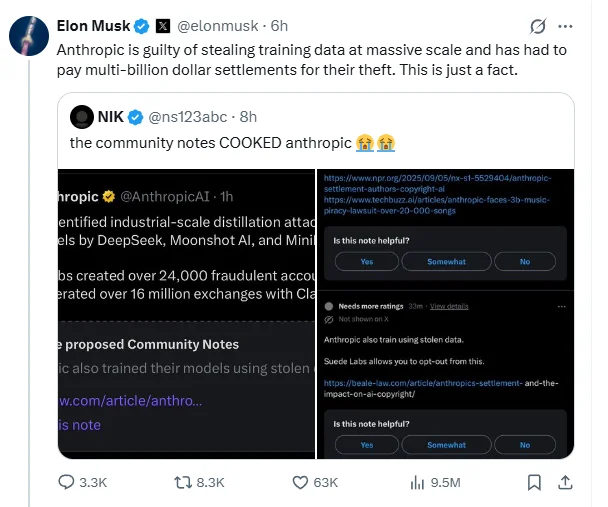
That intervention shifted attention from whether distillation attacks happened to a broader legitimacy battle: when the whole sector faces unresolved training-data and copyright disputes, who gets to claim the moral high ground.
Why this matters beyond 16 million requests
At surface level, this is a platform-abuse story. At a deeper level, it signals a shift from pure model-parameter competition to competition over access, extraction resistance, and enforceable boundaries.
You can think of it as a three-part repricing of the AI stack:
- Capability repricing: model outputs become high-value training assets.
- Access repricing: account systems, proxy infrastructure, and compliance controls become strategic battlegrounds.
- Policy repricing: technical security incidents are rapidly absorbed into export-control and industrial-policy frameworks.
Takeaway
Anthropic's February 23, 2026 disclosure sent a clear signal:
- from quiet enforcement to public naming
- from account security language to national-security framing
- from single-company moderation to calls for coordinated defense
The intense reaction reflects three unresolved boundaries in the AI era:
- learning vs copying
- openness vs abuse
- competitive strategy vs public-interest security claims
The most important next indicators are concrete, verifiable ones:
- whether major labs publish clearer anti-distillation enforcement standards
- whether named companies issue formal technical or legal responses
Sources
- Anthropic: Detecting and preventing distillation attacks
- Hacker News thread (id=47126177)
- Reuters: Chinese companies distilled Claude to improve own models, Anthropic says
- TechCrunch: Anthropic accuses Chinese AI labs of mining Claude
- Elon Musk X post (status/2026054747393011986)
- Hinton et al. (2015): Distilling the Knowledge in a Neural Network
Source Notice
This article is published by merchmindai.net. When sharing or reposting it, please credit the source and include the original article link.
Original article:https://merchmindai.net/blog/en/post/anthropic-distillation-attacks-community-reactions