Size & Fit Queries: Benchmarking Apparel's Most Expensive Unanswered Question
A data-driven benchmark of how Khy, Fashion Nova, and Gymshark expose the real conversion cost of unanswered size and fit questions in apparel ecommerce.

Size & Fit Queries: Benchmarking Apparel's Most Expensive Unanswered Question
The biggest leak in apparel ecommerce is not traffic. It is hesitation that shows up the moment a shopper asks, "Will this fit me?"
Fashion teams still talk about fit as if it were a merchandising problem. It is not. At scale, fit is a revenue system problem.
The modern apparel funnel is brutally compressed. A shopper sees a creator video, a paid social ad, a lookbook email, or a retargeting unit. They click into a storefront already halfway convinced. Then they hit the real barrier:
- Should I buy my usual size or size up?
- Is this stretch denim or rigid denim?
- Does "curve" mean the rise is higher, the hip is roomier, or the waistband is softer?
- Is this sports bra compressive or light support?
- If I am between sizes, which one creates fewer returns?
- If I bracket two sizes, will returns be easy?
Those are not soft questions. They are transaction questions. They decide whether the cart grows, shrinks, or disappears.
That is why size and fit queries are the most expensive unanswered question in apparel. Not because they are the most emotional. Because they sit at the exact point where:
- shopper confidence is fragile,
- return risk is high,
- AOV is often boosted by multi-item baskets,
- and the answer has to arrive before the session expires.
Public benchmarks already show how exposed brands are. Baymard's latest cart-abandonment compilation puts average ecommerce cart abandonment at 70.22%. Zendesk's CX Trends 2026 data says 74% of consumers now expect customer service to be available 24/7 because of AI, while 88% expect faster response times than they did just a year earlier. Vogue Business reported from a 687-person US and UK sizing survey that 91% experience inconsistent sizing across brands, 43% are deterred from buying because of poor fit, and 81% would pay more for adjustable clothing. ZigZag's bracketing research adds another layer: 43% of UK shoppers bracketed in 2024, and the number reached 69% for Gen Z.
Put those signals together and the conclusion is hard to avoid. Apparel does not merely suffer from "returns." It suffers from unresolved fit uncertainty inside live buying sessions.
To make that concrete, I reviewed fresh homepage captures taken on May 12, 2026 from:
- Khy:
https://khy.com - Fashion Nova:
https://fashionnova.com - Gymshark:
https://gymshark.com
These are not identical businesses. Khy is a premium, image-led fashion brand. Fashion Nova is a velocity machine built around breadth, promotion, and constant merchandising refresh. Gymshark is activewear, but that is exactly why it belongs in this comparison: performance apparel makes fit even more consequential because compression, support, fabric recovery, and movement all change the answer.
The title claim, "most expensive unanswered question," should be read precisely. This article is not claiming that any one brand loses most of its total revenue to fit questions. It is claiming that, inside the subset of high-intent apparel sessions where a size or fit objection appears, unresolved fit is often the single largest conversion destroyer. In modeled scenarios, brands frequently capture less than half of the revenue opportunity from fit-questioned traffic if the answer does not arrive in-session.
That is the benchmark lens used throughout this article.
The numbers: how fit uncertainty turns a healthy traffic spike into a margin problem
The easiest mistake in apparel ecommerce is to think of fit as a PDP detail. In reality, fit uncertainty has four separate financial effects at once:
- It suppresses first-session conversion.
- It increases bracketing behavior.
- It inflates returns and reverse-logistics costs.
- It weakens trust for the next purchase.
That means the cost of an unanswered fit question is larger than one missed order. It can hit conversion, returns, support workload, and repeat purchase probability in the same week.
A practical benchmark model
Use a conservative scenario for a mid-to-large apparel merchant receiving 100,000 monthly sessions to hero categories where fit matters heavily: denim, dresses, activewear sets, shapewear, or tailored basics.
| Modeled variable | Assumption |
|---|---|
| Sessions with an active size or fit objection | 38% |
| Mobile share | 76% |
| First-time visitor share | 61% |
| Conversion if fit question is resolved in-session | 5.8% |
| Conversion if fit question remains unresolved | 2.1% |
| Average order value | $84 |
| Bracketing share among fit-anxious buyers | 18% |
Now isolate the 38,000 fit-questioned sessions:
- If answered in-session, they yield about 2,204 orders.
- If not answered clearly and immediately, they yield about 798 orders.
- That is 1,406 lost orders from the fit-questioned segment alone.
- At an $84 AOV, that is roughly $118,104 in gross revenue opportunity lost in one month.
And that still understates the real cost, because it excludes:
- return shipping and processing on bracketed orders,
- markdown exposure on opened or seasonal inventory,
- support labor spent on manual fit clarification,
- and repeat-purchase damage from shoppers who feel misled by the first fit outcome.
Why this question is more expensive in apparel than in many other verticals
Electronics shoppers often ask about compatibility. Furniture buyers worry about shipping and lead times. Supplement buyers ask about ingredients and interactions. Apparel shoppers ask questions that sit between identity, comfort, and logistics all at once:
- How will this look on my body?
- How will this feel after an hour?
- What if I am between sizes?
- Is the fabric forgiving or unforgiving?
- Can I trust the model photography?
- If I buy two sizes, is the return process painless?
Those are hard questions to solve with static content because they are contextual. The right answer depends on:
- the shopper's usual brand baseline,
- the product category,
- fabric behavior,
- intended fit preference,
- previous returns,
- and the retailer's active return rules.
That is why brands with strong creative and strong merchandising still lose money here. They answer with charts and policies. Shoppers are asking for confidence.
The hidden bracketing multiplier
Bracketing deserves its own attention because it makes fit uncertainty look less damaging than it is. When a shopper buys two sizes and returns one, the transaction often appears as a successful conversion in topline analytics. Operationally, it is much messier:
- one conversion becomes two picks, two packing touches, and one likely return,
- inventory becomes temporarily unavailable in multiple sizes,
- refund timing creates cash-flow noise,
- and the support team still handles post-purchase questions.
This is why some fashion operators underreact to fit friction. Their conversion data looks acceptable until return-rate, margin, and NPS views are combined.
Benchmark signals every apparel operator should track
If your team wants to measure fit friction properly, watch these five metrics together:
| Metric | What it reveals |
|---|---|
| PDP-to-cart rate by category | Where fit hesitation begins |
| Cart-to-order rate on fit-sensitive SKUs | Whether uncertainty remains unresolved |
| Multi-size order incidence | Bracketing behavior |
| Return reason codes mentioning fit/size | Post-purchase cost of poor guidance |
| Support contacts before purchase by category | Where AI resolution can recover demand |
Most brands have pieces of this data. Very few connect them in real time.
That gap becomes visible on the storefronts below.
Case study 1: Khy sells aspiration beautifully, but above-the-fold fit confidence is almost invisible
Website: https://khy.com
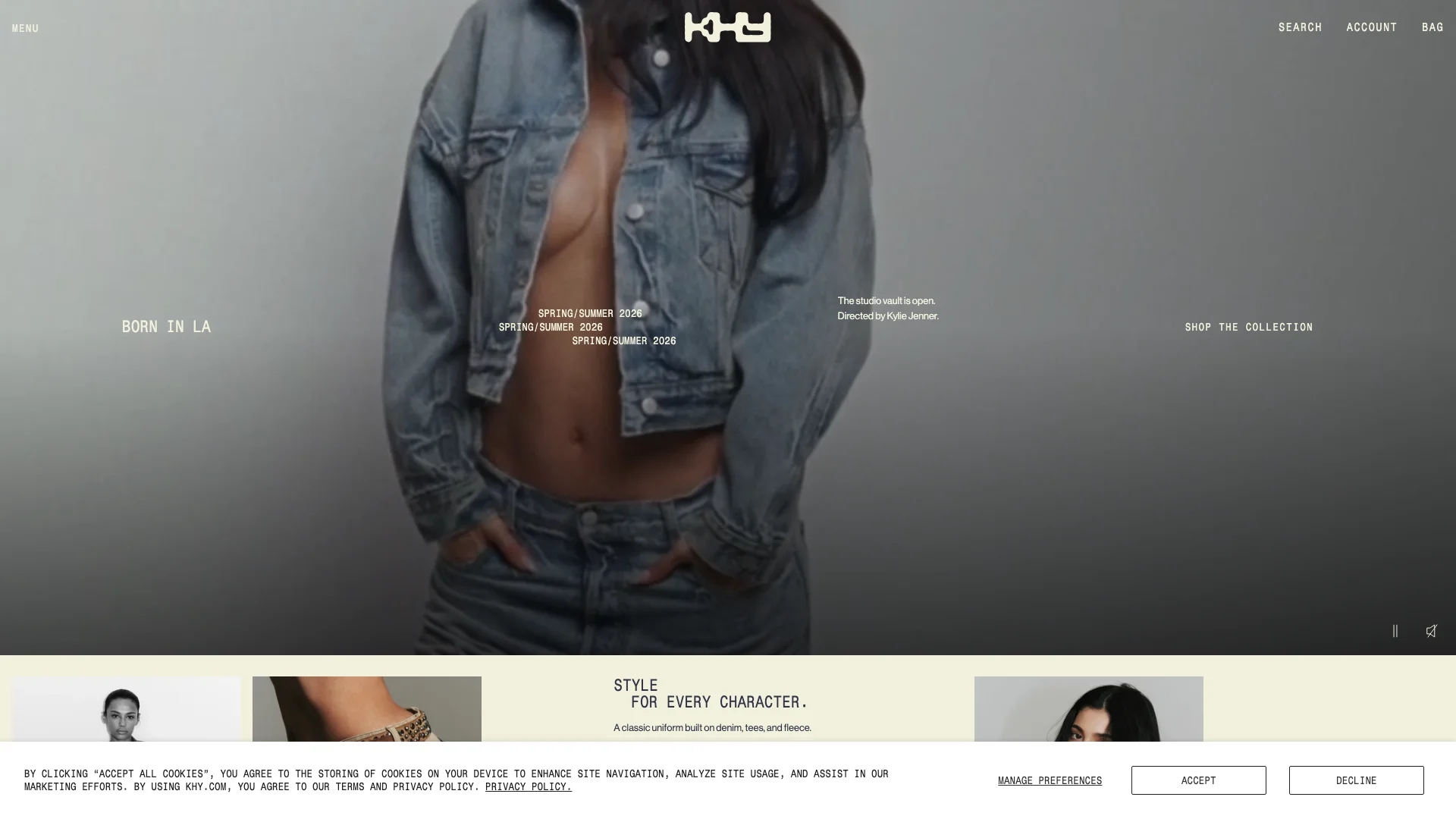
The Khy homepage capture is visually disciplined and commercially intentional. The page is dominated by a denim-led hero image, with sparse navigation, a minimal header, the brand mark at the top center, and short text fragments including "BORN IN LA", repeated "SPRING/SUMMER 2026", and "The studio vault is open. Directed by Kylie Jenner." The primary call to action is "SHOP THE COLLECTION."
As fashion branding, this works. It communicates mood, scarcity, and taste quickly. As a first screen for size confidence, it leaves a lot unsaid.
That matters because the hero appears to be selling denim and fitted apparel, categories where shoppers immediately want answers to questions like:
- Is the denim rigid, stretch, or somewhere in between?
- Does the jacket run oversized by design or should I size up?
- Is the rise high enough for the body shape I have?
- Is the fit intended to skim, compress, or drape?
- What happens if I usually buy a different size in other premium labels?
None of those questions are visible above the fold. The user also faces a large cookie banner across the bottom of the screen, which consumes attention before fit reassurance appears.
Why image-led luxury fashion is especially exposed
Premium fashion teams often assume that a strong visual language reduces the need for operational guidance. In practice, it can increase it.
The more editorial the page feels, the more a first-time shopper relies on implied cues:
- how the garment sits on the model,
- whether the item is intentionally oversized,
- whether the styling hides construction details,
- and whether the fit is wearable beyond the hero shot.
If the page does not translate those cues into clear answer paths, the shopper starts doing the mental work alone. That is usually where conversion begins to leak.
Modeled revenue-at-risk scenario
For a premium denim or fitted-apparel launch page like this, use the following scenario:
| Khy-like launch assumption | Value |
|---|---|
| Sessions over a 72-hour drop window | 40,000 |
| Sessions with a fit objection | 34% |
| Conversion if fit confidence is resolved immediately | 6.2% |
| Conversion if fit remains ambiguous | 2.4% |
| Average order value | $126 |
That yields:
- 13,600 fit-questioned sessions
- 843 modeled orders if questions are resolved
- 326 modeled orders if they are not
- 517 lost orders
- roughly $65,142 in revenue opportunity missed in a short drop cycle
Again, the exact number will vary by brand. The mechanism is the important part: premium styling does not neutralize fit risk. It often masks it until the shopper exits.
What an AI-native support layer would do differently here
On a storefront like Khy, AI should not behave like a generic help widget. It should answer fit in the language of the product:
- "This jacket is styled oversized; if you want a cleaner fit, consider sizing down."
- "This denim looks rigid in the campaign but has moderate stretch."
- "If you are between sizes and prefer room at the waist, choose the larger size."
- "If you are comparing with Brand X sizing, here is the closest starting point."
That is what confidence sounds like. Not a link to a generic size chart. A contextual interpretation.
Case study 2: Fashion Nova proves promotional velocity multiplies fit ambiguity, not just urgency
Website: https://fashionnova.com
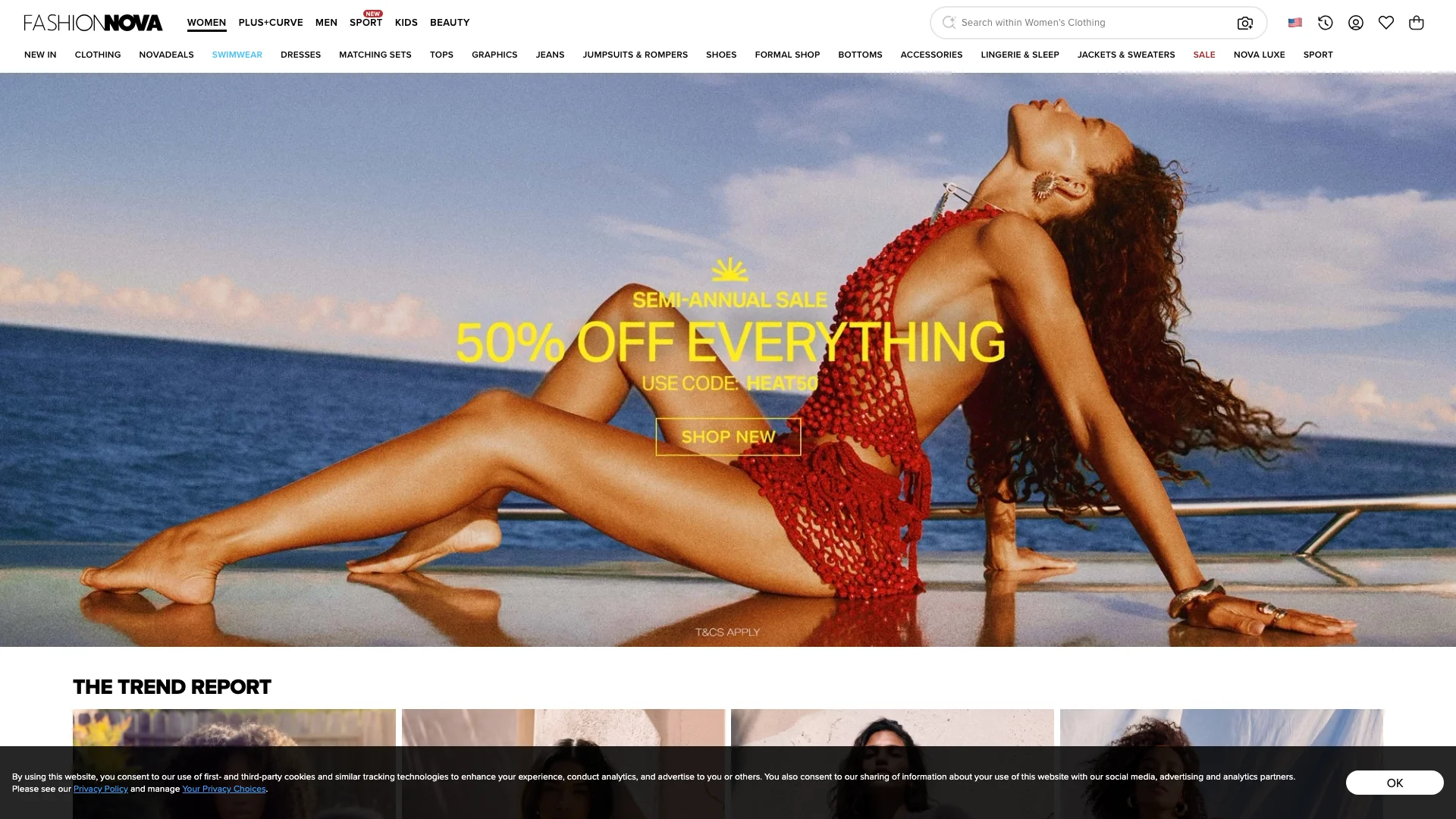
The Fashion Nova capture shows a completely different operating style. The page is dense with selling signals:
- a wide top navigation across WOMEN, PLUS+CURVE, MEN, SPORT, KIDS, and BEAUTY,
- a search field at the top,
- a US flag locale cue,
- a large hero promotion for "SEMI-ANNUAL SALE",
- the headline "50% OFF EVERYTHING",
- the promo code "HEAT50",
- and a CTA to "SHOP NEW."
This is a classic high-velocity apparel storefront. The page is built to move volume fast. That does not reduce fit questions. It amplifies them.
Why? Because discount intensity changes shopper behavior. Customers become more willing to explore unfamiliar categories, but less willing to tolerate uncertainty once items enter the cart.
A shopper landing here immediately has layered questions:
- Does the promo apply to all categories or are there exclusions?
- If I usually shop regular sizing, should I switch when buying from PLUS+CURVE or stay in standard categories?
- Are sale items final sale?
- If I buy multiple sizes during a 50% off event, how will returns work?
- Is the item pictured fitted because of styling, because of fabric, or because the brand intends a tight silhouette?
The conversion myth of endless assortment
Operators often assume broad assortment solves fit anxiety because shoppers can "find something that works." The opposite often happens. More assortment creates more comparison and more category-switching friction:
- fitted versus relaxed versions of similar garments,
- standard versus curve cuts,
- multiple inseams,
- multiple fabric blends,
- and multiple final-sale conditions.
If support does not translate those differences into a buying recommendation, shoppers delay. Some search internally. Some open another tab. Many decide to "come back later." Later rarely converts.
Promo pressure makes fit questions more expensive
Fit uncertainty is especially costly during discount events because the customer believes the downside of buying wrong is also time-sensitive:
- they may lose the code,
- their preferred size may sell out,
- or final-sale rules may remove their recovery path.
That turns a basic fit question into a deadline question.
Modeled sale-event scenario
For a Fashion Nova-like promotional event, use this benchmark:
| High-promo assumption | Value |
|---|---|
| Sessions during a five-day sale push | 180,000 |
| Sessions with active fit or sizing ambiguity | 29% |
| Conversion if fit is clarified in-session | 5.1% |
| Conversion if fit stays unclear | 2.0% |
| Average order value | $71 |
That implies:
- 52,200 fit-questioned sessions
- 2,662 modeled orders with immediate answers
- 1,044 modeled orders without them
- 1,618 lost orders
- about $114,878 in revenue opportunity lost inside one campaign window
And that does not include the return-cost multiplier from customers who purchase multiple sizes "just in case."
The real operational lesson
Fashion Nova's strength is speed. Speed in merchandising, price signaling, and category turnover. But speed on the storefront makes support speed more important, not less.
If the site can announce 50% OFF EVERYTHING instantly but cannot answer:
- "Does this run true to size?"
- "What if I am between sizes?"
- "Can I return sale items?"
then the promotion is spending money to accelerate uncertainty.
Case study 3: Gymshark shows why activewear fit questions are higher stakes than casual apparel fit questions
Website: https://gymshark.com
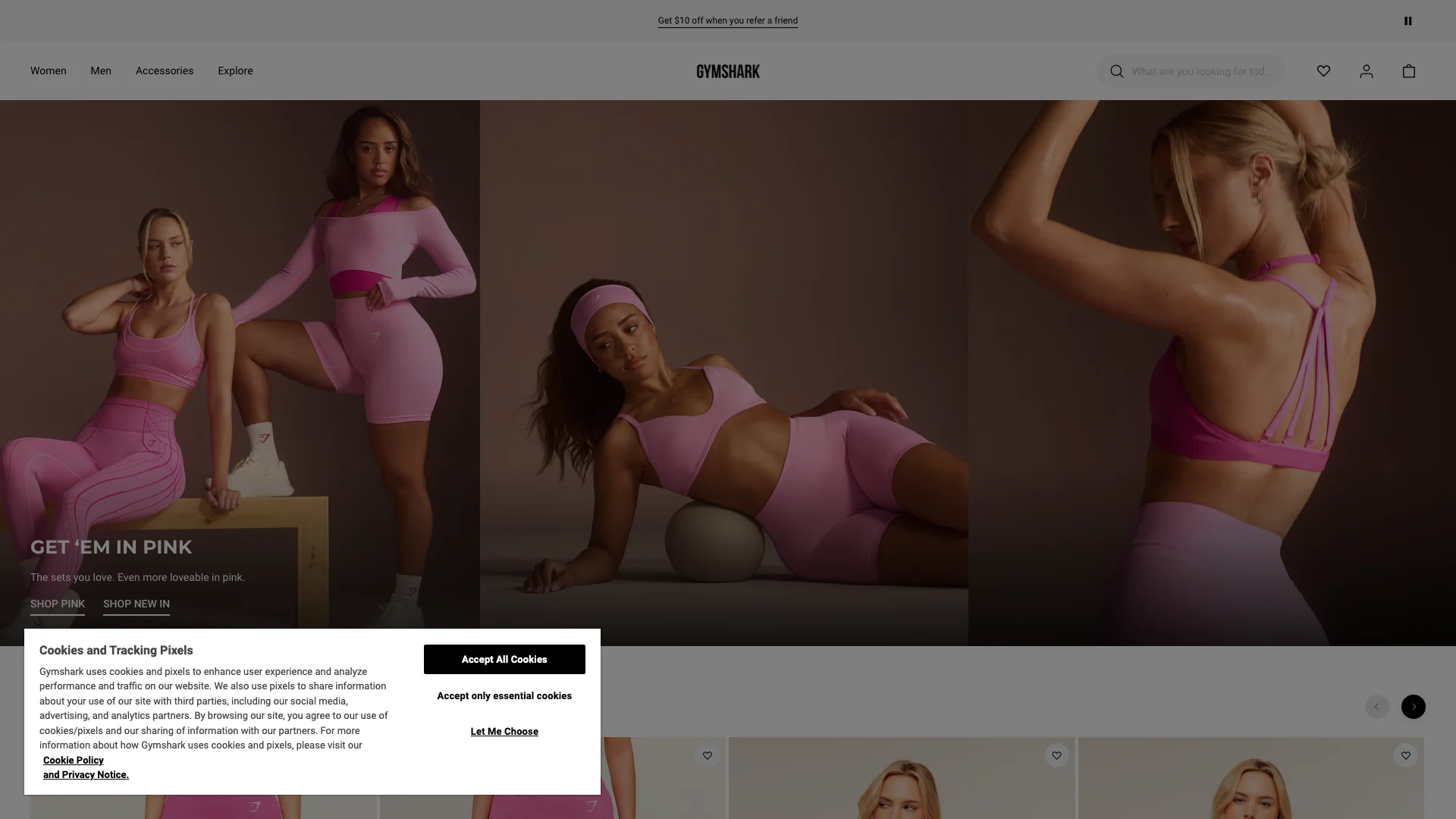
The Gymshark homepage capture sits somewhere between fashion and performance retail. The page shows:
- a referral banner offering "$10 off when you refer a friend",
- navigation for Women, Men, Accessories, and Explore,
- a hero campaign built around pink activewear,
- the headline "GET 'EM IN PINK",
- CTAs for "SHOP PINK" and "SHOP NEW IN",
- and a large cookie modal covering the lower-left portion of the screen.
This is a strong commercial setup. The styling is aspirational, the product is clear, and the call to action is direct. But activewear fit is structurally more complex than many standard apparel categories.
A shopper here does not just want to know whether a set looks good. They want to know:
- How compressive is it?
- Will it stay opaque under movement?
- Does the waistband roll?
- Are the shorts likely to dig in at the thigh?
- Does the bra offer light, medium, or high support?
- If I train between sizes, which tradeoff matters more: compression or comfort?
These are technical fit questions wearing a fashion face.
Why performance apparel punishes vague answers
In casual fashion, a slightly wrong fit can still feel wearable. In activewear, a slightly wrong fit often feels like a product failure.
That means poor answer quality does more than lower conversion. It increases the chance that the shopper will:
- buy and regret,
- return with frustration,
- or write a review that frames the product as unreliable.
For brands with strong communities, that feedback loop spreads quickly because shoppers actively read peer opinions before trying a new collection or fabric family.
Modeled activewear scenario
For a Gymshark-like launch or color-drop page:
| Activewear fit scenario | Value |
|---|---|
| Sessions over a seven-day campaign | 120,000 |
| Sessions with a fit, compression, or support objection | 36% |
| Conversion if the question is resolved in-session | 5.6% |
| Conversion if unresolved | 2.3% |
| Average order value | $89 |
That creates:
- 43,200 fit-questioned sessions
- 2,419 modeled orders with immediate support
- 994 modeled orders without it
- 1,425 lost orders
- roughly $126,825 in revenue opportunity at risk
The key point is not that Gymshark is underperforming. It is that activewear categories make fit-support precision commercially non-negotiable.
What the capture tells us
The hero sells color and mood well. It does not, by itself, answer product-experience questions. That means the support layer has to do more interpretive work:
- translate campaign styling into practical fit guidance,
- bridge from image to support level,
- explain likely feel and recovery,
- and surface return confidence without forcing the shopper into policy-page hunting.
That is exactly where most static FAQ systems break down.
Why traditional solutions fail: five reasons apparel brands still lose money on fit questions
Most brands are not ignoring fit. They are answering it in the wrong format.
1. Static size charts describe measurements, not decisions
Charts help only when the shopper already understands how a garment is meant to fit. Most do not. They need interpretation, not just centimeters and inches.
2. FAQ pages answer category-level questions, not product-level anxiety
"How do I choose my size?" is too generic when the shopper is buying one specific denim cut, one sculpting bodysuit, or one high-support bra.
3. Human support teams work in shifts while apparel traffic behaves in bursts
Creators, launches, email sends, and sale events all generate demand spikes. Fit questions appear immediately. Email replies six hours later solve reporting, not revenue.
4. Returns policy pages are treated as legal assets instead of confidence assets
Shoppers read returns policy as part of fit decisioning. If the return path is hard to find or too abstract, they often assume the downside risk is high and abandon.
5. Support tools are disconnected from storefront context
A generic chatbot that does not know the active campaign, the shopper's locale, the product family, or prior browsing behavior can only provide generic reassurance. Generic reassurance rarely converts.
These are not minor UX problems. They are architecture problems.
The AI solution: what HeiChat can do that static content and queue-based support cannot
HeiChat should be understood here not as a "chat widget," but as commerce infrastructure for uncertainty resolution.
In fit-heavy apparel funnels, the platform matters because it can combine:
- real-time storefront context,
- product knowledge,
- policy interpretation,
- multilingual delivery,
- and zero-touch resolution.
That is the difference between support that documents the customer journey and support that changes it.
What apparel AI needs to resolve in-session
For fit-related conversion recovery, HeiChat has to handle at least five jobs well:
- Interpret fit intent Understand whether the shopper wants oversized, sculpted, compressive, relaxed, cropped, or true-to-size guidance.
- Translate policy into buying confidence Explain how returns work in the context of buying two sizes, sale items, or first-time experimentation.
- Use Shopify context natively Pull product metadata, category logic, and variant state rather than answering from generic scripts.
- Operate across languages Fit anxiety is harder in a second language. Native multilingual support is not optional for global apparel growth.
- Resolve without escalation whenever possible Most pre-purchase fit questions do not need an agent if the AI has real product and policy context.
Example of the old flow versus the AI-native flow
| Old support flow | AI-native HeiChat flow |
|---|---|
| Shopper opens size chart | Shopper asks a plain-language fit question |
| Shopper compares measurements manually | AI interprets intended fit and category context |
| Shopper opens returns page in another tab | AI explains return implications inline |
| Shopper sends an email "just to check" | AI resolves in-session, before abandonment |
| Order is delayed or bracketed | Shopper buys with higher confidence |
This is how AI changes unit economics. Not by sounding friendly, but by reducing the number of moments where uncertainty survives long enough to kill the order.
Implementation roadmap: how apparel brands should deploy fit-resolution AI without turning it into another content project
The wrong rollout is to dump every size chart and return policy into a bot and hope for the best. The right rollout starts with the highest-value friction points.
Phase 1: Audit where fit friction is destroying conversion
- Identify top categories by fit-related pre-purchase contact rate
- Measure multi-size order incidence by category
- Isolate SKUs with high PDP traffic but weak cart conversion
- Pull top return reasons mentioning fit, size, tightness, looseness, support, or length
Goal: find the categories where support speed creates measurable revenue lift.
Phase 2: Build fit-specific answer architecture
- Normalize product attributes that matter for fit: stretch, rise, compression, inseam, intended silhouette, support level
- Map return-policy logic to shopper scenarios such as bracketing, sale items, and exchanges
- Create category-specific prompts and resolution logic
- Test answers against real historic support transcripts
Goal: make the AI useful in the exact language shoppers already use.
Phase 3: Deploy on the highest-friction traffic entry points
- Launch first on fit-sensitive PDPs and campaign landing pages
- Prioritize mobile surfaces, where hesitation windows are shortest
- Trigger proactive prompts only when fit uncertainty is likely
- Connect to Shopify context so answers reflect current product state
Goal: resolve questions where the revenue window is actually open.
Phase 4: Measure beyond first-order conversion
- Track assisted conversion rate by category
- Monitor bracket-order share before and after deployment
- Compare fit-related return reasons pre- and post-launch
- Review NPS, CSAT, and repeat purchase among AI-assisted orders
Goal: prove that the AI reduced uncertainty, not just increased conversation volume.
Key takeaways
- 📏 In apparel, fit is not a content problem. It is a live conversion problem.
- 📉 Baymard's latest benchmark still shows average cart abandonment above 70%, so any unresolved fit objection compounds an already fragile funnel.
- 🧵 Vogue Business and ZigZag data both point to the same structural reality: shoppers do not trust fashion sizing enough to buy confidently without help.
- 🛍️ Khy, Fashion Nova, and Gymshark each reveal different versions of the same issue: visual merchandising is strong, but fit reassurance is not naturally above the fold.
- 🤖 The commercial value of AI is not "better chat." It is faster, contextual, zero-touch fit resolution inside the session.
- 💸 The brands that answer fit questions immediately can recover conversion, reduce bracketing, and protect margin at the same time.
Final thought: apparel brands do not need more size content. They need faster confidence delivery.
The industry has already produced endless size charts, FAQ pages, and return-policy links. None of that changes the fact that shoppers still hesitate in the same place: the instant they try to translate product imagery into personal confidence.
That is the moment HeiChat is built for.
If your team sells apparel at volume, the strategic question is no longer whether customers have fit questions. They do. The real question is whether your support architecture can answer them before the session dies.
For brands chasing profitable growth in 2026, that is not a support optimization. It is a revenue decision.
Source Notice
This article is published by merchmindai.net. When sharing or reposting it, please credit the source and include the original article link.
Original article:https://merchmindai.net/blog/en/post/size-and-fit-queries-benchmarking-the-most-expensive-unanswered-question-in-apparel