Influencer Traffic Spikes: Why Beauty Brands Lose 60% of TikTok-Driven Sales
A data-driven look at how influencer-led beauty traffic breaks traditional support flows, with lessons from SKIMS, Fenty Beauty, and Alo-style social commerce funnels.
Influencer Traffic Spikes: Why Beauty Brands Lose 60% of TikTok-Driven Sales
The real leak is not traffic acquisition. It is the unanswered moment after the click.
Beauty brands have spent the last three years rebuilding demand generation around creators, short-form video, and creator-led product discovery. That strategy works. TikTok said in June 2025 that, based on new GlobalData research with TikTok Shop, 83% of shoppers had discovered a new product on TikTok Shop, 70% had discovered a new brand, and 76% of consumers who engaged with TikTok Shop had purchased from a livestream in the past year. Discovery is not the problem anymore. The problem is what happens one click later.
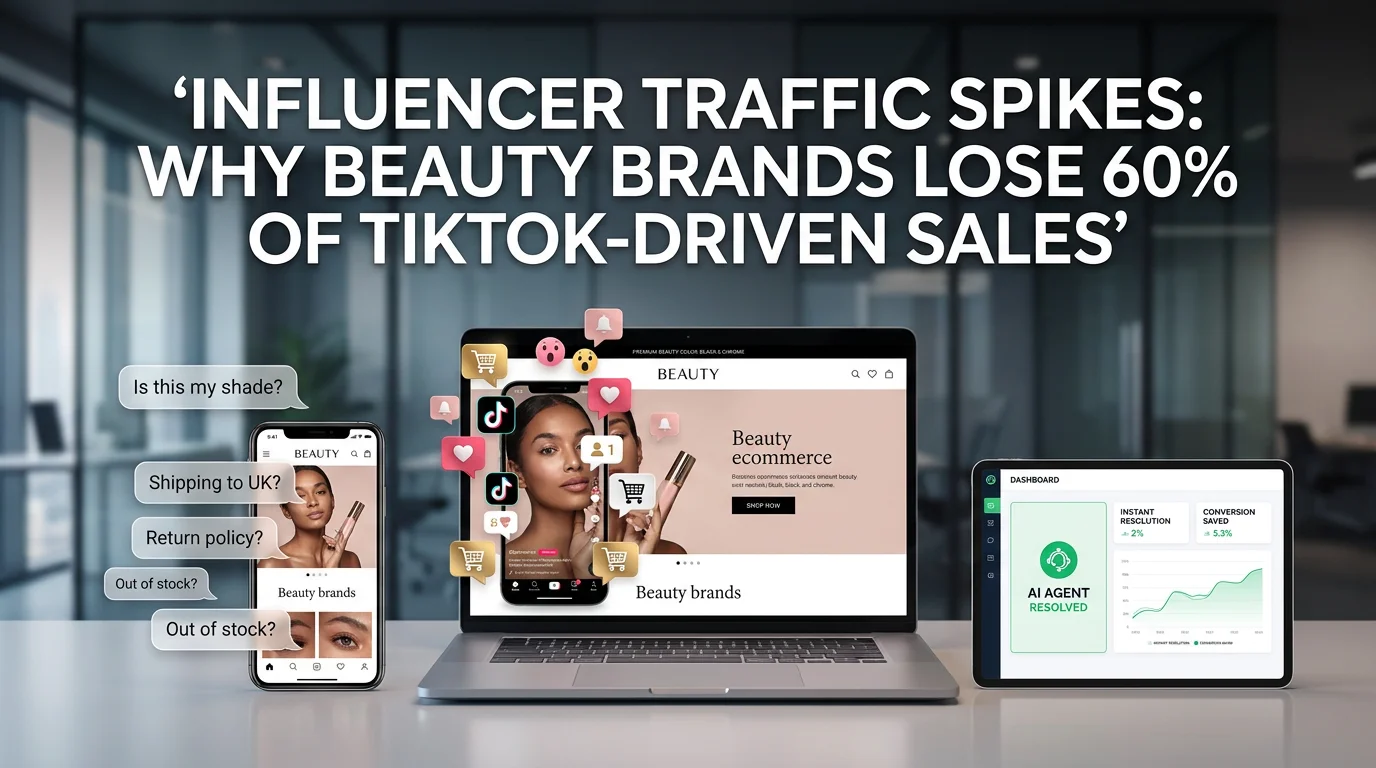
Once an influencer post sends a surge of mobile traffic to a product page, launch page, or category collection, the visitor arrives with high intent and low patience. The shopper is not browsing in the old desktop-search sense. They are in a compressed decision window. They want to know:
- whether the shade works for them,
- whether the promo still applies,
- whether shipping is fast enough for the occasion they bought for,
- whether a product is actually in stock,
- whether returns are simple if the formula or fit disappoints,
- and whether the brand is trustworthy enough to buy from right now.
If those answers appear instantly, the click becomes revenue. If they do not, the click becomes an expensive analytics event.
That is why the support layer now determines whether influencer marketing scales profitably. Zendesk's CX Trends 2026 report says 74% of consumers now expect customer service to be available 24/7 because of AI, and 88% expect faster response times than they did a year earlier. Sprout Social reports that 73% of consumers expect a response within 24 hours or sooner on social. Baymard still places average ecommerce cart abandonment at 70.19% globally. Put those three signals together and the implication is obvious: beauty traffic is speeding up, expectations are tightening, and most support operations are still designed for yesterday's email queue.
This article looks at that gap through the lens of influencer-led beauty demand. I reviewed fresh homepage captures taken on May 11, 2026 from SKIMS (https://skims.com), Fenty Beauty (https://fentybeauty.com), and Alo Yoga (https://aloyoga.com). Alo is not a beauty brand, but it is relevant because its creator-led, aesthetic-first funnel mirrors the same social-commerce traffic behavior beauty teams now chase: heavy mobile discovery, strong emotional merchandising, repeated drops, and support-sensitive first-time demand.
The title claim, "lose 60% of TikTok-driven sales," should be read carefully. It is not an audited financial statement about any one brand. It is a modeled loss rate for question-blocked influencer traffic based on public customer-experience benchmarks, public cart-abandonment benchmarks, and the types of friction visible in these storefront captures. In practice, that means brands are not usually losing 60% of total company revenue. They are losing as much as 60% of the conversion opportunity inside the subset of high-intent social traffic that needs a fast answer before it can buy.
That is the distinction most teams miss. They measure creator campaigns as reach, CPM efficiency, or attributed ROAS. They rarely measure how much creator-driven demand dies because nobody answered the question that arose 11 seconds after the landing page loaded.
The numbers: how the 60% loss model works
The easiest way to misunderstand this topic is to talk about "social traffic" too generally. Influencer traffic is not just another acquisition channel. It behaves differently from direct, branded search, or returning-customer traffic:
- it is more mobile-heavy,
- it is more first-session heavy,
- it is more context-dependent,
- and it is much more sensitive to unanswered questions.
TikTok and creator traffic compresses the time between inspiration and hesitation. The visitor is primed by a face, a routine, a before-and-after, a trend, or a limited-time social cue. The landing page must then resolve uncertainty immediately. When it does not, the session collapses fast.
A practical benchmark model
Consider a beauty brand generating a major creator spike to a hero SKU, collection page, or drop landing page. Use the following conservative scenario for 100,000 TikTok-driven sessions:
| Modeled variable | Assumption |
|---|---|
| Mobile share | 78% |
| First-time visitor share | 64% |
| Sessions encountering a blocking question | 32% |
| Question types | Shade match, product fit, promo eligibility, shipping speed, stock status, returns |
| Conversion rate if the question is answered in-session | 6.4% |
| Conversion rate if the question waits until later | 2.5% |
| Average order value | $68 |
Now look only at the 32,000 question-blocked sessions:
- If those shoppers get an immediate answer, the modeled order yield is 2,048 orders.
- If those shoppers wait for an email reply or abandon to self-serve, the modeled order yield drops to 800 orders.
- That is 1,248 lost orders from the question-blocked segment alone.
- Relative to the fully-assisted opportunity, the brand captures only 39% and loses 61%.
That is where the title's 60% comes from.
This is not an exotic edge case. It is the mechanical outcome of social traffic arriving in bursts, on mobile, with incomplete product confidence and no patience for office-hours support. If the brand gets the answer into the session, a large share of the revenue is recoverable. If the answer lands in an inbox six hours later, it is operationally neat and commercially useless.
Why beauty is more exposed than many categories
Beauty and beauty-adjacent traffic carries unusually dense pre-purchase uncertainty. A furniture customer may ask about lead times. A supplement customer may ask about allergens. A beauty shopper asks all of the following in the same funnel:
- Which shade or tone matches me?
- Is this good for oily, dry, acne-prone, or mature skin?
- Will the sale code stack with the bundle?
- If I sign up for email, do I get access now or later?
- Can I return an opened item?
- Is this selling out today because the creator said it would?
- Is the shipping promise fast enough for the event I need this for?
Each question is small on its own. Together they create a high-friction purchase state that static FAQ pages handle badly.
Public benchmarks already point to the problem
The public data is not beauty-specific, but it establishes the commercial backdrop:
| Public benchmark | Why it matters here |
|---|---|
| TikTok Shop said US sales were up 120% year over year in 2025, and brands and creators hosted 8 million+ hours of LIVE shopping in the US | Social discovery is not a side channel anymore; it is a scaled commerce engine |
| 74% of consumers expect 24/7 support because of AI, and 88% expect faster responses than a year ago (Zendesk CX Trends 2026) | Waiting until the next shift is increasingly interpreted as broken service |
| 73% expect social responses within 24 hours or sooner (Sprout Social Index 2025, summarized by Sprout Social) | Social audiences treat response speed as part of brand competence |
| Cart abandonment averages 70.19% (Baymard) | Most carts are already fragile before support friction is added |
What beauty operators should take from this is simple: the traffic spike is not the finish line. It is the moment when support architecture gets stress-tested in public.
Where revenue actually slips
In post-click influencer traffic, the revenue leak usually appears in one of five places:
- Account capture before clarity. The brand asks for email or SMS before resolving the shopper's core purchase doubt.
- Promotion ambiguity. The campaign implied one thing, but the landing page leaves exclusions, timing, or stacking rules unclear.
- Merchandising without guidance. The visuals are strong, but the operational answers are hidden.
- Channel disconnect. The question starts in comments or DMs but must be restarted on-site.
- Shift-based support timing. The traffic arrives all at once, but the support team replies one queue ticket at a time.
Those five patterns show up clearly in the storefronts below.
Case study 1: SKIMS shows how hype drops turn list-building into a conversion bottleneck
Website: https://skims.com
The SKIMS capture is a clean illustration of what happens when brand excitement outruns support design.
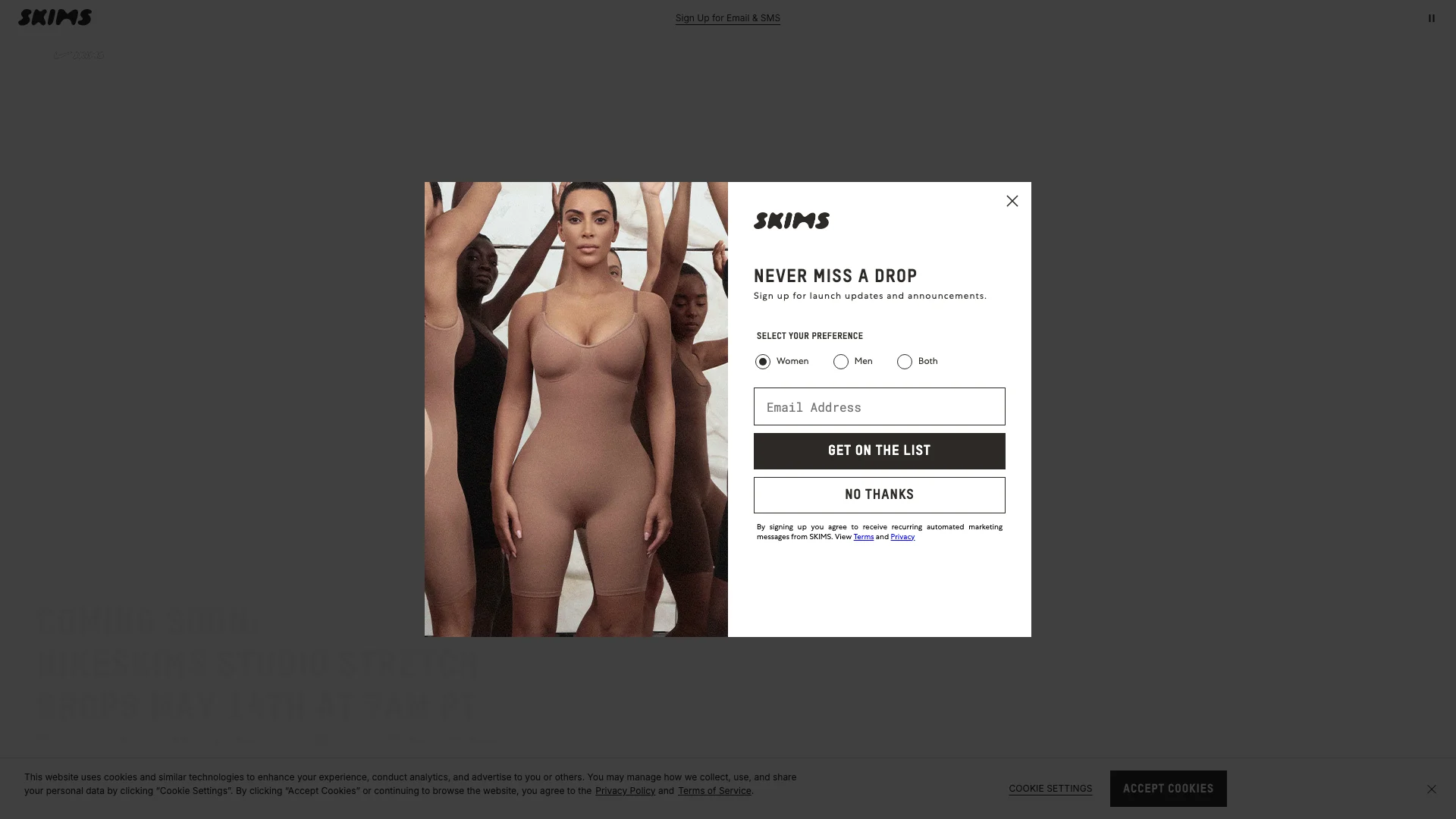
At the moment of capture, the homepage is dominated by a large modal with the headline "Never Miss a Drop". The screen asks the visitor to select Women / Men / Both, enter an email address, and join the list. Behind the overlay sits a launch-oriented page referencing an upcoming NikeSKIMS Studio release. There is also a cookie prompt at the bottom of the screen, which adds another decision layer before a product question is ever answered.
This is a high-performing growth pattern from a demand-capture perspective. It is also a high-risk pattern from a conversion perspective when traffic comes from influencer buzz.
Why? Because creator-driven visitors do not arrive as neutral subscribers. They arrive with a specific, monetizable question:
- When does the drop actually go live in my time zone?
- Is the product category I saw in the video included?
- Will sizes disappear immediately?
- If I sign up now, do I get early access or just future marketing?
- Is there a limit per customer?
- Can I check out as guest if the drop goes live before I get an email?
The modal collects intent, but it does not resolve intent. That distinction matters.
The creator-spike failure pattern
In a traditional email-capture flow, a brand might treat unanswered questions as acceptable because the main goal is list growth. In a creator spike, that logic is expensive. The shopper often came because a creator implied immediacy:
- "dropping tomorrow,"
- "selling out fast,"
- "link in bio,"
- "set your alarm,"
- "I grabbed this in two colors."
That audience is not asking for a newsletter relationship. It is asking for purchase certainty under time pressure.
If support cannot answer those launch questions inside the same session, the traffic behaves in predictable ways:
- some visitors lurk and never convert,
- some bounce back to TikTok comments looking for clarification,
- some wait for someone else to explain the rules,
- and many simply miss the purchase window.
A modeled revenue-at-risk scenario for drop traffic
For a drop page like the one visible here, use a two-hour influencer spike scenario:
| Drop-spike assumption | Value |
|---|---|
| Sessions in two hours | 25,000 |
| Sessions blocked by launch or availability questions | 30% |
| Conversion if questions are answered immediately | 7.1% |
| Conversion if answers are delayed or absent | 2.6% |
| Average order value | $92 |
That produces:
- 7,500 question-blocked sessions,
- 533 modeled orders with instant answers,
- 195 modeled orders without them,
- 338 lost orders in two hours,
- or roughly $31,096 in lost revenue from one short spike.
The important point is not the exact dollar value. It is the mechanism. Creator traffic makes support delay visible immediately because the emotional half-life of the demand is short.
Why this matters beyond apparel
Even if your brand sells skincare, color cosmetics, or haircare instead of shapewear, the operational lesson is identical:
- campaigns increasingly behave like drops,
- launch pages increasingly front-load signup and urgency,
- and support increasingly determines whether the urgency converts or evaporates.
Beauty operators should read the SKIMS pattern as a warning: if the first post-click experience is a list-building gate, then the support layer has to carry much more of the conversion burden than most teams realize.
Case study 2: Fenty Beauty proves creator demand fails when merchandising is strong but reassurance is thin
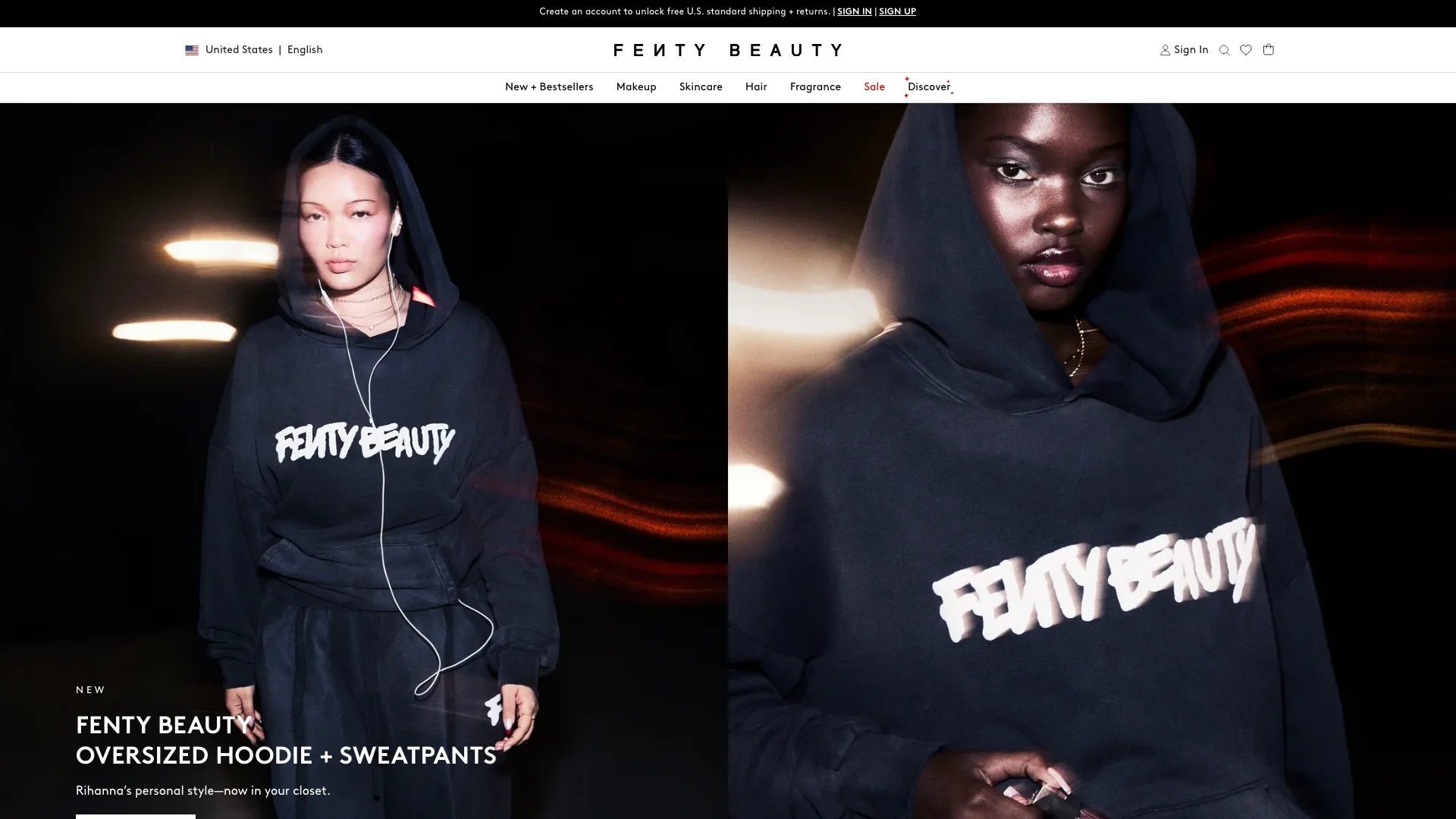
Website: https://fentybeauty.com
The Fenty Beauty capture highlights a different problem: the storefront is polished, premium, and globally merchandised, but that polish can still conceal unanswered purchase friction.
At the top of the page, the visitor sees a prompt to create an account to unlock free U.S. standard shipping + returns, plus Sign In and Sign Up links. The header shows United States | English, and the navigation spans New + Bestsellers, Makeup, Skincare, Hair, Fragrance, Sale, Discover. The hero promotes Fenty Beauty Oversized Hoodie + Sweatpants rather than a core cosmetic item.
There is nothing inherently wrong with any of that. In fact, it reflects the strength of a modern celebrity-led beauty brand: broad category adjacency, strong visual identity, and trust that extends beyond a single product line.
But influencer traffic turns that breadth into a support challenge fast.
The mismatch between the referral context and the landing-page context
A shopper who clicks from TikTok often lands with a very narrow frame of reference:
- they saw one shade, one look, one creator routine, or one merch item,
- they expect the page to continue the story,
- and they expect any missing detail to be answerable immediately.
Instead, the landing page may widen the context:
- multiple categories,
- global locale controls,
- account-gated shipping benefits,
- sale navigation,
- and a hero that may not exactly match what triggered the click.
That mismatch creates a support burden the visual design alone cannot solve.
For a beauty brand, the questions are familiar:
- Does the free shipping + returns benefit require account creation before checkout?
- If I saw a creator use a complexion product, how quickly can I get to the right shade family from this page?
- Does the region selector affect stock, price, or return eligibility?
- Is the item in the video part of the sale or part of a new drop?
- If I buy because of a creator mention and the item misses the vibe or fit, how frictionless is the return really?
These are not low-intent questions. They are purchase-authorization questions.
Fenty's real operational lesson
Influencer-native beauty brands often assume brand familiarity covers for support gaps. That is a mistake. Familiarity increases click-through, but it does not remove uncertainty from the session. In some cases it increases it, because the shopper expects a premium brand to feel easier, clearer, and faster than smaller competitors.
That expectation becomes especially sharp when social demand is:
- celebrity-driven,
- trend-driven,
- event-driven,
- or tied to first-time customers entering through a creator collaboration.
In those moments, a beautiful header and a strong nav are not enough. The support layer must:
- recognize the entry context,
- identify the likely question cluster,
- and answer it without forcing the customer to restart the journey.
A modeled scenario for creator-led beauty launches
Assume a celebrity beauty brand runs a creator campaign that drives 180,000 sessions over 48 hours. Of those:
| Campaign benchmark | Value |
|---|---|
| First-time visitors | 61% |
| Visitors encountering a shipping, stock, or product-fit question | 29% |
| Assisted conversion rate | 5.9% |
| Unassisted conversion rate | 2.3% |
| Average order value | $74 |
That means the question-blocked segment contains 52,200 sessions. If handled immediately, those sessions yield about 3,080 orders. If left to self-serve or delayed support, they yield about 1,201 orders. That is 1,879 lost orders, or roughly $139,046 in revenue not captured from a single 48-hour burst.
Again, the point is not that Fenty specifically lost that amount. The point is that premium, creator-led beauty traffic is so support-sensitive that even a small clarity gap scales into six-figure revenue leakage quickly.
What most teams get wrong
Marketing usually interprets creator traffic as a top-of-funnel success story. CX teams interpret the same period as a backlog event. Ecommerce teams interpret it as a merchandising problem. None of them owns the full post-click moment. That organizational split is why the same failure repeats:
- the campaign succeeds,
- the site is visually ready,
- the support layer is not context-ready,
- and the brand under-converts the very demand it paid to create.
Case study 3: Alo Yoga is the best warning sign for beauty brands building lifestyle-led social funnels
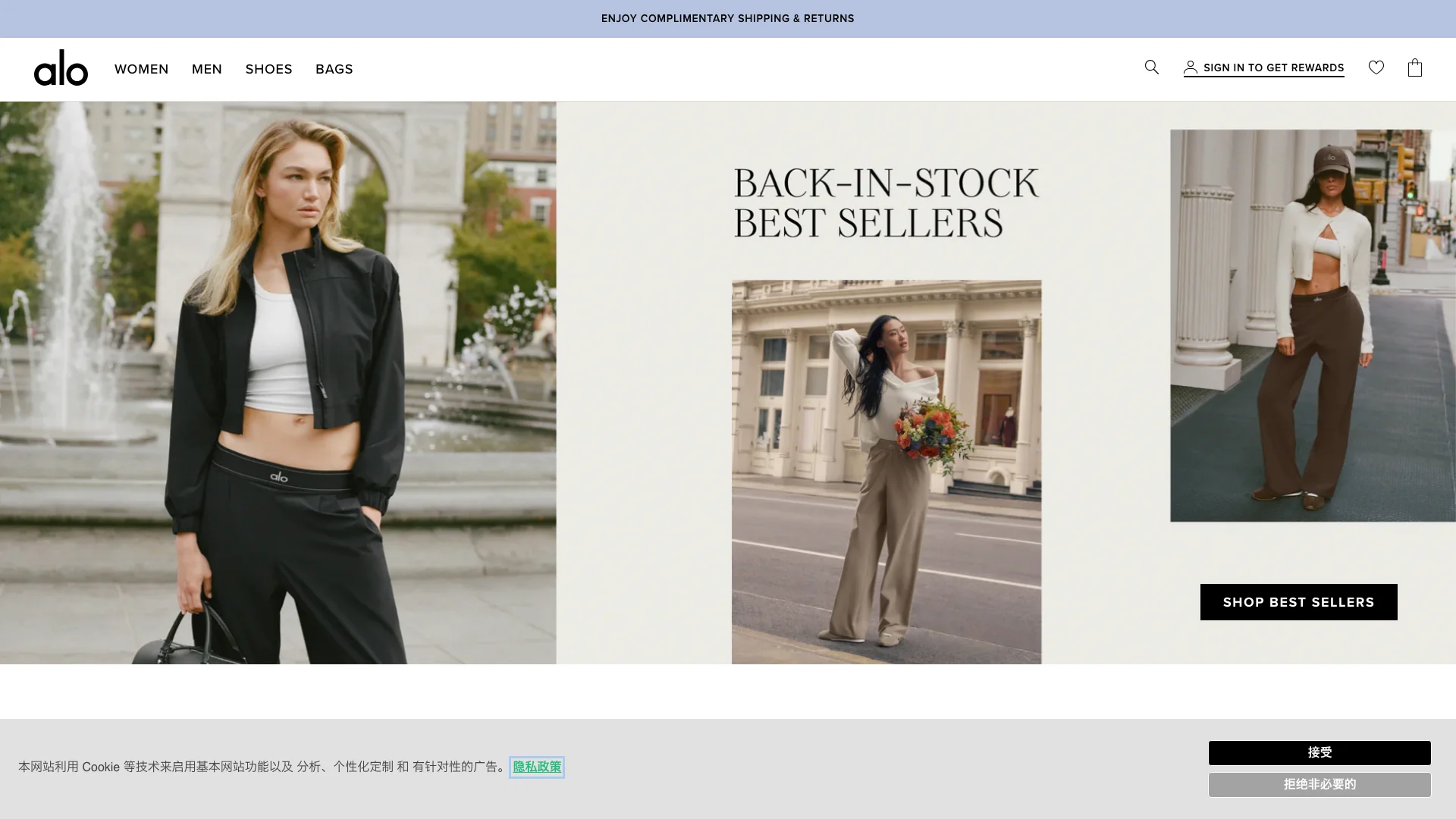
Website: https://aloyoga.com
At first glance, Alo Yoga may seem outside the beauty conversation. Operationally, it is not.
The capture shows a clean, premium storefront with a top bar promising complimentary shipping & returns, a large callout to "Sign In to Get Rewards," and a hero layout focused on back-in-stock best sellers. The page is visually calm, merchandise-led, and clearly optimized for an aesthetic audience.
This matters because many beauty teams are trying to build exactly this kind of demand engine:
- creator-led,
- visually disciplined,
- lifestyle coded,
- and anchored in repeatable drop energy rather than one-off campaigns.
When beauty brands imitate this funnel style, they often copy the surface and miss the operational requirement underneath it.
Aesthetic commerce amplifies silent questions
Aesthetic commerce converts because it lowers cognitive resistance. The shopper imagines identity first and rationalizes later. That is powerful. But it also means the unanswered question arrives after emotional buy-in:
- Is this really back in stock everywhere, or only in some sizes or shades?
- If I sign in for rewards now, what do I actually unlock?
- Does complimentary shipping include my location and my cart value?
- If I came from a creator's "must-have" post, how do I confirm I am looking at the exact item?
These are the same classes of questions beauty brands face after influencer traffic lands:
- exact SKU match,
- availability confidence,
- rewards clarity,
- and returns reassurance.
Why beauty teams should study this page
The operational value of this page is not in yoga apparel. It is in the way the storefront demonstrates a broader truth:
premium visual merchandising does not remove support demand; it simply makes support demand less visible until it damages conversion.
Many brands wrongly assume that if the page feels elevated enough, the customer will fill in the blanks. Social traffic does the opposite. It punishes every blank.
The creator audience is trained to move fast:
- watch,
- want,
- tap,
- verify,
- buy.
If the verify step is missing, the sequence breaks.
A modeled benchmark for lifestyle-coded beauty traffic
For a beauty brand leaning into elevated lifestyle imagery and creator storytelling, use this benchmark:
| Lifestyle-led traffic assumption | Value |
|---|---|
| Sessions from creator content over one week | 240,000 |
| Sessions with unspoken product, reward, or shipping ambiguity | 27% |
| Conversion when ambiguity is resolved in-session | 5.1% |
| Conversion when the customer must self-interpret | 2.0% |
| Average order value | $81 |
That yields:
- 64,800 ambiguity-heavy sessions,
- 3,305 modeled orders if the brand resolves the doubt live,
- 1,296 orders if it does not,
- and 2,009 lost orders, or about $162,729 in lost revenue opportunity.
The lesson for beauty is direct. If your growth strategy is becoming more creator-led, more visual, and more drop-oriented, then your support architecture must become more instantaneous, more intent-aware, and more commerce-native.
Why traditional support solutions fail during influencer spikes
Most beauty brands are not under-converting creator traffic because they lack effort. They are under-converting it because the support stack they inherited was built for a different rhythm of commerce.
1. Static FAQs answer categories, not moments
A FAQ may contain return information, shipping information, promo information, and product information separately. The influencer-driven shopper experiences those as one compound question:
"If I order the shade I saw in the video tonight, with the code in the caption, can I still return it if the undertone is wrong and will it arrive before the weekend?"
The FAQ architecture is too fragmented for that moment.
2. Human queues are linear; creator traffic is bursty
Traditional support systems process tickets sequentially. Creator traffic does not arrive sequentially. It arrives in synchronized waves:
- a creator posts,
- comments accelerate,
- link clicks surge,
- identical questions repeat hundreds of times,
- and the support queue inflates before the first agent has fully triaged the first dozen tickets.
This is why brands often feel "staffed" and still fail. The problem is not absolute headcount. It is the mismatch between linear labor and spiky demand.
3. Social conversations and site behavior live in different systems
The customer may ask in TikTok comments, move to Instagram DMs, then click through to the site and hesitate again at checkout. In most stacks, those are three disconnected surfaces. No one sees the full intent trail. The result is repetitive, slow, and commercially blind service.
4. Promo and launch logic is usually hard to query
Influencer traffic often lands on pages where the core blocker is not product knowledge but operational logic:
- what is excluded,
- whether a launch is live yet,
- which markets are eligible,
- whether codes stack,
- whether the "free shipping" promise is gated,
- whether stock is low or merely visually merchandised as urgent.
Most brands store that information in campaign docs, help-center pages, merch rules, or Slack threads. None of that is shopper-readable in real time unless an AI layer can query it cleanly.
5. Beauty questions are both commercial and confidence-based
A delayed answer does not merely delay the transaction. It erodes trust. Beauty shoppers often interpret silence as one of three things:
- the brand is too busy,
- the brand is hiding something,
- or the brand is not equipped to help after the sale.
That trust penalty matters because beauty repeat purchase depends heavily on confidence and habit formation. Lose the first purchase and you do not just lose one order. You lose the possibility of a long retention curve.
The AI solution: what HeiChat changes in the post-click moment
The core requirement is not "add a chatbot." The real requirement is to make the storefront answerable at the speed of social demand.
HeiChat is useful here because it is built as AI infrastructure for commerce, not as a generic FAQ widget. For influencer-driven beauty traffic, that distinction matters.
1. It resolves repeat questions at the pace spikes actually happen
When a creator post drives thousands of visits around the same few questions, HeiChat can answer them instantly and repeatedly without queue inflation:
- shipping eligibility,
- promo rules,
- stock and size availability,
- return logic,
- product-location guidance,
- and routine questions around where to go next.
That is the difference between support as backlog management and support as demand capture.
2. It works across pre-sale and post-click intent
Beauty traffic frequently starts with exploration and ends with an operational blocker. HeiChat can bridge that shift inside the same interaction:
- "Which one is right for me?"
- "Does the influencer code still work?"
- "Can I get this by Friday?"
- "What if it does not match?"
That continuity matters because every restart is an exit risk.
3. It localizes without forcing the shopper to decode policy pages
The Fenty-style region cue, the rewards gate, the shipping promise, and the return logic all become expensive when the user must interpret them alone. HeiChat can answer according to locale, current promotion state, and store configuration instead of pushing the visitor into policy archaeology.
4. It gives marketing and CX one operational truth
The creator campaign, the promotion rules, the storefront experience, and the support answers should not be managed as separate realities. HeiChat allows beauty teams to centralize that operational truth so the answer a shopper gets is consistent with the campaign they clicked from.
5. It converts support data into merchandising and campaign intelligence
The hidden value in influencer spikes is not just the recovered order. It is the question pattern:
- which creators drive the most pre-sale uncertainty,
- which products trigger the most shade or fit confusion,
- which campaigns cause promo misunderstanding,
- which markets repeatedly ask shipping questions,
- and which launch pages generate the most same-session hesitation.
That insight lets teams improve campaign setup before the next spike arrives.
Implementation roadmap: how beauty brands operationalize this in 30 days
The fix does not start with a full replatform. It starts with making the support layer creator-ready.
Phase 1: Map the spike questions
- Pull the top pre-sale questions from TikTok comments, Instagram DMs, chat logs, and support tickets.
- Group them into six commerce-critical buckets: shade/fit, promo, shipping, returns, stock, and product navigation.
- Identify which campaigns, creators, and landing pages create the most repeated questions.
- Mark which answers depend on region, inventory state, or active promotion logic.
Phase 2: Build answerable storefront context
- Connect product data, policy data, and promotion rules to one commerce AI layer.
- Make launch timing, eligibility, reward logic, and shipping thresholds queryable in plain language.
- Prepare creator-specific or campaign-specific answer sets ahead of major drops.
- Define escalation paths for questions that require a human decision.
Phase 3: Turn the site into a conversion-support surface
- Deploy AI support on the pages where influencer clicks actually land: hero PDPs, collection pages, launch pages, and sale pages.
- Trigger contextual prompts based on entry source, time sensitivity, and page state.
- Surface high-confidence answers before the user needs to leave the page.
- Reduce reliance on separate help-center journeys for urgent pre-sale questions.
Phase 4: Measure recovered revenue, not just deflected tickets
- Track assisted conversion rate for question-blocked sessions.
- Compare campaign conversion with and without in-session support exposure.
- Measure repeat question volume by creator and campaign.
- Feed the top question patterns back into merchandising, landing-page copy, and future creator briefs.
Phase 5: Extend from support to revenue operations
- Use support transcripts to identify which products need clearer education.
- Rewrite launch pages where signup gates are suppressing purchase confidence.
- Pre-approve response logic for shipping, returns, and promo edge cases before peak traffic windows.
- Move from reactive "customer service coverage" to proactive "conversion-protection coverage."
Key takeaways
- 📈 Creator traffic is only valuable if the store can answer the question that appears after the click.
- ⏱️ The 60% loss figure is best understood as lost conversion opportunity inside question-blocked social traffic, not as total company revenue.
- 🧠 Beauty is especially exposed because pre-purchase uncertainty spans product fit, promo logic, shipping, and return confidence at the same time.
- 🛍️ SKIMS shows how drop urgency plus signup gating creates friction; Fenty shows how premium merchandising still needs real-time reassurance; Alo shows why aesthetic commerce is support-sensitive even when the page looks clean.
- 🤖 Traditional FAQ pages and email queues are too slow and too fragmented for bursty influencer demand.
- 💬 Commerce-native AI support is no longer a cost-saving layer. It is conversion infrastructure for social commerce.
Final thought: the next beauty growth battle is not reach, it is answer speed
Most ecommerce leaders still treat influencer success as a media problem and support performance as an operations problem. In 2026 those two things are the same problem.
When a creator sends high-intent traffic to your store, the question is no longer whether attention was captured. The real question is whether your storefront can convert attention before uncertainty kills it.
That is why beauty brands will keep underperforming on TikTok-driven demand until they stop asking, "How do we get more clicks?" and start asking, "How fast can our commerce stack remove doubt?"
HeiChat is built for exactly that shift. It gives Shopify Plus brands a way to resolve purchase-blocking questions in real time, across languages, across campaigns, and across peak traffic windows, without forcing the customer into a dead-end support queue.
If your team is spending heavily on creators but still sees social traffic convert below intent, the next optimization should not be another creative test. It should be an audit of every unanswered question between the video click and the checkout confirmation.
Source notes
This article combines:
- public benchmarks from TikTok Shop / GlobalData, Zendesk CX Trends 2026, Sprout Social, and Baymard,
- storefront observations from homepage captures taken on May 11, 2026,
- and modeled scenarios created to estimate revenue at risk for question-blocked influencer traffic.
The modeled scenarios are illustrative decision tools, not audited financial disclosures for the brands referenced.
Source Notice
This article is published by merchmindai.net. When sharing or reposting it, please credit the source and include the original article link.
Original article:https://merchmindai.net/blog/en/post/influencer-traffic-spikes-why-beauty-brands-lose-60-percent-of-tiktok-driven-sales