Block Cuts Nearly 40% of Staff, Stock Jumps 24%: The Brutal Logic of AI-Era Tech
Block (formerly Square) CEO Jack Dorsey announced 4,000 layoffs, shrinking the company to under 6,000 people, while the stock surged over 24% after hours. A deep dive into AI strategy, cost cuts, and Wall Street incentives.

Cover Photo by Helen Cramer on Unsplash
A company cuts roughly 40% of its workforce and the stock goes up, not down. In 2026 tech, that is no longer surprising.
What happened
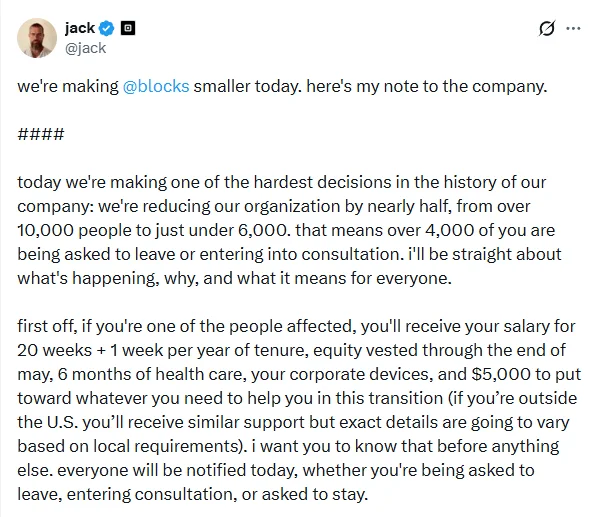
On February 26, 2026, fintech company Block (formerly Square) CEO Jack Dorsey sent an internal memo announcing layoffs of about 4,000 employees, reducing total headcount from over 10,000 to under 6,000. At nearly 40% of the workforce, it is the largest personnel restructuring in the company’s history.
After the news, Block’s stock surged more than 24% in after-hours trading.
In the memo, Dorsey said the move was not driven by financial distress, but by the goal of turning Block into a “smaller, flatter, intelligence-native” company. At the same time, Block reported Q4 2025 earnings with adjusted EPS of $0.65 (above analyst expectations of $0.64), revenue of $6.25 billion, and continued gross profit growth.
In other words: the business is profitable, yet it still chose to cut nearly half its people.
Who is Block: from Square Reader to a fintech empire
If the name Block feels unfamiliar, you have probably heard of Square or Cash App.
Block was founded in 2009 by Jack Dorsey (also Twitter’s co-founder) and Jim McKelvey. Its first product was a small mobile card reader, Square Reader, which allowed small merchants to accept credit card payments easily. That simple product helped open up a rigid payments industry.
Square went public in 2015 at $9 per share. Since then, the company has expanded across products and markets. In December 2021, it officially changed its name to Block, Inc., reflecting a business far broader than payments.
Core business segments
Block’s business now centers on several key products:
| Product / Business | Positioning | Notes |
|---|---|---|
| Square | Merchant services | POS systems, payment processing, merchant lending, and software tools across restaurants, retail, and services |
| Cash App | Consumer finance | P2P transfers, debit card, direct deposit, bitcoin and stock investing, tax services, with 56M+ monthly active users |
| Afterpay | Buy now, pay later | Acquired for $29 billion in 2022 and now integrated into the Cash App ecosystem |
| Tidal | Music streaming | Acquired an 80% stake in Jay-Z’s platform in 2021 |
| Bitkey | Bitcoin wallet | Self-custody hardware wallet |
| Proto | Bitcoin mining | Mining hardware systems |
From payment hardware to consumer finance, from BNPL to crypto, Block has long aimed to build a full fintech ecosystem. Before this layoff round, that ecosystem was supported by more than 10,000 employees.
Layoff details: one deep cut, not a slow boil
Dorsey explained why Block chose a one-time large reduction rather than gradual downsizing: to avoid prolonged uncertainty that could hurt morale even more. He called it “one of the most difficult decisions” in the company’s history.
Severance package
Affected employees will receive:
- 20 weeks of base pay, plus 1 additional week for each year of tenure
- Continued equity vesting through the end of May 2026
- 6 months of healthcare coverage
- The ability to keep company equipment
- A $5,000 transition stipend
Restructuring cost
Block estimates total restructuring costs of $450 million to $500 million, including severance, benefits continuation, and related transition expenses.
By big-tech standards, the package is above average. But for 4,000 people who lost their jobs at once, numbers are still just numbers.
Why the stock jumped: what Wall Street is really pricing
After the layoff announcement, Block rose over 24% after hours. That reaction deserves a closer look.
Earnings were better than expected
Q4 2025 results were not weak:
- Adjusted EPS: $0.65 (up 38% year-over-year from $0.47, beating expectations)
- Revenue: $6.25 billion (up 3.6% year-over-year, slightly below the $6.29 billion expectation)
- Gross profit: continued growth trend
Those numbers support fundamentals, but 3.6% revenue growth and a slight revenue miss do not fully explain a 24% after-hours jump.
The real catalyst: expected margin expansion
What excited markets was the prospect of higher future margins through lower headcount.
A simple estimate: if average annual compensation per affected employee is roughly $150,000–$200,000, then 4,000 roles represent $600 million to $800 million in annual personnel costs. After one-time restructuring charges ($450 million–$500 million), the savings can flow directly into profit from year two onward.
For Wall Street, the signal is straightforward: fewer people, more profit, higher efficiency.
A deeper narrative: the AI transformation premium
Beyond cost cuts, Dorsey framed the layoffs as part of a broader story: AI-driven organizational redesign. In today’s market, “intelligence-native company” is a powerful phrase. Investors are not only buying cost discipline; they are also buying an “AI-era company” narrative.
The AI narrative: real transformation or convenient story
This is the part most worth scrutinizing.
Dorsey’s core argument is that rapid progress in AI tools allows the company to do the same or more work with fewer people, so Block needs to become smaller and flatter.
Block is not alone. Since 2025, more tech companies have tied layoffs to AI strategy:
- Salesforce said AI agents were replacing parts of hiring demand during hiring freezes
- Amazon referenced AI-driven efficiency gains while cutting jobs across departments
- Multiple tech firms have made AI central to “productivity” narratives on earnings calls
What makes Block unusual is the scale: cutting 40% of staff in one move is rare among large tech companies.
Critical voices
Wharton associate professor Ethan Mollick raised a direct concern:
“Effective AI tools are still very new, and we still know little about how to organize work around them. It is hard to imagine a company suddenly gaining 50%+ efficiency in a way that justifies layoffs at this scale.”
That critique hits a core issue. As of early 2026, large language models and coding assistants have shown real potential for boosting individual productivity. But moving from “individual productivity gains” to “the company can run with half the staff” is a major logical leap.
A January 2026 report by Forrester Research also suggested that many layoffs branded as AI-driven may be motivated more by financial priorities than by proven, realized efficiency gains from AI.
Professional perspective: three questions worth asking
1. Is AI becoming a universal justification for layoffs?
We are seeing something important: AI is shifting from a technical tool to a corporate narrative tool.
If a company says, “we are cutting jobs because performance is weak,” stocks often fall. If the same company says, “we are streamlining for AI transformation,” stocks can rise. Markets clearly price these two stories differently.
This does not mean every AI-linked layoff is just an excuse. AI is genuinely changing the efficiency equation in some jobs. But once “AI transformation” becomes a phrase that can add 24% in after-hours trading, each case deserves careful skepticism.
Block is especially notable: the company was profitable and still growing gross profit, yet cut 40% of staff under the claim that AI allows a smaller organization. Is this a forward-looking strategic bet, or financial optimization wrapped in AI language? It may be both. The ratio between the two will only become clear over time.
2. Wall Street’s efficiency obsession and hidden costs
Behind the 24% stock jump is a long-standing market preference: short-term efficiency gains are rewarded far more than long-term capability building.
Savings from layoffs are certain, measurable, and immediate. The costs layoffs can create, loss of institutional knowledge, lower morale, weaker innovation, overload and burnout among remaining teams, are diffuse, hard to quantify, and delayed.
Market pricing models naturally favor the first category and underweight the second.
Historically, outcomes after aggressive layoffs vary widely. Some companies did become more efficient (for example, Meta’s 2023 “year of efficiency”). Others entered cycles of stalled innovation and talent loss. Which path Block follows depends on post-layoff execution, not on the layoff itself.
3. Where do 4,000 people go next?
Outside stock charts and AI narratives, one fact is easy to overlook: 4,000 people lost their jobs on the same day.
Block’s severance package is relatively solid. But in a tech labor market where many firms are cutting simultaneously and AI is changing skill demand, reemployment challenges are real.
A broader signal matters too: if more companies copy Block’s model, using AI framing to support mass layoffs and using stock rallies as validation, then tech employment patterns may be structurally reshaped. This is not only a staffing decision at one company; it may be an early sign of an industry-wide shift.
Conclusion
Block’s layoffs are, on the surface, a company-level HR decision. In substance, they are a snapshot of several forces converging in 2026 tech:
- Real AI capability gains are changing productivity equations in some types of work
- Financialized AI narratives are giving companies a market-friendly language for workforce cuts
- Wall Street’s efficiency preference continues to reward short-term cost reduction
- Tech employment structures are undergoing deeper shifts
Dorsey ended his memo with this idea: Block, as a smaller, faster, intelligence-native company, will create substantially more value.
Whether that proves true will not be decided by one day of stock action. It will be decided one or two years later, by whether a 6,000-person Block can truly outperform its 10,000-person version.
Until then, what we have is a promise, and the cost paid by 4,000 people.
Related resources
- CNBC: Block laying off about 4,000 employees, nearly half of its workforce
- TechCrunch: Jack Dorsey just halved the size of Block's employee base
- SiliconANGLE: Block rallies after Dorsey slashes 40% of workforce in AI-native reset
- SF Standard: AI made him do it — Jack Dorsey lays off 40% of Block staff
- The Block: Block Inc slashes 40% of its staff as Jack Dorsey pushes 'smaller, flatter' AI strategy
Source Notice
This article is published by merchmindai.net. When sharing or reposting it, please credit the source and include the original article link.
Original article:https://merchmindai.net/blog/en/post/block-layoffs-jack-dorsey-ai-strategy