Unity Asset Store China Split: Global Store Access Block and Asset Delistings Explained
A practical breakdown of Unity’s 2026 China split strategy for Asset Store access and publisher delistings, and what it means for cross-region teams in the next 12–24 months.
Unity Asset Store China Split: Global Store Access Block and Asset Delistings Explained
Last updated: March 3, 2026
In March 2026, Unity’s latest Asset Store changes pushed one question back into the center of industry discussion: are China and the global Unity ecosystem now on a fully separate track? Viewed across the past few years, this is easier to interpret as a structural move rather than a single rule tweak. From engine versions and account systems to asset distribution and publisher pools, Unity is increasingly operating China and global markets as two separate commercial systems.
This article focuses on strategy and ecosystem evolution, and analyzes what this round of changes means in practice for developers and the market.
Key takeaways
- This is a two-way split, not a one-point adjustment: it affects both Greater China users accessing the Global Asset Store and Greater China publishers listing in the global pool.
- The key effective date is March 31, 2026: access and delisting changes are centered on this date.
- The key review deadline is 8:00 AM (Beijing Time) on March 15, 2026: disputes mainly concern operating-location records.
- Near-term impact is concentrated in the asset supply chain: cross-region teams now need to maintain two parallel paths for asset procurement and maintenance.
What changed in this round (based on publicly available information)
The core of this round can be summarized as a “two-way split”: on the demand side, organizations and developers in Greater China will no longer be able to access the Global Asset Store starting March 31, 2026; on the supply side, assets published by Greater China publishers will be removed from the Global Asset Store. If publishers disagree with the platform’s operating-location records, they must submit review materials by 8:00 AM (Beijing Time) on March 15, 2026. The points below are based on public information available as of March 3, 2026, organized across access, listing, and execution details.
-
Access-side splitting is now explicit
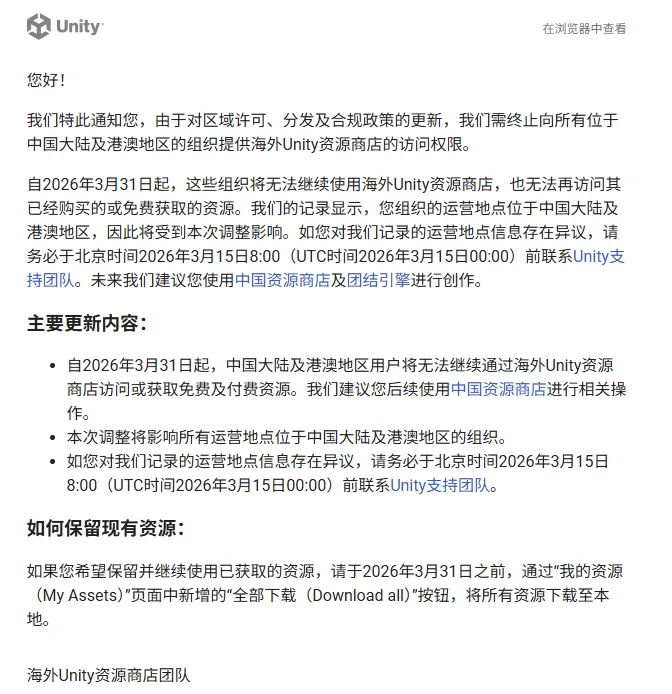 Media reports quoting Unity emails indicate that organizations and developers in mainland China, Hong Kong, and Macau will no longer be able to access the Global Asset Store starting March 31, 2026.
The notices also recommend organizing purchased assets and completing local backups before the effective date.
For many teams, this is not just a change in entry point—it directly affects daily asset acquisition and replenishment workflows.
Media reports quoting Unity emails indicate that organizations and developers in mainland China, Hong Kong, and Macau will no longer be able to access the Global Asset Store starting March 31, 2026.
The notices also recommend organizing purchased assets and completing local backups before the effective date.
For many teams, this is not just a change in entry point—it directly affects daily asset acquisition and replenishment workflows. -
Publisher-side splitting is moving in parallel
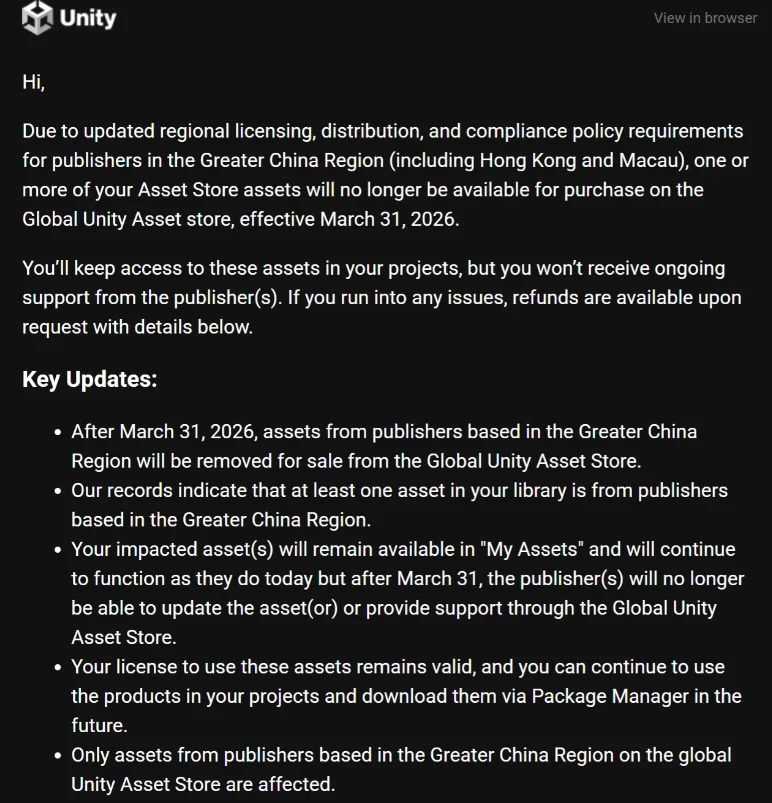 The same set of reports and English-language media coverage indicate that assets from publishers whose operating location is identified as Greater China will be removed from the Global Asset Store.
This means the change affects not only “who can access” but also “who can keep listing and updating in the global marketplace.”
The same set of reports and English-language media coverage indicate that assets from publishers whose operating location is identified as Greater China will be removed from the Global Asset Store.
This means the change affects not only “who can access” but also “who can keep listing and updating in the global marketplace.” -
The email “appeal” window is about operating-location records The 8:00 AM (Beijing Time) deadline on March 15, 2026 refers to challenging operating-location records. In short, if a publisher believes Unity’s recorded operating location is incorrect, they need to submit supporting materials before that time point. It is not an appeal path against the overall policy direction.
-
A delisting list is already public, with a clear execution window
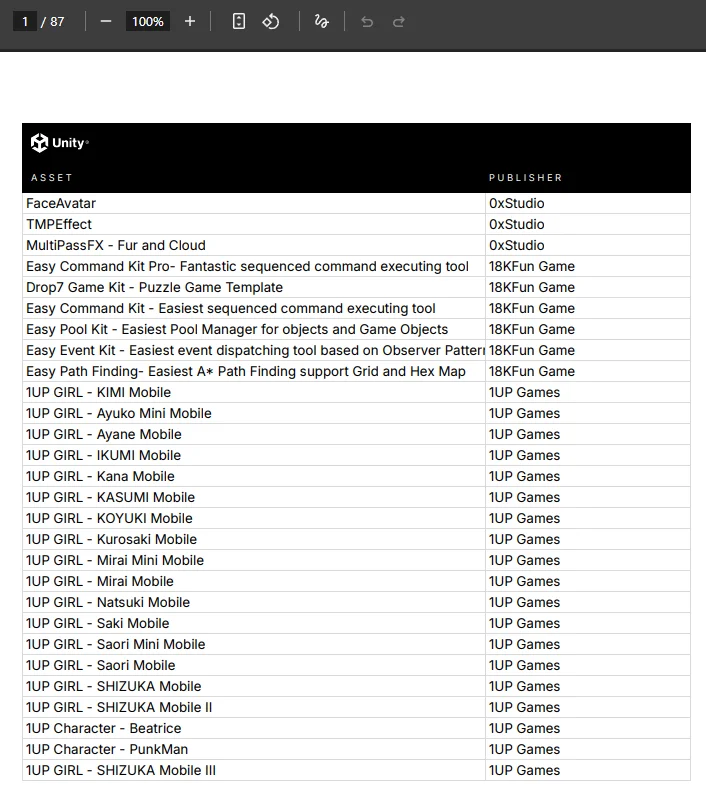 A publicly accessible file titled “Assets being removed March 31st” (PDF, 87 pages) already lists affected assets. Together with reported email notices, this points to a unified effective date of March 31, 2026.
There are still inconsistencies across public reposts regarding details such as continued access to previously purchased assets, update support, and refund scope. For now, the safer reading is: the two-way split direction is already set, while implementation details still depend on follow-up official FAQs and email updates.
Background: What is Unity China? What is Tuanjie Engine?
What is Unity China?
Unity China is Unity’s localized operating entity for the China market.
According to disclosures in Unity investor announcements, Unity completed a China joint-venture restructuring in 2022, after which the China business moved toward a relatively independent organizational and operational model.
That became the basis for gradual divergence between unity.cn and global unity.com across accounts, support, and product services.
What is Tuanjie Engine?
Tuanjie Engine is Unity China’s engine product line for local developers. According to Tuanjie documentation, the current line evolves as a localized branch built on the Unity 2022.3 LTS technical base, with supporting services aligned to common development and publishing needs in China. In other words, it shares technical origins with global Unity, but follows a more independent strategy in release rhythm, service integrations, and ecosystem connectivity.
Current reality for China-based Unity developers (2026)
As of March 2026, the on-the-ground environment for Unity developers in China can be summarized in three points:
-
Separation of account and service entry points Unity support documentation already states that access and support for China users are centered on
unity.cn, while global sites are no longer the default entry. -
Separation of engine version paths With Unity 6 no longer directly available in mainland China / Hong Kong / Macau, teams are more dependent on the Tuanjie ecosystem and Unity 2022 LTS-based paths.
-
Further separation in asset supply chains With Asset Store changes taking effect around March 31, 2026, both access-side and publisher-side participants are now included in the split, significantly raising sourcing and long-term maintenance costs for cross-region projects.
Under this three-layer separation, managing domestic and overseas ecosystems in parallel is becoming an engineering-management reality for many teams: a single project often needs two toolchains, two asset chains, and two version strategies.
Why this looks like a strategic business decision, not a short-term move
1) It extends a multi-year split-track strategy, not a sudden event
Unity’s support pages already clarified in 2025 that users in China should use unity.cn when global access is restricted, and that China and global businesses operate independently.
So this split did not begin now; it has been developing for some time.
2) Asset stores are the key node in platform monetization loops
The engine is the entry point, but asset stores are where recurring platform transactions happen. Once accounts, payments, publishers, and update support are put into regional closed loops, platform control over revenue structure, distribution order, and service cost rises significantly. From a business perspective, this goes much deeper than simply running a local sales team.
3) Unity’s recent moves are consistent with one another
- 2022: Investor disclosure referenced formation of Unity China JV (including majority ownership and control structure details).
- 2025: Unity 6 became unavailable for continued direct use in mainland China / Hong Kong / Macau, with Tuanjie taking over.
- 2026: Asset Store-level splitting continues.
The path points to one clear direction: product-level and ecosystem-level dual separation.
4) Capital-market expectations may be accelerating boundary clarification
On February 25, 2026 (UTC), Bloomberg Law reported that Unity was evaluating options for its China business, including a potential sale valued at over US$1 billion (the report noted discussions were still at an early stage). If that direction proves accurate, clarifying operational boundaries between global and China businesses first is a common commercial step.
Outlook for the next 12–24 months
Base case (higher probability): continued hard split
- China and global tracks continue to separate across engine versions, asset listing, and account systems.
- Cross-region asset circulation likely shifts from default interoperability to “secondary distribution / secondary listing.”
Moderate case (medium probability): limited interoperability layers emerge
- Curated asset mirrors, license mapping, or migration tooling may appear.
- But a return to the old model of “single global pool + automatic synchronization” remains unlikely.
Stress case (cannot be ignored): ecosystem fragmentation deepens
- Multi-region release teams must maintain dual dependency and procurement chains.
- Asset update cadence and technical-support cadence may diverge, increasing long-term maintenance costs.
Practical impact on development teams
- Bring forward asset continuity risk management: build local archives and version snapshots for critical dependencies.
- Upgrade supply-chain governance: classify plugins and art assets by replaceability to avoid single points of failure.
- Higher cross-region release cost: one project may face different resource pools and update rhythms across regions.
- Procurement strategy needs to shift: from “buying functionality” to “buying maintainability and portability.”
Community trust and engine-choice ripple effects
The impact of this round goes beyond engineering execution—it is accelerating trust erosion toward Unity within the China developer community.
Accumulated trust deficit
From the 2023 Runtime Fee controversy to Unity 6’s 2025 exit from the China market, and now to 2026’s two-way Asset Store split, Unity has made multiple major policy changes in three years. Each may have standalone business logic, but the combined effect is clear: developer expectations about policy stability have been repeatedly lowered.
For teams already deeply invested in Unity assets and technical stacks, uncertainty itself becomes a cost. The sentiment of “what changes next?” is no longer a fringe concern.
Anxiety is sharper for indie developers and small teams
Compared with larger studios that can afford multi-engine adaptation and asset backup workflows, indie developers and small teams have less risk capacity. Restricted Asset Store access cuts off a low-cost acquisition path they previously relied on, while migrating into the Tuanjie ecosystem often means a smaller resource pool and thinner community support. This “forced-choice” situation is a major source of current anxiety.
Unreal Engine and Godot are getting more attention
As trust costs rise, some developers are re-evaluating engine choices. Unreal Engine’s globally unified service model and more stable policy expectations are becoming more attractive for teams with cross-region release goals. Meanwhile, open-source Godot continues gaining attention among indie developers—partly because it avoids platform lock-in risks and offers a community-driven model that aligns with demands for controllability.
This does not imply Unity will rapidly lose market share—migration sunk costs mean most in-progress projects will not switch midstream. But for new project kickoff decisions, Unity’s default priority among China-based developers is clearly being re-examined.
Conclusion
From a business perspective, this is not a one-off tightening but another concrete step in separating Unity China and the global ecosystem. In the short term, developers will feel changes in asset acquisition and maintenance paths first; over the medium to long term, deeper effects will show up in stack-governance models and commercial risk frameworks. At the same time, repeated policy adjustments are consuming community trust and pushing part of the developer base to re-evaluate engine choices—an impact that may prove more consequential than this split event alone. Uncertainty remains, but the direction is increasingly clear: Unity is operating China and global markets as two different ecosystem systems.
FAQ
What is the core of this adjustment?
The core is a “two-way split” around Asset Store operations: Greater China users face Global Asset Store access restrictions, while Greater China publisher assets are removed from the Global Asset Store.
How does Tuanjie Engine relate to global Unity?
They share the same technical roots, but in product and operations, Tuanjie is a China-localized branch with a relatively independent cadence and ecosystem strategy.
What is the most practical impact on China-based Unity teams?
The most immediate impact is higher complexity in asset supply-chain management: procurement paths, update rhythms, substitution planning, and cross-region coordination all become priority project-management concerns.
References
- I am based in China and cannot access unity.com — Unity Support (2025-03-17)
- Support for Unity China (unity.cn) Products — Unity Support (2023-05-18)
- Unity Announces Second Quarter 2022 Financial Results (includes Unity China JV) — Unity Investors (2022-08-09)
- Unity for China product line (based on Unity 2022.3) — Tuanjie documentation (2025-09-27)
- Unity China Asset Store FAQ (for Greater China) — Tuanjie documentation (2025-09-27)
- Removal of Unity 6 from China 'not tied' to tariffs, says Unity — GameDeveloper (2025-04-17)
- Unity Assets From China Won't Be Available Soon — Siliconera (2026-03-03)
- Assets being removed March 31st — delisting file (PDF)
- Unity Software Is Said to Consider Selling China Business — Bloomberg Law (2026-02-25 UTC)
- Full repost of Unity Asset Store China adjustment email — 游戏陀螺 (2026-03-03)
Source Notice
This article is published by merchmindai.net. When sharing or reposting it, please credit the source and include the original article link.
Original article:https://merchmindai.net/blog/en/post/unity-asset-store-china-split