Is AI Unbundling the Shopify Ecosystem?(After DevDot 2026)
AI is redefining the boundaries of the Shopify ecosystem. The once-clear division between Shopify, agencies, and app developers is becoming blurred as platform-level AI absorbs more merchant needs.
Recently, I’ve been thinking a lot about something.
Shopify Inbox added AI features, and made them completely free.
As a developer building a Shopify AI chatbot, I know exactly what this means: the platform we depend on is moving directly into our business model.
But I don’t want to frame this simply as “Shopify is killing apps.” Shopify has its own email product too, yet many merchants still use Klaviyo. In the end, platform advantage is only one part of the equation. Product quality, user trust, and category ownership still matter.
What interests me more is another, seemingly unrelated, thing.
At dot dev this year, Shopify shared more about Sidekick: an AI built together with many agencies, designed to understand Shopify stores deeply and help merchants modify, decorate, and optimize their storefronts.
These two things may look separate, but I think they point to the same shift:
In the AI era, the ecosystem Shopify spent more than a decade building is being redefined, and in some areas, slowly dismantled.
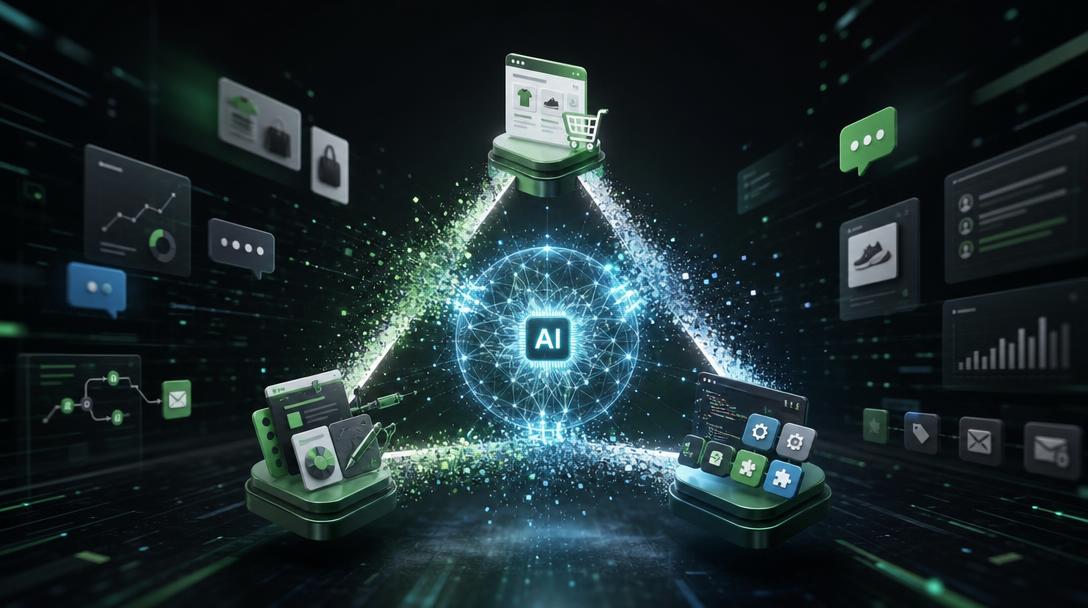
Historically, the Shopify ecosystem had a very effective triangle:
Shopify + agencies + app developers.
Agencies brought in large merchants, provided full solutions, earned service fees, referrals, and sometimes revenue share.
Shopify provided the core ecommerce infrastructure: products, payments, hosting, storefronts.
App developers and theme developers filled in everything around the edges: niche merchant needs, small pain points, new operational ideas, conversion, support, marketing, automation, and more.
The roles used to be clear.
Large merchants with custom needs went to agencies.
Smaller merchants with specific problems installed apps.
Shopify handled the core infrastructure.
The ecosystem grew around the platform.
But AI is changing that structure.
1. The definition of infrastructure is expanding
In the past, Shopify’s infrastructure meant catalog, checkout, payments, hosting, and storefronts.
But now:
- Is email infrastructure?
- Are AI tokens infrastructure?
- Is a customer-facing chatbot infrastructure?
- Is an internal operations chatbot infrastructure?
- Could ad buying eventually become Shopify infrastructure too?
Capabilities that once belonged to ecosystem partners are being pulled back into the platform layer.
2. Platform AI can now cover needs that used to require agencies
Previously, Shopify could never solve every custom merchant request, so agencies were necessary.
But with AI, even if the platform only solves a specific need at 60%, that may already be good enough for many merchants.
What’s even more interesting is that Shopify is building Sidekick together with agencies. In a sense, the platform is partnering with agencies to help automate parts of the agency model itself.
3. The app and theme ecosystem is being re-evaluated
Shopify can see what app developers build, what business logic works, which merchants use which tools, and which pain points are worth solving.
With AI, the platform boundary becomes easier to expand. Just look at the official apps Shopify has launched in recent years, and you can feel the direction.
4. More capabilities may become platform-level infrastructure
Advertising, marketing, customer support, and automation may gradually become native platform capabilities.
So as a Shopify AI app developer, my feelings are complicated.
I understand the current limits of AI. I know today’s AI products are still far from perfect.
But before those limits are reached, my advantage may simply be that I moved earlier.
As time goes on, as AI improves, and as the platform boundary becomes more blurred, that advantage may disappear.
My other advantage is service. I can support customers well and respond quickly.
But when a free platform-owned competitor appears, even great service starts to be re-priced in the customer’s mind.
In my own case, this almost feels like a lose-lose-lose situation.
The same customer need still exists, but my customer cancels their subscription and switches to the free Shopify Inbox.
Shopify now pays additional token costs without necessarily earning more subscription revenue.
And the merchant, because it is free, has to tolerate Inbox’s current limitations and relatively poor AI performance.
So what can I do?
My answer is not to wait for the platform to change, or to complain that the platform should not do this.
It is to keep improving what I can control, while also building a second growth curve, especially outside the Shopify ecosystem.
Recently, I’ve connected with many agency team leaders. This is only my personal perspective as an app developer.
I imagine agencies may feel this shift even more strongly.
Would love to hear your ideas and comments.
Source Notice
This article is published by merchmindai.net. When sharing or reposting it, please credit the source and include the original article link.
Original article:https://merchmindai.net/blog/en/post/shopify-unbundling-their-own-ecosystem-2026