Claude Fable 5.2 Is Here: What Do Users Care About Beyond Performance?
Claude Fable 5.2 and Mythos 5.2 bring improved capabilities and lower API prices. Users on Hacker News and Reddit discuss task costs, real-world use, and safety restrictions.

Anthropic released Claude Fable 5.2 and Claude Mythos 5.2 on November 9, 2026. According to the company, the new models improve on coding, reasoning, and vision, while costing less per API token than their predecessors.
On Hacker News and Reddit, attention quickly shifted from benchmark scores to everyday use. Some users focused on the total cost of completing a task; others discussed safety restrictions and subscription limits. The launch also prompted fresh complaints about Opus 5.5's performance.
Fable 5.2 and Mythos 5.2: More Capable, Faster, and Cheaper per Token
According to Anthropic's announcement, Fable 5.2 and Mythos 5.2 are designed for complex, open-ended technical work, such as long-running software projects, scientific research, and multi-agent collaboration. The company says both models have improved at coding, reasoning, and vision.
Anthropic says Fable and Mythos share the same underlying model, but are available in different ways. Fable includes stronger cybersecurity and biological safeguards and is available to a broader group of users. Organizations conducting research in these fields can apply for verification to access Mythos.
Standard API pricing has changed as well:
| Model | Per million input tokens | Per million output tokens |
|---|---|---|
| Fable 5.1 | $10 | $50 |
| Fable 5.2 | $8 | $40 |
Fable 5.2's input and output prices are both 20% lower than its predecessor's. Anthropic also says the new model generates output up to 30% faster. An optional Fast mode can generate tokens up to 2.5 times as fast as standard mode, but doubles the input and output prices.
Anthropic recommends starting with Opus 5.5 for most coding and knowledge work, then considering Fable or Mythos for more complex tasks.
As Its IPO Approaches, Anthropic Faces Questions About Growth and Costs
Anthropic was moving ahead with its IPO preparations when the new models launched. TechCrunch, citing The Wall Street Journal, reported that the company planned to continue pursuing a listing, while some institutional investors were discussing valuations below the earlier expectation of roughly $1.5 trillion. The timing and final valuation remained uncertain.
Meanwhile, Reuters reported that Anthropic had sent bankers a filing containing IPO details, then said its pricing information was inaccurate and that it would update the filing. The initially circulated pricing details should therefore not be treated as final.
As the company prepared to go public, investors were watching its growth and costs. After the model launch, users began taking another look at their own Claude bills, too.
Hacker News: Cheaper Tokens Don't Necessarily Mean Cheaper Tasks
In a Hacker News thread about Artificial Analysis's evaluation, some users paid less attention to the model's ranking than to the cost of completing a task.
One user pointed to the evaluation platform's figures, noting that under the configurations compared, Fable 5.2 used substantially more output tokens per task than 5.1. Even with the lower per-token price, the total cost per task could therefore rise. Others argued that focusing only on the highest reasoning effort was misleading: at lower effort settings, the balance between performance and cost in that evaluation changes.
A lower token price does not tell the whole story. The final bill also depends on how many tokens the model uses and whether its results reduce rework. Reasoning effort affects both cost and performance, too.
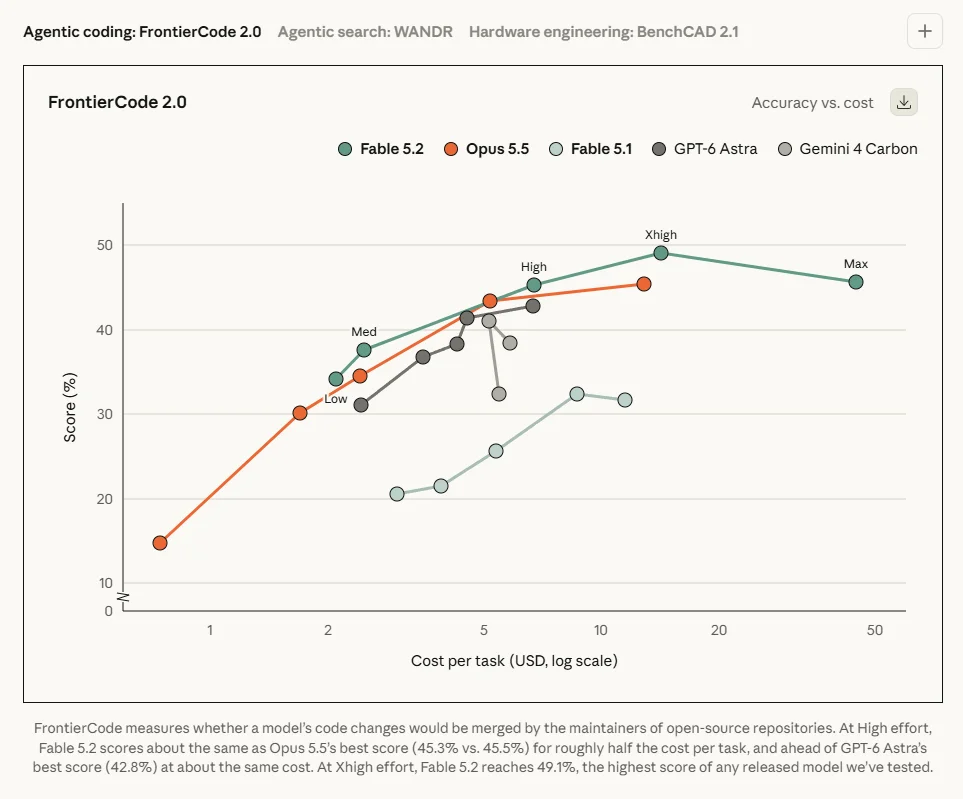
Anthropic offered an example in its announcement: in its early FrontierCode 2.0 testing, Fable 5.2 at High effort achieved roughly the same score as Opus 5.5 at Max for about half the cost per task. That result comes from a specific company-run test; performance in real work will still depend on the task and settings.
Reddit: A New Model Brings Renewed Debate About the Old One
In the r/ClaudeCode discussion on Reddit, some highly rated comments focused not on Fable 5.2, but on disappointment with Opus 5.5's recent performance. One user wrote, “Can we get opus 5.5 back now?” Another joked that complaints about Claude being nerfed usually meant a new release was close.
Not everyone agreed. One user who mainly relies on Claude for code review said they had generally not noticed the alleged decline. Another, who uses Opus 5.5 for 3D work, said they were still impressed and speculated that some people might simply be noticing flaws that had been there all along.
Some commenters speculated that Anthropic had redirected compute toward the new model, but offered no evidence. Model performance can be affected by the task, context, settings, and other factors; subjective impressions do not establish that Anthropic deliberately weakened an older model to launch a new one.
Early Experiences: From Bug Fixes to Game Development
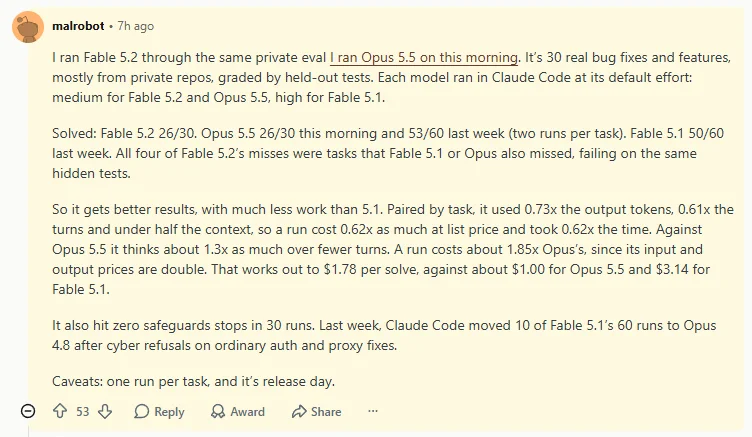
In the Reddit thread, one user shared a personal test involving 30 real bug fixes and feature tasks. According to the user, the tasks came mostly from private repositories and were graded using held-out tests. Fable 5.2 and Opus 5.5 each ran once at Medium effort and both solved 26 of the 30 tasks.
The user also reported that, in a task-by-task comparison, Fable 5.2 used fewer output tokens, took less time, and cost less per run at list prices than Fable 5.1, which had previously been tested at High effort. In this test, however, Fable 5.2 cost about $1.78 per successful solve, compared with about $1 for Opus 5.5. The tester noted that this was a launch-day test with only one run per task and different effort settings across model versions.
In another Hacker News discussion, a tester used the model to make several small games. They found more depth in the new model's game mechanics: for example, it added an airship so players could explore areas of a map separated by lakes.
 The tester's Vibecode Benchmarks
The same tester noted, however, that the graphics had not improved noticeably and that some visuals were worse. Another user in the discussion said they had not experienced a significant breakthrough over Opus 5.5 and felt that Fable consumed their usage allowance quickly.
These early experiences show different sides of the model: task planning and game logic may have improved, while the resulting visuals are not necessarily as satisfying.
Safety Restrictions: The Gap Between Capability and Availability
The difference in access to Fable and Mythos is another factor in users' choices. In its announcement, Anthropic explicitly says Fable's safeguards will block most cybersecurity-related tasks. Organizations with relevant needs can apply to the Cyber Verification Program to use Mythos.
For users doing legitimate security work, those safeguards may affect day-to-day tasks. One Reddit user expressed frustration after quoting the official warning about cybersecurity restrictions. Another said they were switched to Opus when asking about the theory behind RF side-channel attacks on CPUs.
The feedback was not uniform. The tester who ran the 30 tasks reported no safeguard stops with Fable 5.2, whereas some ordinary authentication and proxy fixes had previously triggered switches away from Fable 5.1. These reports involve different tasks and do not establish an overall block rate or false-positive rate.
From Benchmarks to Real Work
Since Fable 5.2 launched, users have begun trying it for everything from fixing code to making games, while others are weighing its cost against Opus 5.5. For subscribers, model allowances and reset rules also affect day-to-day use; API users need to consider the total cost of completing a task, not just the price per token.
Most of the discussion so far reflects initial impressions after launch. More real-world use and independent testing will be needed to assess how Fable 5.2 performs over longer projects, and whether its additional capabilities justify the associated costs.
References
- Anthropic: Introducing Claude Fable 5.2 and Claude Mythos 5.2
- Artificial Analysis: Claude Fable 5.2 evaluation
- Hacker News: Discussion of Claude Fable 5.2's evaluation and cost per task
- Reddit: Discussion of the Fable 5.2 and Mythos 5.2 launch
- Hacker News: Early experiences with game-generation tasks
- Reuters: Anthropic retracts details of IPO filing
Source Notice
This article is published by merchmindai.net. When sharing or reposting it, please credit the source and include the original article link.
Original article:https://merchmindai.net/blog/en/post/claude-fable-5-2-community-reactions