Heroku’s Shift to Sustaining Engineering: Causes, Consequences, and Industry Impact
In February 2026, Heroku announced a shift to sustaining engineering. Based on official announcements, help docs, and Hacker News discussion, this article examines what changed, why it happened, and what it means.
Heroku’s Shift to Sustaining Engineering: Causes, Consequences, and Industry Impact
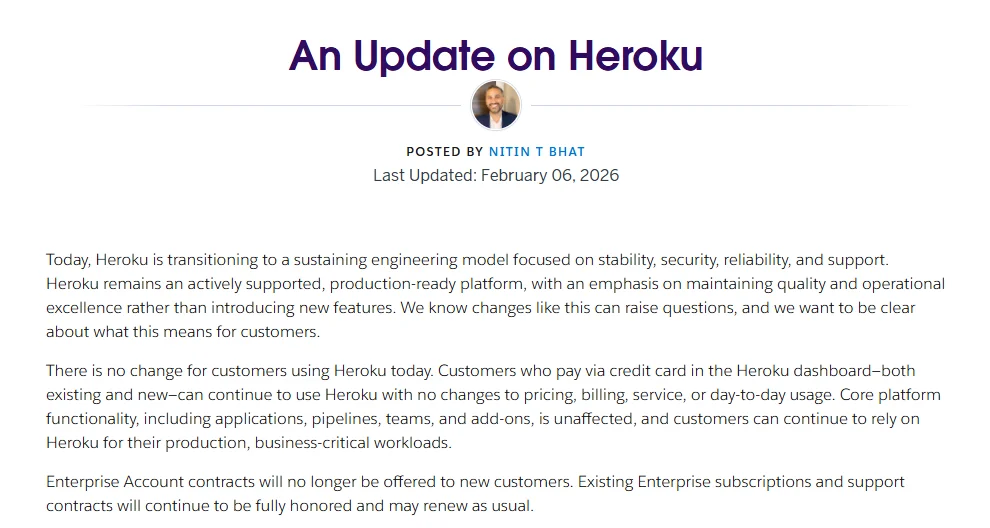
On February 6, 2026, Heroku published "An Update on Heroku", confirming that the platform is moving to a sustaining engineering model. The announcement quickly triggered debate about whether Heroku has entered a long-term maintenance phase.
This article focuses on one goal: separate sentiment from verifiable facts, then discuss what those facts may imply.
Factual claims in this article are based on public sources. Any section explicitly labeled "Personal perspective" reflects analysis, not official statements.
What the official announcement actually says
According to Heroku’s official post, "An Update on Heroku" (updated on 2026-02-06), there are four core points:
- Heroku is moving to a sustaining engineering model focused on stability, security, reliability, and support.
- Heroku remains an actively supported, production-ready platform.
- For current dashboard credit-card customers (both existing and new), pricing, billing, and day-to-day usage are unchanged.
- Heroku will no longer offer new Enterprise Account contracts to new customers; existing enterprise subscriptions and support contracts will continue and can be renewed as usual.
Taken together, this is clear: it is not an immediate shutdown, but a shift from growth-oriented expansion to steady-state operations with slower feature velocity.
Enterprise contract changes: why the reaction is strong
A large part of the reaction comes from changes on the enterprise track.
Heroku’s help article, "What needs to be done when my Heroku Enterprise contract ends?", outlines the following:
- After an enterprise contract ends, the account is transitioned to online credit-card billing after 5 business days.
- Teams can continue using Heroku, but some enterprise capabilities change, for example SSO is disabled, so moving to MFA is recommended in advance.
- If credit-card payment fails, the account can enter a suspend-then-delete billing flow.
In other words, Heroku is not hard-cutting existing customers. It provides a transition path from enterprise contracts to online billing. That is why "service continuity" and "new enterprise sales contraction" can both be true at the same time.
The lead-up: this did not happen overnight
If you only look at the February 2026 notice, the shift can look sudden. But Heroku’s 2025 public roadmap signals already showed directionality:
- 2025-05-15: Heroku announced Managed Inference and Agents GA.
- 2025-06-26: Heroku positioned itself explicitly as an AI PaaS.
- 2025-10-14: Heroku introduced the next generation of Heroku Postgres (Advanced tier) for intelligent and mission-critical application workloads.
At the same time, the Heroku Dev Center changelog remained active in January-February 2026 (runtime updates, buildpack and stack security updates, Heroku AI/Connect changes, and more). This suggests platform engineering has not stopped, but the center of gravity has moved toward sustained operability rather than rapid new-platform narrative building.
Why the community reads this as a "maintenance phase"
In the Hacker News thread (id=46913903) you shared, opinions mostly cluster into three groups:
- Cautious/pessimistic view: sustaining engineering is interpreted as the end of growth.
- Historical diagnosis view: Heroku’s slowdown is seen as multi-causal, including early over-expansion, accumulated technical debt, and organizational pacing issues.
- Product-value view: even now, some developers still emphasize Heroku’s uniquely streamlined developer experience, especially the classic "git push to deploy" value.
As of 2026-02-07, the thread showed around 360 points and 248 comments. The volume itself indicates that Heroku’s trajectory is still treated as a significant PaaS case study.
What impact should we expect?
It helps to split this into "confirmed impacts" and "high-probability impacts."
1) Confirmed impacts (from official statements and docs)
- Positioning has changed: from feature-expansion-first to stability-operations-first.
- New enterprise sales are reduced: no new enterprise contracts for new customers.
- Existing users can continue running workloads: current credit-card customers are unaffected; some enterprise users can continue via online billing transition.
- Enterprise capability continuity changes: for example, SSO behavior can change after enterprise contracts end, requiring organizational planning.
2) High-probability impacts (inference from public signals)
- Procurement and architecture review criteria will shift: once a vendor publicly enters sustaining engineering, enterprise evaluations usually move from "innovation potential" to "stability and predictability."
- Market conversations move from "what’s new" to "cost of moving": users care more about economical continuity than feature surprise.
- Developer brand perception keeps diverging: Heroku may retain goodwill on classic DX, while facing a higher bar on future roadmap confidence.
Personal perspective (not a factual conclusion)
The following is personal analysis, not an official statement, and not investment, procurement, or migration advice.
My view is that the key word is not "ending," but role redefinition:
- For Heroku: a shift from growth platform to a steady-state platform optimized for reliability, maintainability, and billing continuity.
- For users: decision-making moves from "what’s new" to "risk control plus cost clarity."
- For the industry: PaaS competition is no longer decided by deployment UX alone; AI integration, data-layer strength, and commercial model flexibility now matter together.
So the broader takeaway is not just whether Heroku is "good" or "bad." It is that when an industry transitions from expansion to optimization, product narrative, business strategy, and customer expectations are rewritten in parallel.
Closing thoughts
Heroku’s 2026 update looks more like strategic narrowing than service termination.
For observers, three questions should be evaluated separately:
- Is service becoming unavailable immediately? (Current evidence says no.)
- Is new enterprise sales contracting? (Yes.)
- Is the platform still being maintained? (Yes, but under sustaining engineering priorities.)
Once these are separated, much of the noise becomes easier to parse.
References
- Heroku official update (2026-02-06): https://www.heroku.com/blog/an-update-on-heroku/
- Heroku Help Center (Enterprise contract transition): https://help.heroku.com/7WJISJVU/what-needs-to-be-done-when-my-heroku-enterprise-contract-ends
- Hacker News thread: https://news.ycombinator.com/item?id=46913903
- Heroku Dev Center Changelog: https://devcenter.heroku.com/changelog
- Heroku AI (Managed Inference and Agents GA, 2025-05-15): https://www.heroku.com/blog/managed-inference-and-agents-now-generally-available/
- Heroku AI PaaS (2025-06-26): https://www.heroku.com/blog/introducing-the-heroku-ai-platform-as-a-service/
- Next Generation Heroku Postgres (2025-10-14): https://www.heroku.com/blog/introducing-the-next-generation-of-heroku-postgres/
- Salesforce announces Heroku acquisition (2010-12-08): https://www.salesforce.com/news/press-releases/2010/12/08/salesforce-com-signs-definitive-agreement-to-acquire-heroku/
- Salesforce completes Heroku acquisition (2011-01-03): https://www.salesforce.com/news/press-releases/2011/01/03/salesforce-com-completes-acquisition-of-heroku/
Source Notice
This article is published by merchmindai.net. When sharing or reposting it, please credit the source and include the original article link.
Original article:https://merchmindai.net/blog/en/post/heroku-sustaining-engineering-analysis