ChatGPT Ad Testing Starts: A Trust-Boundary Analysis for AI Assistants
OpenAI started testing ads in ChatGPT in the US in February 2026. This report explains the rollout rules, HN sentiment, competitor positions like Anthropic, and what this means for AI business models and user trust.
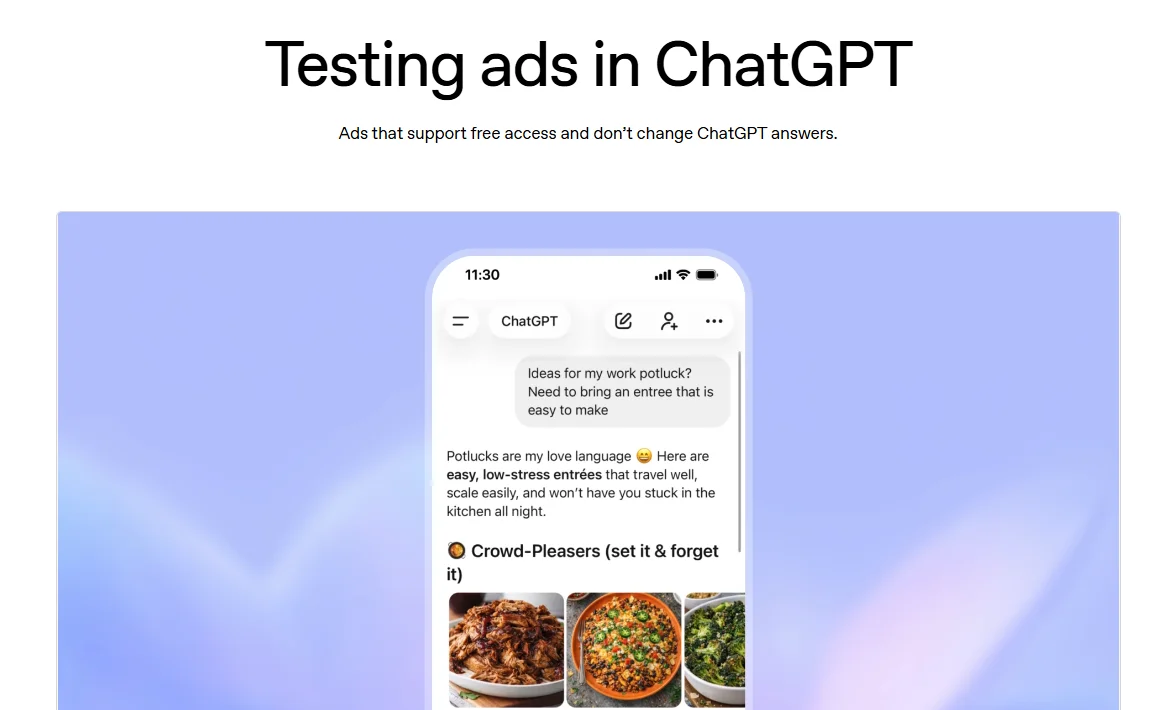
As of February 10, 2026, OpenAI's ChatGPT ad test is one of the clearest signals that AI assistants are entering a new phase of monetization and trust design.
Key facts at a glance
- OpenAI announced ChatGPT ad testing on February 9, 2026.
- Current scope is the US, signed-in adults, and Free/Go tiers.
- Plus, Pro, Business, Enterprise, and Education/Edu tiers are currently ad-free.
- Google, Microsoft, and Perplexity have already tested adjacent AI ad formats.
- Anthropic publicly positions Claude chat as ad-free, framing this as a trust decision.
Why this rollout matters
OpenAI's move is not a "maybe someday" statement. It is a live product rollout with concrete UX, policy, and controls. That alone changes the discussion from theory to execution.
It also lands in a market where the economics are still expensive. Inference costs, infrastructure, and model development pressure most providers toward one of two paths: subscription-heavy monetization, or broad access subsidized by ads and partnerships.
That is why this moment is bigger than one feature launch. It marks a shift from pure model competition to incentive-system competition.
What OpenAI is testing in ChatGPT ads
Based on OpenAI's announcement and help documentation, the current boundaries are relatively explicit.
1) Audience and plan scope
- Region: United States
- User scope: signed-in adults
- Included plans: Free and Go
- Excluded plans: Plus, Pro, Business, Enterprise, Education/Edu
2) Placement and labeling
- Ads appear below the main response
- Ads are labeled as sponsored
- OpenAI describes a visual separation between ads and organic answers
3) Privacy and sensitive-topic limits
OpenAI states that advertisers do not receive users' chat content, chat history, memory content, or personal information, and receive aggregated performance reporting instead.
OpenAI also states:
- no ads in Temporary Chat
- no ads for accounts identified as under 18
- no ads shown next to sensitive or regulated categories such as health, mental health, and politics
4) User controls
The current controls include:
- turning ad personalization on or off
- viewing "why this ad"
- hiding or reporting ads
- deleting ad-related data (OpenAI says removal from servers may take up to 30 days)
Help documentation also describes an Ads-Free mode for Free users with lower message limits and reduced tool access. That is a notable product choice: monetization tradeoffs are exposed directly to the user instead of being hidden behind opaque ranking behavior.
HN reaction: concern centers on boundary drift
At capture time, the HN thread (item?id=46949401) showed roughly 245 points and 319 comments. The exact numbers are dynamic, but the argument patterns were consistent.
Three recurring concerns stood out:
1) Will ad placement move closer to core answers over time?
Many comments did not reject ads outright. The concern was trajectory: ads start below the answer, then move toward tighter blending, then begin to shape perceived neutrality.
2) Can privacy promises survive growth pressure?
A common criticism focused on KPI pressure. Once an ad business scales, internal optimization can drift toward more targeting and conversion pressure. That concern is rooted in prior internet ad cycles, not only in this specific rollout.
3) Ads in free tiers are expected, but trust cost is real
Some commenters took a pragmatic view: free access at scale needs subsidy. In that framing, the key question is not whether ads exist, but whether ad influence stays outside answer integrity.
Not an isolated event: the industry has been moving here
OpenAI is accelerating an existing trend rather than creating one from zero.
- Microsoft (October 2, 2024): described Copilot ad formats positioned below organic answers and informed by session context.
- Google (October 3, 2024): announced ads in AI Overviews on US mobile, with sponsored labeling.
- Google (October 28, 2024): reiterated expansion of AI Overviews and ad placements with clear labels.
- Perplexity (blog page shows November 12, 2024): announced ad experiments including sponsored follow-up questions and sponsored media slots, while stating sponsors do not write or edit answer text.
Anthropic's contrast strategy: "ad-free thinking space"
On February 4, 2026, Anthropic published "Claude is a space to think." The key position was clear:
- no ads inside Claude chat
- no sponsored links in chat responses
- no ad-driven influence on outputs
- business model centered on subscriptions and enterprise agreements
- commitment to transparent communication if policy changes in the future
This does not reject commercialization. It reframes where commerce should appear: as user-initiated actions, not background pressure inside a reasoning interface.
Strategically, this is a brand-level trust moat.
Analysis: the real divide is not "ads vs no ads"
The strongest long-term separator is whether boundaries are verifiable.
1) Ads are not inherently the failure mode
An ad-supported tier can be legitimate if separation is auditable across policy, UI, ranking, and logging. The risk appears when those layers quietly converge and users can no longer tell whether outputs optimize for usefulness or monetization.
2) AI products are likely to segment by monetization model
Over the next 12-24 months, a two-lane market is likely:
- Access lane: free/low-cost, ad-supported, broader reach
- Trust lane: higher price, ad-free, stronger controls, enterprise-weighted demand
Both lanes can scale. But they optimize for different user promises.
3) Watch KPI design, not only policy language
OpenAI's principles include an explicit signal against optimizing for raw usage time. That is directionally positive.
Still, long-term outcomes are usually decided by operational metrics, not launch-day wording. The central governance question is whether trust and answer quality remain first-order metrics when revenue pressure rises.
Practical implications for users and brands
For users
- Review ad controls before assuming defaults match your preference.
- For high-sensitivity topics (health, legal, financial), prefer stricter settings or ad-free tiers.
- Treat recommendations as leads, not final truth, and keep independent verification habits.
For marketers and brand teams
- Early inventory may offer experimentation upside, but CTR alone is not a success metric.
- Measure brand safety, contextual fit, and trust impact alongside conversion.
- In conversational interfaces, aggressive sales tone can damage brand perception faster than in classic search ads.
FAQ
Do ChatGPT ads currently change the answer text itself?
As of OpenAI's February 2026 public documentation, OpenAI states ads are separated from core chat generation and do not directly alter answer content. The practical question is whether this separation remains transparent and enforceable over time.
Is Anthropic promising to never run ads?
As of February 4, 2026, Anthropic's published position is that Claude chat is ad-free. It also says any future change would be communicated transparently, which is a strong current stance but not an absolute "never" contract.
Conclusion
The February 2026 ChatGPT ad rollout marks a structural shift in AI competition.
From here, market leaders will be judged not only by model quality, but by whether their monetization architecture preserves user trust under pressure.
In practical terms, this is now a credibility race as much as a capability race.
References
- OpenAI: Testing ads in ChatGPT (2026-02-09) https://openai.com/index/testing-ads-in-chatgpt/
- OpenAI: Our approach to advertising and expanding access to ChatGPT (2026-01-16) https://openai.com/index/our-approach-to-advertising-and-expanding-access/
- OpenAI Help Center: Ads in ChatGPT (living document) https://help.openai.com/en/articles/20001047-ads-in-chatgpt
- Hacker News discussion page (dynamic) https://news.ycombinator.com/item?id=46949401
- Anthropic: Claude is a space to think (2026-02-04) https://www.anthropic.com/news/claude-is-a-space-to-think
- Microsoft Advertising: Transforming audience engagement with generative AI (2024-10-02) https://about.ads.microsoft.com/en/blog/post/october-2024/transforming-audience-engagement-with-generative-ai
- Google Ads & Commerce Blog: New ways for marketers to reach customers with AI Overviews and Lens (2024-10-03) https://blog.google/products/ads-commerce/google-lens-ai-overviews-ads-marketers/
- Google Keyword: AI Overviews in Search are coming to more places around the world (2024-10-28) https://blog.google/products-and-platforms/products/search/ai-overviews-search-october-2024/
- Perplexity Blog: Why we're experimenting with advertising (page shows 2024-11-12) https://www.perplexity.ai/cs/hub/blog/why-we-re-experimenting-with-advertising
Source Notice
This article is published by merchmindai.net. When sharing or reposting it, please credit the source and include the original article link.
Original article:https://merchmindai.net/blog/en/post/chatgpt-ads-test-trust-analysis